
Will My Existing Ductwork Work with a Heat Pump?
Key Takeaways
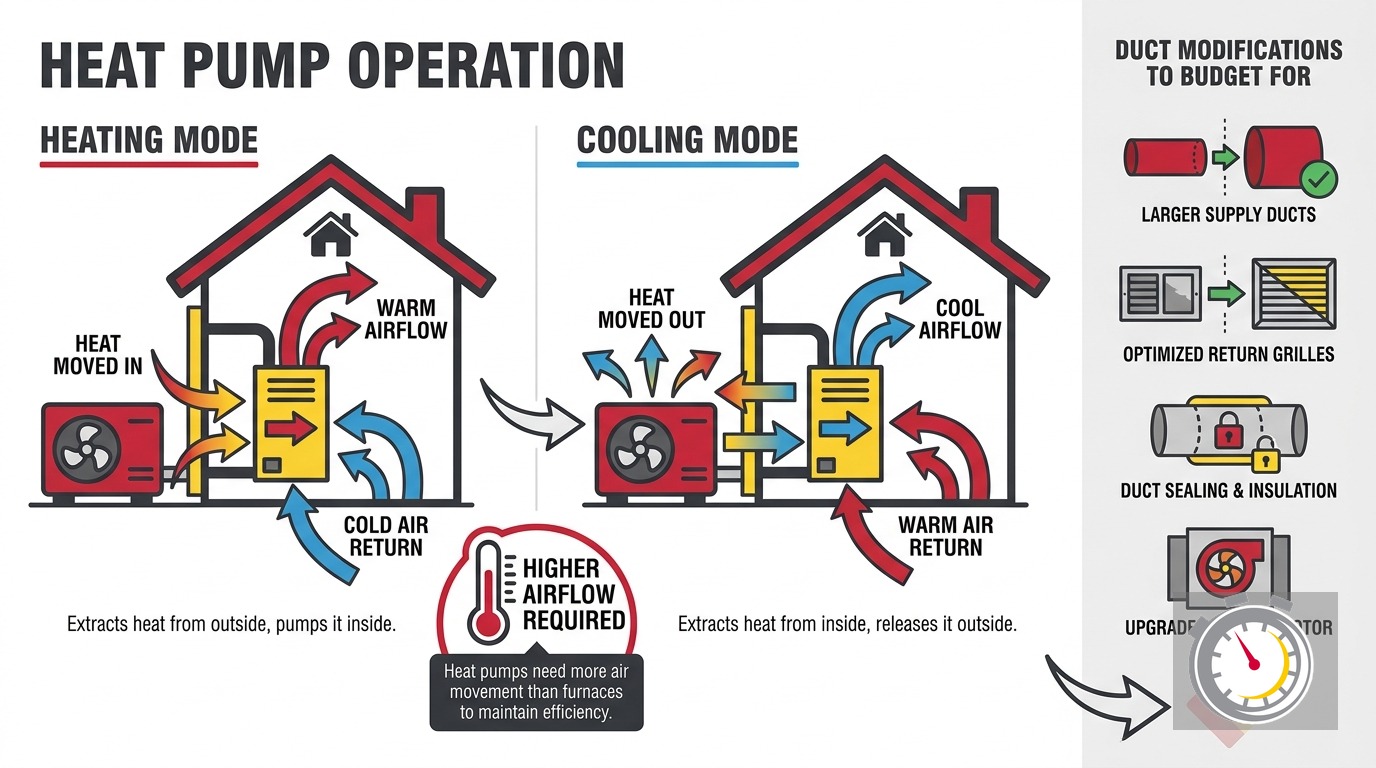
- Heat pumps require 400-450 CFM per ton of airflow. That is significantly more than a gas furnace moves, and your ducts have to handle it.
- Minnesota winters push heat pump supply air down to 85-90°F. That is lower than the 90-110°F numbers used in most national articles, which means even higher airflow demands here than in moderate climates.
- The supply trunk is often not the bottleneck. Minnesota contractors historically oversized furnaces, so ducts were sized for more airflow than you actually need. The return side is where most homes fall short.
- A static pressure test tells you whether your ducts fall in the use, modify, or replace category. Know this before the installer quotes the job.
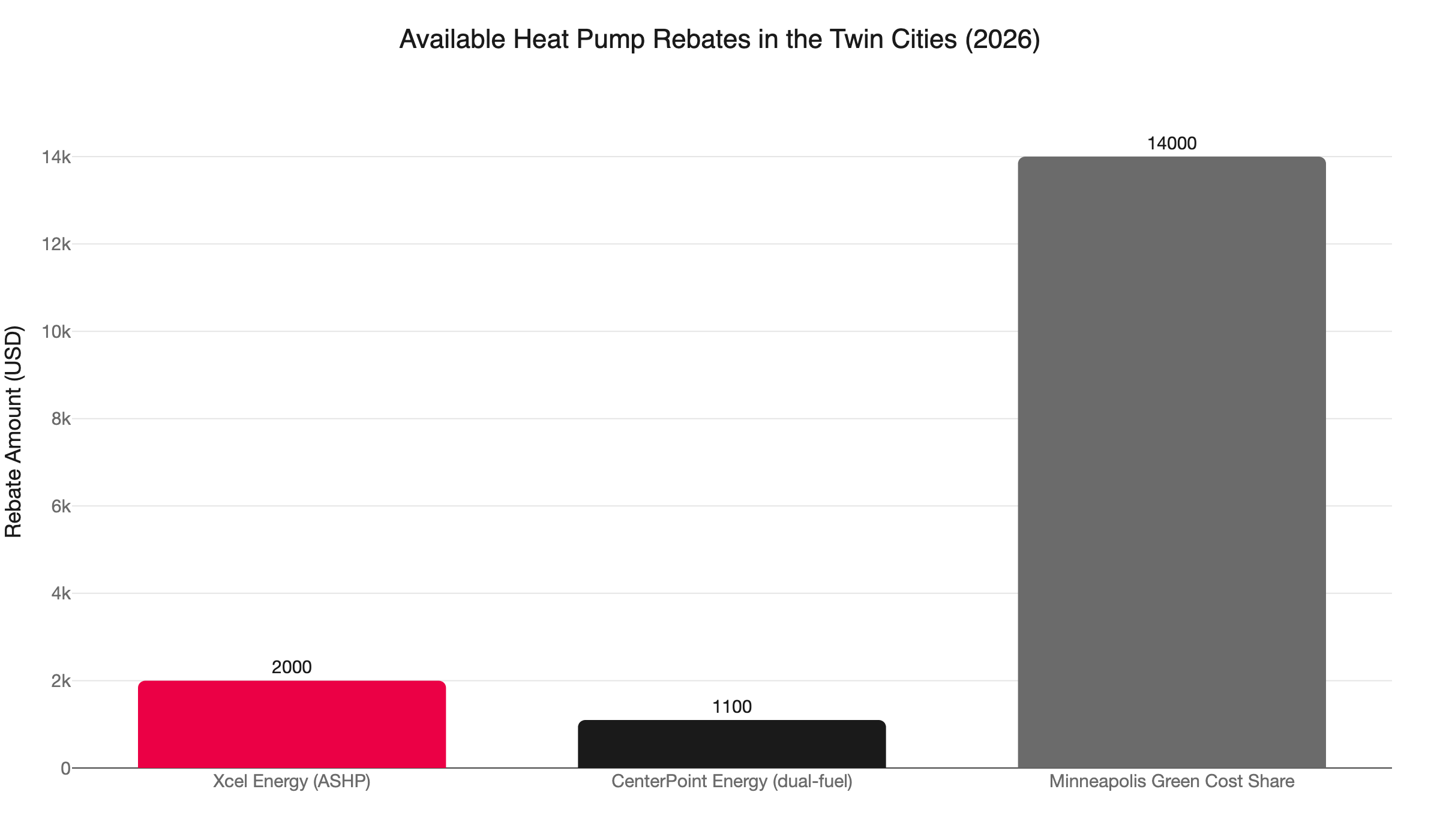
- Both the Xcel Energy ($2,000) and CenterPoint Energy ($1,100) rebates require a permitted install. The permit is the gateway to the money.
- The federal 25C tax credit expired December 31, 2025. Do not include it in a 2026 budget.
Why Do Heat Pumps Need More Airflow Than a Gas Furnace?
Heat pumps deliver cooler supply air than a gas furnace does. To move the same BTUs at that lower temperature, the system compensates with volume - pushing more air through your ducts each minute. In a Minnesota winter, that gap is wider than national articles typically acknowledge, and your duct system has to be ready for it.
A gas furnace pushes supply air at 120-140°F. A cold-climate heat pump in a Minnesota winter delivers supply air at roughly 85-90°F. The math is straightforward: cooler air carries fewer BTUs per cubic foot, so you need more cubic feet per minute to heat the same space.
The standard design requirement for a heat pump is 400-450 CFM per ton of capacity. A 3-ton unit needs approximately 1,200-1,350 CFM flowing through your supply and return system. Your gas furnace never made that demand.
Most national articles quote heat pump performance at 47°F outdoor temperature. That is not your design condition. The Twin Cities residential design temperature runs around -15°F. When outdoor temps drop that far, heat pump supply air temperature falls further, pushing the required CFM even higher. The duct problem is more acute in Blaine or Brooklyn Park than it is in Atlanta.
There is also the “cold blow” issue. Supply air below roughly 98°F can feel uncomfortable - air that does not feel warm even when the system is working correctly. That threshold gets crossed more often in Minnesota winters than milder-climate content suggests. Adequate airflow and well-sealed ducts reduce how often and how severely it occurs.
Will My Existing Ductwork Work with a Heat Pump?
Probably yes on the supply side and probably not on the return side - but the honest answer requires a static pressure measurement, not a visual guess. Most Twin Cities homes were built with oversized furnaces and ducts sized to match. Right-sizing to a heat pump often reveals that the supply trunk has latent capacity. The return side is a different story.
The CEE Duct Retrofit Decision Guide organizes your options into three paths:
- Use as-is: ducts pass a visual check, total external static pressure (TESP) is within range, rooms receive adequate CFM, and leakage is under 10% of total system airflow.
- Modify: minor leaks, return imbalance, restrictive registers, or marginal static pressure that targeted modifications can resolve.
- Replace: duct capacity is fundamentally too small, leakage exceeds 20%, materials are degraded, or runs in unconditioned spaces are uninsulated.
Full replacement is less common than internet articles suggest - especially in Minnesota. The reason is the oversized-furnace starting point that defines most homes in this market.
Why Do Minnesota Homes Often Have More Supply Duct Capacity Than They Need?
Minnesota contractors historically specified larger furnaces than homes actually required, and ducts were sized for those large furnaces. Right-sizing to a heat pump often means the existing supply trunk already has the capacity to handle the required airflow.
Energy Vanguard documented a condo example where the installed furnace was rated at 66,000 BTU/hr against an actual heating load of 23,000 BTU/hr. The furnace was nearly three times oversized. Right-sizing to a heat pump reduced required airflow proportionally, and the existing duct trunk handled it without modification.
In Minnesota homes with 80,000-100,000 BTU furnaces serving actual loads of 30,000-50,000 BTU, this plays out regularly. The supply trunk is not the weak link. The work tends to be on the return side and in duct sealing - not trunk replacement.
This does not mean nothing needs to change. It means the supply-side capacity question - “are my main trunks too small?” - often resolves in your favor before the installer arrives.
Why Is the Return Side Almost Always the Weak Link?
Most residential return duct systems were built to minimum code requirements, not to the higher airflow a heat pump demands. Return-side restriction and return imbalance are the most common reasons an otherwise adequate duct system fails a heat pump assessment.
In a typical Twin Cities home, you might have one large return grille in a central hallway and small or no returns in bedrooms. That layout worked with an oversized furnace running short, high-temperature cycles. It struggles when a heat pump runs longer, higher-volume cycles to maintain temperature during a January cold snap.
Duct leakage makes it worse. Properly installed sheet metal systems lose 20-30% of total airflow to leaks before it reaches supply grilles. Up to 50% of return airflow may be drawn through unintended leaks - through gaps in duct joints, around fittings, or through unsealed penetrations - rather than through actual return paths. Your system is drawing unfiltered air from the attic, basement, or wall cavities, and robbing the supply side of what it needs.
The return-side modifications that resolve this in most Twin Cities homes:
- Enlarging the return plenum to accept more airflow volume
- Replacing a 1-inch throwaway filter with a 4-inch media filter housing, which drops flow restriction dramatically
- Installing high-flow return grilles in place of standard ones
- Adding a return pathway in a second-story hallway or bedroom corridor
These changes address the actual bottleneck. They cost less than a full duct replacement and often bring a marginal system into range for a heat pump install. Our post on leaky ductwork and energy loss covers what a duct assessment typically finds.
How Do I Know If My Ducts Need to Be Replaced or Just Modified?
A static pressure test gives you the answer. The design target is 0.5 in. w.c. total external static pressure. Real-world systems commonly measure 1.0 in. w.c. or higher - more than double the design intent.
The threshold that shapes your path forward:
- Under 0.7 in. w.c.: Higher heat pump airflows can generally be accommodated with targeted modifications to the return side and duct sealing.
- Above 0.7 in. w.c.: More substantial work is needed. Trunk modifications or full replacement may be on the table.
A competent installer measures TESP before quoting any duct work. If a contractor proposes a heat pump without taking this measurement, ask why. You are paying for a diagnosis, not a guess.
Visual inspection catches the obvious problems: crushed flex duct, disconnected runs, uninsulated ductwork in an unconditioned attic or crawl space. Minnesota code requires insulation for ducts outside the air barrier, and UL181-rated mastic is required for duct sealing on those runs - not foil tape, which fails over time. Visual inspection alone does not tell you whether total airflow capacity is adequate for the new equipment. Measurement does.
Leakage testing adds a second data point. Under 10% leakage of total system airflow: use as-is. Above 20%: the leakage itself disqualifies the duct system for a rebate-eligible install, and sealing is required before the heat pump goes in. Our post on ductwork replacement cost in the Twin Cities covers what scope of work triggers each cost tier.
What Does Duct Modification Cost in the Twin Cities?
Return-side modifications are the most common scope. Targeted return-side work - plenum enlargement, filter housing upgrade to a 4-inch media cabinet, added return paths - runs roughly $1,300-$3,500 in most Twin Cities homes. The range reflects the size of the home, the number of return paths needed, and whether plenum work requires framing changes.
Duct sealing with UL181-rated mastic runs approximately $1,300 for a whole-home treatment. It is often the first modification recommended because it recovers airflow already being lost to leaks. It is also required by Minnesota code for ducts outside the air barrier.
Full ductwork replacement - the path taken when trunk sizing is fundamentally wrong or materials have failed - runs $6,500-$13,000 in the Twin Cities depending on home size and layout complexity. This is the least common outcome on Minnesota homes with historically oversized furnaces, but it does come up on homes with original flex duct systems in poor condition or severely undersized trunk lines.
The budget question worth asking before the installer visits: what does the modification cost compared to the rebate stack the heat pump itself qualifies for? Return-side work costing $1,500-$2,500 frequently unlocks more in utility rebates than it costs. That math matters when you are deciding whether to proceed with modifications now or delay.
Do Minnesota Rebates Cover Duct Work?
Current utility rebates apply to the heat pump equipment, not the duct modifications. The duct work is not rebatable directly. It is, however, what makes the equipment eligible - because a permitted install is required to claim any rebate, and duct modifications trigger the permit.
Here is the active rebate stack for 2026:
Xcel Energy (electric): Up to $2,000 for a cold-climate air-source heat pump listed on the NEEP qualifying product list. Minimum COP of 1.75 at 5°F. Rated capacity at 5°F must be at least 70% of rated capacity at 47°F. An additional $600 insulation bonus is available if qualifying insulation was installed within the prior two years. Requires installation by a participating contractor. Details at the Xcel Energy heat pumps page.
CenterPoint Energy (gas): $1,100 for a ducted air-source heat pump in a dual-fuel configuration. The balance point must be programmed at 40°F or below. This is a hard system-design requirement. A system wired at a higher balance point for convenience loses the $1,100 rebate outright. Details at the CenterPoint ducted ASHP rebate page.
Minneapolis Green Cost Share: Up to $14,000 additional for Minneapolis city residents. This stacks with utility rebates and can significantly shift the economics of a dual-fuel install. Homeowners in Maple Grove, Bloomington, or Woodbury are not eligible for this specific program.
Federal 25C tax credit: Expired December 31, 2025. Not available for 2026 installs.
MN HEAR/HOMES state rebate: Not yet launched as of September 2026. Minnesota Commerce has no published launch date. Do not include it in your planning budget.
For a current tracker of all statewide incentives, the MN ASHP Collaborative maintains the most accurate and up-to-date list.
Does a Heat Pump Install Require a Permit in Minnesota?
Yes - and that permit is what makes you eligible for every rebate listed above. A heat pump installation and any duct modifications both require a mechanical permit under Minnesota Rules Chapter 1346. Your local building department issues the permit. The Department of Labor and Industry oversees code adoption statewide.
An unpermitted install disqualifies Xcel Energy and CenterPoint rebates. Both utilities verify permit status as part of the rebate claim process. Skipping the permit to save time upfront costs you thousands in rebates and leaves you with an install that has not been inspected.
Ask your installer before any work begins: will this job be permitted? A qualified contractor pulls mechanical permits routinely. It is not an unusual request. Our post on HVAC permits in Minnesota explains what the mechanical permit process looks like and what the inspection covers.
What About Dual-Fuel Hybrid Systems?
Dual-fuel systems pair a heat pump with your existing gas furnace, sharing the same air handler and duct system. The heat pump handles heating down to its efficient operating range. The gas furnace takes over when outdoor temperatures drop below the balance point - typically set at 25-40°F in Minnesota.
The duct work requirements are identical whether you install a heat pump only or a dual-fuel hybrid. Static pressure, return-side adequacy, and leakage all apply regardless of which heating source is running.
One detail matters for the CenterPoint rebate: the balance point must be programmed at 40°F or below. That is also a duct-system design decision. A correctly configured dual-fuel system at 40°F runs the heat pump during conditions where supply air temperature is most likely to drop toward the “cold blow” threshold. Adequate return airflow and tight duct sealing matter more in this configuration, not less.
Our post on dual-fuel heat pump and gas furnace hybrids in Minnesota covers how the balance point affects both efficiency and rebate eligibility in detail.
Schedule Your Duct Assessment Before You Commit to an Install
The duct assessment should come before the equipment quote, not after. Knowing your static pressure and return-side condition lets you make the equipment decision with accurate total-cost information - and you avoid discovering a $2,000 duct modification after you have already chosen a system.
At Northern One Hour, we are locally owned and operated in Ramsey, serving Minneapolis, St. Paul, Blaine, Maple Grove, Plymouth, Brooklyn Park, Woodbury, Bloomington, and the surrounding Twin Cities area. When we assess your home for a heat pump install, static pressure measurement is part of the process. We check return-side adequacy, identify restrictive filter housings, and flag leakage points. If modifications are needed, you get a clear scope and price before any work starts.
We pull mechanical permits on every install. We are also familiar with the Xcel Energy and CenterPoint rebate programs, including the balance point requirement that costs homeowners $1,100 if it is missed.
“Always On Time… Or You Don’t Pay a Dime!(R)” is our promise - and it applies to assessment visits the same as any service call.
Call (763) 260-6662 or book online to schedule your duct and heat pump assessment.
Frequently Asked Questions
Do I need new ductwork for a heat pump? +
Why do heat pumps need more airflow than a gas furnace? +
What static pressure should my ductwork hit for a heat pump install? +
What heat pump rebates are available in Minnesota in 2026? +
Need a technician now?