
Heat Pump vs. Gas Furnace Cost in Minnesota: Real Numbers
Key Takeaways
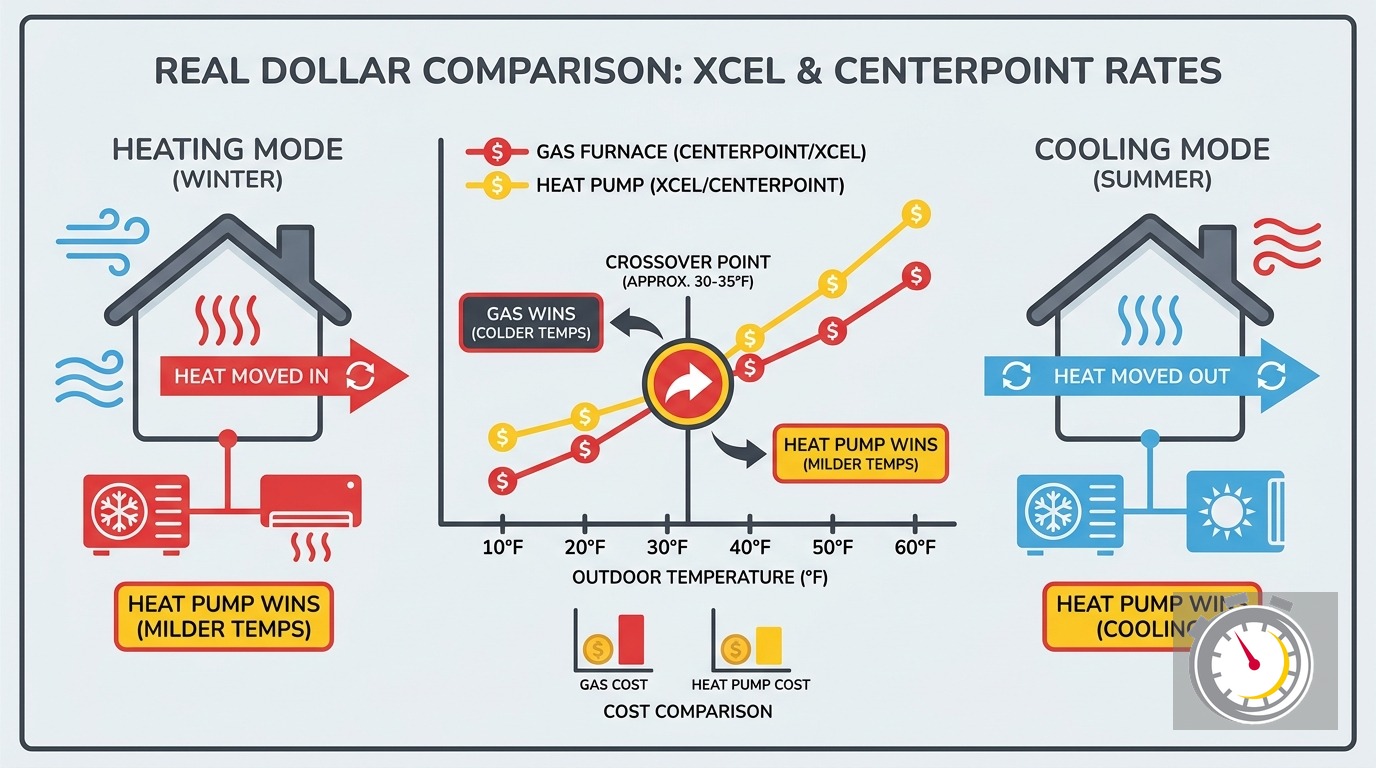
- At the standard Xcel residential rate (~$0.17/kWh), a heat pump costs more per delivered therm than a 96% AFUE gas furnace once outdoor temperatures fall below about 47-50°F. That threshold covers most of a Minnesota heating season.
- At Xcel’s electric space heating tariff (~$0.12/kWh), the crossover drops to about 28-32°F. The heat pump is the cheaper fuel for the majority of heating hours.
- The Section 25C federal tax credit expired December 31, 2025. Equipment installed in 2026 does not qualify.
- Xcel rebates: up to $1,200 for qualifying cold-climate heat pumps; up to $150 for high-efficiency gas furnaces.
- Cold-climate heat pumps are rated to operate at -13°F to -22°F. The “heat pumps don’t work in Minnesota” objection applies to older standard models, not current equipment.
- The single most important question before choosing: which Xcel tariff does your home qualify for after a heat pump installation? That one number changes the entire calculation.
Heat Pump vs. Gas Furnace: Which Wins in Minnesota?
The short answer: For most Twin Cities homeowners, a dual-fuel hybrid system wins on both operating cost and day-one rebates: the heat pump covers the majority of heating hours, the gas furnace takes over when temperatures drop below 25-35°F. Qualifying dual-fuel installs can stack $2,000 from Xcel and $1,100 from CenterPoint for $3,100 in combined utility rebates - the highest incentive of any option.
Why Minnesota Makes This Comparison Harder
Most heat pump vs. gas furnace cost comparisons are written for mild climates. They plug in national electricity averages and wrap up quickly. That framework breaks down in the Upper Midwest.
The Twin Cities sits in IECC climate zone 6. A typical heating season accumulates a substantial number of heating degree days. Minneapolis averages a January low around 6°F. Stretches below -20°F happen every winter. Minneapolis’s Manual J design temperature is 5°F - the performance floor cold-climate equipment is tested against, not the 47°F that standard efficiency ratings use.
A heat pump can be cost-competitive in Denver or Chicago. In Minneapolis during January, it can still be the more expensive fuel. The equipment works. The economics depend on local rate variables that no national article handles correctly.
Two policy shifts make the 2026 numbers different from what most comparison articles show. The Section 25C federal tax credit was repealed by the One Big Beautiful Bill Act (Public Law 119-21) and expired December 31, 2025 - no 2026 install qualifies. And Xcel Energy restructured its heat pump bonus for gas-heating customers effective October 1, 2026. Any article still citing a live 25C credit or the pre-October Xcel bonus structure is working from outdated data.
Two variables drive the Minnesota answer: Xcel’s electric space heating tariff (which most articles skip entirely) and the current CenterPoint therm cost (which changes monthly). This post uses both.
We are locally owned and operated in Ramsey, MN. We install heat pumps, gas furnaces, and dual-fuel systems across the Twin Cities. Here is the honest comparison.
How Much Does Heating Actually Cost Per Delivered Therm?
The short answer: A 96% AFUE gas furnace delivers heat at about $1.15 per therm at current CenterPoint rates. A cold-climate heat pump ranges from $0.94 to $1.85 per equivalent therm, depending on outdoor temperature and which Xcel tariff applies. The tariff is the deciding variable.
To compare gas and electric heat fairly, both need to be measured in the same unit: the therm, or 100,000 BTUs of delivered heat.
Gas furnace math:
CenterPoint’s natural gas rate has two components. The delivery charge is currently proposed at $0.27884 per therm. The fixed monthly basic charge is proposed to rise from $9.50 to $11.00. CenterPoint has filed for this rate increase. The commodity charge passes through at wholesale and changes monthly. Verify the current rate at centerpointenergy.com before running your final numbers.
EIA data for Minnesota natural gas tracks the per-therm heating season average from October 2025 through April 2026. Using $1.10 per therm as a mid-season estimate with a 96% AFUE furnace:
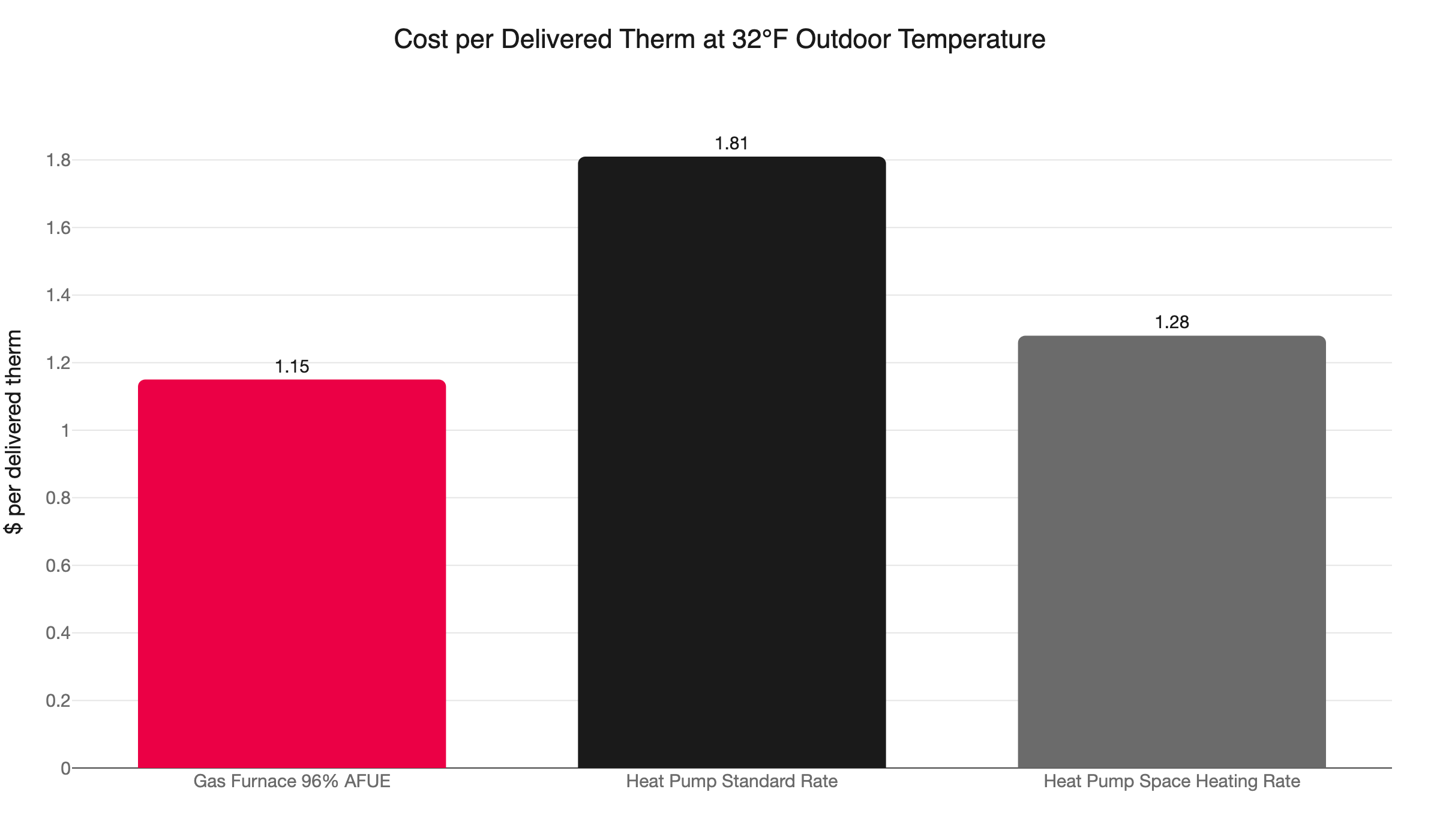
$1.10 ÷ 0.96 AFUE = $1.15 per delivered therm
Heat pump math:
A heat pump moves heat rather than burning fuel. Its efficiency ratio is COP (Coefficient of Performance). COP 3.0 means three therms of heat for every therm-equivalent of electricity consumed.
The formula, via homeenergybasics.com: (electricity rate x 29.3 kWh/therm) ÷ COP = cost per delivered therm
At Xcel’s 2026 residential rate - the rate that applies to most Twin Cities homeowners before any tariff change:
| Outdoor temp | Typical COP | Cost per delivered therm |
|---|---|---|
| ~47°F | 3.75 | $1.24 |
| ~32°F | 2.75 | $1.69 |
| ~5°F | 2.50 | $1.85 |
At Xcel’s electric space heating rate (~$0.12/kWh):
| Outdoor temp | Typical COP | Cost per delivered therm |
|---|---|---|
| ~47°F | 3.75 | $0.94 |
| ~32°F | 2.75 | $1.28 |
| ~5°F | 2.50 | $1.41 |
At the standard rate, gas wins for most of the Minnesota heating season. At the space heating rate, the heat pump beats gas at $1.15 per therm down to about 30°F. The tariff is the headline, not the equipment.
At What Outdoor Temperature Does Gas Become the Cheaper Fuel?
The short answer: At Xcel’s 2026 residential rate (15.82¢/kWh), a heat pump needs a COP of about 4.03 to match gas at $1.15 per therm. Cold-climate heat pumps approach that threshold only around 47°F. At the space heating rate (~$0.12/kWh), the breakeven COP is 3.06, which cold-climate heat pumps reach around 28-32°F.
The math is direct once you have the rate in hand.
To match gas at $1.15/therm at the standard rate: (0.1582 x 29.3) ÷ COP = 1.15
Solving: COP needed = 4.03
Cold-climate heat pumps achieve strong efficiency ratings in mild outdoor temperatures. They rarely sustain 4.03 at lower temperatures. Gas is the cheaper fuel for most of the Minnesota heating season on the standard tariff.
To match gas at the space heating rate: (0.12 x 29.3) ÷ COP = 1.15
Solving: COP needed = 3.06
Cold-climate heat pumps reach COP 2.5-3.0 around 32°F. The economic crossover falls near 28-32°F. Gas only wins below that point. That is a meaningful portion of Minnesota winters but not the majority of heating hours.
The dual-fuel crossover setpoint is typically set at 25-35°F by the installer. That setpoint should be calibrated to which tariff the homeowner qualifies for.
What Is Xcel’s Electric Space Heating Rate, and Who Qualifies?
The short answer: Xcel offers a separate space heating tariff at roughly $0.11-0.13/kWh for customers whose primary heating source is electric. That rate is significantly below the standard residential rate. It may apply after a heat pump installation. Confirm eligibility directly with Xcel before running your numbers.
This tariff exists because Minnesota regulators recognize that electric heat competes against cheap natural gas. The rate is designed to make the math workable for homeowners who choose electric heating.
Qualifying generally requires electric heat to be the primary source, not supplemental. If you install a heat pump and it becomes your main heating system, you may qualify for this rate. That eligibility question changes the economics from “gas wins most of the season” to “heat pump wins most of the season.”
Note that Xcel received PUC approval for a 5.8% rate increase in June 2026. The per-tariff impact is still being finalized. Get the current rate schedule from xcelenergy.com and ask directly whether a heat pump installation qualifies your home for the space heating tariff.
Is the Federal Tax Credit Still Available in 2026?
The short answer: No. The Section 25C energy efficient home improvement credit was repealed by the One Big Beautiful Bill Act (Public Law 119-21), signed July 4, 2025, and expired December 31, 2025. No equipment placed in service in 2026 qualifies. Several articles currently in the top search results still claim a 30% credit worth up to $2,000 is available for heat pumps this year. Those claims are wrong.
The 25C credit was repealed and did not survive into 2026. Congress has not enacted a replacement. Do not factor a federal tax credit into a 2026 heat pump purchase.
This is the biggest single piece of misinformation circulating for Minnesota homeowners researching this topic right now. The credit previously covered 30% of eligible equipment costs, up to $2,000 for heat pumps. That benefit is gone. Verify current tax law status with your tax advisor or at IRS.gov. If you read a comparison article that lists the 25C credit as a current benefit, that article is working from outdated information.
For context on what that credit covered before it was repealed, see our post on IRA tax credits for high-efficiency HVAC in Minnesota.
What Rebates Are Actually Available Right Now?
The short answer: Xcel offers up to $2,000 for qualifying cold-climate heat pumps (gas customers) and up to $150 for high-efficiency gas furnaces. CenterPoint offers up to $1,000 for a 97%+ AFUE furnace and a $1,100 add-on for qualifying dual-fuel installs. A dual-fuel system stacks both: $2,000 from Xcel plus $1,100 from CenterPoint equals $3,100 in utility rebates on day one. Verify current amounts directly with each utility before purchasing.
Xcel rebates:
Xcel’s rebate for qualifying cold-climate heat pumps is available for customers with gas or combination heating. The qualifying spec is strict: the unit must appear on the NEEP cold-climate list, achieve a COP of at least 1.75 at 5°F, and maintain at least 70% of its 47°F rated capacity at the Minneapolis design temperature.
The Xcel rebate for a high-efficiency gas furnace is up to $150 at 96%+ AFUE - a fraction of the heat pump incentive.
Xcel restructured its heat pump bonus for gas-heating customers effective October 1, 2026, dropping the rate from 2x to 1x. That change is now in effect. Confirm current rebate amounts and your home’s eligibility at xcelenergy.com before purchasing - do not rely on figures from articles written before October 2026.
CenterPoint rebates:
CenterPoint’s 2026 rebate program offers:
- $1,000 for a furnace at 97%+ AFUE, or $400 at 96-96.9% AFUE
- $1,100 dual-fuel heat pump add-on for existing homes, with conditions: the paired furnace must be 92%+ AFUE, and the system must be programmed to switch to gas at 40°F or below
The dual-fuel add-on is the highest CenterPoint heating rebate available. Combined with Xcel’s $2,000 heat pump rebate, a qualifying dual-fuel install captures $3,100 in utility rebates from two sources on a single project.
The gas furnace stack:
A high-efficiency gas furnace install can capture Xcel’s $150 and CenterPoint’s up to $1,000 in the same pass. That is $1,150 combined - meaningful, but $1,950 less than the dual-fuel stack.
Rebate program pages on both utilities’ sites have returned errors intermittently. Call to verify before purchasing. Our team can also confirm what is currently active in your area.
For a current summary of Minnesota-specific incentives, see our post on Minnesota heat pump rebates and tax credits.
How Do Cold-Climate Heat Pumps Perform on Minnesota’s Coldest Nights?
The short answer: Modern cold-climate heat pump models are rated to operate at -13°F to -22°F. They do not shut off at 32°F. The argument that heat pumps fail in Minnesota applies to older standard models, not equipment from Mitsubishi, Daikin, Bosch, or Hyundai installed today.
To qualify for Xcel’s rebate, a cold-climate heat pump must meet the NEEP cold-climate specification: COP of at least 1.75 at 5°F, and at least 70% of rated 47°F heating capacity retained at 5°F. That 5°F threshold is Minneapolis’s Manual J design temperature - the performance floor the equipment is tested against. Higher-performing equipment exceeds that minimum; the COP values in the tables above (2.0-2.5 at 5°F) reflect better equipment, not the required floor.
DOE-funded NREL field testing recorded COPs of 1.5-2.0 at -10°F, with significant variation between units of the same model. Real-world performance varies by installation quality, home size, and duct condition - not just the equipment spec sheet.
Note that the NEEP cold-climate product list (ashp.neep.org) transitioned to pull from AHRI data in April 2026. Some qualifying units temporarily dropped off the list during that transition. If a model you are considering does not appear on the list, verify directly with the manufacturer or call us before assuming it does not qualify.
Cold-climate heat pumps maintain a seasonal COP of 2.8-3.1 in a Minnesota climate. Standard models average about 2.2. That difference drives the annual operating cost gap between the two equipment categories.
These systems do lose efficiency as temperatures fall. COP drops from about 3.75 at 47°F to 2.5 at 5°F. They still run at extreme temperatures. They consume more electricity per therm delivered. At the space heating rate, they remain competitive with gas until outdoor temperatures reach the low 20s.
For a detailed look at what to expect during Minnesota’s coldest stretches, read our post on heat pump performance below zero in Minnesota.
What Is a Dual-Fuel Hybrid System, and Is It Right for the Twin Cities?
The short answer: A dual-fuel system pairs a heat pump with a gas furnace. The heat pump handles the majority of the heating season. The thermostat switches automatically to gas when outdoor temperatures drop below a configured setpoint - typically 25-35°F. It captures heat pump efficiency for most heating hours while running gas when gas is the cheaper fuel. A qualifying dual-fuel install also captures the $3,100 combined Xcel and CenterPoint rebate - the highest day-one incentive available.
This setup is the most common recommendation for Twin Cities homes that want to reduce gas use without eliminating it. The heat pump runs efficiently through the shoulder season. When temperatures fall far enough that gas wins on cost, the furnace takes over automatically. No manual switching, no guesswork.
The upfront cost is higher because you are installing two systems. The operating cost savings from the heat pump need to offset that difference over time. In a typical Twin Cities year, the heat pump handles the majority of heating hours. The furnace covers the coldest fraction of the season.
The $3,100 combined rebate - Xcel’s $2,000 plus CenterPoint’s $1,100 dual-fuel add-on - applies to qualifying installs. The CenterPoint portion requires a 92%+ AFUE furnace in the pairing and a switchover setpoint programmed at 40°F or below. That condition aligns with the temperature where gas typically wins on operating cost anyway, so the programming requirement matches the optimal economic setpoint.
For sizing details and how the crossover setpoint is calibrated, see our post on dual-fuel heat pump hybrid systems in Minnesota.
Upfront Cost: What Each System Runs in the Twin Cities
Installed costs depend on home size, equipment tier, and ductwork condition.
Cold-climate heat pump (whole-home split system):
- Equipment and installation: $8,000-$16,000
- Ductwork repairs or replacement if needed: add $2,000-$5,000
- Xcel rebate: up to $2,000 for qualifying cold-climate models (gas customers)
Gas furnace (96% AFUE replacement):
- Equipment and installation: $3,500-$7,500
- Xcel rebate: up to $150; CenterPoint rebate: up to $1,000 at 97%+ AFUE
Dual-fuel hybrid system:
- Equipment and installation: combined cost of both the heat pump and furnace
- Xcel plus CenterPoint rebates: up to $3,100 on a qualifying install
The heat pump costs more upfront in nearly every scenario. The payback period depends on the tariff gap and annual fuel savings. At the electric space heating rate, payback periods of 6-10 years are achievable for homes with high heating loads. At the standard rate, the payback extends substantially or may not close within a typical equipment lifespan.
Which System Makes Financial Sense for Your Home?
The short answer: It depends on which Xcel tariff your home qualifies for after installation and whether you are replacing heating alone or heating and cooling together. There is no single right answer for all Twin Cities homes.
Here is how to frame the decision:
Lean toward a heat pump when:
- You qualify for Xcel’s electric space heating tariff after installation
- You are replacing both an aging furnace and an aging AC - compare heat pump to furnace-plus-AC combined, not furnace alone
- You want the $2,000 Xcel rebate as a day-one cost offset
- Your ductwork is modern and well-sealed
Lean toward a gas furnace when:
- You are on the standard Xcel residential rate and do not qualify for the space heating tariff
- You are replacing only heating, not also the air conditioner
- The upfront cost gap does not close within a reasonable payback horizon for your situation
Consider a dual-fuel hybrid when:
- You want heat pump efficiency for the majority of the season
- You already have gas service and want to keep gas backup for the coldest days
- You want to capture the $3,100 combined Xcel and CenterPoint rebate
- You are not ready to go fully electric
What About Replacing the Furnace and AC at the Same Time?
The short answer: Compare a heat pump to furnace-plus-AC combined, not furnace alone. A heat pump handles both heating and cooling in one system. When both systems are aging, the upfront cost gap between a heat pump and two separate replacements is often much smaller than it first appears.
Comparing a $15,600 heat pump to a $7,100 furnace makes the heat pump look expensive. Comparing that same heat pump to a $7,100 furnace plus $6,500-$7,800 in central AC replacement changes the picture significantly.
If your AC is under 10 years old and running well, replacing just the furnace now usually makes sense. If both systems are at the end of their service life, run the combined replacement comparison before making a decision either way.
Ready to Compare for Your Home Specifically?
A blog post gives you the framework. It cannot tell you which Xcel tariff your address qualifies for, what your ductwork condition is, or what load calculation your home requires.
That is what a site assessment is for.
We are locally owned and operated in Ramsey, MN, and we serve the Twin Cities: Minneapolis, St. Paul, Maple Grove, Plymouth, Blaine, Brooklyn Park, Woodbury, Bloomington, and the surrounding area. We install heat pumps, gas furnaces, and dual-fuel systems. We have no stake in steering you toward one fuel type over the other. We show you the math for your home.
When we say we will be there, we mean it: “Always On Time… Or You Don’t Pay a Dime!(R).”
Call (763) 260-6662 or book your estimate online. When you call, ask about current Xcel and CenterPoint rebate eligibility for cold-climate heat pumps and dual-fuel systems. Our team will confirm what is active and help you capture it.
Frequently Asked Questions
Is the federal heat pump tax credit still available in 2026? +
At what outdoor temperature does a gas furnace beat a heat pump in Minnesota? +
What is the current Xcel rebate for a cold-climate heat pump? +
Should I compare a heat pump to a gas furnace alone or to furnace plus AC? +
Need a technician now?