
Replace Electric Baseboard Heat Minnesota: 3 Proven Paths
Key Takeaways
- Electric baseboard is one of the most expensive ways to heat a Twin Cities home. Replacing it cuts your heating bill and adds cooling in a single project.
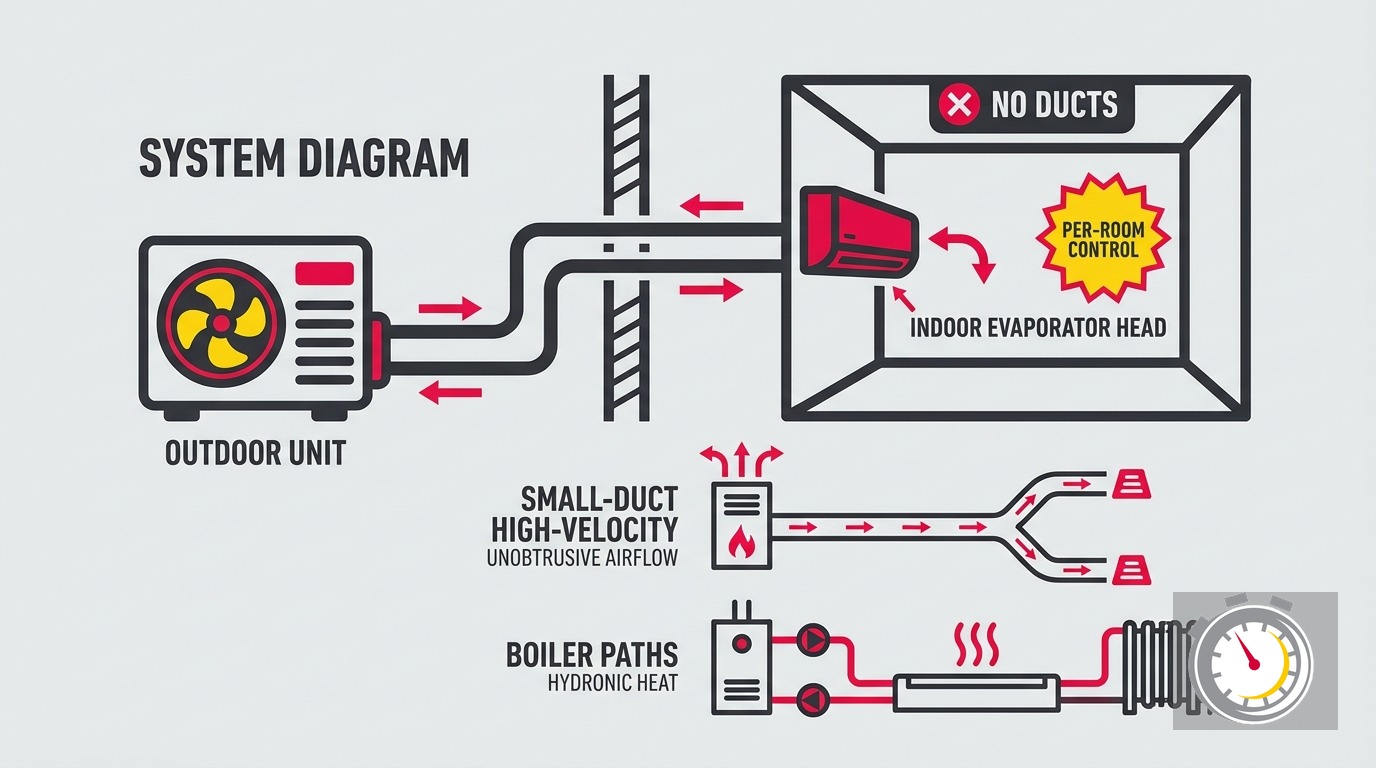
- Three replacement paths work for older Minnesota homes: ductless mini-split, small-duct high-velocity (SDHV), and hydronic boiler conversion. Building type determines which fits best.
- The federal 25C tax credit expired December 31, 2025. It does not apply to 2026 installs. State and utility rebates remain active.
- Xcel Energy pays up to $2,000 for a qualifying cold-climate mini-split. Minneapolis homeowners can stack the Green Cost Share on top for up to $14,000 more.
- Minneapolis-St. Paul’s design temperature is -12°F (Climate Zone 6A). Backup heat is required on every path, no matter how efficient the equipment.
- A boiler conversion is often the most practical path for condos. HOA restrictions frequently prohibit the exterior refrigerant line sets that a mini-split requires.
If you want to replace electric baseboard heat in Minnesota, you have three real paths - not one. This guide maps each option to a building type and shows what you actually pay in 2026 after stacking rebates.
Why Is Electric Baseboard Heat So Expensive to Run in Minnesota?
Electric resistance heat converts electricity to heat at 100% efficiency. That number sounds good until you compare it to a heat pump, which moves three to four units of heat for every one unit of electricity it consumes.
Minnesota winters are long. Baseboards run from November through March, and sometimes into April. At current electricity rates, heating a home entirely with baseboard can cost two to three times more per BTU than a natural gas or heat pump alternative.
There is also a cooling gap. Baseboard does nothing in summer. Many homeowners on baseboard-only systems run portable or window units in July and August. A single replacement system handles both seasons together: one installation, one maintenance schedule, one rebate to claim.
What Are the Three Paths to Replace Electric Baseboard Heat in Minnesota?
Quick answer: The three proven paths are ductless mini-split, small-duct high-velocity (SDHV), and hydronic boiler conversion. Each solves a different constraint. The right choice depends on your building type: condo with HOA restrictions, pre-1950 home with plaster walls, or a postwar home with accessible interior spaces.
Each path fits a different set of constraints. A homeowner in a Minneapolis condo where the HOA prohibits exterior line sets has a different problem than the owner of a 1912 bungalow with plaster ceilings and no existing ductwork. The sections below walk through each option in detail, then match each to a building type.
Path 1: Ductless Mini-Split
A mini-split connects an outdoor compressor to one or more indoor air-handling heads through small refrigerant lines. No ductwork is required. The heads mount high on the wall and provide both heating and cooling from the same unit.
Modern cold-climate mini-splits are designed to operate well below zero. To qualify for Xcel Energy’s top rebate tier, equipment must appear on the NEEP cold-climate product list with a COP (coefficient of performance) of 1.75 or higher at 5°F.
One outdoor unit can serve multiple indoor zones. Each zone controls its temperature independently. A single-zone system runs $3,000-$5,500 installed before rebates. Multi-zone systems - one outdoor unit serving two to four heads - run $6,500-$14,500+ before rebates, depending on the number of zones and the equipment tier.
Best fit for: Any room or home without existing ductwork. Additions and sunrooms. Properties where the exterior is accessible and no HOA restriction applies to line sets.
Not a good fit for: Condos where HOA rules prohibit exterior refrigerant line sets. Buildings where exterior wall penetration is structurally difficult or where the HOA controls all exterior surfaces.
Is a Mini-Split Enough for a Minnesota Winter?
Quick answer: A qualifying cold-climate mini-split handles most of your heating load through a typical Twin Cities winter. But Minneapolis-St. Paul’s design temperature is -12°F, which is Climate Zone 6A. Backup heat - either an electric strip in the air handler or a gas furnace in a hybrid configuration - is required to cover the coldest nights reliably.
The dual-fuel hybrid is the highest-rebate path for most Twin Cities homeowners on natural gas. It pairs a cold-climate heat pump with a 92%+ AFUE gas furnace. The heat pump handles heating down to roughly 40°F. The furnace takes over when temperatures drop below the switchover point.
This configuration qualifies for both the Xcel Energy rebate and the CenterPoint dual-fuel rebate simultaneously. It is the only path that unlocks both utility programs at once. It typically delivers the lowest operating cost over the life of the equipment.
For a deeper look at how heat pumps perform when temperatures drop below zero, see our post on heat pumps in Minnesota and whether they are a good fit.
Path 2: Small-Duct High-Velocity (SDHV)
Small-duct high-velocity systems use 2-to-2.5-inch diameter flexible ducts with a nylon inner core wrapped in insulation. These ducts thread through existing wall cavities, floor joist bays, and ceiling spaces. Plaster stays on the wall. Interior walls stay closed.
The supply outlets are small round discs that install in the ceiling or high on the wall. Air delivers at high velocity and mixes quickly with room air. The result is a system that removes about 30% more humidity than a conventional ducted system - a real advantage during Minnesota’s humid summers when indoor moisture makes a cooled space feel stuffy.
The central air handler connects to a heat pump or a gas furnace. The system delivers whole-home heating and cooling through ducts that route through existing framing without opening walls. A properly installed SDHV system achieves near-zero duct leakage, versus the 20-30% duct loss common in conventional ductwork.
Best fit for: Pre-1940 Minneapolis homes with plaster walls and no existing ductwork. Historic properties where wall restoration would be costly. Homeowners who want central, whole-home heating and cooling from a single system without disrupting their interiors.
Not a good fit for: Buildings where fire-blocking or structural framing between floors makes threading small-diameter ducts impossible. Spaces with no practical location for the central air handler.
For more on how SDHV compares to other options in older Twin Cities homes, see our post on high-velocity HVAC for Twin Cities homes with no ductwork.
Path 3: Hydronic Boiler Conversion
Hydronic baseboard looks nearly identical to electric baseboard from the outside. The enclosure and profile are the same. What changes is what runs inside: hot water through copper pipe and aluminum fins, instead of an electric element.
In a boiler conversion, a high-efficiency condensing gas boiler replaces your electric heat source. Hot water circulates through a loop running to each baseboard unit. In many older Minneapolis homes, the existing baseboard enclosure stays in place. Only the internal element is swapped for a fin-tube hot-water section fed by the new boiler.
A condensing boiler replacement in Minnesota starts at $9,100-$15,600 installed, depending on boiler size and whether zone valves, circulator pumps, or distribution piping also need replacement.
Best fit for: Condos where HOA rules prohibit exterior refrigerant line sets or exterior wall penetrations. Properties with existing hydronic distribution in the walls. Homeowners who want quiet, even heat without adding ductwork.
Not a good fit for: Homes without natural gas service. Properties where existing piping is in poor condition and would need full replacement alongside the boiler.
One important note: a boiler conversion provides heat only. If your condo has no cooling solution today, you still need one for summer. Many condo owners in this situation pair a hydronic boiler with a single small-zone ductless mini-split run in cooling-only mode on the warmest floors.
See our boiler installation and replacement service page for what a conversion project involves.
Which Path Fits Your Building Type?
Quick answer: Condos with HOA restrictions: boiler conversion, or a mini-split if line sets are permitted. Pre-1950 homes with plaster walls: SDHV or mini-split depending on exterior wall access. Postwar ranch with attic or basement access: mini-split, SDHV, or a dual-fuel hybrid heat pump paired with a high-efficiency furnace.
If you live in a condo: Start with your HOA documents. If exterior refrigerant lines or roof penetrations are restricted, a hydronic boiler conversion is your most practical option. If line sets are permitted and you have an accessible exterior wall, a single-zone mini-split can heat and cool the unit without touching any HOA-controlled common space.
If you own a pre-1950 Minneapolis home: Plaster walls, no duct chase, and limited basement clearance all point toward SDHV. The 2.5-inch flexible ducts route through existing framing cavities and preserve the plaster ceilings that make older homes worth keeping. If your exterior is accessible and you prefer room-by-room control, a multi-zone mini-split is a strong alternative at a lower upfront cost.
If you own a postwar home (roughly 1945-1975): These homes often have attic access, some existing partial ductwork, or open stud bays that make routing straightforward. A dual-fuel hybrid - cold-climate heat pump plus high-efficiency furnace - is typically the highest-rebate and lowest-operating-cost path. The furnace handles the deep-cold backup; the heat pump handles the swing seasons and summer cooling.
A note on permits: Any replacement path requires a mechanical permit under the Minnesota State Building Code. All gas appliance work must be performed by a licensed contractor. Our team handles the permit paperwork and can provide the documentation your HOA or building association may require before and after the project.
How Do Minnesota Rebates Stack in 2026?
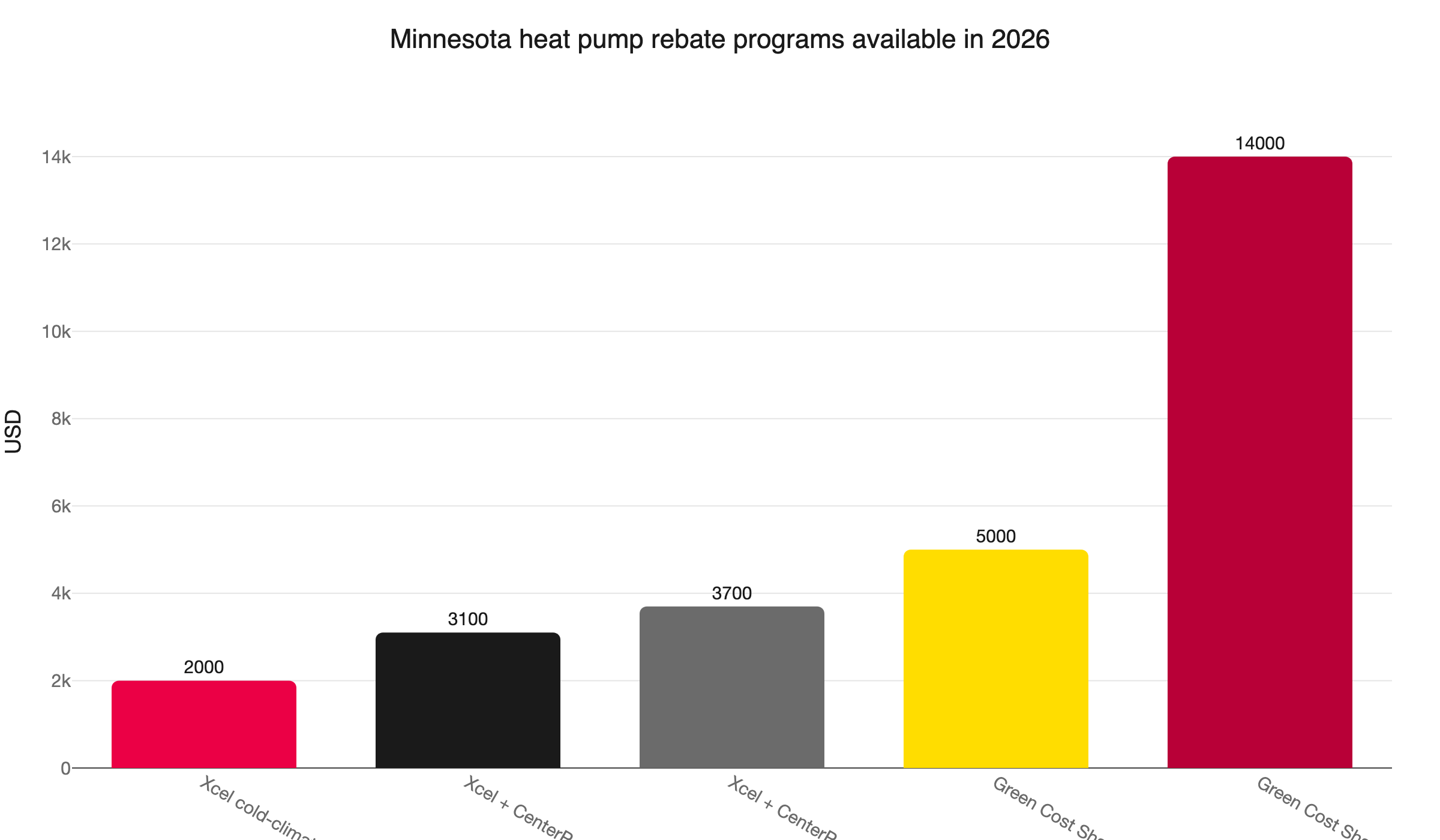
Quick answer: Xcel Energy pays up to $2,000 for a qualifying cold-climate mini-split. Pair it with a 92%+ AFUE gas furnace and add CenterPoint’s dual-fuel rebate for $3,100 total. Add the Xcel insulation bonus for $3,700 total. Minneapolis homeowners can stack the Green Cost Share on top for up to $14,000 more in a Green Zone.
Here is what each layer includes:
Xcel Energy cold-climate mini-split rebate: $2,000. Equipment must appear on the NEEP cold-climate product list with a COP of 1.75 or higher at 5°F. Standard mini-splits that do not meet the cold-climate spec qualify for $1,600. No participating contractor is required. A homeowner can self-install and still claim the rebate.
Xcel insulation and air sealing bonus: An additional $600 if qualifying insulation is installed within two years of the heat pump. This stacks on top of the mini-split rebate.
CenterPoint dual-fuel rebate: $1,100 for a heat pump paired with a 92%+ AFUE gas furnace, with the switchover temperature set at 40°F or lower. This requires both a heat pump and a gas furnace. It does not apply to full-electric replacements or to standalone mini-splits without a gas backup.
Minneapolis Green Cost Share: Stacks on top of all utility rebates. Up to $14,000 inside a Green Zone, up to $5,000 outside one. Limited to 1-4 unit residential properties in Minneapolis. Funding is first come, first served.
Save Energy Minnesota (HEAR): A state income-qualifying program that could add $8,000-$12,000 for eligible households. As of September 2026, this program has not launched and has no set date. If your household might qualify, waiting may make financial sense. No retroactive rebates apply once a system is already installed.
For the complete guide to layering every available program, see our post on stacking HVAC rebates and tax credits in Minnesota.
What Happened to the Federal 25C Tax Credit?
Quick answer: The federal 25C energy-efficient home improvement tax credit, which had been worth up to $2,000 for qualifying heat pump installations, expired December 31, 2025. It is not available for any system installed in 2026. State and utility rebates described above remain in effect.
Any quote or proposal from 2025 that includes a $2,000 federal tax credit is working from outdated information. Do not count on it. If you received a 2025 proposal with the credit factored into the net cost, ask for a revised quote before signing.
This change does not affect Xcel, CenterPoint, or the Minneapolis Green Cost Share programs. Those are currently active.
What Does It Cost to Replace Electric Baseboard Heat in Minnesota?
Quick answer: A single-zone mini-split runs $3,000-$5,500 installed before rebates. SDHV pricing is site-specific and best quoted after a home assessment. A condensing boiler conversion starts at $9,100-$15,600 installed.
Here are realistic ranges for the Twin Cities market in 2026:
Ductless mini-split, single zone: $3,000-$5,500 installed before rebates. After Xcel’s $2,000 cold-climate rebate, a qualifying single-zone system can net out under $3,500. Multi-zone systems serving two or more rooms run $6,500-$14,500+ before rebates.
Small-duct high-velocity: SDHV pricing depends on your home’s square footage, the number of supply outlets needed, and the equipment tier. Request a Manual J load calculation and a site-specific quote. Budget in a range comparable to a full furnace installation combined with new ductwork.
Hydronic boiler conversion: $9,100-$15,600 installed for a condensing boiler in a typical Twin Cities home. Complexity increases - and cost goes up - if zone valves, circulator pumps, or distribution piping also need replacement.
Ongoing maintenance: Plan for an annual tune-up regardless of which path you choose. Tune-up visits typically run $95-$250. An annual maintenance plan costs $195-$390 and usually includes priority scheduling and discounts on parts.
Financing: For larger installations, financing options are available. Call us at (763) 260-6662 and we will walk you through terms before any work begins.
Ready to Replace Your Electric Baseboard Heat?
Northern One Hour Heating & Air Conditioning is locally owned and operated in Ramsey, MN. Our team serves the full Twin Cities metro, including Minneapolis, St. Paul, Blaine, Maple Grove, Plymouth, Brooklyn Park, Woodbury, and the surrounding communities.
We will come to your home, assess your building type, and explain the replacement paths that actually fit your situation. Honest pricing upfront. No surprises after the work starts. “Always On Time… Or You Don’t Pay a Dime!(R)”.
Call us at (763) 260-6662 or book online to schedule your consultation.
Frequently Asked Questions
What is the best replacement for electric baseboard heat in Minnesota? +
Are there rebates to replace electric baseboard heat in Minnesota in 2026? +
Is the federal 25C tax credit still available for heat pumps in 2026? +
Can a ductless mini-split heat a Minnesota home in winter? +
Need a technician now?