
HVAC for Old Home Without Ductwork: 3 Real Options
Key Takeaways
- Most Twin Cities homes built before the 1960s have no ductwork. Boilers and cast-iron radiators were the standard.
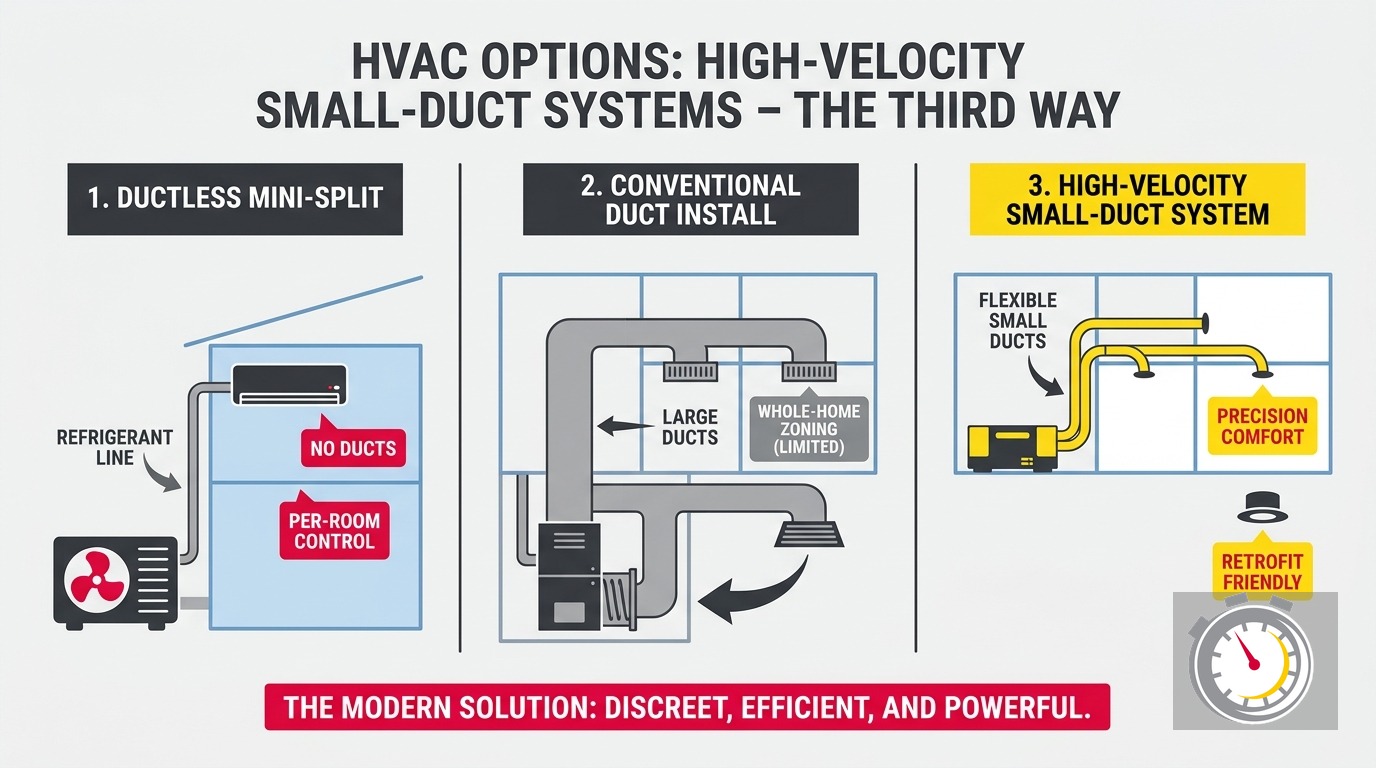
- Three systems work without conventional ductwork: a full duct retrofit, ductless mini-splits, or a high-velocity small-duct (SDHV) system.
- SDHV systems use 2 to 2.5-inch flexible tubes that thread through existing wall cavities without major demolition.
- SDHV systems remove about 30% more moisture than conventional central air. That matters in Minnesota summers.
- The federal Section 25C tax credit expired December 31, 2025. It does not apply to 2026 installs.
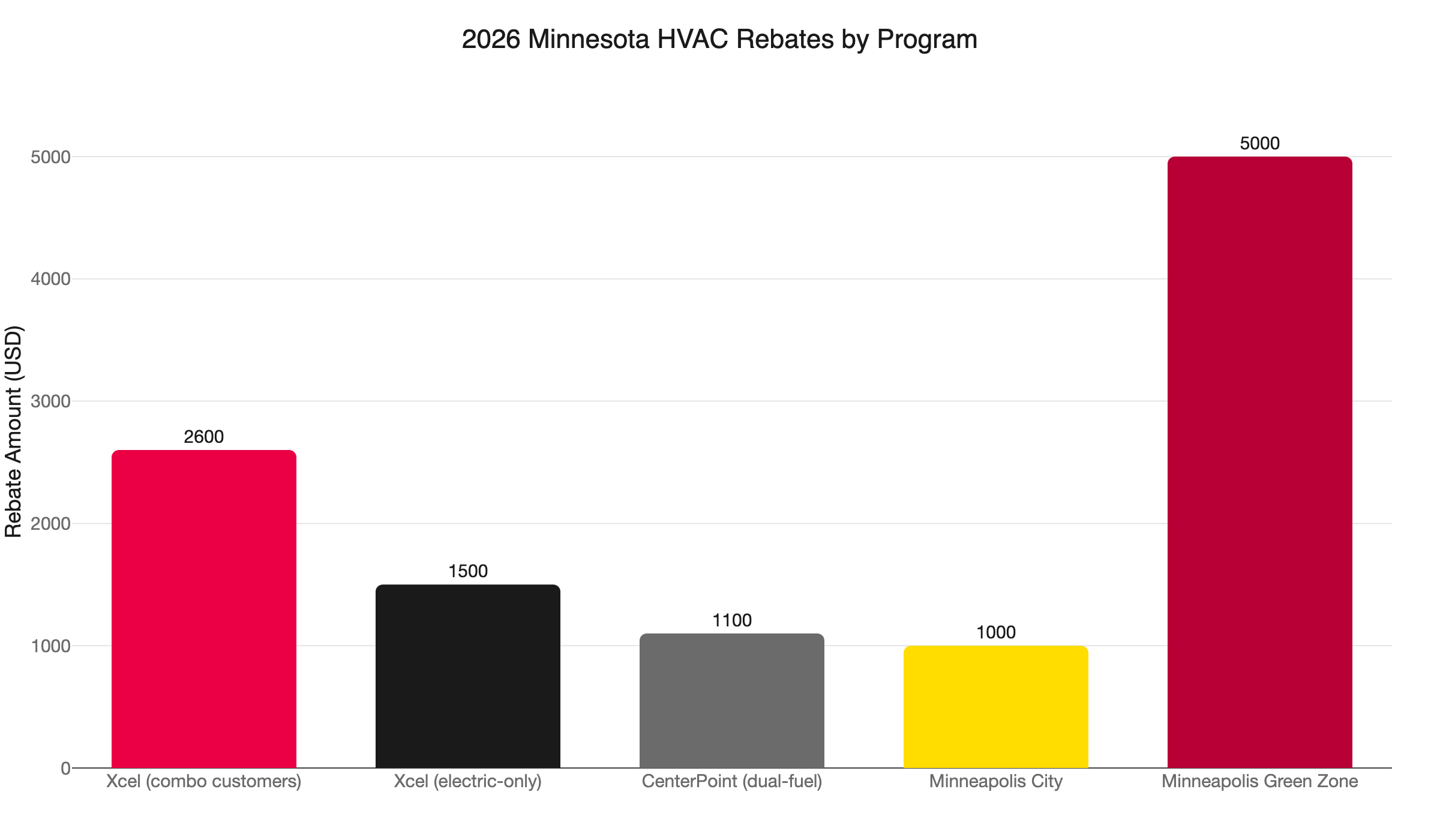
- Xcel Energy offers up to $2,600 for eligible customers who combine a heat pump rebate with the insulation bonus.
- CenterPoint Energy offers $1,100 for a dual-fuel heat pump paired with a gas furnace.
- Minneapolis residents can stack a city rebate of up to $1,000, or up to $5,000 in a designated Green Zone.
- Minnesota requires a mechanical permit for equipment replacements, not just new installs.
HVAC for Old Home Without Ductwork: Three Paths, One Right Answer
Most Twin Cities homes built before the 1960s ran on boilers and cast-iron radiators. No ductwork was ever installed because none was needed. If you own one of these homes and need central heating and air, you have three real options - not two.
Most articles frame this as a binary: ductless mini-splits or a full conventional duct retrofit. That framing skips the system built specifically for plaster-wall homes. High-velocity small-duct systems thread 2 to 2.5-inch tubes through existing wall cavities. They deliver central-system comfort without demolishing your historic millwork and without a months-long restoration bill after the installer leaves.
This guide covers all three options, who each one fits, and what the 2026 incentive landscape actually looks like. One fact up front: the federal tax credit is gone. The rest of the article covers what remains.
Why Older Twin Cities Homes Make HVAC More Complicated
The challenge is not the age of your home. It is what is inside the walls.
Before forced-air heating became common, most homes in Minneapolis, St. Paul, Ramsey, Blaine, and the surrounding suburbs used cast-iron radiators fed by a boiler. Heat traveled through hot water or steam. No supply ducts, no return air, no blower - just pipes, radiators, and gravity.
That system heated the home. It did not cool it. When central air conditioning became expected, the entire distribution problem had to be solved from scratch. The building was never designed for it.
Plaster-and-lath construction makes the retrofit harder. Walls in pre-1940 homes are often 1.5 to 2 inches of dense plaster over wood lath. Cutting a chase wide enough for a 6-inch supply duct is doable. Then comes the replastering. Skilled plasterers who can match original texture charge accordingly, and in a home with intact historic finishes, that restoration work can rival the cost of the equipment itself.
That context is why the third option in this guide was designed in the first place.
What Are the Three Real Options for HVAC for Old Home Without Ductwork?
Short answer: A full conventional duct retrofit, ductless mini-splits, or a high-velocity small-duct system. Each fits a different profile of home and homeowner. The right call depends on your wall construction, how you want the system to feel day-to-day, and what you can invest upfront and over the system’s life.
Option 1: Full Conventional Duct Retrofit
Standard forced-air systems are reliable and familiar. Every HVAC contractor knows them. Parts are widely stocked. If your home already has some ductwork, extending it is typically the most straightforward path to whole-home conditioning.
In a home with no ductwork at all, a full retrofit means building the distribution system from scratch. Supply trunks typically run 6 to 8 inches in diameter. Return-air chases need dedicated space. Routing all of it through finished plaster walls means opening wall cavities. Floor joists may need cuts where clearance is tight. Then everything gets patched and repainted.
In a home that is already under major renovation - walls open, plaster coming down, a full gut in progress - a conventional duct retrofit is competitive. The marginal labor for ductwork is low when the walls are already exposed. This is the scenario where it often makes the most sense.
In a home you are not planning to gut, add up the equipment, sheet metal and ductwork materials, and the labor to run everything through finished structure. Then add plaster repair across multiple rooms. The total climbs fast.
When to choose it: Your home is already under major renovation. You have partial existing ductwork to extend. You want the most familiar long-term maintenance and service path.
Option 2: Ductless Mini-Splits - Effective, with Real Trade-offs
Mini-splits are genuinely good equipment. They are efficient, they provide both heating and cooling without ductwork, and they serve multiple zones independently. For a home addition, a finished basement, or a room the existing system never reached, they are often exactly the right tool.
For a whole-home solution in an older home, they come with trade-offs most guides understate.
Placement. Each zone needs a wall-mounted indoor air handler. In a home with built-in bookcases, original millwork, or period details, finding clean placement is harder than it looks. Four or five indoor units need somewhere to go. That somewhere changes the look of the room, and in a home you are preserving, that matters.
Central-system feel. Mini-splits operate by zone. Each air handler has its own sensor and control. If you want one thermostat and even temperature throughout the house, mini-splits can approximate that. It requires careful zoning design and programming to get close.
Humidity on shoulder-season days. Standard mini-splits dehumidify while they cool. On a cool, humid Minnesota day in June - outdoor temperature in the low 60s, dew point above 60 degrees - the mini-split may not run enough to remove meaningful moisture. The air does not need enough cooling to trigger sustained run time. Indoor humidity stays elevated.
Cold-climate heating. Minneapolis-Saint Paul falls in IECC Climate Zone 6, with a 99% heating design temperature of approximately negative 16 degrees Fahrenheit. A mini-split used as a primary heat source must carry NEEP ccASHP certification to maintain rated capacity through a Minnesota winter. Undersized or uncertified equipment fails when it is needed most.
Lifespan. Some manufacturers cite 5 to 10 years for mini-split equipment. Independent estimates for well-maintained units run closer to 15 to 20 years. Know what the specific product specification says before you commit.
For a deeper look at how mini-splits perform in Twin Cities homes, see our guide to ductless mini-splits in older Twin Cities homes.
When to choose it: You need to condition specific zones, not the whole house. Wall placement works with your room layouts. Budget is the primary constraint and zone-by-zone control is acceptable.
What Is a High-Velocity Small-Duct System?
Short answer: A high-velocity small-duct system (SDHV) uses 2 to 2.5-inch flexible insulated tubes instead of standard 6 to 8-inch ducts. Those small tubes thread through existing wall cavities and around structural obstacles without opening finished surfaces. Conditioned air is delivered at higher velocity, and an aspiration principle mixes room air evenly without creating drafts.
This is the system built specifically for the problem we are describing: finished plaster walls, original millwork, no existing ductwork. Brands in this category include Unico and SpacePak. These are specialty systems. Not every HVAC contractor installs them. When you request an estimate, ask specifically for a contractor certified by the manufacturer.
The supply outlets are small and circular, roughly the diameter of a recessed light. They mount in the ceiling or high on a wall. In most rooms, installation requires only a few small access points that patch cleanly. No exposed duct runs, no bulk added to walls, no soffits built to hide sheet metal.
How Does the Aspiration Principle Work, and Why Does It Matter?
Short answer: High-velocity discharge from the small supply tubes creates continuous air movement that pulls room air into the stream. This process - called aspiration - eliminates hot and cold spots without the noticeable draft you feel from a conventional supply register. Room air stays in motion and mixes continuously, producing even temperature from floor to ceiling.
In a two-story older home where the second floor runs 5 to 8 degrees warmer in summer, that even distribution is a meaningful feature. Conventional systems stratify. Hot air collects near the ceiling and stays there. SDHV systems disrupt that pattern continuously by keeping air in motion throughout the room.
The leakage story matters too. A Unico system installed by a certified contractor can achieve 0% supply-air leakage. Flexible insulated tubing has less surface area than sheet-metal runs. Tight joints replace the seams and connections that lose conditioned air in conventional systems. Industry estimates for duct leakage in standard systems run 20 to 30% of conditioned air volume. That is air you paid to heat or cool, delivered to the wall cavity instead of the room.
Does a High-Velocity System Handle Minnesota’s Summer Humidity?
Short answer: Yes, and it handles it better than most alternatives. SpacePak’s system removes 30% more moisture than conventional central air. You can set the thermostat a few degrees higher and still feel comfortable because the relative humidity is lower. In a humid Minnesota July, that difference is real and noticeable on the utility bill.
Minnesota summers hit dew points above 60 degrees Fahrenheit regularly through July and into August. At 72 degrees and 65% relative humidity, a room feels warmer and stickier than at 74 degrees and 50%. The thermostat reading does not tell the whole comfort story.
Mini-splits and conventional central air dehumidify while cooling, but only as a byproduct of the cooling cycle. When outdoor temperatures drop and the system does not need to cool much, it does not run long enough to remove the moisture. Indoor humidity stays elevated even though the thermostat reads a comfortable number.
SDHV systems remove more moisture per cycle because the higher air velocity moves more air across the cooling coil per unit of time. The aspiration effect keeps air circulating between supply outlets and the room, which maintains more consistent coil contact throughout the cycle.
What Happened to the Federal Tax Credit?
Short answer: It is gone. The Section 25C energy efficiency tax credit expired December 31, 2025. The One Big Beautiful Bill Act, signed July 4, 2025, ended the program. 2026 installs do not qualify. The 30% credit capped at $2,000 for heat pumps and high-efficiency equipment is no longer available.
If you have been researching HVAC options and reading that you can get $2,000 back from the federal government, that information is out of date. Most articles ranking on this topic were written before July 4, 2025. The incentive landscape changed materially on that date.
The programs below are still active. They operate independently of federal legislation.
What Rebates Are Still on the Table in 2026?
Short answer: Xcel Energy offers up to $2,600 for qualifying customers who combine a cold-climate heat pump rebate with the insulation bonus. CenterPoint Energy offers $1,100 for a ducted heat pump paired with a gas furnace in a dual-fuel configuration. Minneapolis residents can stack a city rebate on top. The federal match is gone, but the utility stack remains meaningful.
Here is the 2026 rebate picture in detail:
Xcel Energy (electric customers):
- Up to $2,000 for a qualifying cold-climate air-source heat pump or cold-climate ductless mini-split.
- Customers with both Xcel electric and Xcel gas service receive the higher tier. Electric-only customers receive up to $1,500.
- An additional $600 if qualifying insulation and air sealing is installed alongside the heat pump, bringing the total to $2,600.
CenterPoint Energy (natural gas customers):
- $1,100 for a ducted heat pump paired with a gas furnace in a dual-fuel hybrid setup. Applies to the large share of older Twin Cities homes already on natural gas service.
Minneapolis City:
- Up to $1,000 for any Minneapolis resident, or up to $5,000 for residents in a designated Green Zone. Equipment must meet Xcel’s efficiency specification tier to qualify. These rebates stack on top of Xcel’s program.
Incentive programs change. Confirm current eligibility with your contractor before signing anything. For a current overview of Minnesota incentive options, see our Minnesota heat pump rebates guide.
On permits. Minnesota requires a mechanical permit for replacement of heating and cooling equipment, not just new installs. Confirm the permit requirement with your contractor before any system swap. We cover what that process involves in our guide to HVAC permits in Minnesota.
How Do You Know Which System Is Right for Your Home?
Short answer: Three questions narrow it down. Do you want one thermostat and a central-system feel? Do you have plaster walls and millwork worth preserving? Is humidity removal a priority? If the answer to all three is yes, a high-velocity small-duct system is typically the strongest fit for an older home without ductwork.
Here is the practical framework:
Choose a full duct retrofit if:
- You are already doing a major renovation and walls are open.
- Your home has partial existing ductwork to extend.
- You want the most familiar long-term maintenance and service path.
Choose ductless mini-splits if:
- You need to condition specific zones, not the whole house.
- Wall placement works with your room layouts.
- Budget is the primary constraint and zone-by-zone control is acceptable.
Choose a high-velocity small-duct system if:
- The whole home needs conditioning and the plaster and millwork are worth preserving.
- You want one thermostat and a central-system feel.
- Humidity removal is a priority.
- You can invest more upfront for a system rated for 20-plus years of service.
For any system with a heat pump component, cold-climate performance is a real constraint in Minnesota - not a footnote. A design temperature of negative 16 degrees Fahrenheit is a working engineering parameter for Minneapolis. Heat pump equipment used as a primary heat source needs to maintain rated capacity there. Look for NEEP ccASHP certification or an ENERGY STAR Cold Climate designation when evaluating equipment.
Sizing matters more in an older home than in newer construction. A drafty pre-1940 home loses heat faster than a code-built 2000s house. Ask your contractor to run a Manual J load calculation for your specific home - not a square-footage rule of thumb. We cover why that distinction matters in our HVAC sizing guide for Twin Cities homes.
Ready to Get a Straight Answer for Your Home?
Every old house is different. Wall depth, insulation, floor joist spacing, and your existing mechanical layout all factor into which system actually fits. An in-person assessment answers questions that no article can.
We are locally owned and operated in Ramsey, MN, serving the Twin Cities - Minneapolis, St. Paul, Blaine, Maple Grove, Plymouth, Brooklyn Park, Woodbury, Bloomington, and the surrounding area. Our team works with older homes regularly. We can tell you whether your walls can accommodate SDHV tubes, whether mini-split placement makes sense in your rooms, or whether a conventional duct retrofit is more viable than you think given your specific structure.
We back every appointment with our commitment: “Always On Time… Or You Don’t Pay a Dime!(R)”
Call us at (763) 260-6662 or book online to schedule an in-home assessment. We will give you an honest answer on which system fits, what the permit path looks like, and exactly what you qualify for in 2026.
Frequently Asked Questions
Can I add central air to an old house with no ductwork? +
What is a high-velocity small-duct HVAC system? +
Is the federal heat pump tax credit still available in 2026? +
How much more humidity does a high-velocity HVAC system remove than standard central air? +
Need a technician now?