
How to Add Central Air to a Twin Cities Home With Radiators
Key Takeaways
- You do not need to replace your boiler to add AC. The boiler stays and handles all heating.
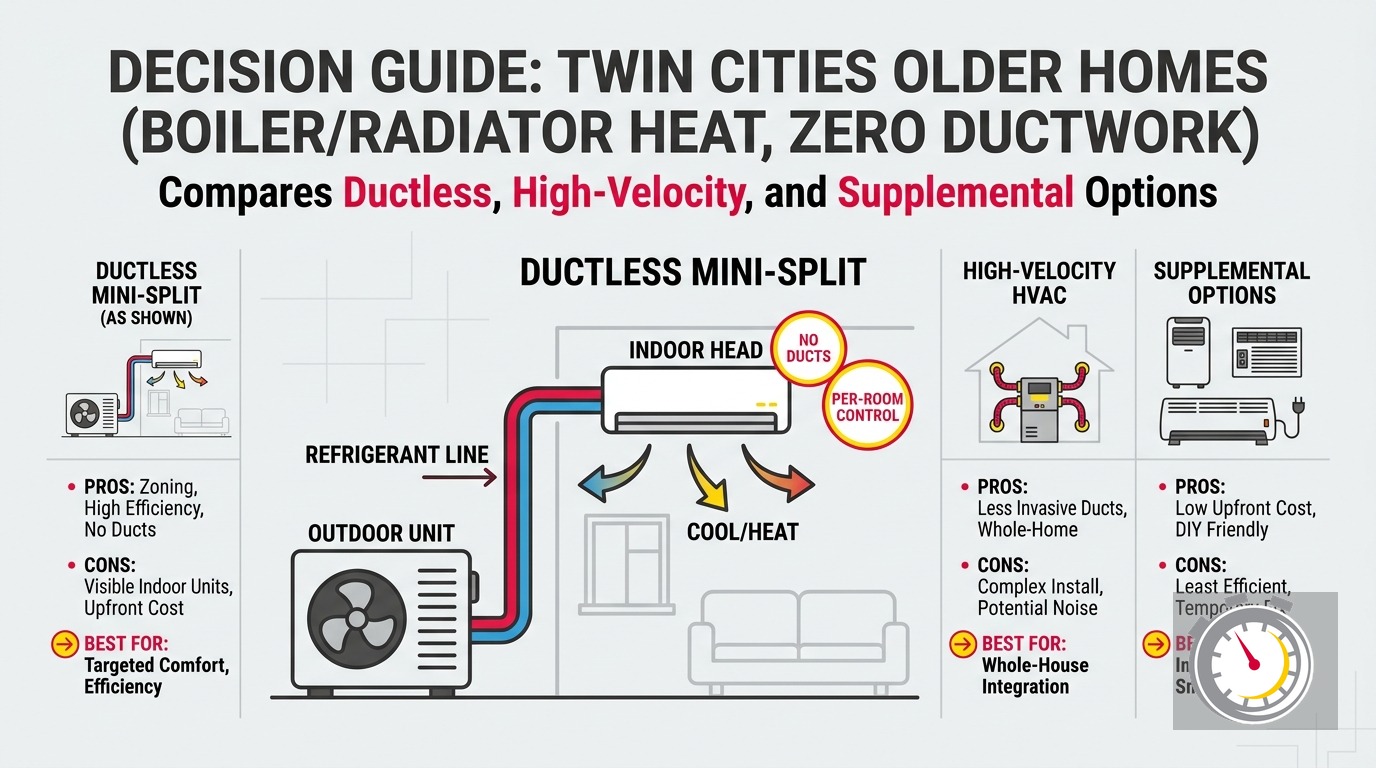
- Three options work for no-ductwork homes: ductless mini-splits, high-velocity small-duct systems, and window or portable units.
- Only cold-climate-rated mini-splits perform reliably at the Minneapolis heating design temperature of -13°F. Standard models fail in deep cold.
- Minnesota requires a mechanical permit for all HVAC installs under MN Rules 1346. Pull the permit every time.
- A heat-pump mini-split qualifies for a 30% federal tax credit, up to $2,000 per tax year.
- Stack the federal credit with Xcel Energy or CenterPoint Energy utility rebates in the same project year for maximum savings.
- A subsidized Home Energy Squad audit leads directly to the rebate programs that apply to your home.
- High-velocity small-duct systems are the best single-system option for whole-house cooling in a two-story plaster-wall home.
Your boiler has kept your family warm through every January Minnesota could deliver. That is not a system to replace. But boilers do not cool, and a Twin Cities July with dew points in the mid-60s and temperatures near 90 is a separate problem entirely.
The solution is not to replace the boiler. The solution is to add a cooling system alongside it. Three options work for homes with radiator heat and no ductwork. Each fits a different budget, house layout, and comfort goal. This guide covers all three: what they cost, what permits they require, and how to stack federal credits and Minnesota utility rebates to bring the investment down.
Should You Replace Your Boiler When Adding AC?
No. A working hot-water or steam boiler is one of the best heating systems for a Minnesota climate. With a design heating temperature of -13°F, the boiler’s ability to deliver consistent, high-output heat through radiators makes it worth keeping. The goal is a cooling-only system added alongside your existing boiler.
Most national home-improvement articles frame this as an HVAC replacement project. That framing makes sense for forced-air homes where heating and cooling share the same ductwork. In a radiator home, the two systems never shared infrastructure to begin with. Cooling gets its own delivery method. The boiler goes right on doing its job.
A working hot-water boiler is a long-lived, efficient asset. Replacing a good boiler just to add AC is an unnecessary expense. Keep the boiler. Buy the cooling system that runs alongside it.
Option 1: Ductless Mini-Splits
A ductless mini-split places an outdoor compressor unit outside the home and connects it to one or more wall-mounted indoor heads via small refrigerant line sets. No ductwork required. Each indoor head conditions one zone independently.
A single-zone setup works well for cooling one room or an open main-floor layout. For whole-house coverage, a multi-zone system runs one outdoor unit connected to two, three, or four indoor heads placed in different rooms or floors. You choose which areas get a head. You control each zone independently.
The zone-by-zone control is one of the main appeals. A bedroom head runs at night while the living room head is off. A home office stays cool during work hours without conditioning the rest of the house. That flexibility suits homeowners who want comfort where they actually spend time.
Installed costs run $3,000-$8,000 per zone. A whole-house multi-zone setup with three or four heads typically lands between $12,000 and $22,000 installed. The final number depends on the number of heads, the outdoor unit capacity, and the complexity of routing line sets through the house.
Our mini-split installation cost guide for the Twin Cities has a detailed breakdown by zone count and configuration.
What Makes a Mini-Split Safe for Minnesota Winters?
Standard mini-splits lose heating capacity quickly below 20°F and stop operating reliably below 0°F. Cold-climate-rated models - the Mitsubishi H2i, Daikin Aurora, and Bosch IDS series - are engineered to maintain heating output at -13°F and below, matching the Minneapolis ASHRAE design temperature.
If you plan to use the mini-split as a heating backup during shoulder seasons or mild winter days, the cold-climate rating is not optional. A standard mini-split leaves you without heat on the nights that matter most in Minnesota. The cold-climate designation is a functional performance requirement, not a premium upgrade tier.
The ENERGY STAR Cold Climate designation identifies units engineered for heating-dominated climates like Minnesota’s. It is also the qualifying pathway for the heat pump federal tax credit. Any contractor quoting a mini-split in the Twin Cities should name the specific model and confirm it carries the cold-climate or ENERGY STAR Most Efficient designation.
For detail on how cold-climate units perform at extreme temperatures, see our guide to heat pump performance below zero in Minnesota.
What About Line Set Routing in Plaster-Wall Homes?
The refrigerant line sets connecting the outdoor unit to each indoor head have to go somewhere. A typical 1920s Minneapolis two-story has thick plaster walls, balloon-frame construction, and very few interior chases running floor to floor. That makes line set routing a real planning conversation before any quote is signed.
The most common approach is exterior routing. The line set runs along the outside of the house in a protective channel or conduit, enters through a small wall penetration near each indoor head, and connects. Done well, this looks clean. The channel is painted to match the siding and sits flush against the exterior. Done carelessly, it looks like an afterthought.
Interior routing through closets, utility walls, or floor joist bays is possible on some houses. It hides the line sets entirely but requires more labor and planning. The feasibility depends on the specific framing of the house.
A competent contractor walks through the home in person before quoting and maps the line set route for each head. Ask to see photos of their line set work on houses similar to yours. Routing quality is a visible part of the finished job.
Option 2: High-Velocity Small-Duct Systems
A high-velocity system uses a centrally located air handler - typically in the basement, utility room, or attic - connected to 2-inch flexible supply ducts. Those small ducts thread through existing wall cavities, floor joist bays, and ceiling spaces. Each room gets one or two 2-inch round outlets, smaller than a hockey puck, that deliver high-velocity conditioned air.
The small, flexible ducts navigate the irregular framing of a 1920s or 1930s home without large wall openings. The outlets are subtle. When the installation is done, the system is largely invisible: no wall-mounted heads, no visible line sets, no equipment taking up floor space.
This is the best option if your goal is whole-house cooling from a single system. One air handler, one thermostat, and consistent conditioning throughout every room. For a two-story plaster-wall home, it is often the only practical way to achieve true whole-house coverage without major demolition.
High-velocity delivery also provides better dehumidification than ductless heads. All the home’s air passes through the air handler continuously, so moisture control is even across the house. In a Twin Cities July, that matters. Dew points regularly reach the mid-60s. A house at the right temperature but too humid is not comfortable.
The tradeoffs are real. Installation is more disruptive than a mini-split install. Contractors open walls or ceilings in some locations to route the small ducts, particularly going from the basement to the second floor. The job takes longer, and the upfront cost is higher. But the result is a permanent, integrated cooling system.
A high-velocity system is cooling-only, just like a ductless mini-split. Your boiler continues to handle all winter heating.
What Does High-Velocity Small-Duct Installation Cost?
Expect $15,000-$25,000 installed for a whole-house high-velocity system in a typical Twin Cities two-story home. Larger homes, additional floors, and complex routing in tight balloon-frame construction push toward the top of that range. The upfront cost is higher than a single-zone mini-split but comparable to a full multi-zone ductless setup.
The right comparison is not a single-zone mini-split: it is a three- or four-zone ductless system covering the same square footage. Both approaches to whole-house coverage land in a similar installed price range. High-velocity wins on invisibility and whole-house dehumidification. Ductless multi-zone wins on zone-by-zone flexibility and the ability to provide heating from the same equipment.
For help layering federal and utility incentives to offset the upfront cost of either system, our guide to stacking HVAC rebates in Minnesota walks through the current programs.
Option 3: Window and Portable Units
Window air conditioners are the honest starter option for homeowners who need cooling this summer and are not ready for a larger investment. A window unit installs in an open window, requires no permit, and needs no contractor. A 12,000-BTU unit cools one room effectively. You can buy one at a local hardware store and install it the same day.
Portable units vent through a flexible hose to a window opening. They are less efficient than window units and take up floor space, but they move easily between rooms and require no permanent mounting.
The limitations deserve honesty. Window and portable units do not cool a whole house. They are louder than ductless mini-splits. They block natural light in the window they occupy. They do not control humidity in adjacent rooms. Condensate management can be a nuisance with portable units.
Window and portable units are a legitimate phase-one bridge when budget is the primary constraint. They get you through this summer while you plan a ductless or high-velocity project. They are not a permanent whole-house solution.
Do You Need a Permit for AC in Minnesota?
Yes. Minnesota Mechanical Code (MN Rules 1346) requires a mechanical permit for HVAC equipment installations, including new ductless mini-splits and high-velocity AC systems. A homeowner can pull their own permit, but the installation must pass inspection. All refrigerant work requires EPA 608 certification, which means a licensed HVAC contractor handles the refrigerant connections.
The permit process creates a record that the install was inspected and met Minnesota’s mechanical and energy codes. That record matters at resale. A buyer’s inspector who asks about the AC installation will look for a permit. An unpermitted install can complicate a sale or require a retroactive inspection.
No reputable contractor skips the permit. If a quote comes in noticeably low and the contractor suggests skipping the permit to save money, that is a red flag. Our HVAC permit guide for Minnesota explains what the permit process involves and what the inspector checks.
How Do You Stack Federal Credits and Minnesota Rebates?
Combine the federal heat pump tax credit (30%, up to $2,000) with a Xcel Energy or CenterPoint Energy utility rebate in the same project year. A Home Energy Squad audit shows you exactly which rebates apply to your home and costs very little to schedule.
Here is how each piece works.
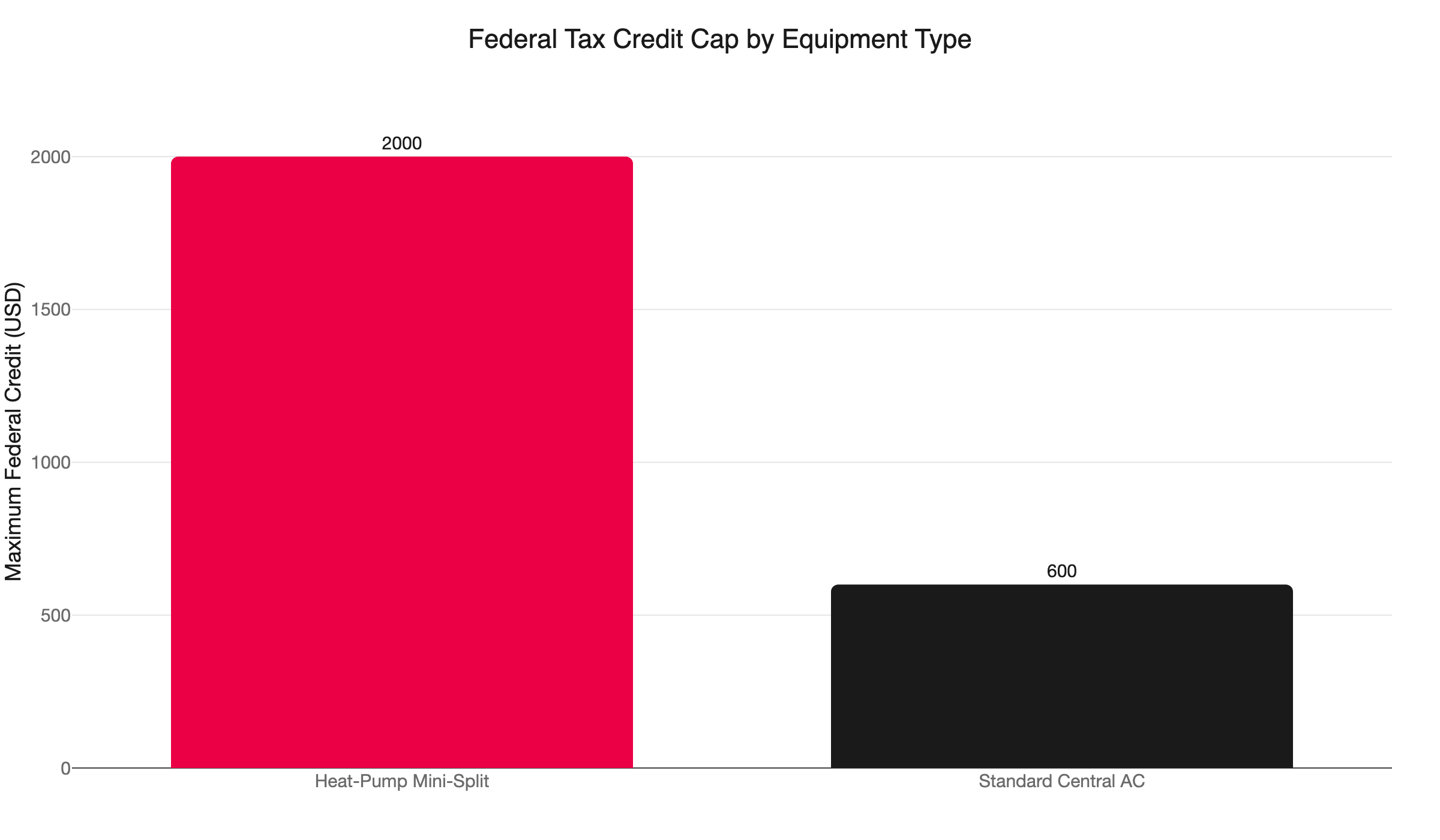
Federal credit for a heat-pump mini-split: A unit that carries the ENERGY STAR Most Efficient or ENERGY STAR Cold Climate designation qualifies for a 30% federal tax credit, capped at $2,000 per tax year. In Minnesota, you want the cold-climate designation for performance reasons anyway. The credit eligibility and the performance requirement align.
Federal credit for standard central AC: A non-heat-pump split system that meets SEER2 17.0 and EER2 12.0 minimums qualifies for a 30% credit capped at $600. That is the ceiling for cooling-only equipment that is not a heat pump.
Stacking credits: The maximum combined energy-efficiency credit in one tax year is $3,200. Claim the heat pump credit ($2,000) and an attic insulation credit ($1,200 cap) in the same year. You reach the full $3,200 ceiling. If your plaster-wall home is also underinsulated - common in pre-1940 Twin Cities construction - that combination makes strong financial sense in a single project year.
Utility rebates: Before committing to a system, schedule a Home Energy Squad audit through the Center for Energy and Environment. The program is subsidized by Xcel Energy and CenterPoint Energy. The auditor assesses your heating, cooling, and insulation situation and connects you directly with the utility rebate programs that apply to your specific home. Call 651-328-6220 or visit mncee.org to book.
After the audit, check current rebate amounts at centerpointenergy.com/rebates (CenterPoint customers) or Xcel’s rebate portal. Rebate amounts update annually, so current figures from the audit are more reliable than numbers published in any blog post.
One important note: the ENERGY STAR pages cited here state credit eligibility through December 31, 2025. Confirm the current extension status with a tax professional before filing your return.
Will a Single Mini-Split Dehumidify the Whole House?
No. A mini-split head cools and dehumidifies the zone it serves. Adjacent rooms, upper floors, and unconditioned areas stay at ambient humidity. In a Twin Cities July, when outdoor dew points regularly reach the mid-60s, rooms without a head will feel sticky even when the temperature seems acceptable.
This is one of the most overlooked comfort gaps in older homes. It is easy to install one mini-split on the main floor and call the problem solved. But a humid second floor or a sticky basement signals that the job is only half done.
A high-velocity system handles this better. The air handler processes all the home’s air continuously. Dehumidification is consistent throughout the house, not zone by zone.
If you go the ductless route with limited zones, one practical option is pairing the mini-split with a whole-home dehumidifier. That adds a second system to maintain and some additional cost, but it addresses the comfort gap in rooms the mini-split does not directly serve.
Which Option Is Right for Your Home?
The answer depends on your house layout, budget, and what you are trying to solve.
Choose ductless mini-splits if:
- Zone-by-zone comfort control is the priority
- You want heating capability from the same equipment (cold-climate model required)
- Budget suits a phase-in approach: start with one or two zones, add more later
- Exterior line set routing is feasible on your specific house
Choose a high-velocity small-duct system if:
- Whole-house cooling from one invisible system is the goal
- You have a two-story home and want consistent coverage throughout every room
- Whole-house dehumidification matters as much as cooling
- You can accept a more involved installation in exchange for a permanent, invisible result
Choose window or portable units if:
- Budget is the main constraint for this cooling season
- You need cooling in one or two rooms while planning a larger project next year
- You are renting or planning to sell in the near term
For most Twin Cities homeowners with a working boiler and no ductwork, a cold-climate-rated ductless mini-split is the most practical starting point. It delivers real comfort, qualifies for the strongest federal credits, works alongside your boiler without modifying it, and can be expanded zone by zone as budget allows.
As a locally owned and operated HVAC company based in Ramsey, we have assessed dozens of Twin Cities homes with exactly this situation. We know where line sets route in a 1920s plaster house. We know which cold-climate models hold capacity at -13°F. And we show up when we say we will. That is the promise behind “Always On Time… Or You Don’t Pay a Dime!(R)”.
Call (763) 260-6662 or schedule your assessment online to get a straight answer about the right option for your home.
Frequently Asked Questions
Do I need to replace my boiler to add central AC? +
What does it cost to add AC to a Twin Cities home with radiators? +
Do I need a permit to install a mini-split in Minnesota? +
Can I get a tax credit for adding AC to my Minnesota home? +
Need a technician now?