
Thermostatic Radiator Valves Minneapolis: The Complete Guide
Key Takeaways
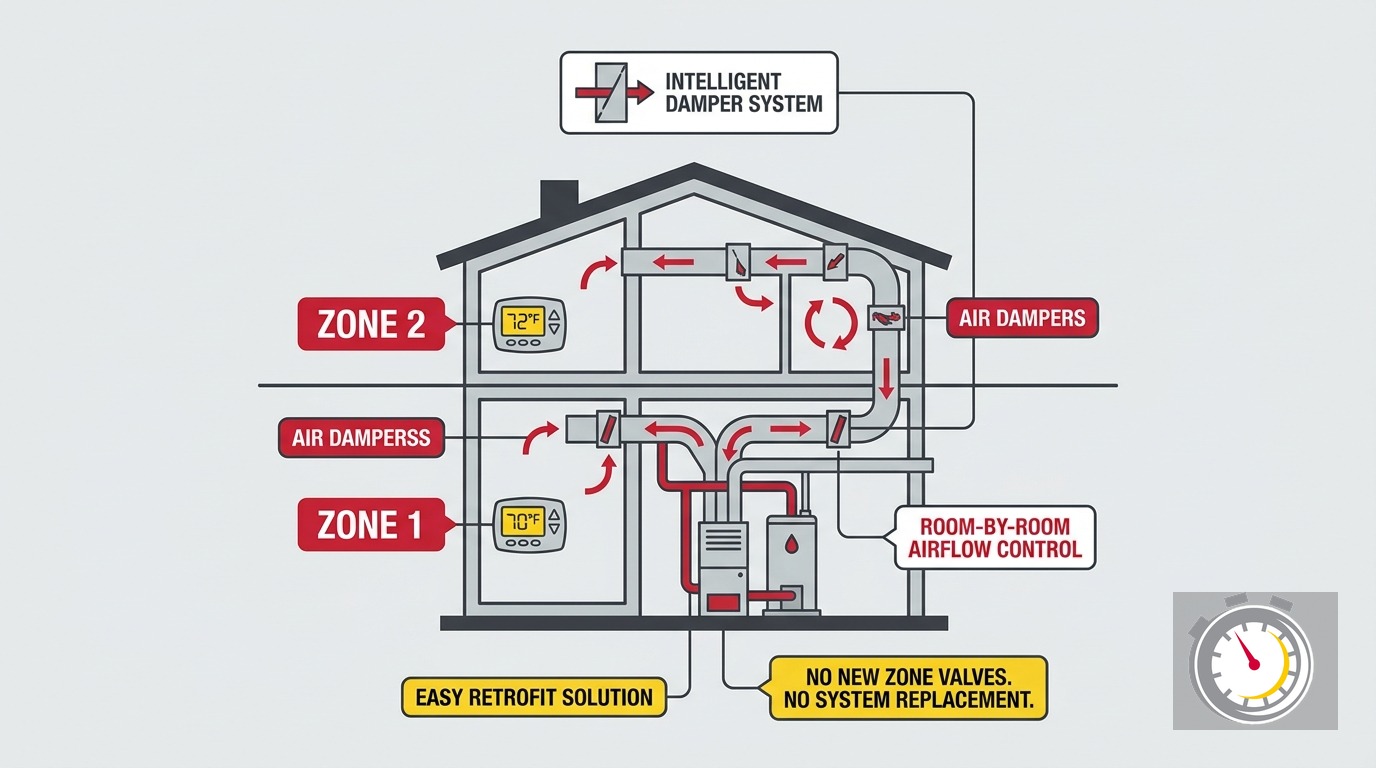
- TRVs mount at the radiator supply inlet and control water flow based on local room temperature, with no wiring or external power.
- On a single-thermostat boiler, leave one radiator fully open without a TRV. That radiator drives the call for heat. Install a TRV on every radiator and the boiler loses its demand signal.
- Minneapolis-St. Paul logs roughly 8,300 heating degree-days per year, nearly double the national average. Zone control pays back faster here than in milder climates.
- Older non-condensing boilers need a return-water temperature check before TRVs go in. Restricted flow can drop return temps below 120-130°F and cause internal corrosion.
- Boiler zone work in Minnesota requires a bonded mechanical contractor. TRV installation on a pressurized hydronic system is not permit-exempt.
- CenterPoint Energy customers can earn a $300-$500 rebate on a qualifying boiler replacement through December 31, 2026, if a TRV evaluation reveals the need for an upgrade.
If a room in your Twin Cities boiler home stays too hot or too cold no matter how you adjust the main thermostat, a thermostatic radiator valve could be stuck, seized, or set too low. It might also be working exactly as intended. Thermostatic radiator valves Minneapolis homeowners use let each radiator control its own room temperature, independent of the boiler’s single thermostat, with no new wiring and no zone valve controllers. This guide covers how they work, how to spot a valve that has failed, what they cost, and what Minnesota’s licensing rules require before installation.
What Are Thermostatic Radiator Valves?
A thermostatic radiator valve mounts on the supply pipe feeding a hot-water radiator and meters flow based on the room temperature it senses directly. An internal wax or liquid-filled element expands when the room is warm, pushes the valve pin closed, and reduces hot-water flow. When the room cools, the element contracts, the pin lifts, and flow resumes. No wiring required.
TRVs have two parts. The valve body installs in the supply pipe at the radiator. The actuator head clips or threads onto the valve body and holds the sensing element. The head has a numbered dial, typically 1-5. Setting 3 maps to roughly 68°F on most brands. Setting 1 is around 50°F, enough to prevent a room from freezing. Setting 5 is fully open.
The head reads the air immediately around it. That means placement matters. A head buried inside a radiator cabinet, blocked by a curtain, or positioned near a heat-generating lamp will misread the room and control poorly. Remote sensor heads solve this: the actuator sits on the valve body, but a capillary tube connects it to a sensor you clip in a spot with free air circulation.
TRVs have been standard on hydronic systems throughout Europe for decades. They are increasingly common on the cast-iron and fin-tube radiator setups found in pre-1970 Minneapolis, St. Paul, and inner-ring suburb homes.
Why Do Minneapolis Homes Benefit More from TRVs?
Minneapolis-St. Paul logs about 8,300 heating degree-days annually, nearly double the national average of roughly 4,500. PNNL recommends TRVs for IECC climate zones 4 and above, and Minnesota sits at zones 6-7. Every percentage of fuel savings from zone control compounds across a full six-month heating season.
Minneapolis sits in IECC Climate Zone 6A with a design temperature of -15°F at the 99th percentile, and the metro logs significantly more heating degree-days per year than the national average. PNNL specifically recommends TRVs for climate zones 4 and above. The recommendation is not marginal in Minnesota.
There is also a home-stock factor. Many Minneapolis, St. Paul, Robbinsdale, and Edina homes built between 1900 and 1960 have original cast-iron radiators sized for poorly air-sealed, single-pane construction. Since then, windows have been upgraded, insulation added, and air sealing tightened. Those radiators now deliver far more heat than the rooms need. A bedroom designed for an 8,000 BTU per hour load may only need 5,000 today, but the boiler has no way to know that. It fires, the radiator blasts, the room overheats, and you crack a window in January. TRVs close that mismatch room by room without touching the boiler or re-running any pipe.
How Do TRVs Work in a Hot-Water Boiler?
The valve body replaces the existing manual lockshield valve at the radiator’s supply inlet. The actuator head attaches to the body. Together, they meter flow at that radiator based on local air temperature, independent of whatever the main thermostat is doing.
The valve body replaces or installs alongside the existing supply valve. Once the head is on, you dial in your room setpoint. The system does the rest, opening and closing throughout the day as the room gains and loses heat from solar gain, occupancy, and the boiler itself.
When multiple TRVs are installed throughout a house and several rooms warm simultaneously, multiple valves throttle back at once. That reduces total system flow and raises pump head pressure. On some systems, this stresses the circulator, creates noise at partially closed valves, or causes the pump to work against excess pressure. A variable-speed or pressure-regulated circulator is the right companion to a whole-home TRV installation. Your mechanical contractor will assess whether the existing pump is adequate or whether a differential pressure bypass valve is needed.
The Rule You Cannot Break on a Single-Thermostat Boiler
Most older Twin Cities boiler homes use one wall thermostat. The boiler fires when that thermostat calls for heat. The problem: if every radiator has a TRV, all of them can throttle back simultaneously when rooms warm up. The boiler loses effective demand, short-cycles, or stops before the thermostat is satisfied. You end up with a system that seems to run but cannot hold temperature.
The correct approach is to leave one radiator without a TRV, typically the radiator in the coldest room or the one farthest from the boiler. That radiator stays fully open and always requests heat, keeping the boiler running until the thermostat is satisfied. Every other radiator can have a TRV and manage its own zone independently.
Without a variable-speed pump, closing multiple TRVs simultaneously raises system pressure and reduces overall efficiency. Confirming circulator adequacy is part of a proper installation assessment.
One exception: if your boiler uses outdoor reset control with a warm-weather shutdown, the system can be configured with TRVs on every radiator and the TT terminals jumpred to maintain the demand signal. This is an advanced configuration your mechanical contractor handles during commissioning.
What Happens to Your Older Boiler When You Add TRVs?
Adding TRVs to an older non-condensing boiler without first checking return-water temperature can accelerate internal corrosion and shorten the boiler’s life.
Non-condensing boilers can suffer flue-gas condensation and internal corrosion when return-water temperature drops below roughly 120-130°F. Here is why TRVs can trigger this: when multiple valves throttle back, total system flow drops. Water spends more time in the radiators and gives up more heat. It returns to the boiler cooler than the unit was designed to accept. On a non-condensing boiler, flue gases that would normally exhaust as vapor condense inside the heat exchanger instead, depositing acidic moisture that corrodes the unit from inside. The damage is cumulative and often invisible until the boiler fails.
A licensed contractor will check:
- Whether the boiler is condensing or non-condensing
- Current return-water temperature under normal operating conditions
- Whether the circulator is sized correctly for reduced-flow operation
- Whether a low-temperature bypass or mixing valve is needed to protect the boiler
If the boiler is aging, a TRV installation is a natural time to evaluate a replacement. A modern condensing unit is designed for low return-water temperatures and actually runs more efficiently when TRVs reduce flow. Our boiler installation and replacement service covers what we offer, and the condensing boiler upgrade cost post details what to expect in the Twin Cities.
Why Is My TRV Hot But My Radiator Is Cold?
If the valve body is warm to the touch but the radiator stays cold, the most common cause is a stuck or corroded valve pin that is not lifting to allow flow, even though the actuator head is calling for it. Remove the head and press the pin up and down manually several times to free it before ordering a replacement valve.
This happens most often on TRVs that have sat fully closed for a long time, especially in a guest room or storage space that was kept cold for years. The pin corrodes in place. Manual cycling often frees it. If the pin will not move, or the valve body shows visible corrosion, the valve needs replacement.
Other causes to check first:
- Setpoint too low. Turn the dial to 4 or 5 and wait 15-20 minutes. If the radiator heats up, the valve was simply set too cold for the current room temperature.
- Pin left depressed during reinstallation. Remove the actuator head and confirm the pin is in the raised, open position before putting the head back on.
- Air trapped in the radiator. Bleed the bleed valve at the top of the radiator. A hiss followed by water confirms air was the issue. Our guide on how to bleed air from radiators covers the full process step by step.
Does TRV Installation Require a Permit in Minnesota?
Yes. Boiler zone work requires a bonded mechanical contractor in Minnesota. TRVs install on a pressurized hydronic system, which falls under mechanical licensing requirements. Work done without a proper permit can void homeowner’s insurance coverage and creates a disclosure issue when you sell the home.
Minnesota’s energy code requires at least one thermostat per separate heating system under Section R403.1. Any modifications to the pressurized hydronic piping that controls heat delivery fall under the state’s mechanical licensing rules. TRVs are hydronic components. The work requires a permit and a licensed contractor.
Our post on what triggers an HVAC permit in Minnesota explains how different types of work are classified. For a breakdown of what permits actually cost in Minneapolis and the suburbs, see the HVAC permit cost guide for Minnesota.
Can TRVs Lower Your Heating Bills?
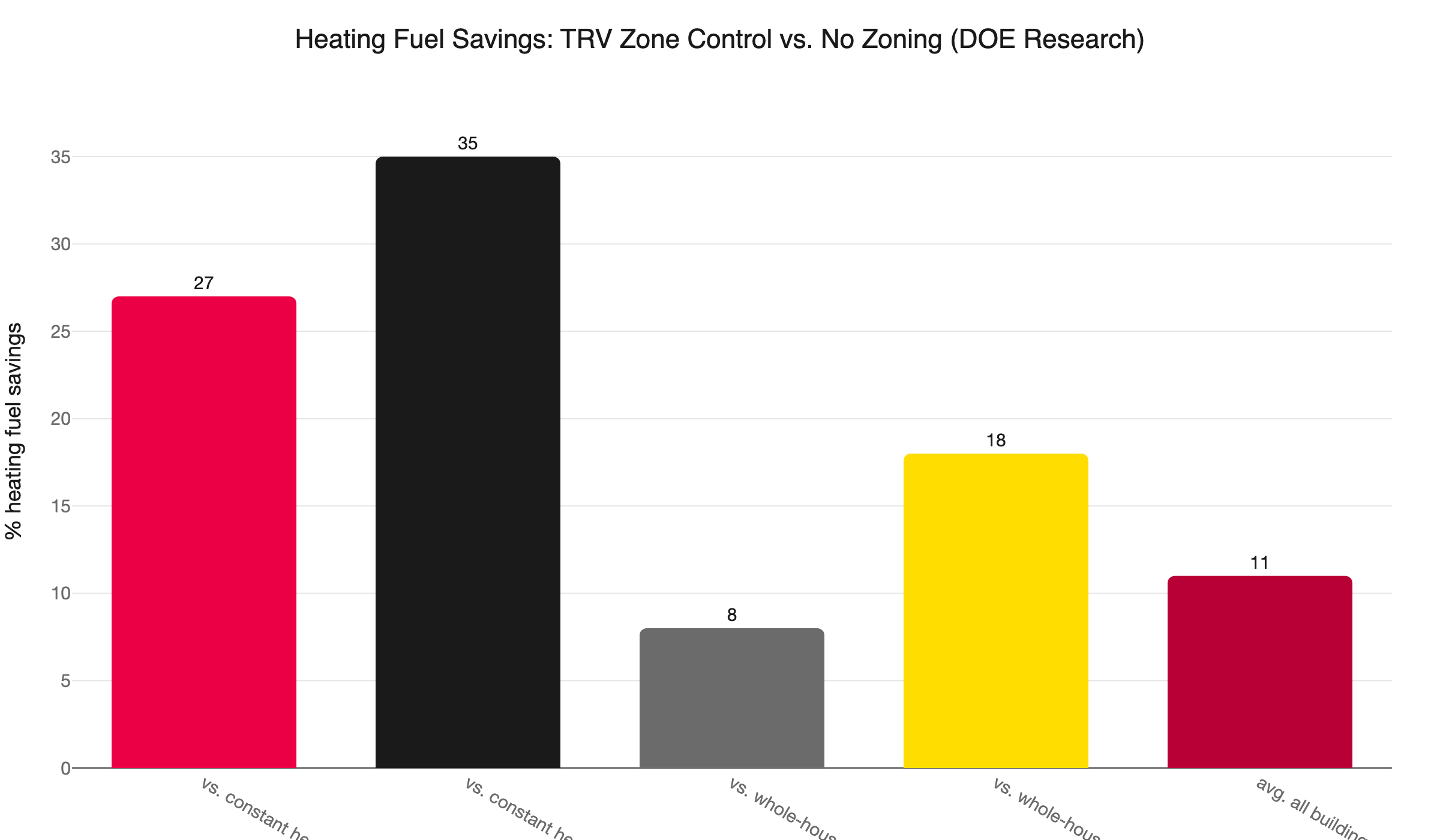
Yes, and the savings numbers come from DOE research, not manufacturer claims. Overheating by just 1°F above setpoint wastes up to 3% of annual heating fuel. Studies on zonal hydronic controls found 8-18% gas savings versus a single whole-house schedule. In a Minnesota heating season that runs six months, those percentages add up to real money.
The DOE finds that overheating by just 1°F above the desired setpoint raises annual heating fuel use by up to 3%. A bedroom running 3°F over target is adding nearly 10% extra heating cost to that zone alone, every day of the heating season. TRVs prevent that overshoot automatically.
Studies on zonal hydronic heating controls in individual homes found meaningful gas savings compared to a whole-house heating schedule, and even greater savings versus leaving heat on constantly. A full TRV retrofit combined with other boiler efficiency work can deliver up to 15% heating fuel savings.
In a Twin Cities home spending $2,200-$3,000 per year on natural gas heat, 10-15% savings means $220-$450 back annually. With Minneapolis logging 8,300 heating degree-days per year, the payback period on a full TRV install is shorter than national estimates suggest. The colder the climate, the faster zone control pays for itself.
What TRVs Cost vs. Zone Valves
Powered zone valves with room thermostats cost at least $350 per radiator and require low-voltage wiring runs to a central controller. On a 10-radiator home, that is $3,500-plus in hardware before wiring labor is added.
TRVs skip all the wiring. Hardware runs $30-$80 per valve. A licensed mechanical contractor in the Twin Cities typically charges $150-$350 per radiator for labor, depending on accessibility and whether the valve body needs replacement. A full 10-radiator TRV installation generally runs $2,000-$4,500 total.
The trade-off is precision. Zone valves pair with a dedicated room thermostat and a programmable schedule. A TRV reads the air temperature right at the valve head. In rooms with strong sun exposure, drafts near the radiator, or deep radiator enclosures that trap heat around the head, TRV accuracy can suffer. A remote sensor head solves most placement problems, but the setup is less flexible than a wired zone.
For a bonus room over a garage or any room with extreme temperature swings driven by insulation or exposure issues, TRVs may be only part of the answer. Our team can walk through which approach makes sense for your layout before you commit to either option.
Are There Rebates for Boiler Work in the Twin Cities?
TRVs are not a standalone rebate line item. But if TRV work surfaces a boiler that should be replaced, CenterPoint Energy offers $300-$500 on qualifying gas boiler replacements through December 2026. Xcel Energy discontinued its gas boiler rebate at the start of 2026, though a $50 smart thermostat rebate remains available.
CenterPoint Energy (natural gas residential customers in Minnesota) offers:
- $500 on a condensing boiler at 91%+ AFUE
- $300 on a standard boiler at 85%+ AFUE
- Applications due December 31, 2026
Xcel Energy discontinued its gas boiler rebates as of January 1, 2026. Their $50 rebate for ENERGY STAR smart thermostats is still available.
Minnesota sets a minimum efficiency standard for residential gas boilers. If your boiler falls below that or has exceeded 20 years, combining TRV work with a new condensing boiler is worth modeling. A condensing boiler installed in the Twin Cities starts around $9,100-$15,600. CenterPoint’s rebate stacked with the federal 25C tax credit can move that number meaningfully. Our boiler replacement cost post covers the full range.
For homeowners who also want to add summer cooling to a radiator home, our post on adding central air to a Twin Cities home with radiators covers the ductless and high-velocity ducted options available in Minnesota.
When to Call a Pro
A straightforward TRV installation on a newer boiler with accessible radiators and standard pipe sizes is typically a single-visit job. Call us when:
- You are not sure whether your boiler is condensing or non-condensing
- The boiler has not had a tune-up in the past two years
- You see water staining or corrosion near the boiler heat exchanger
- Multiple valve pins are seized and manual clearing has not freed them
- You want the circulator and system pressure assessed before TRVs go in
- The boiler is 15 or more years old and you want it evaluated alongside the TRV work
Annual boiler service is also the right time to inspect TRV operation and catch pins that are sticking before they cause a cold room mid-winter. Our post on what boiler annual maintenance includes covers what a full service visit involves and why it matters for long-term reliability.
We are locally owned and operated out of Ramsey, MN. Our team serves Minneapolis, St. Paul, Maple Grove, Plymouth, Blaine, Bloomington, Woodbury, and Brooklyn Park. Technicians arrive within the time window you select. “Always On Time… Or You Don’t Pay a Dime!(R)” means if we miss that window, you do not pay for the service. Pricing is transparent before work begins.
Call (763) 260-6662 or schedule online with our team to book a boiler evaluation or TRV consultation.
Frequently Asked Questions
How much does a thermostatic radiator valve cost? +
How to tell radiator valve size? +
Need a technician now?