
Condensing Boiler Upgrade Cost Minnesota: 2026 Guide
Key Takeaways
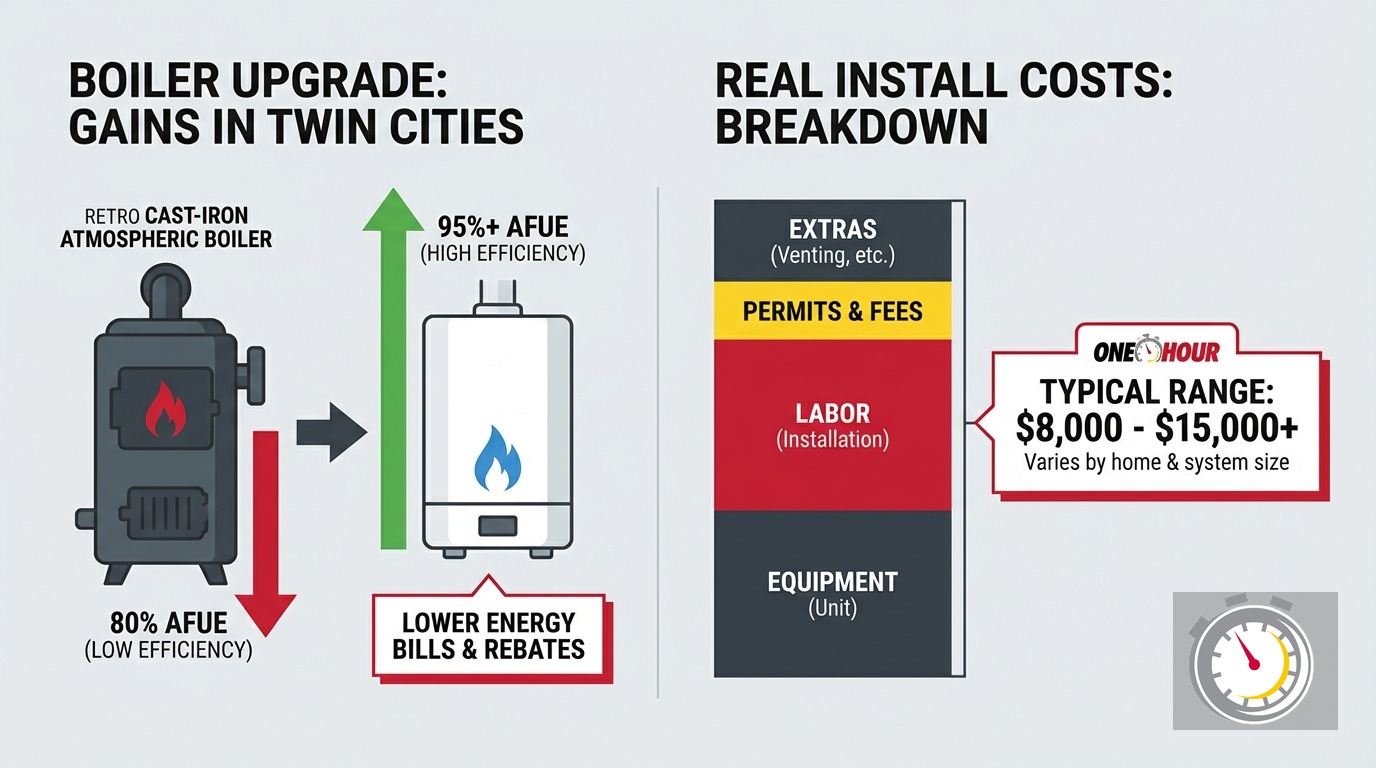
- A condensing gas boiler installed in Minnesota runs $7,000-$12,000. A standard non-condensing replacement costs $5,000-$8,500.
- Budget an additional $650-$1,950 for the venting changeover. This is a real line item that most cost articles and many quotes leave out.
- Old atmospheric boilers in cast-iron radiator homes typically run 60-70% AFUE. Modern condensing units reach 90-96% AFUE. The jump from 70% to 95% cuts fuel consumption by roughly 26%.
- Cast-iron radiator systems are the ideal match for a condensing boiler. Low return-water temperatures keep the unit in condensing mode for most of a Minnesota heating season.
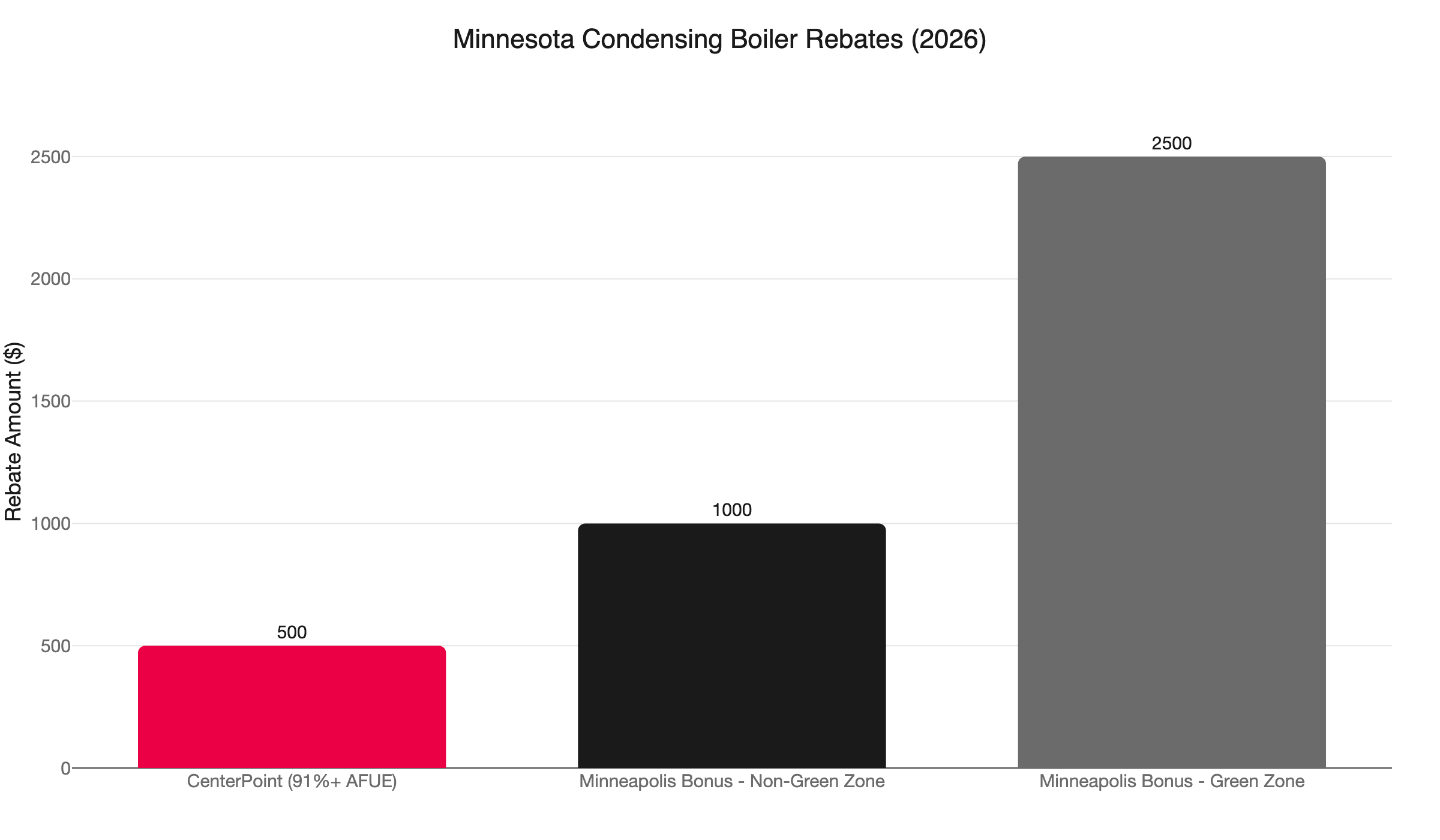
- CenterPoint Energy pays $500 for a condensing boiler rated at least 91% AFUE. No heat pump required. The deadline is December 31, 2026.
- The Minneapolis Bonus Rebate can add $1,000-$2,500, but only when you install a qualifying air-source heat pump at the same time.
- The federal 25C tax credit for boilers is gone. It expired December 31, 2025. Any contractor still advertising it is citing dead law.
Why Do Cast-Iron Homes Benefit Most from a Condensing Upgrade?
A condensing boiler hits peak efficiency when return water arrives below 140F. Cast-iron radiators naturally operate at 130-140F return. That pairing keeps the boiler in condensing mode for most of a Minnesota winter. Homes with standard hot-water baseboard run hotter and rarely reach the threshold for full condensing operation.
This is the information gap most condensing boiler upgrade cost articles skip. It matters a lot if your home was built before 1960.
A condensing boiler extracts heat from exhaust gases that a standard atmospheric boiler simply vents out the chimney. For that heat recovery to happen, the return water has to arrive cool enough to condense water vapor inside the heat exchanger. Condensing boilers achieve their efficiency gains by recovering heat from flue gases, which only happens when return water temperatures are low enough for condensation to occur.
Cast-iron radiators are a low-temperature distribution system by design. They are physically large, they radiate heat slowly and evenly, and they do not need high supply temperatures to warm a room effectively. Return water typically comes back to the boiler at 130-140F. A condensing boiler on a cast-iron system runs in condensing mode for most of the heating season. That is where the 90-96% AFUE rating actually materializes.
Hot-water baseboard is a different situation. Fin-tube baseboard elements are compact. They need supply temperatures around 180F to deliver enough heat output. Return water comes back too warm for consistent condensing. A condensing boiler on a baseboard system still works, but you will not capture the full efficiency benefit unless the distribution is redesigned for low-temperature operation.
The Twin Cities has a large stock of homes built between 1900 and 1950 with original cast-iron radiators still in service. Many of these homes also have atmospheric boilers that are 30-50 years old and operating at 60-70% AFUE. If that describes your home, you are positioned to get the complete benefit of a condensing upgrade.
The cast-iron radiators themselves do not need replacement or modification. They stay in place. The boiler swaps out, the venting changes, and the system runs more efficiently than it has in decades.
What Does a Condensing Boiler Upgrade Cost in Minnesota?
Installed condensing gas boiler in Minnesota: $7,000-$12,000. Standard non-condensing replacement: $5,000-$8,500. Add $650-$1,950 for the venting changeover. After the $500 CenterPoint rebate, your net cost lands between $7,000 and $13,000 depending on system size and job complexity.
The total project cost breaks into several components: the unit, installation labor, venting work, and permitting.
Equipment and installation
One Twin Cities HVAC contractor puts the installed cost of a condensing boiler noticeably higher than a standard non-condensing replacement. A combi boiler - one unit that handles both home heating and domestic hot water - runs $6,500-$11,000.
St. Paul homeowners typically land near the top of those ranges. Labor and materials in St. Paul run approximately 6% above the national average, putting a condensing install at $7,000-$9,200 and a combi install at $9,200-$11,900 in that market specifically.
The spread within each range comes from a few variables: the unit’s output capacity (matched to your home’s heat load), the brand and efficiency tier, and the complexity of connecting to your existing piping.
Permits and inspections
All boiler replacements in Minnesota require a mechanical permit under MN Rules Chapter 1346, the state’s Mechanical Code based on the International Mechanical Code with Minnesota amendments. Minneapolis charges $132.40 for the permit. Most Minnesota municipalities charge between $75 and $200. A licensed inspector signs off after the installation is complete.
Work must be performed by a licensed Minnesota HVAC contractor. An unlicensed installation fails the inspection and voids most manufacturer warranties. Minnesota code also requires a minimum 18-inch clearance on all sides of the boiler. Confirm the new unit’s footprint before ordering equipment if your mechanical room is tight.
Financing
A condensing boiler upgrade is a meaningful investment. If spreading the cost over time makes the project easier to commit to, HVAC financing options are available and worth reviewing before the job.
How Much More Efficient Is a Condensing Boiler?
Old atmospheric boilers typically run 60-70% AFUE. Modern condensing units reach 90-96% AFUE. Going from 70% to 95% cuts fuel consumption by roughly 26% for the same heat delivered. Going from 60% to 95% cuts it by about 37%. With Minnesota averaging roughly 8,000 heating degree-days per year, that efficiency gap translates to hundreds of dollars in annual gas savings.
AFUE stands for Annual Fuel Utilization Efficiency. A boiler rated at 70% AFUE converts 70 cents of every gas dollar into useful heat. The other 30 cents escapes up the flue as exhaust. A 95% AFUE condensing unit sends only 5 cents out the exhaust pipe.
Heating industry data confirms that older cast-iron atmospheric boilers run well below the efficiency ratings of modern condensing units. Units 30-50 years old typically fall in the 60-70% range. Newer cast-iron atmospheric models top out around 82-84%. Modern condensing units run 90-96% AFUE.
At Minnesota’s current all-in residential gas rate of approximately $1.00-$1.10 per therm, those efficiency differences are meaningful. A home that needs 780 therms of delivered heat per heating season burns about 1,200 therms at 65% AFUE. At 95% AFUE, it burns roughly 820 therms. That is a savings of about 380 therms, or $380-$420 per year at current rates.
Xcel Energy raised Minnesota residential gas rates 6.8% effective January 1, 2026, with another increase of up to 8.2% pending regulatory review. Gas costs are not going down. Every therm you do not burn stays in your account.
Minneapolis averages roughly 8,000 heating degree-days per year, well above the national average. A boiler in Minnesota runs a lot of hours. That means the efficiency difference between 65% and 95% AFUE shows up as more dollars saved here than it would in a milder climate.
The Venting Changeover: The Cost Most Quotes Leave Out
Your old atmospheric boiler relies on the masonry chimney. Hot exhaust gases rise naturally through the flue. No fan, no PVC pipe, no problem.
A condensing boiler exhausts differently. Its gases exit the heat exchanger at roughly 100-120F - much cooler than the 350-500F exhaust from an atmospheric unit. Cool exhaust will not rise on its own. It also carries slightly acidic condensate. Running it through a masonry chimney corrodes the masonry over time and risks dangerous backdrafting. The code requires a dedicated vent path.
In most installations, a two-inch or three-inch PVC pipe runs from the boiler through an exterior wall. Direct-vent configurations use two pipes: one for exhaust, one to pull combustion air in from outside.
Two things happen when the chimney connection gets abandoned. The old flue gets capped, blocked, or the liner gets removed. New PVC runs from the boiler to the exterior wall. Both steps take real labor and materials.
Budget $650-$1,950 for the venting changeover. A boiler sitting near the rim joist on an exterior wall is a short, straightforward run. A boiler in the center of a finished basement with a long path to the exterior costs more. Complexity in the chimney abandonment also adds to the range.
When you collect quotes, ask each contractor to list the venting work as a separate line item. If one bid comes in significantly below the others, find out whether the venting changeover is included before you sign anything.
What Rebates Can You Claim in Minnesota in 2026?
CenterPoint Energy pays $500 for a condensing boiler rated at least 91% AFUE. No heat pump required. Apply by December 31, 2026. Minneapolis homeowners who also install a qualifying air-source heat pump can stack an additional $1,000-$2,500 through the Minneapolis Bonus Rebate. The federal 25C tax credit does not apply to any 2026 installs.
CenterPoint Energy Rebate
The most straightforward rebate available is the CenterPoint Energy residential heating system rebate. It pays $500 for a condensing boiler rated at least 91% AFUE installed in an existing home. You do not need to also install a heat pump or any other system. The application must be submitted by December 31, 2026.
A lower tier is also available: $300 for a non-condensing boiler rated at least 85% AFUE. Most homeowners replacing an aging atmospheric boiler should aim for the condensing tier. The higher rebate and the long-term fuel savings both point the same direction.
Minneapolis Bonus Rebate
If you live in Minneapolis and are considering a larger project, the Minneapolis Bonus Rebate program, administered through MNCEE, can be significant. A condensing boiler rated at least 95% AFUE, installed alongside a qualifying air-source heat pump, qualifies for $500 in utility rebates plus a city bonus: $2,500 in Green Zone areas or $1,000 in Non-Green Zone areas.
Total potential value in a Green Zone: $3,000. That is a meaningful offset on a $7,000-$12,000 project. But this program requires the heat pump installation - the boiler alone does not unlock the bonus amount. Funds are first-come, first-served, and the program has per-household caps ($20,000 in the Green Zone, $6,000 in the Non-Green Zone across all qualifying improvements). If this path fits your situation, move on it early.
For a complete look at what CenterPoint and Xcel are offering this year, see our Xcel and CenterPoint HVAC rebate guide.
What Happened to the Federal Tax Credit for Boilers?
The Section 25C federal tax credit for high-efficiency boilers expired December 31, 2025. It no longer applies to any equipment placed in service in 2026. Up to $600 was available for qualifying condensing boilers under the old law. That credit is gone for this heating season.
The One Big Beautiful Bill Act (Public Law 119-21), signed July 4, 2025, terminated Section 25C for equipment placed in service after December 31, 2025. Sources tracking current federal energy incentives confirm the credit has ended for 2026 installs. At least one contractor website was still advertising it as of mid-2025 without noting it had expired.
If a contractor’s proposal includes a federal tax credit line item on your boiler, ask them to cite the current law. It is worth $0 on a 2026 installation.
Your real incentive stack for 2026 is the CenterPoint rebate ($500) and, if you are in Minneapolis and adding a qualifying heat pump, the Minneapolis Bonus Rebate ($1,000-$2,500). Those are verified programs with 2026 deadlines. Do not budget for the federal credit.
There is also no pending legislation that would restore the credit retroactively for 2026. Plan around what is available now, not what may return in a future tax year.
Does the Payback Math Work in Minnesota?
Yes, for most homes with aging cast-iron systems. Fuel savings of $300-$420 per year, combined with the $500 CenterPoint rebate, typically produce payback on the condensing upgrade premium in under 10 years. The boiler itself lasts 20-25 years.
The comparison that matters is not condensing versus doing nothing. It is condensing versus non-condensing replacement. If your boiler has failed or is showing signs of failure, you are already spending $5,000-$8,500 on a new unit. The question is whether the extra $2,600-$4,500 for the condensing tier pays back over the life of the equipment.
Here is the math with round numbers. A home that needs 780 therms of delivered heat per season burns about 1,200 therms at 65% AFUE. At 95% AFUE, it burns roughly 820 therms - a savings of about 380 therms. At $1.05 per therm all-in, that is approximately $400 per year in fuel savings.
The condensing premium over a non-condensing unit is roughly $2,600-$4,500. Subtract the $500 CenterPoint rebate and the out-of-pocket premium falls to $1,500-$3,000. At $400 per year in savings, payback is 4-8 years. The boiler lasts 20-25 years. The math is in your favor.
Gas rates are trending up, not down. Xcel raised Minnesota residential rates 6.8% at the start of 2026, with more increases pending. Every year that gas prices rise, the fuel savings calculation improves and the payback period shortens.
If your boiler is under 10 years old and passing its annual checks, a replacement is not urgent yet. Keep up with service to extend its remaining life. See what annual boiler maintenance covers so you know what to ask for at each service visit.
Is a Condensing Boiler Right for Your Home?
Strong candidates: homes with cast-iron radiators, a CenterPoint gas account, and an atmospheric boiler that is more than 20 years old or has needed multiple repairs in recent years. If all three apply, the upgrade almost always makes sense. If your boiler is under 10 years old and holding pressure well, you likely have more time to plan.
Here is a checklist to work through:
- Cast-iron radiators: Your distribution system already operates at the return-water temperature where a condensing boiler excels. No changes to the radiators are needed. The boiler swaps; the radiators stay.
- Aging atmospheric boiler: A unit over 20 years old is likely running at 60-70% AFUE. The jump to 90-96% AFUE is real, verifiable on your gas bill, and pays back at Minnesota gas rates within a reasonable timeframe.
- Repeated repairs: Two or more service calls in the past three years is a signal. A condensing replacement resets your maintenance horizon for 20-25 years.
- CenterPoint customer: The $500 rebate is verified and available through December 31, 2026. It requires only that the boiler rate at least 91% AFUE. Nearly all modern condensing units exceed that threshold.
- Minneapolis homeowner planning a heat pump: If you are considering both projects, coordinating the installations unlocks the Minneapolis Bonus Rebate. That can be $1,000-$2,500 on top of the CenterPoint rebate. Apply before the funds are exhausted.
The upgrade makes less sense if your boiler is newer and performing well. A well-maintained boiler can serve reliably for another decade. In that case, start planning now so the replacement is a deliberate decision, not an emergency one.
As a locally owned Twin Cities company, we see a lot of these cast-iron homes in Ramsey, Blaine, Maple Grove, Minneapolis, and St. Paul. We will give you a straight answer on whether a condensing upgrade makes sense for your system or whether a repair will carry you several more years. We do not push replacements when a repair is the right call.
Our on-time promise backs every job: “Always On Time… Or You Don’t Pay a Dime!(R)”
Call (763) 260-6662 or schedule your boiler estimate online.
Frequently Asked Questions
How much does a condensing boiler cost to install in Minnesota? +
Is a condensing boiler worth it for a home with cast-iron radiators? +
What rebates are available for a condensing boiler in Minnesota in 2026? +
Is the federal tax credit for boilers still available in 2026? +
What is the venting changeover and how much does it cost? +
Need a technician now?