
Boiler Replacement Cost in Minnesota (2026 Guide)
Key Takeaways
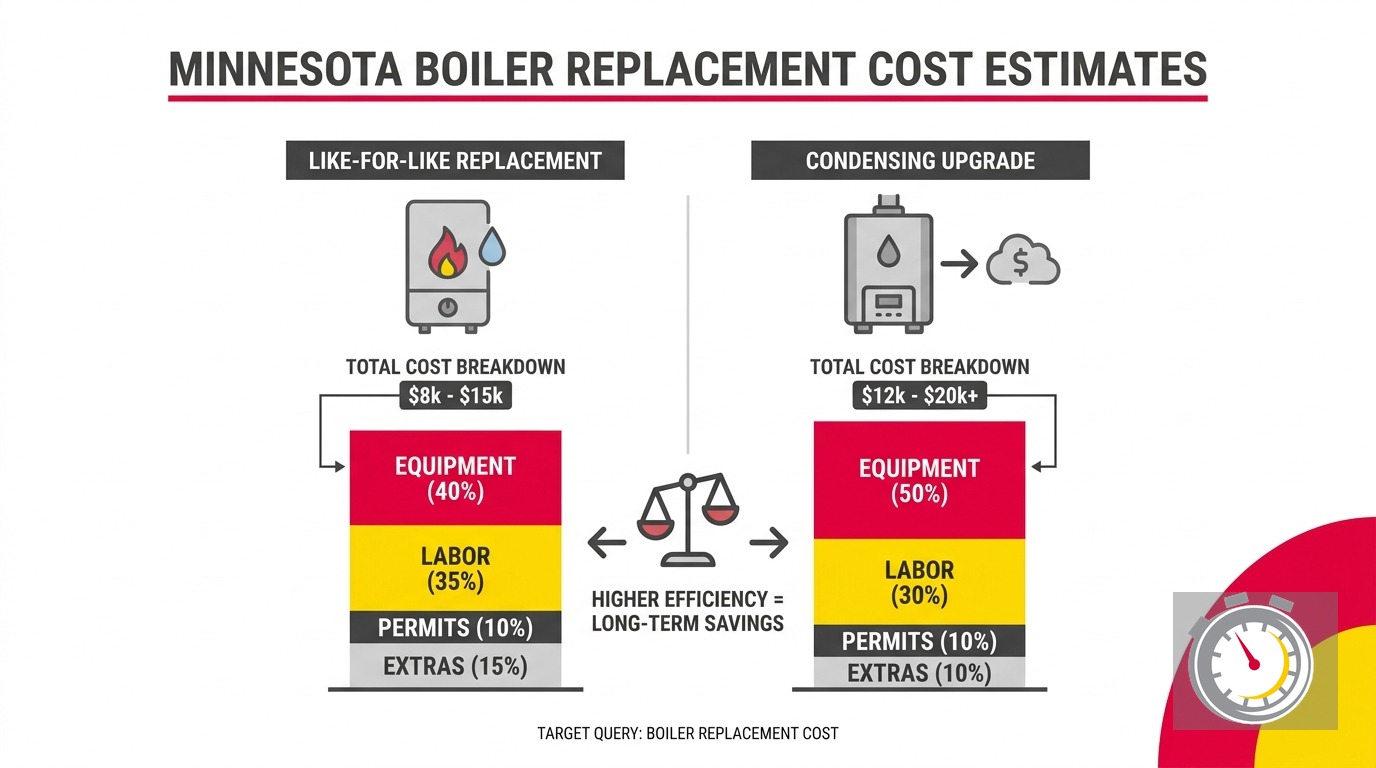
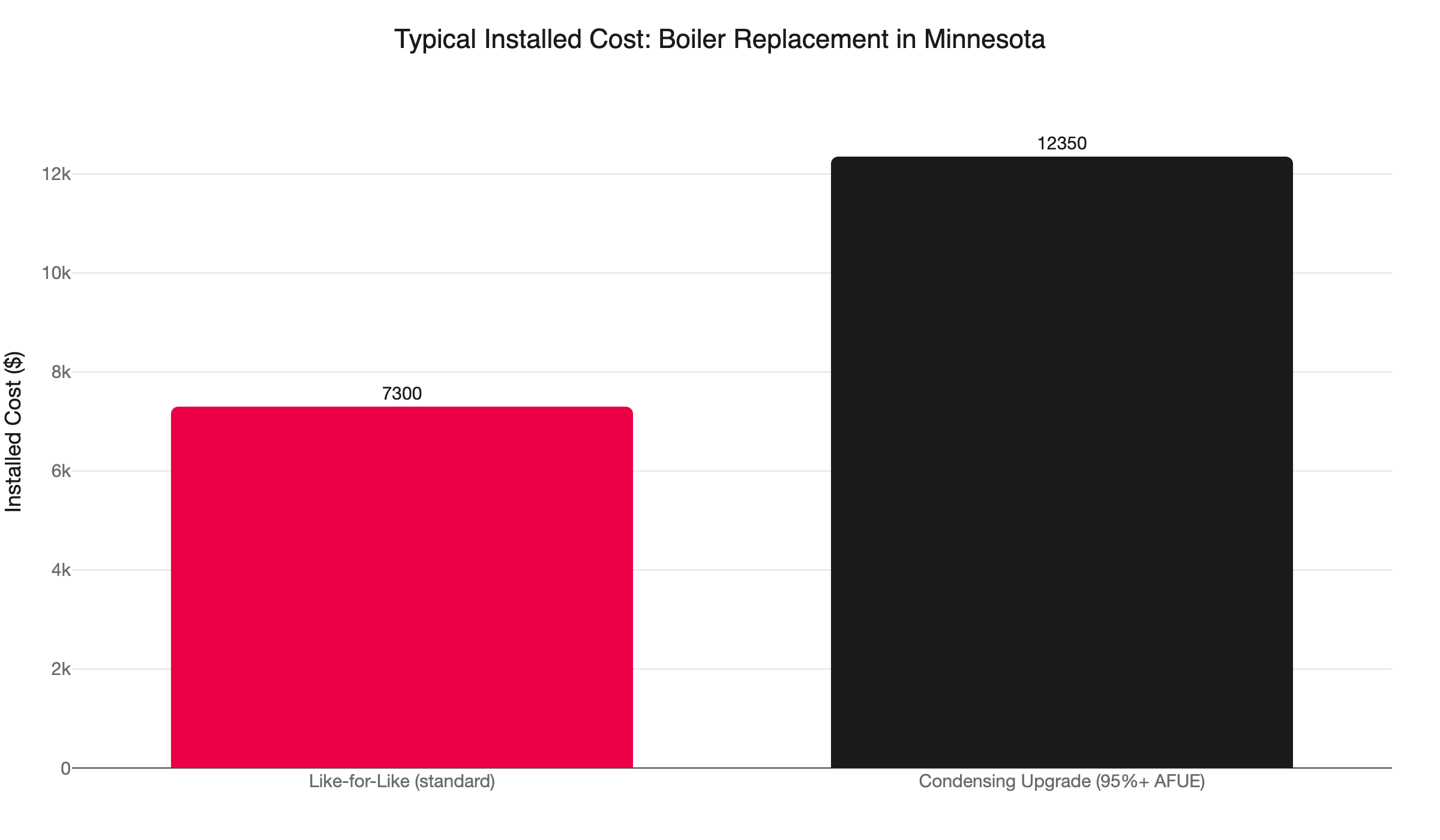
- A like-for-like gas boiler replacement runs $5,500-$9,100 installed in the Twin Cities. It reuses your existing metal flue.
- A condensing upgrade (95%+ AFUE) runs $9,100-$15,600 installed. New PVC venting and a condensate drain line account for most of the premium.
- Minnesota averages roughly 8,000 heating degree days per year. That makes the payback case for a condensing upgrade stronger here than in most of the country.
- Upgrading from 80% to 95%+ AFUE saves an estimated $300-$600 per year on natural gas. Payback typically runs 4-10 years.
- 2026 rebate reality: CenterPoint Energy offers up to $300 for a 90%+ AFUE boiler. Xcel Energy has no gas boiler rebate. The federal 25C tax credit expired December 31, 2025.
- All boiler replacements in Minnesota require a mechanical permit. Single-family homes are exempt from the separate DLI Certificate of Inspection.
- We are locally owned and operated in Ramsey, MN. Call (763) 260-6662 or schedule a boiler replacement quote.
What Does Boiler Replacement Cost in Minnesota?
A like-for-like standard-efficiency gas boiler costs $5,500-$9,100 installed in the Twin Cities. A condensing upgrade to 95%+ AFUE costs $9,100-$15,600 installed. The gap reflects new PVC venting, a condensate drain line, and often a new exterior wall penetration that the condensing unit requires and a standard unit does not.
Most national cost guides stop at the average and move on. They cite a number somewhere around $6,100 and tell you “it depends on your home.” That is not wrong, but it skips the questions Twin Cities homeowners actually face: which path makes sense for Minnesota’s climate, what the venting change actually costs and why, what the rebate landscape looks like right now in 2026, and what the permit process requires.
This guide answers all four.
The Two Choices Your Tech Will Present
When a boiler is 20 or more years old, the conversation usually comes down to one question: direct swap or condensing upgrade?
A direct swap (also called a like-for-like or standard-efficiency replacement) installs a new boiler of similar efficiency, typically 82-84% AFUE. It reuses your existing metal chimney liner or flue. It costs less upfront, and the installation is simpler.
A condensing upgrade steps up to 90-95%+ AFUE. Condensing boilers extract more heat from combustion by cooling the flue gas to the point where water vapor condenses out of it. That condensate is acidic. It cannot travel through a metal flue, so the installation requires a separate PVC venting system, a condensate drain line, and often a new termination point through an exterior wall.
Neither option is automatically right. The decision depends on how long you plan to stay in the home, your current gas bills, and whether your existing flue and mechanical room have space for new pipe runs.
Why Does the Condensing Installation Cost More?
Three things drive the condensing premium: the unit itself costs more to manufacture, it requires new PVC venting, and it needs a condensate drain. Together those add $1,500-$3,000 to the base installed price, according to Empire Home Protect’s 2026 boiler cost breakdown.
Here is where the money goes, broken out:
- The unit. A condensing boiler has a more complex heat exchanger and more sophisticated combustion controls than a standard unit. The unit cost is higher.
- PVC venting. Condensing flue gas is cool enough to run through PVC pipe, but your existing metal flue cannot be reused. A new PVC run has to be sized, routed, and installed from the boiler to an exterior termination point.
- Condensate drain. The combustion process pulls enough heat from the flue gas that water condenses out of it. That water collects and has to drain somewhere: a floor drain, utility sink, or a small condensate pump if gravity drainage is not possible.
- Wall penetration. Many condensing installations terminate through a side wall rather than up through the existing chimney. That means cutting a new hole, installing a code-compliant fitting, and sealing it correctly against Minnesota’s freeze-thaw cycles.
When you see a quote for a condensing upgrade that looks higher than expected, those four items are where to ask questions. A contractor who cannot explain each line is one worth pressing.
Does a Condensing Upgrade Pay Off in Minnesota’s Climate?
More often than elsewhere. Minnesota averages roughly 8,000 heating degree days per year — nearly double what a Southern state sees. A longer heating season means more months extracting the efficiency gain, which compresses the payback window.
The baseline math: upgrading from an 80% AFUE boiler to 95%+ saves an estimated $300-$600 per year on natural gas, per Minnesota Department of Commerce modeling. The condensing premium over a like-for-like swap is roughly $3,000-$6,500 at Northern’s pricing. That puts payback at 4-10 years, depending on where you start and whether you capture a rebate.
Several variables move the needle significantly:
- Your boiler’s actual efficiency today. Replacing a 70% AFUE boiler from 1998 saves more than replacing an 83% unit installed in 2010. The older the boiler, the faster the payback.
- Natural gas prices. Higher gas prices accelerate the return. Lower prices stretch it.
- How long you stay. A 5-year payback looks very different if you plan to sell in three years versus stay for fifteen.
- Rebate. CenterPoint customers who qualify for the $300 rebate reduce the premium modestly but meaningfully.
For context: Minnesota already requires 92% AFUE for gas furnaces in Climate Zones 6-7. Boilers have a lower state minimum of 82% AFUE, so there is no code mandate pushing you to a condensing unit. But the climate-driven payback logic is the same: this is one of the best states in the country to capture the efficiency premium.
What Rebates and Tax Credits Are Available in 2026?
CenterPoint Energy offers up to $300 for a gas boiler at 90%+ AFUE installed in 2026. Xcel Energy discontinued its gas boiler rebate on January 1, 2026. The federal 25C tax credit for high-efficiency gas boilers expired December 31, 2025. There is no federal credit for 2026 installs.
Most cost guides tell you to “check with your utility” and leave it there. The current situation is specific, so here it is:
CenterPoint Energy customers: Up to $300 rebate for gas boiler replacement at 90%+ AFUE. Equipment must be installed between January 1 and December 31, 2026. Confirm unit qualification before the install is finalized. Details at CenterPoint Energy’s heating rebate page.
Xcel Energy customers: Xcel discontinued all gas furnace and boiler rebates effective January 1, 2026. There is no utility rebate available for this project if you are on Xcel.
Federal 25C tax credit: This credit was worth 30% of cost up to $600 for qualifying high-efficiency boilers. It expired December 31, 2025. Installations completed by 12/31/2025 can still be claimed on the 2025 tax return. Nothing is available for 2026 installs under current law.
ENERGY STAR threshold: The ENERGY STAR residential boiler threshold is 90% AFUE. Equipment at that level qualifies for the CenterPoint rebate. Meeting it does not require a full 95%+ condensing unit; some 90-91% AFUE models exist at the margin.
The incentive picture has changed sharply compared to prior years. A CenterPoint customer replacing in 2026 can capture $300. An Xcel customer replacing in 2026 captures nothing from utilities or the federal government. Factor that into your payback math.
Do You Need a Permit for Boiler Replacement in Minnesota?
Yes. All boiler replacements in Minnesota require a mechanical permit. Single-family through five-unit residential properties are exempt from the separate DLI Certificate of Inspection, but the mechanical permit is required regardless. No permit means no inspection, which can affect your homeowner’s insurance and your ability to sell.
Here is what each step involves:
Mechanical permit: Required for every boiler replacement. Pulled through your local municipality. Fees typically run $75-$200 in Twin Cities suburbs. Your contractor pulls the permit on your behalf. You do not manage a separate process; confirm it is included in your quote.
DLI Certificate of Inspection: Under MN Statutes Chapter 326B, the Department of Labor and Industry oversees boiler safety. Single-family through five-unit residential properties are exempt from the DLI inspection requirement. If you own a larger residential building, your contractor will need to account for the DLI inspection timeline.
What this means in practice: Your installation includes a permit application and a municipal mechanical inspection before the project closes. A reputable contractor builds both into the timeline. If a contractor proposes skipping the permit to move faster or save money, that is a significant red flag. Unpermitted work voids some homeowner’s insurance coverage and creates problems at resale.
Most national boiler cost guides omit this step entirely. Homeowners who skip the research often get surprised when they discover a permit fee was not included in their quote.
How Do You Know If Your Boiler Needs Replacing?
Age, repair frequency, and fuel bills are the three clearest signals. A boiler over 20 years old that has needed two or more significant repairs in the last few years, or whose efficiency has noticeably dropped, is often a better candidate for replacement than continued repair.
A few specific signs that point toward replacement:
- Age over 20 years. Most gas boilers last 20-30 years with consistent maintenance. Past 20 years, the cost of repairs starts competing with replacement, and a new boiler comes with a warranty.
- Repeated significant repairs. Two or three major repairs within three years typically means you are funding a declining asset, not solving a problem.
- Pressure problems that do not stay fixed. A boiler that repeatedly loses pressure after service often has an underlying issue with the heat exchanger or expansion tank. These are expensive to resolve on an aging unit.
- Uneven heat across zones. Older boilers sometimes struggle to serve multiple zones reliably, especially as zone valves age alongside the main unit.
- Rising fuel bills without explanation. Efficiency drops as a boiler ages. If your gas bills have climbed without a change in how you use the home, the boiler may be running well below its rated AFUE.
If you are not sure whether you are looking at a repair or a replacement, a boiler repair and maintenance visit with a full system assessment will give you a clear picture of what the unit is worth saving.
How to Choose: Direct Swap or Condensing Upgrade
The right answer depends on your situation. Here is a practical framework:
Choose a like-for-like swap if:
- You are planning to sell within 3-5 years and the payback window extends past your ownership horizon
- Your existing metal flue is in good condition and the boiler room has limited space for new PVC runs
- Budget is the binding constraint and minimizing upfront cost is the priority
- Your current boiler is already reasonably efficient (83%+ AFUE) and the upgrade savings are smaller
Choose a condensing upgrade if:
- You are staying in the home 7 or more years and want to capture the long-run efficiency gain
- You are a CenterPoint customer and the $300 rebate offsets part of the premium
- Your existing flue needs repair or replacement anyway — at that point, running new PVC may not cost much more than repairing the old flue
- You are replacing a 70-80% AFUE boiler from the 1990s or early 2000s, where the annual savings are largest
Either way, ask your technician to confirm the new boiler is properly sized for your home. An oversized boiler short-cycles and wears faster. An undersized one cannot keep up on the coldest January nights in Minnesota.
For a broader comparison of boiler heat versus forced-air systems, our boiler vs. forced-air furnace guide walks through the tradeoffs for Twin Cities homes.
What Should a Boiler Replacement Quote Include?
A complete quote covers the unit, labor, removal of the old boiler, venting (whether reusing or replacing), the mechanical permit fee, and warranty terms for both parts and labor. Any quote that excludes the permit or venting work will look lower than it should.
When you receive a quote, ask for these four things specifically:
- Efficiency rating and AFUE of the proposed unit. Know whether you are getting a standard or condensing system.
- Venting scope. Whether existing venting is being reused or replaced, and what material. PVC for condensing, existing liner for standard.
- Permit inclusion. Confirm the mechanical permit fee is part of the quoted price, not an add-on.
- Warranty breakdown. What the manufacturer covers on parts, and what your contractor covers on labor, and for how long.
Getting two or three quotes for a job of this size is reasonable. Boiler replacement quotes can vary significantly — not because one contractor is padding, but because one is pricing in everything required and another is not. Compare scope, not just the bottom line.
Our team is locally owned and operated in Ramsey, MN, and we serve the Twin Cities metro: Minneapolis, St. Paul, Blaine, Maple Grove, Plymouth, Brooklyn Park, Woodbury, Bloomington, and the surrounding area. Pricing is transparent before work starts, and we back every job with our on-time guarantee: “Always On Time… Or You Don’t Pay a Dime!(R)”
Call (763) 260-6662 or schedule a boiler replacement quote online. If you already have a boiler and want to stay on top of maintenance to extend its life, our boiler annual maintenance guide covers what a thorough service visit should include.
Frequently Asked Questions
How much does boiler replacement cost in Minnesota? +
Is upgrading to a condensing boiler worth it in Minnesota? +
Are there rebates for boiler replacement in Minnesota in 2026? +
Do I need a permit to replace a boiler in Minnesota? +
Need a technician now?