
Boiler vs. Forced Air Furnace: Minnesota's Honest Breakdown
Key Takeaways
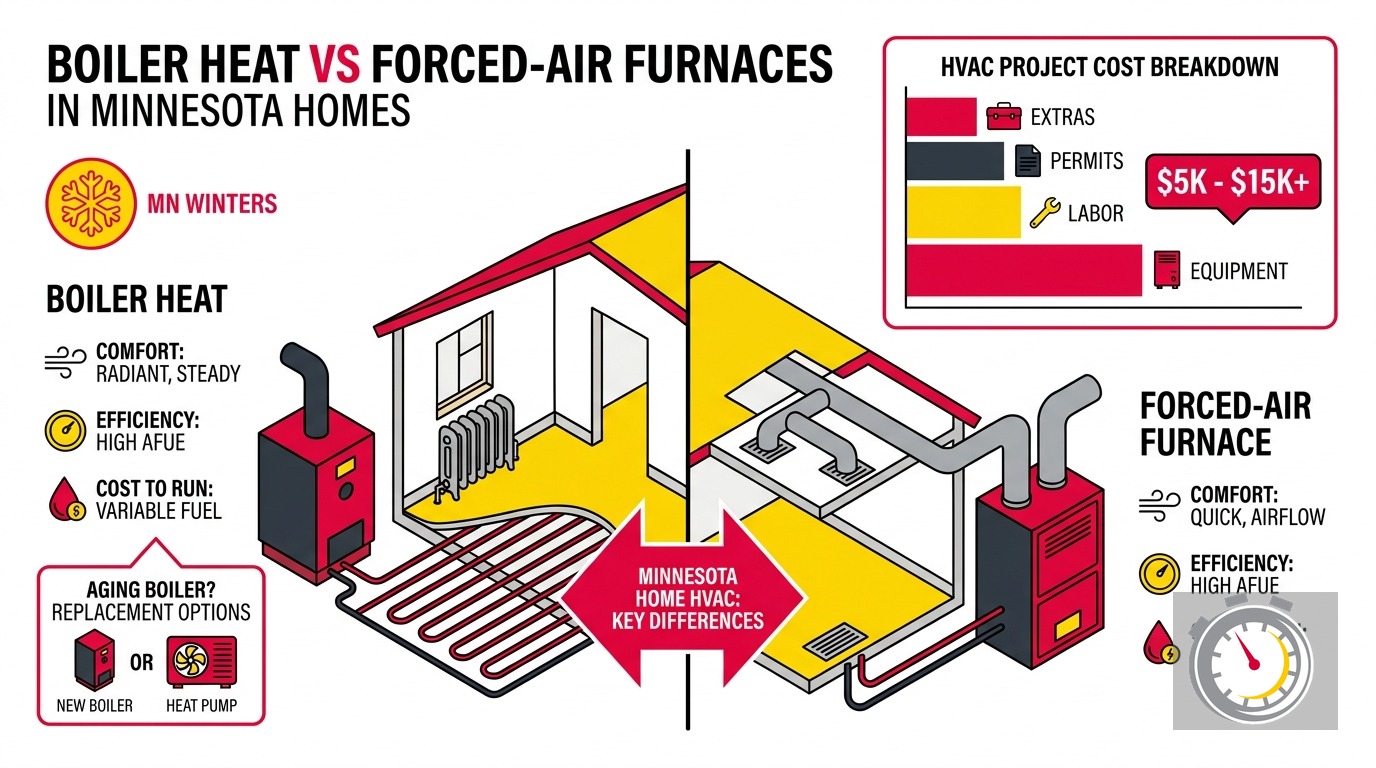
- Boilers distribute heat through hot water; furnaces push warm air through ducts.
- Forced-air systems can lose 15 to 30 percent of heating energy through duct leakage in unconditioned spaces like attics and crawl spaces.
- Boilers typically last 20 to 30 years; furnaces average 15 to 20 years.
- Upgrading from an 84% to a 97% AFUE boiler saves approximately $1,824 in lifetime energy costs.
- Minnesota’s energy code requires 92% AFUE minimum for gas furnaces in new residential construction.
- A federal DOE rule taking effect in late 2028 will require 95% AFUE for all new non-weatherized residential gas furnaces.
- Utility rebates from Xcel Energy, CenterPoint, and Minnesota Energy Resources can meaningfully offset replacement costs.
- For most older Twin Cities homes built around hydronic systems, a boiler-for-boiler replacement is often the most practical and cost-effective path.
What Is the Difference Between a Boiler and a Forced-Air Furnace?
If you are comparing boiler vs. forced air furnace options for your Twin Cities home, start with how each system moves heat. A boiler heats water and pushes it through pipes to radiators or radiant floor tubing. A forced-air furnace heats air and moves it through a duct network to registers in your floors, walls, or ceiling. Both typically run on natural gas in Minnesota. The heat source is similar. The delivery system is completely different.
You can identify your system in seconds. Cast-iron radiators along exterior walls, or in-floor radiant tubing, means hydronic. Registers with visible ductwork means forced air.
How Do Boiler vs. Forced Air Furnace Systems Compare on Efficiency?
Quick answer: Both systems are rated by AFUE, or Annual Fuel Utilization Efficiency - the percentage of fuel that becomes usable heat. Federal minimums sit at 80% AFUE for gas furnaces and 82% AFUE for gas boilers. High-efficiency versions of both reach 96 to 98% AFUE. On paper, they look comparable. In a real home, forced-air systems face a variable that boilers never do: duct loss.
The duct loss penalty that most efficiency comparisons skip
Duct leakage through unconditioned spaces reduces delivered heating by 15 to 30 percent in typical homes. In older Twin Cities homes, duct runs through attics, unheated crawl spaces, and cold basements are common. Every foot of duct in an unconditioned space bleeds heat before it reaches the register.
Work through the math. A 96% AFUE furnace with duct runs losing 25% of output delivers roughly 72 cents of heat per gas dollar. An 80% AFUE boiler with sealed copper piping and zero duct loss delivers 80 cents. The boiler with the worse AFUE rating actually heats your home more efficiently in that scenario.
A well-installed furnace with sealed, insulated duct runs in conditioned spaces performs very well. But the honest comparison is not AFUE vs. AFUE. It is delivered efficiency that matters, and boilers have no duct loss in the equation at all.
If you have forced air and suspect ductwork is costing you money, read our breakdown of what leaky ductwork actually costs homeowners.
What efficiency gains look like on a boiler upgrade
Pre-1990s boilers often had AFUE ratings as low as 57 to 70%. That means burning nearly a third to almost half of your gas bill on heat that exits through the flue.
Upgrading from an 84% AFUE boiler to a 90% AFUE unit saves approximately $1,150 in lifetime energy costs. Stepping up to a 97% AFUE boiler saves approximately $1,824 over the equipment’s life, based on $0.961 per therm over a 20-year model. An ENERGY STAR-certified gas boiler saves roughly $780 over its lifetime compared to a non-certified baseline.
These are verified federal figures. Not estimates, not marketing claims.
Does a Boiler or Furnace Heat a Home More Comfortably?
Quick answer: Most homeowners who have lived with both rate boiler heat as more comfortable. Hydronic radiators and radiant floors deliver steady, even warmth without blowing air. Forced-air systems cycle on and off, which creates temperature swings and can produce drafts. Boilers are also quieter and do not push dust or allergens through the air supply.
That said, comfort depends heavily on system condition and design.
Hydronic systems heat from the perimeter, where radiators typically sit along exterior walls. The warmth radiates inward. Heat does not stratify toward the ceiling the way warm air does. Your floors and walls absorb and re-radiate heat slowly, which evens out temperature between cycles.
Forced air can heat very evenly with a well-designed duct layout and proper return placement. A poorly designed system with undersized returns or long runs creates cold spots regardless of how efficient the furnace is.
One important point: boilers do not distribute cooling. If you have a hydronic system and want central air conditioning, you need a separate delivery system. Many Twin Cities homeowners with boiler heat use ductless mini-splits for summer cooling. It avoids the cost of adding ductwork to a home not built for it.
What Does It Cost to Run Each System in a Minnesota Winter?
Running costs depend more on equipment condition, AFUE rating, and duct integrity than on system type alone.
The variables that move the bill:
- AFUE rating: A 97% unit of either type beats an 80% unit of either type by a wide margin.
- Duct condition: Forced-air only. Leaky runs through attics or crawl spaces add real dollars to your winter bill.
- System age: Both types degrade over time. A poorly maintained 15-year-old boiler or furnace runs less efficiently than the specs suggest.
- Thermostat control: Programmable and smart thermostats reduce runtime on both types.
- Home envelope: Insulation, window quality, and air sealing affect how hard the system has to work regardless of type.
The most useful comparison you can get is a measured one: have your equipment inspected, ask about its current operating efficiency, and identify any delivery losses. That is worth more than any chart comparing nominal AFUE ratings.
The Option Nobody Talks About: Replace Your Boiler in Kind
When a boiler starts showing its age, the conversation often jumps to whether you should convert to forced air. That framing skips the option that is right for most older Twin Cities homes: replace the boiler with a new, high-efficiency boiler.
Converting from hydronic to forced air in a home not built for it means:
- Removing the boiler, radiators, pumps, piping, and zone valves
- Designing and installing a complete duct network through existing walls, floors, and ceilings
- Patching and repainting throughout the home afterward
- A construction project that can cost as much as or more than the HVAC equipment itself
In older Minneapolis-St. Paul metro neighborhoods - particularly homes built between the 1910s and 1950s in areas like Crystal, Robbinsdale, and Fridley - the architecture was engineered around hydronic systems. The walls have no duct chases. The layout assumes radiant heat. Retrofitting ductwork is invasive in a way that a boiler-for-boiler replacement simply is not.
A new 90% to 97% AFUE boiler on existing piping and radiators gives you modern efficiency, better controls, quieter operation, and a 20- to 30-year life expectancy - without tearing up the house. The system the home was designed for keeps working. You just replaced the heat source.
Our boiler installation and replacement page covers the process in detail, including what to expect from a modern condensing boiler install.
What Rebates Are Available for Boilers and Furnaces in Minnesota?
Quick answer: Utility rebates and federal incentives can meaningfully reduce out-of-pocket costs. Amounts change year to year. Verify current figures directly with your utility before you schedule an install - the numbers in public search results are not always the current program year.
Xcel Energy
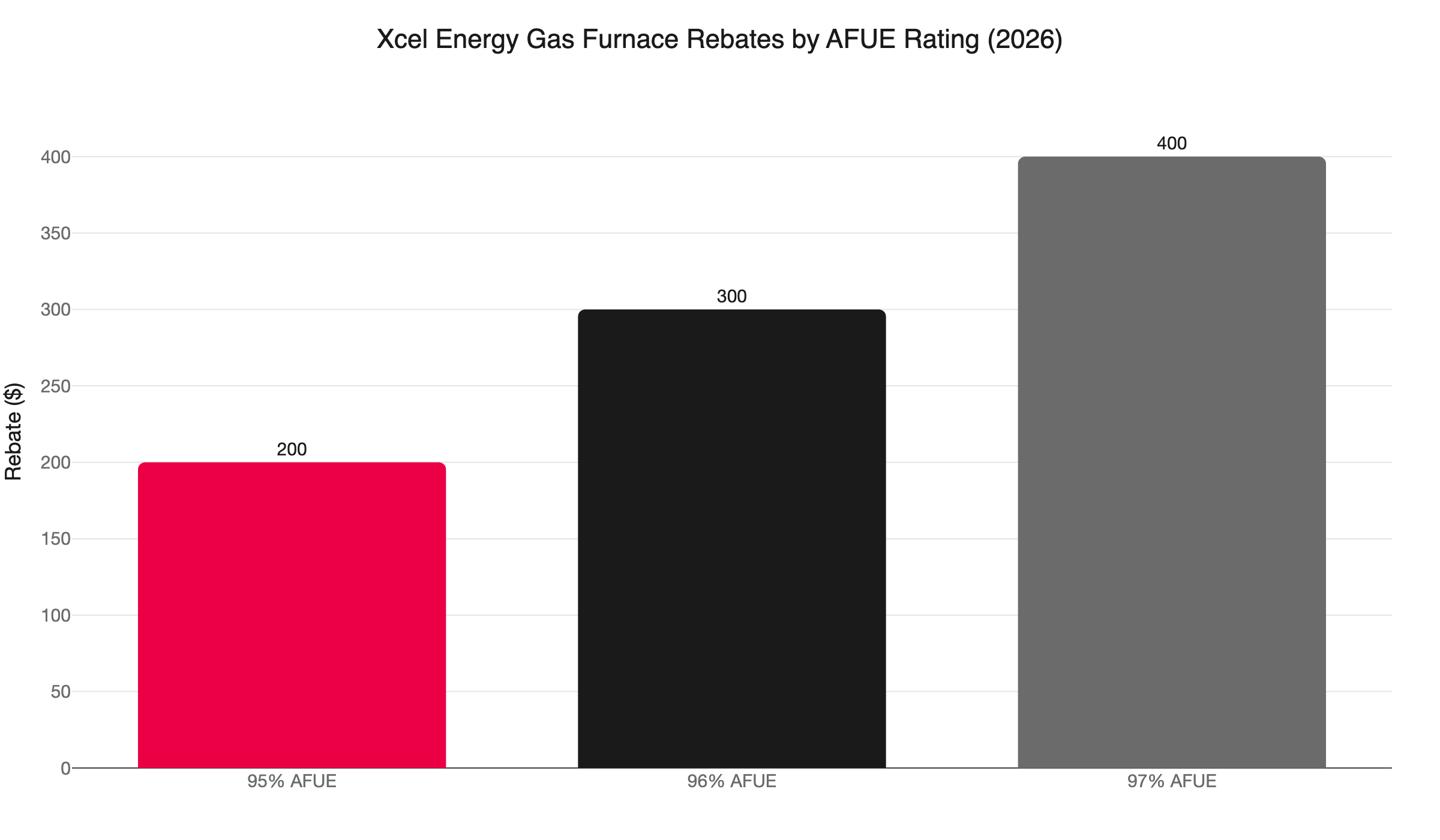
Xcel offers gas furnace rebates by efficiency tier: $200 for 95% AFUE, $300 for 96% AFUE, and $400 for 97% AFUE. Xcel’s residential boiler rebate program was not confirmed in current public materials. Call Xcel directly to ask about boiler rebate availability before building a number into your project budget.
CenterPoint Energy
CenterPoint offers up to $400 for 95%+ AFUE gas furnaces. Income-qualified customers may be eligible for up to $1,200. CenterPoint has a dedicated residential boiler rebate form (CNP1153). The specific dollar amount was not confirmed in current public materials. Contact CenterPoint directly to confirm.
Minnesota Energy Resources
Minnesota Energy Resources offers $350 for a 95% AFUE furnace and $500 for a 97% AFUE furnace. Boiler-specific amounts should be confirmed directly with the program.
Federal tax credits
The 25C Energy Efficient Home Improvement Credit has covered 30% of installed cost, up to $600 annually, for qualifying furnaces and boilers. The current status of this credit is uncertain - one source indicates it expired December 31, 2025; another cites eligibility through 2032 for certain equipment. Check irs.gov or speak with a tax professional before counting it in your project math.
Stacking rebates
Utility rebates and a federal credit are generally stackable. A homeowner replacing an aging boiler with a 97% AFUE condensing unit may qualify for a utility rebate, a federal credit, and a manufacturer’s rebate simultaneously. Combined, that can move the needle significantly on total project cost. Northern One Hour can walk through what your specific install may qualify for before you commit.
What Is the 2028 Federal Furnace Standard?
Quick answer: The DOE finalized a rule requiring 95% AFUE for all new non-weatherized residential gas furnaces beginning in late 2028. Most high-efficiency furnaces sold today already meet that minimum. The rule signals where the market floor is headed.
Here is the practical point for homeowners comparing purchases today: a 95% AFUE furnace bought now will be at the legal minimum in 2028. You are buying at the floor, not above it. A 97% AFUE boiler sits above the coming furnace threshold. That alone is not a reason to choose one system over the other. But it is context worth having when you are looking at equipment that will be in your home for the next 20 to 30 years.
What Does Minnesota’s Energy Code Require?
Minnesota falls entirely in Climate Zones 6 and 7 - the coldest classification for residential heating in the continental U.S. The Minnesota energy code requires a minimum of 92% AFUE for gas furnaces in new residential construction. The federal minimum of 80% does not apply when state code sets a higher bar.
For boiler replacements, the Minnesota Department of Labor and Industry (DLI) oversees residential boiler installation and inspection. A replacement boiler requires a mechanical permit. Skipping the permit creates a compliance problem and can complicate insurance claims or future resale.
Northern One Hour handles permit coordination on every boiler and furnace install. You do not manage that paperwork yourself.
Should You Convert from a Boiler to a Forced-Air Furnace?
Conversion can make sense in specific situations:
- You are doing a major gut renovation and walls are already open. Ductwork cost drops sharply when you are not cutting through finished surfaces.
- You want central air conditioning integrated with your heating system and you are not interested in ductless mini-splits.
- You are adding a significant home addition and hydronic zoning for the new space would be complicated.
Conversion usually does not make sense when:
- The home has no ductwork and is not undergoing major renovations.
- The boiler is in reasonable condition and facing a repair decision, not end of life.
- Budget is a constraint and a boiler replacement costs significantly less than a full conversion project.
A decision framework that works for most homeowners:
- Age and condition. Under 15 years with no major issues: repair. Between 15 and 20 years with recurring problems: assess carefully. Over 20 to 25 years: plan for replacement.
- Existing ductwork. If ductwork already exists, conversion cost is lower. If not, it is a major construction project.
- Renovations planned. If walls are already open for other work, bundling ductwork installation into existing labor changes the math.
- Cooling needs. If central AC is the goal, evaluate whether a ductless mini-split paired with a new boiler might serve you better than full system conversion.
Our post on when to repair vs. replace your heating and cooling system walks through this framework in more depth.
For the boiler-specific side, our boiler repair and maintenance team can look at your current system and give you a straight read on where it stands before you decide anything.
Boiler vs. Forced Air Furnace: Side by Side
| Factor | Boiler (Hydronic) | Forced-Air Furnace |
|---|---|---|
| Heat delivery | Radiators or radiant tubing | Ducts and registers |
| Duct loss | None | 15-30% in leaky systems |
| Typical AFUE range | 82% to 97% | 80% to 98% |
| Typical lifespan | 20-30 years | 15-20 years |
| AC integration | Separate system required | Integrated with cooling coil |
| Noise level | Quiet operation | Fan cycles audible |
| Air quality impact | No airborne dust | Ducts can circulate allergens |
| MN new construction minimum | Federal 82% | State code 92% AFUE |
Ready to Talk Through Your Heating System?
The boiler vs. forced air furnace question does not have a single right answer. It has the right answer for your specific home, your budget, and what you actually want from your heating system.
Northern One Hour is locally owned and operated in Ramsey, MN. We serve the Twin Cities metro from Minneapolis and St. Paul to Maple Grove, Plymouth, Blaine, Woodbury, and Bloomington. We work in homes that have run on hydronic heat for 80 years and in new construction with modern high-efficiency forced air. We will look at your system, your home, and your situation, and tell you what we would actually do.
Every appointment comes with the same guarantee: “Always On Time… Or You Don’t Pay a Dime!(R).”
Call us at (763) 260-6662 or schedule a heating assessment online. If your boiler needs attention now, our boiler repair and maintenance team is available for same-day service.
Frequently Asked Questions
How long does a boiler last compared to a forced-air furnace? +
Is it worth converting from a boiler to a forced-air furnace? +
What rebates are available for replacing a boiler or furnace in Minnesota? +
What AFUE is required for new furnaces in Minnesota? +
Need a technician now?