
Gas vs Electric Heat Cost Minnesota: The Real Twin Cities Math
Key Takeaways
- Gas heat is still cheaper per delivered BTU in the Twin Cities, but the gap is smaller than national articles show.
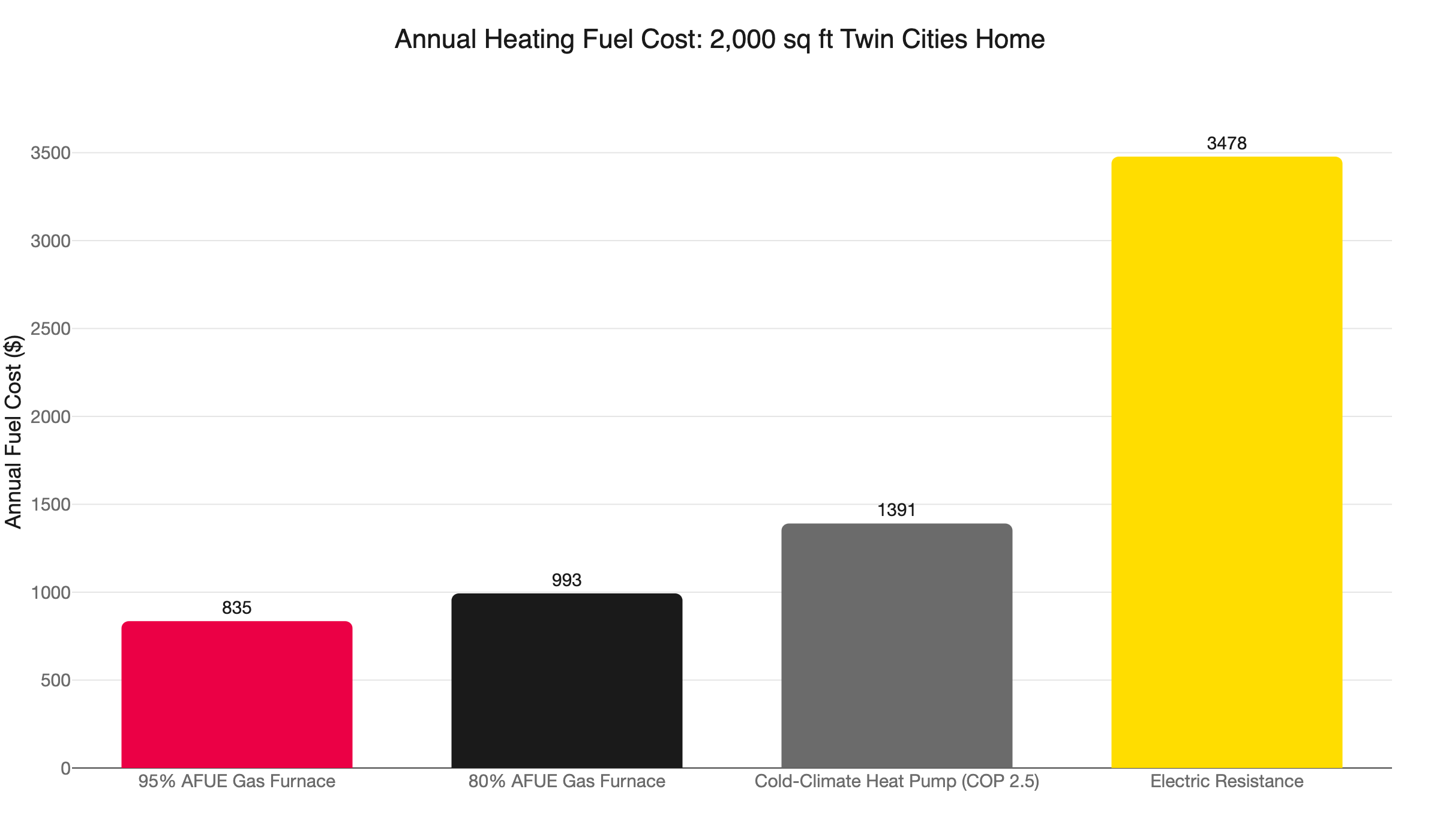
- At current Minnesota rates, a 95% AFUE gas furnace costs about $835 per year in fuel for a 2,000 sq ft home. A cold-climate heat pump at COP 2.5 runs about $1,391 per year. Electric resistance heat costs roughly $3,478 per year.
- Minnesota electricity from Xcel Energy sits at 15.82 cents per kWh, below the national average of 18.83 cents. That narrows the heat pump penalty compared to what most national articles show.
- The federal 25C tax credit for heat pumps expired December 31, 2025. Xcel’s $2,000 rebate is still active in 2026.
- A dual-fuel system, a gas furnace paired with a cold-climate heat pump, often delivers the best economics for Twin Cities homes.
- Minnesota’s roughly 8,000 heating degree days per year mean fuel efficiency choices matter more here than almost anywhere else in the country.
Do National Gas vs Electric Heat Cost Comparisons Apply in Minnesota?
No. They use the wrong rates. Most national calculators use $1.57 per therm for gas and 18.83 cents per kWh for electricity. Minnesota gas runs about $1.06 per therm. Xcel residential electricity is 15.82 cents per kWh. Those two differences alone change your annual heating math by hundreds of dollars.
This matters more here than anywhere else. The Twin Cities averages roughly 8,000 heating degree days per year, making it the coldest major metro in the country. We run heating systems for five or more months per year. A one-dollar-per-MMBTU fuel cost difference, multiplied across a full Minnesota heating season, adds up to serious money.
National comparison articles are calibrated for an average climate using average rates. A Twin Cities homeowner running those numbers will get the wrong answer. Every figure in this post uses actual Xcel and CenterPoint tariff data, not national averages.
What Does Natural Gas Cost in Minnesota Right Now?
Minnesota gas costs about $1.06 per therm. That figure comes from EIA data showing a 2025 annual average of $10.98 per Mcf for residential customers, divided by 10.37 therms per Mcf. It is well below the $1.57 per therm national average used in most comparison articles.
Most Twin Cities homes get gas from CenterPoint Energy or Xcel Energy. CenterPoint serves more than 900,000 Minnesota residential customers. After its 2024-2025 rate case was approved by the Minnesota Public Utilities Commission in June 2025, the average residential customer on 74 therms per month pays about $72 per month. Roughly half of that bill is a fixed delivery charge. The other half tracks the commodity price, which CenterPoint passes through at cost with no markup.
Xcel received PUC approval for a 6.8% interim gas rate increase on January 1, 2026. Its full 8.2% request is still before the commission, with a final decision expected by November 2026. The interim increase adds about $70 per year to the average Xcel gas customer’s bill.
Gas prices have moved around in recent years. Minnesota hit $1.17 per therm in 2022, then settled back to $1.03 per therm in 2024. For planning, $1.06 per therm is a reasonable midpoint.
Even with recent increases, Xcel states its gas rate is 26.5% below the national average, per 2023 EIA data. Minnesota remains a relatively low gas-cost state, but the trend is upward.
What Does Electric Heat Cost in Minnesota Right Now?
Xcel Energy’s residential electric rate is 15.82 cents per kWh as of March 2026, below the national average of 18.83 cents per kWh. Minnesota runs about 16% under the U.S. midpoint. The PUC issued a verbal decision in June 2026 allowing Xcel to collect an additional 5.8% increase. Rates will tick up again, but Minnesota will stay below the national average.
This is the detail most national comparison articles get wrong. When an article tells you electric heat costs three or four times more than gas, it is using 18.83 cents per kWh. At Xcel’s 15.82 cents, the ratio shrinks. Electric resistance is still expensive in Minnesota, but the penalty here is smaller than those articles show.
The difference matters most when comparing heat pumps. A cold-climate heat pump uses electricity but runs at a coefficient of performance above 2.0 on most days. It delivers more than two units of heat for each unit of electricity consumed. At Minnesota’s below-average electric rate, the heat pump’s annual fuel cost comes out lower than a national calculator would show for the same home.
Still, let’s be direct: electric resistance heat, baseboards, an electric furnace running straight resistance coils, remains the most expensive way to heat a Minnesota home. At 15.82 cents per kWh, resistance heat costs about $46 per delivered MMBTU. A 95% AFUE gas furnace at $1.06 per therm delivers the same BTUs for about $11. No efficiency upgrade on the distribution side closes a gap that wide.
Annual Heating Costs for a Twin Cities Home: The Real Numbers
These figures use a 2,000 sq ft Twin Cities home as the benchmark. At a normal 8,000 heating degree days, that home needs roughly 750 therms of delivered heat output per year.
At current Minnesota rates, a 95% AFUE gas furnace costs about $835 per year in fuel. An 80% AFUE furnace costs about $993. The 15-point efficiency difference runs about $158 per year. Over 15 years, that gap exceeds $2,300 in extra fuel cost.
A cold-climate heat pump at a seasonal COP of 2.5 costs about $1,391 per year. That is more than either gas furnace option, but roughly four times less than electric resistance heat at $3,478.
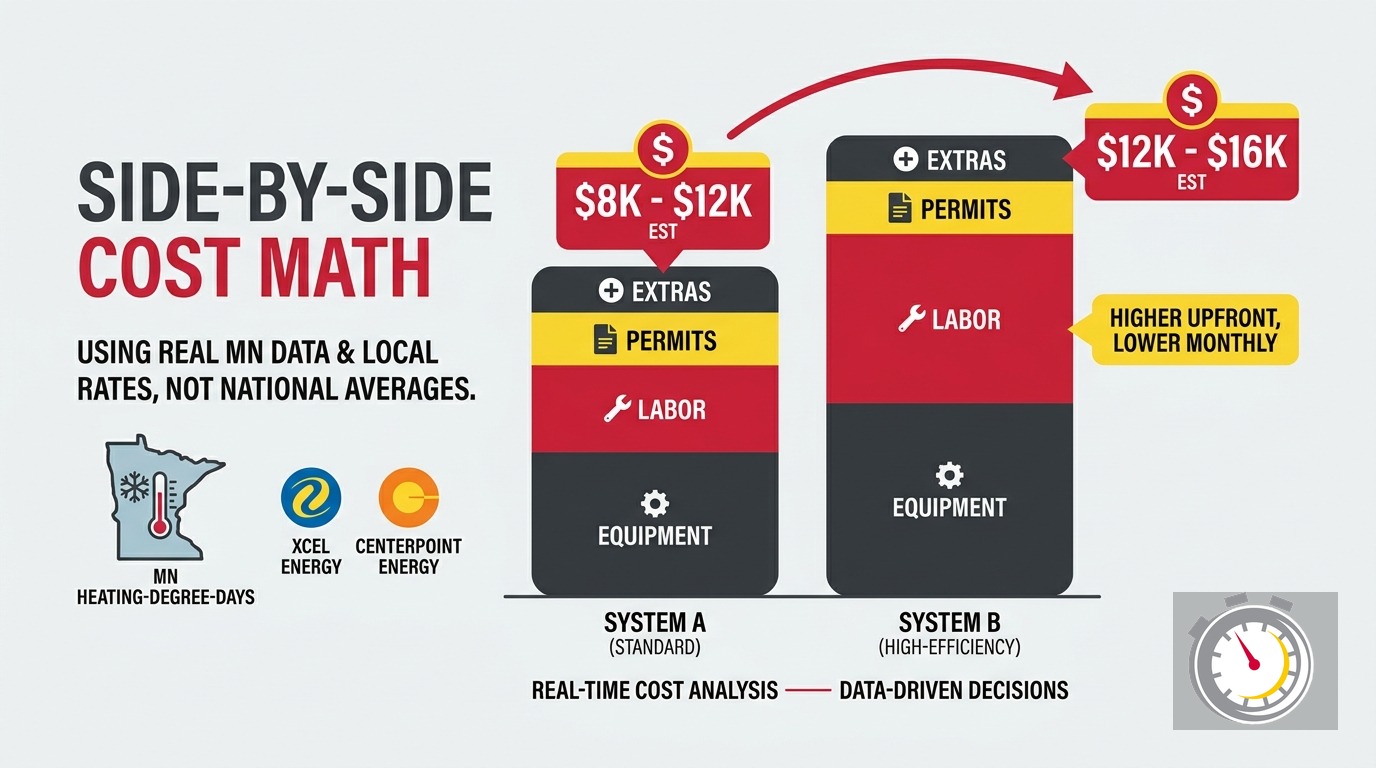
These are fuel costs only. They do not include installation price, maintenance, or equipment replacement at end of life. A 95% AFUE furnace costs more upfront than an 80% unit. A cold-climate heat pump system carries a higher installation price than either furnace option. Those upfront differences need to factor into any real comparison.
The fuel cost gap between a gas furnace and a heat pump is real. A ccASHP at COP 2.5 costs about $556 more per year in fuel than a 95% AFUE gas furnace. Over 10 years, that is roughly $5,500 in additional fuel cost before any rebates or changes in utility rates.
What About Cold-Climate Heat Pumps in Minnesota?
A properly spec’d cold-climate air source heat pump can work in a Minnesota winter, but “cold-climate” is doing critical work in that sentence. A standard heat pump is not designed for our climate. A cold-climate unit rated by NEEP to maintain a COP of at least 1.75 at 5 degrees F is a fundamentally different piece of equipment.
During most of the heating season, when outdoor temperatures are above freezing, a good ccASHP typically runs at COP 3.0 or higher. That means it delivers $3.00 worth of heat for every $1.00 of electricity used. At those conditions, the delivered cost per MMBTU is around $15.46, which sits between an 80% and a 95% AFUE gas furnace in cost.
At 5 degrees F, a NEEP-listed ccASHP should hold COP 1.75. At that efficiency, delivered heat costs about $26.50 per MMBTU. That is more expensive than gas, but still cheaper than electric resistance.
At -10 degrees F during a polar vortex, COP can drop further. That is why most Minnesota heat pump installs include a backup heat source. Options include a gas furnace in a dual-fuel setup, electric resistance strips, or both.
One critical point: we are talking specifically about cold-climate air source heat pumps. A standard heat pump without NEEP verification will underperform in a Minnesota winter. It may not maintain comfort on the coldest days. Always confirm the unit is on the NEEP list and rated for 5-degree performance before purchase.
Learn more about how heat pumps perform in our climate on our heat pump services page, or read our guide on whether heat pumps are a good fit for Minnesota.
The Dual-Fuel Approach: Gas Furnace and Heat Pump Together
Most Twin Cities homes are served by CenterPoint or Xcel for gas and Xcel for electricity. That dual-utility setup makes a hybrid heating system a natural fit.
In a dual-fuel setup, a cold-climate heat pump handles most of the heating load. When outdoor temperatures drop below a set threshold, typically around 25 degrees F, the system switches to the gas furnace. The crossover point is set where the heat pump’s efficiency drops low enough that gas becomes the cheaper fuel.
During shoulder-season days, the heat pump runs efficiently and burns no gas. On the coldest Minnesota nights, the gas furnace handles the load as the cheaper fuel source. Annual fuel costs come out lower than either system running alone.
The dual-fuel approach also addresses the comfort concern many homeowners have about relying on a heat pump through a polar vortex. The gas furnace is still there for the hardest days. You are not putting everything on one piece of equipment at -20 degrees F.
The upfront cost of a dual-fuel install is higher than a furnace replacement alone. But for a home that already has gas service and a furnace nearing the end of its life, pricing out a dual-fuel system alongside a straight furnace swap is worth the time. Ask about financing when you call: the monthly payment on a dual-fuel system can often be partially offset by the fuel savings it generates.
What Rebates and Incentives Are Available in 2026?
The biggest 2026 change: the federal 25C tax credit expired December 31, 2025. Under the One Big Beautiful Bill Act signed July 4, 2025, heat pump installs completed in 2026 are not eligible for the credit that previously covered up to $2,000. If you were waiting to move forward, that window has closed.
Here is what remains:
Xcel Energy ccASHP rebate: Up to $2,000 for a qualifying cold-climate heat pump. The unit must appear on the NEEP list and carry a rated COP of at least 1.75 at 5 degrees F. A $600 bonus is available when the install is paired with qualifying insulation or air sealing upgrades.
Federal IRA HOMES and HEAR rebates: Both programs survived the One Big Beautiful Bill Act. These income-based rebates carry higher caps for lower-income households. Minnesota has not launched these programs yet. The MN Air Source Heat Pump Collaborative is tracking the launch timeline and expected stacking rules.
MN Residential Heat Pump Rebate Program: A state-level rebate is expected to stack with the federal HOMES/HEAR programs when they arrive. No confirmed launch date as of mid-2026.
The takeaway: the Xcel $2,000 rebate is the reliable incentive right now. The federal and state stacking opportunities may arrive during the year, but they are not guaranteed for any specific install date.
For a full breakdown of what is currently available, see our post on Minnesota heat pump rebates and tax credits.
Why 8,000 Heating Degree Days Change the Math
The Twin Cities averages roughly 8,000 heating degree days per year based on the 1991-2020 climate normal. That number moves: the 2024-25 season came in at 6,779 HDD, a mild year by our standards. Polar vortex winters can push above 9,500.
No other major U.S. metro consistently runs this cold for this long. The HDD gap between Minneapolis and a city like Dallas exceeds 5,000 degrees. That difference translates directly into fuel costs. In a mild climate, choosing between an 80% and a 95% AFUE furnace might add $30 to $40 per year. In the Twin Cities, the same choice costs about $158 per year, compounding over the life of the equipment.
That multiplier matters across every comparison in this post. The heat pump’s roughly $556-per-year fuel premium over a 95% AFUE gas furnace feels larger in Minnesota than it would in a mild climate. The electric resistance penalty is especially stark here: at $3,478 per year versus $835 for a gas furnace, you are spending about $2,600 more every year in fuel alone.
HDD variability also affects planning. In a mild year like 2024-25, actual fuel costs will run 15 to 20 percent below the normal-year estimates shown here. In a cold year, they will run above them. The normal-year figures are the right planning baseline, but build in headroom for harder winters.
Which Heating System Is Right for Your Twin Cities Home?
The right answer depends on your current equipment, your utility connections, and your budget. There is no single correct choice for every home, but here is a practical framework for most situations.
If your gas furnace is under 15 years old and running well: Keep it. Schedule a furnace tune-up each fall and keep efficiency high. A well-maintained 95% AFUE furnace is already your lowest-cost-per-BTU option.
If your gas furnace is 15 or more years old and you have both gas and electric service: Price out a dual-fuel system. The Xcel $2,000 rebate is real money. Get a quote alongside a straight furnace replacement and compare the payback period with actual numbers.
If you want the simplest, lowest-risk replacement: A 95% AFUE gas furnace delivers the lowest annual fuel cost at today’s rates. At about $835 per year for a 2,000 sq ft home, it is the strongest straightforward choice. Choose it if the upfront cost of electrification is not in the budget right now.
If you are currently heating with electric resistance: Any upgrade, a gas furnace, a ccASHP, or a dual-fuel system, will cut your heating bill significantly. At roughly $3,478 per year, electric resistance is the most expensive path available in any Minnesota scenario.
Ready to Run the Numbers for Your Home?
We are locally owned and operated, serving Minneapolis, St. Paul, Ramsey, Blaine, Maple Grove, Plymouth, Brooklyn Park, Woodbury, Bloomington, and the surrounding Twin Cities area. We help homeowners work through these decisions every day, across every type of home and equipment setup in our market.
The figures in this post are accurate starting points. Your actual costs depend on your home’s insulation, air sealing, square footage, ductwork condition, and which utility serves you. The best way to get a real number: have someone walk through your home and review your bills.
We show up when we say we will. That is the commitment behind “Always On Time… Or You Don’t Pay a Dime!(R)” and it applies to every assessment and every service call, not just emergencies.
Call us at (763) 260-6662 or book online to schedule an assessment. We will look at your system, run the numbers for your specific home, and give you a straight answer on what makes sense.
Frequently Asked Questions
Is gas or electric heat cheaper in Minnesota? +
How much does it cost to heat a home in Minnesota per year? +
Are cold-climate heat pumps worth it in Minnesota winters? +
Did the federal heat pump tax credit expire in 2026? +
Need a technician now?