
Electric Space Heater vs Furnace Cost: Minnesota's Real Math
Key Takeaways
- Running a space heater for several hours a day adds up to significant cost per heating season at Xcel Energy’s Minnesota rate of 16.98¢/kWh.
- Electric resistance heating costs roughly 4.3 times more per BTU than a 96% AFUE gas furnace at current Minnesota gas prices.
- A correctly sized furnace for a 1,600 sq ft Twin Cities home delivers 80,000-100,000 BTU/hr. One space heater delivers 5,118 BTU/hr. You would need 15-16 heaters running at once to match the furnace at peak load.
- Minnesota’s heating season runs 252 days, roughly September through late May. A small cost disadvantage that looks tolerable for a short southern winter compounds into thousands of dollars here.
- Space heaters account for 29% of home heating fires but 77% of heating fire deaths, per NFPA data covering 2019-2023.
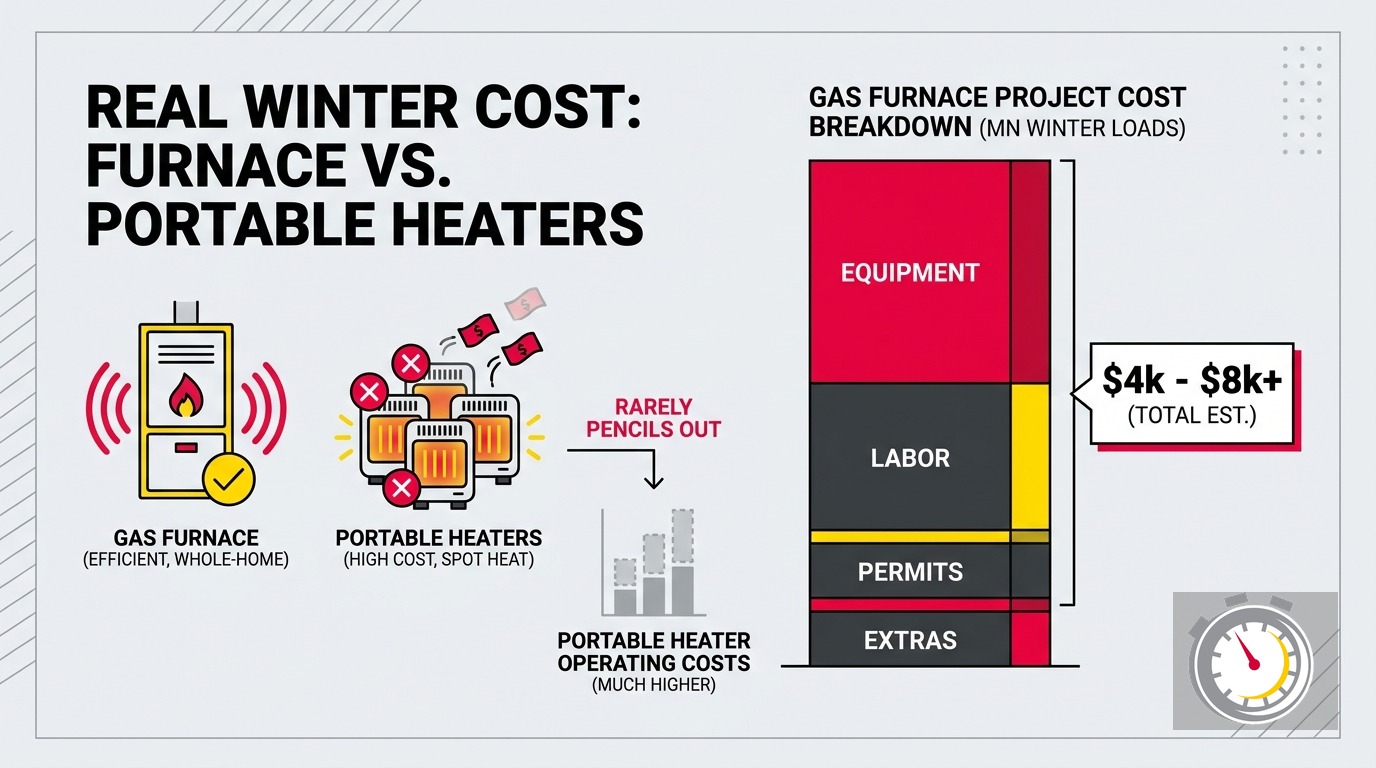
- A new gas furnace in the Twin Cities starts at $3,900-$7,800 installed for most homes. Xcel rebates and a potential federal tax credit can reduce that cost.
Is a Space Heater Really Cheaper Than Running Your Furnace?
For one room used a few hours a day, a space heater can cost less than heating the whole house to the same temperature. For whole-home heating in Minnesota, a gas furnace wins on operating cost by a wide margin. The BTU cost ratio is roughly 4.3 to 1 in favor of gas at current Minnesota rates.
The zone-heating argument has real merit in a narrow scenario. It requires one room, attended use, a few hours per day, and the thermostat genuinely set back in the rest of the house. Most homeowners add a space heater to supplement a running furnace. In that situation, you are paying for both systems at once.
What most articles on this comparison get wrong: they build their math on southern utility rates or the national average. Neither applies to a Twin Cities homeowner on Xcel Energy. When you use actual Minnesota numbers - Xcel’s rate, our 252-day season, and the BTU load needed to heat a real Minnesota home - the picture shifts significantly.
What Does It Cost to Run a 1,500W Space Heater in Minnesota?
At Xcel Energy’s average residential rate of 16.98¢/kWh, running a space heater several hours a day adds up to a notable cost over Minnesota’s full heating season. That is for one heater in one room.
Every resistance heater converts electricity to heat at 100% efficiency. The wattage is the only number that matters for operating cost. Brand, style, and design do not change how much energy a 1,500W heater draws per hour. A 1,500W heater is a 1,500W heater.
Here is the full breakdown at Xcel’s rate:
- Per hour: 1.5 kWh × $0.1698 = $0.255
- Per day (8 hours): $0.255 × 8 = $2.04
- Per month (30 days): $2.04 × 30 = $61.20
- Full season (252 days): $2.04 × 252 = $513
Minnesota’s statewide average rate, which is slightly lower. But most Twin Cities homeowners are Xcel customers, so the Xcel number is the more accurate baseline.
The national average runs higher than both at 18.44¢/kWh, which means articles using that figure actually overstate the heater’s seasonal cost compared to what you actually pay. The Xcel-based number is the right one to use here.
Why Does Minnesota’s Heating Season Change the Calculation?
Most space heater vs. furnace articles model a 90 to 120-day heating season. Minneapolis-St. Paul’s heating season runs approximately 252 days, from about September 17 to May 26. That is nearly eight months of active heat demand.
A cost disadvantage that looks manageable over a short southern winter compounds significantly across our season. At $61.20 per month per heater, the full-season cost of $513 is meaningful for one room. For the number of heaters needed to match a properly sized furnace - 15 or more - the seasonal electricity cost exceeds $7,500.
The heating load context matters here. Minneapolis-St. Paul averages about 7,399 heating degree days per year, with a design winter temperature of -16°F. These are not mild-climate conditions a homeowner can work around with supplemental resistance heating at a reasonable cost.
The scale of Midwest heating demand reinforces this. EIA data shows Midwest households consumed 76.1 million BTU of natural gas per household in 2020 - 34% more than the national average. Space heating accounts for 53% of that energy load. Running even a significant share of that load on resistance electricity would cost multiples of what gas costs at current rates.
Do Space Heaters Spike Your Electric Bill?
Yes. A single 1,500W heater draws as much continuous power as ten 150-watt bulbs. Run it 8 hours a day and your monthly bill goes up about $61. Run two heaters in two rooms and add $122. At three heaters, your bill climbs by $180 before the furnace contributes a dollar.
The spike feels surprising because space heaters look like a minor appliance. But 1,500W is a substantial continuous draw. Many homeowners add one to a bedroom, one to the living room, and one to a home office. They check the bill the following month and the jump looks unexplained.
The furnace does not stop running when you add heaters. A thermostat set to 55°F to prevent frozen pipes still cycles the furnace on the coldest nights. You are paying for both systems. That dual-system cost is almost never factored into zone-heating savings estimates.
One more factor worth checking: whether your Xcel plan has tiered pricing. If the added heater-hours push your household usage into a higher-cost tier, the marginal cost of each heater-hour can exceed the average rate shown on the bill.
How Many Space Heaters Would a Twin Cities Home Actually Need?
A standard 1,500W space heater delivers approximately 5,118 BTU/hr of heat output. A correctly sized furnace for a 1,600 sq ft Minneapolis home needs 80,000-100,000 BTU/hr to maintain temperature through a Minnesota winter. That sizing reflects about 55-60 BTU per square foot for Climate Zone 6 construction.
To match the furnace at peak load, you would need 15 to 16 heaters running simultaneously.
At $513 per heater per season, the whole-home equivalent operating cost reaches $7,700-$8,200 per season in electricity alone. That is before accounting for the fact that a standard home’s electrical circuits cannot support 15 simultaneous 1,500W draws without significant panel work.
A well-maintained gas furnace heating the same home uses far less fuel cost to deliver that warmth - from a single, properly ventilated system. This is the math that “zone heating saves money” articles consistently omit. They model one heater in one room. They do not model what 15 heaters running through a Minnesota February actually costs.
The Cost Per BTU: How Gas and Electric Heating Actually Compare
The clearest way to compare heating fuels is cost per million BTU (MMBTU) of heat delivered to the home. This strips out system size and heating hours. It gets to the actual fuel economy of each option.
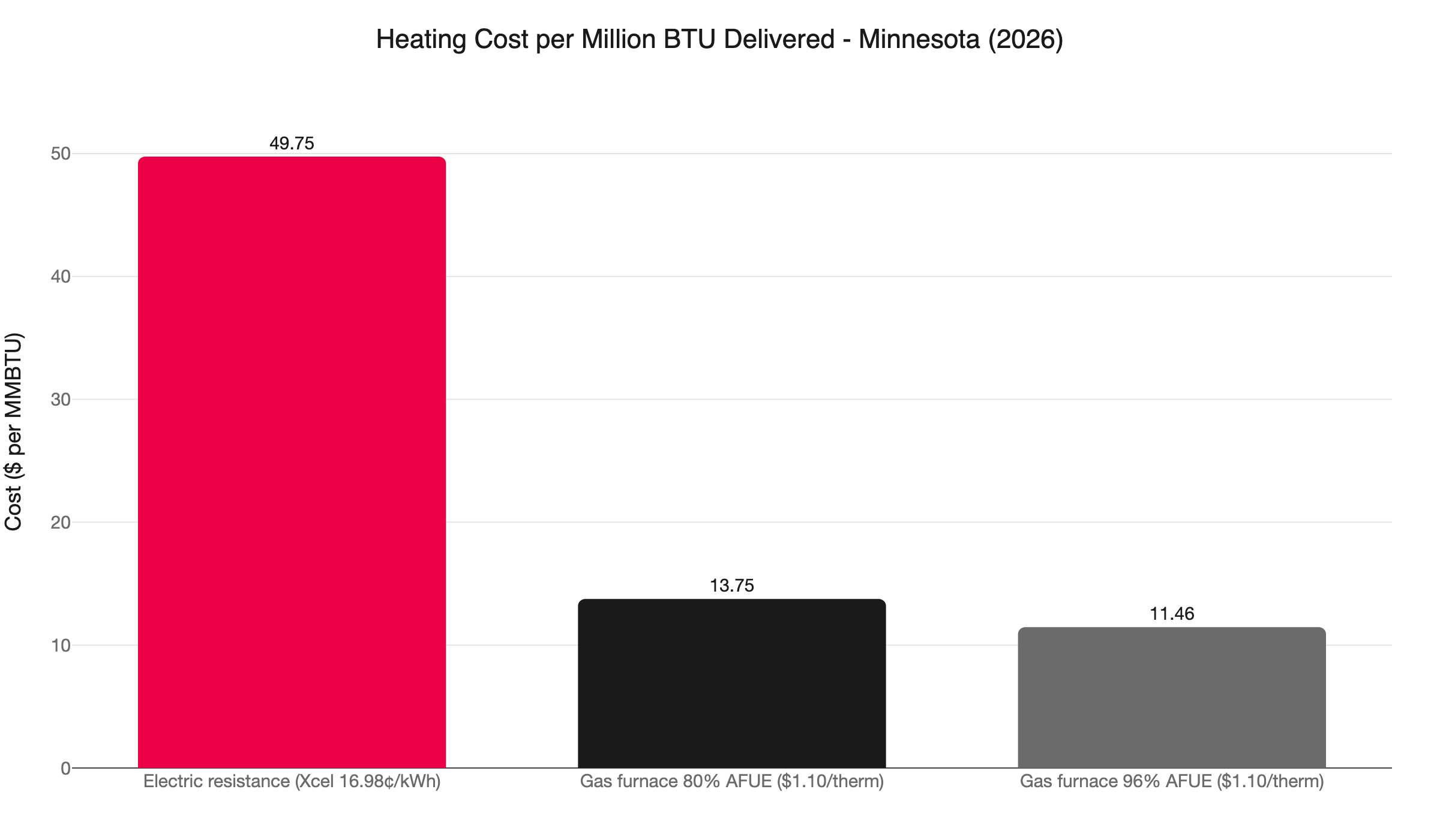
Electric resistance at Xcel’s rate: 1 kWh contains 3,412 BTU. To deliver 1 MMBTU, you need about 293 kWh. At 16.98¢/kWh: $49.75 per MMBTU delivered.
High-efficiency natural gas: Minnesota’s residential gas price averaged a competitive per-therm cost over the recent heating season. One therm at 96% AFUE delivers 96,000 usable BTU. So 1 MMBTU costs $11.46.
Natural gas at 80% AFUE: One therm at 80% efficiency delivers 80,000 usable BTU. So 1 MMBTU costs $13.75.
The result: electric resistance heating costs 4.3 times more per BTU than a 96% AFUE gas furnace. Even an 80% AFUE furnace delivers each BTU at 3.6 times lower cost than resistance electricity at current Minnesota rates.
This ratio would need to shift dramatically before space heaters became cost-competitive for whole-home heating. Gas prices would need to roughly quadruple, or electricity rates would need to drop by more than 75%, for the numbers to cross.
For a broader look at how these fuel costs compare across a full Minnesota year, see our post on gas vs. electric heat cost for Twin Cities homeowners. If you are weighing whether a heat pump could close the gap, our post on heat pump electric bills during Minnesota winters explains how a cold-climate system’s efficiency affects the comparison at different outdoor temperatures.
What Is the Cheapest Way to Heat a Home?
For a Twin Cities home with natural gas service, a high-efficiency gas furnace is typically the lowest-cost primary heating option at current rates. It delivers heat at roughly $11.46 per MMBTU at 96% AFUE. Electric resistance heating costs about $49.75 per MMBTU at Xcel rates.
A cold-climate heat pump uses electricity but delivers 2-3 BTU of heat per BTU of electricity consumed. That efficiency gain narrows the cost gap with gas in moderate cold. Below zero, a heat pump’s efficiency drops and backup resistance strips run at the full electricity rate. The annual answer depends on your home’s load profile, insulation quality, and how many extreme cold days you see in a given winter.
For most Twin Cities homeowners with natural gas available, a well-maintained, properly sized gas furnace is the most cost-effective primary heat source at today’s rates. “Well-maintained” is not a throwaway qualifier. An aging furnace running below its rated efficiency closes the gap with alternatives faster than most homeowners realize. An annual tune-up keeps the system operating at the efficiency it was designed for.
The Fire Risk Nobody Factors Into the Rate Comparison
Operating cost is not the only cost to weigh. NFPA’s home heating fire report found that space heaters represent a disproportionate share of home heating fire deaths relative to their share of all heating fire incidents. The U.S. annual average: 38,881 heating fires, 432 deaths, 1,352 injuries, and $1.1 billion in property damage.
Space heaters kill at a rate disproportionate to their share of heating equipment in homes. The reason is use pattern. Heaters get placed near furniture, used in bedrooms overnight, or left running in rooms the homeowner has temporarily stepped out of.
The risk concentrates in winter. Forty-six percent of all home heating fires occur December through February. That is exactly the window when a Minnesota homeowner is most likely to rely on a space heater to supplement during a cold snap or run one overnight.
This is not a reason to never use a space heater. It is a real cost the rate-per-BTU comparison never includes: the probability-weighted financial and safety risk of a device used in the conditions most likely to cause a fire.
How Much Does a Gas Furnace Cost?
A new gas furnace installed in the Twin Cities typically runs $3,900-$7,800 for most homes, depending on efficiency tier, size, and installation complexity. Here is where the tiers land:
- 80% AFUE: Starting around $4,950 installed
- 95-96% AFUE: Starting around $6,500 installed
- 97-98% AFUE: Starting around $9,100 installed
Higher efficiency costs more upfront. But the operating cost difference between an 80% and a 96% AFUE furnace is real across eight Minnesota heating months. At current gas prices, a 96% AFUE furnace delivers each million BTU at $11.46 versus $13.75 for an 80% AFUE unit. Across a full heating season, that gap compounds into a meaningful number.
Financing is available for most furnace replacements. If you are facing a repair decision rather than a planned replacement, our post on whether to repair or replace when the heat exchanger fails walks through how to run that math for your specific situation.
Minnesota Rebates and Tax Incentives
The upfront cost of a furnace replacement can be partially offset. Here are the programs currently available:
Xcel Energy rebates (based on the 2024 program; verify current amounts at xcelenergy.com before scheduling your installation):
- $200 for a 95%+ AFUE furnace
- $300 for 96%+ AFUE
- $400 for 97%+ AFUE
IRS Section 25C Energy Efficient Home Improvement Credit: Up to $600 for a qualifying high-efficiency gas furnace. The eligibility status for 2026 has been inconsistent across sources, with some indicating the credit expired for furnaces at end of 2025 and others citing continued availability. Confirm current eligibility at irs.gov before counting on it.
Where both incentives are available and stackable, a 97% AFUE installation can net $800-$1,000 off the installed price. That improves the payback calculation on upgrading from an 80% to a 97% AFUE furnace and brings the break-even timeline closer.
When Does a Space Heater Actually Make Sense?
A space heater is the right tool in a few specific scenarios. For a single room used a few hours a day with the thermostat genuinely set back elsewhere, a heater can reduce furnace runtime at a manageable electricity cost. The fire risk is also lower when the heater is attended and monitored.
Here are the scenarios where a space heater works:
- Single-room spot heating for a few hours: A home office, a bathroom during a morning routine, or a bedroom you want warmer than the rest of the house. At $0.255 per hour, the cost is contained.
- A detached garage or workshop: A space not connected to the home’s ductwork that needs heat occasionally - not all day, every day for eight months.
- Emergency bridging: If your furnace fails on a Saturday night in January, a space heater can buy you a day or two while you wait for a repair appointment. That is its best use as a primary heat source.
The scenario where zone heating saves real money is narrow: one room, a few hours per day, thermostat set back elsewhere. At that scale the cost is manageable and the tradeoff makes sense. Using space heaters as a whole-home heating substitute over a Minnesota winter costs more than gas heating and carries a significantly higher fire risk.
Ready to Talk Through Your Options?
If your heating bills have climbed, your furnace is aging, or you are curious whether a replacement would pay off at current fuel prices, our team is here to help. We are locally owned and operated in Ramsey, MN. We serve Minneapolis, St. Paul, Blaine, Maple Grove, Plymouth, Brooklyn Park, Woodbury, and the surrounding Twin Cities.
We show up when we say we will. That is the point of our guarantee: “Always On Time… Or You Don’t Pay a Dime!(R)”
Schedule a furnace assessment online or call (763) 260-6662. We will walk through efficiency tiers, expected operating costs at your home’s size, and any rebates you qualify for.
Frequently Asked Questions
How much does furnace repair cost in Eden Valley, MN? +
Is it cheaper to use a space heater than central heat in Minnesota? +
Need a technician now?