
Propane vs Natural Gas Furnace Minnesota: Know Your Options
Key Takeaways
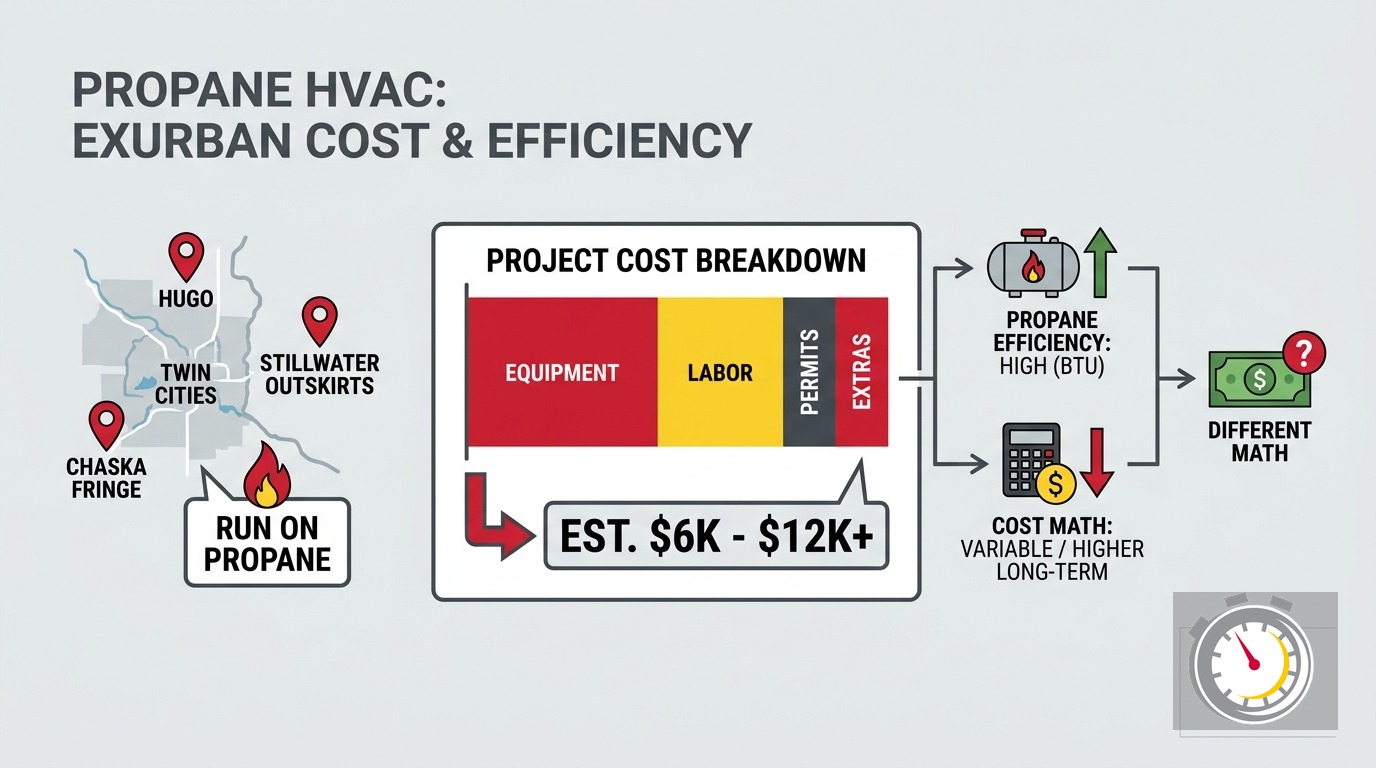
- If your home is in Hugo, east of Stillwater, or the Chaska/Carver County fringe, you’re on propane because gas lines don’t reach your street. That shapes the entire decision.
- Minnesota propane averaged about $2.06/gallon in March 2026, roughly 23% below the national average. The “propane costs 2-3x more” framing comes from national numbers, not ours.
- CenterPoint and Xcel Energy furnace rebates ($200-$400) apply only to their natural gas customers. Propane homeowners are outside both programs.
- The federal 25C tax credit for high-efficiency furnaces expired December 31, 2025. No federal incentive is available for furnace replacements in 2026.
- Owning your propane tank rather than leasing it is the single biggest controllable cost lever available to you.
- For many exurban homeowners, the smartest 2026 move is a cold-climate heat pump paired with your propane furnace as backup. Not a propane-for-propane swap.
Why Propane vs Natural Gas Looks Different Here
Most homeowners searching “propane vs natural gas furnace Minnesota” aren’t choosing between two equally available fuels. They’re figuring out what to do about a situation they inherited.
If you live in Hugo, east of Stillwater in the St. Croix Valley, or anywhere on the Chaska/Carver County fringe, you probably heat with propane because the gas main doesn’t reach your street. The question isn’t which fuel wins in the abstract. It’s: what are your actual options, what does propane really cost in Minnesota today, and does 2026 change the math?
National comparison articles treat Minnesota as a monolith. They recycle the same BTU-equivalent math without acknowledging that exurban Twin Cities homeowners sit outside the major rebate programs, outside some utility footprints, and outside the assumptions those pieces were built on. This post addresses your situation specifically.
Can You Even Get Natural Gas at Your Address?
Start with the Minnesota PUC utility locator. It confirms whether a gas utility serves your specific property. If none does, the propane vs natural gas comparison is hypothetical until the infrastructure changes.
Three major natural gas utilities serve the Twin Cities region:
- Xcel Energy serves about 492,000 residential gas customers across 27 Minnesota counties.
- CenterPoint Energy serves more than 900,000 Minnesota customers, primarily in the metro core and established suburbs.
- Minnesota Energy Resources serves about 254,000 customers across 179 communities, including many outer-ring suburbs and smaller cities outside the Xcel and CenterPoint footprints.
If none of those utilities serve your address, you’re looking at one of three paths. Petition for a gas main extension. Stay on propane and optimize how you use it. Or move toward a cold-climate heat pump that reduces your propane dependency. All three are real options. We’ll cover each one.
What Does a Gas Main Extension Actually Cost?
Extending a gas main to an unserved rural or exurban property can run from $10,000 to $50,000 or more, depending on distance to the nearest main. That number rarely works out for a single household acting alone.
Minnesota utilities are required to offer Line Extension Allowances, which subsidize part of the cost of running new gas infrastructure to unserved areas. After a 2024-2025 regulatory debate at the Minnesota PUC, where advocates argued ratepayers shouldn’t fund gas utility expansion as the state pursues carbon reduction targets, the PUC kept the program but adjusted the maximums.
For a homeowner a quarter-mile from the nearest main, the cost typically exceeds what any single household finds worthwhile. The math changes for a new development. A collective petition across 15 to 20 homes can spread the cost across enough connections to make it viable. If your neighborhood is growing and a gas extension is realistic in a few years, it’s worth tracking. But it’s not a basis for your current heating decision.
One broader point worth keeping in mind: Minnesota’s carbon reduction mandates are creating regulatory pressure on new gas utility expansion. The long-term trajectory for gas infrastructure is uncertain. That context matters if you’re weighing a long-term propane strategy against a path toward electric alternatives.
What Does Propane Actually Cost in Minnesota Right Now?
The EIA’s weekly heating fuel survey for the week of March 30, 2026 put Minnesota residential propane at about $2.06/gallon. That’s roughly 23% below the national average of $2.67/gallon and below the Midwest average of $2.21/gallon.
That number matters for how you read the comparisons online. Most articles frame propane as “2-3 times more expensive than natural gas.” That comparison is based on national BTU-equivalent cost math. It’s not wrong as a national average. But Minnesota propane runs meaningfully cheaper than in most of the country. The cost gap with natural gas exists here. It’s just narrower than those articles imply.
Natural gas rates have been climbing, too. Xcel Energy’s 6.8% rate increase took effect January 1, 2026, adding roughly $85 to the average residential customer’s annual bill. CenterPoint saw a 5.3% interim increase in 2024 and another 2.4% in 2025. Both utilities remain below the national average. But the gap between propane and gas is narrower in 2026 than it was three years ago.
One pricing factor specific to propane: the EIA only tracks Minnesota propane prices from October through March. Summer pre-buy contracts are negotiated directly with your supplier. If you haven’t priced your summer pre-buy, do it now. Pre-buy pricing is typically lower than in-season rates. A well-timed contract can cut your annual fuel spend in a meaningful way.
Are There Rebates for Propane Homeowners in Minnesota?
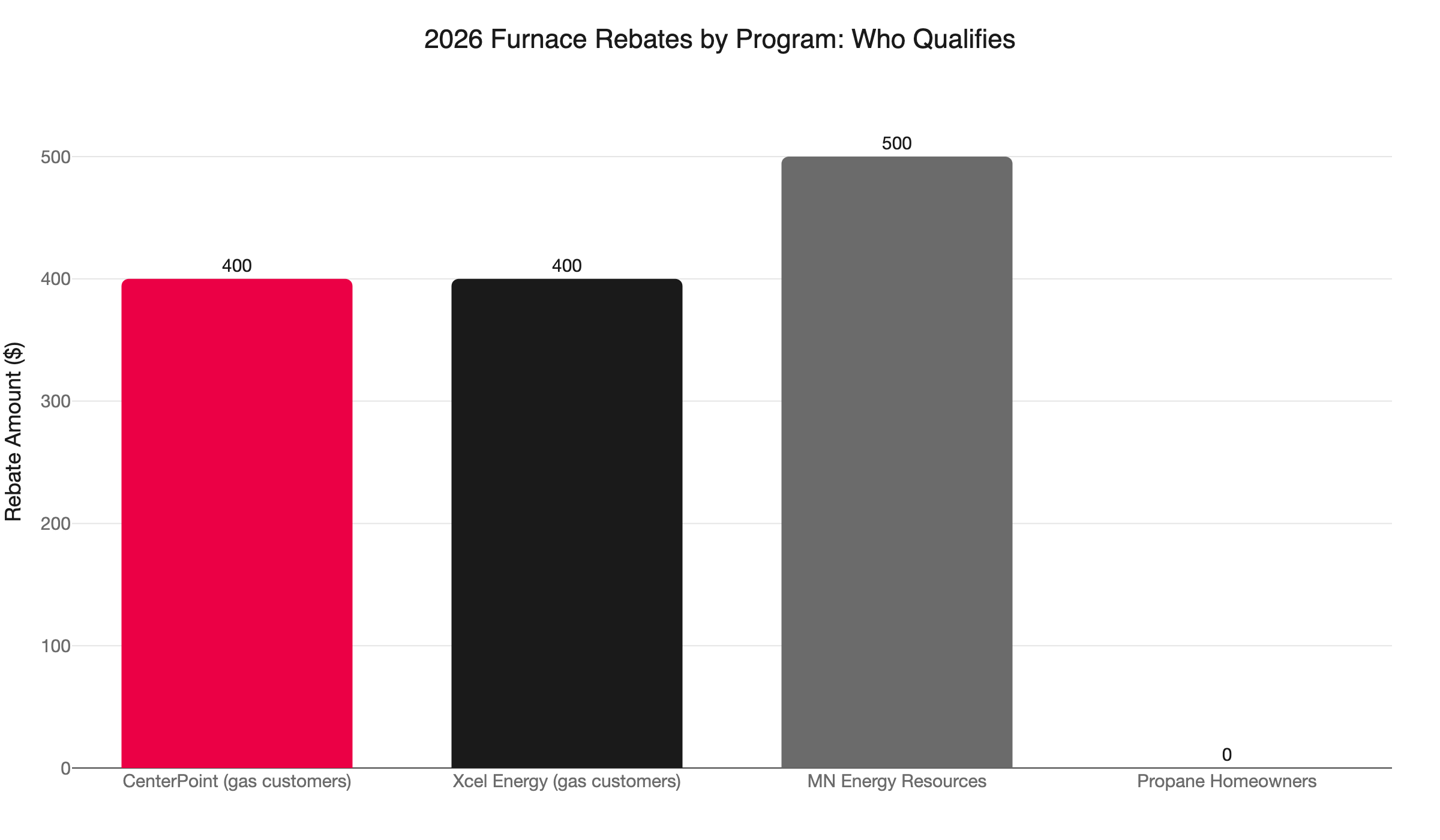
Not from the major utilities. CenterPoint and Xcel furnace rebates require an active natural gas account with that utility. If you heat with propane, you don’t qualify. Minnesota Energy Resources offers $500 for 97%-or-higher AFUE equipment, but only within its 179-community service territory.
This is the rebate gap none of the generic comparison articles flag. CenterPoint’s 2026 rebate of $400 for a 95%-or-higher AFUE furnace and Xcel’s $200 to $400 rebates for high-efficiency equipment both require an active gas account. Propane homeowners fall outside both programs entirely.
Minnesota Energy Resources is the exception. They serve 179 communities across the state, including some exurban areas outside the Xcel and CenterPoint footprints. If your home falls within their territory, a 97%-or-higher AFUE furnace earns a $500 rebate. Check their service area map to confirm eligibility before you count on it.
Some electric co-ops in the outer metro offer incentives for heat pump installations. Those programs sit outside the gas utility rebate ecosystem. If you’re served by a co-op, ask them directly about heat pump programs.
For the full breakdown of what each program covers and who qualifies, see our post on Xcel and CenterPoint HVAC rebates in Minnesota.
What Happened to the Federal Tax Credit?
The 25C Energy Efficient Home Improvement Credit for residential furnaces expired December 31, 2025. Per Energy Star and the IRS, the 119th Congress did not extend it. No federal credit is available for furnace replacements in 2026.
This matters specifically for propane homeowners. When the credit was live, upgrading to a 96%-or-higher AFUE propane furnace could earn up to $600 in federal incentives. That offset reduced the payback period on high-efficiency equipment. The credit is now gone.
That doesn’t change the conclusion on efficiency. High-efficiency propane furnaces still pay back their premium through fuel savings. On propane, where every wasted BTU costs more, the case for 96%-or-higher AFUE remains strong. The math just rests entirely on energy savings now, with no federal buffer.
Is Owning Your Propane Tank Worth It?
Almost always yes, if you plan to stay in the home for more than a few years. An owned tank lets you buy from multiple suppliers at competitive spot prices. A leased tank locks you to one supplier at their posted rate.
The price difference is real and documented. One supplier example: $1.49/gallon for customers with an owned tank versus $2.25/gallon for leased-tank customers, from the same dealer for the same product. That gap is a direct function of tank ownership, not your volume or your relationship length.
There are tradeoffs to understand. Some suppliers prioritize their own leased-tank customers during shortage periods. That’s not hypothetical if you’ve lived through a propane crunch during a Minnesota cold snap. Purchasing a tank also carries an upfront cost: typically $400 to $2,000, depending on size and whether a buried tank requires excavation.
Over five to ten years, the pricing flexibility from an owned tank usually outpaces those costs. If you’re currently in a lease, review your contract. Many include a purchase-out option at year three or five. If you’re replacing a furnace anyway, that’s a natural moment to revisit your tank situation at the same time.
How Does Efficiency Compare Between Propane and Natural Gas Furnaces?
The AFUE ladder is fuel-agnostic. A 96% AFUE propane furnace converts 96 cents of every fuel dollar into heat. A 96% AFUE natural gas furnace does the same. The equipment is identical on efficiency. Only the fuel cost per BTU differs.
What changes is how much each efficiency point is worth in dollar terms. Propane costs more per BTU than natural gas. So moving from 80% AFUE to 96% AFUE saves the same percentage of fuel on both systems, but that percentage represents a larger dollar figure per year on propane. You’re cutting 20% of your fuel waste. On propane, that 20% is worth more than it would be on gas.
Practically: if you’re replacing a propane furnace, go 96% AFUE or higher. Don’t replace propane with propane at 80% AFUE. There’s no financial case for it. The efficiency premium typically pays back in two to four heating seasons on propane, depending on home size and annual usage. The higher the AFUE, the faster the return.
For current pricing on what a high-efficiency furnace replacement costs installed in this market, our furnace replacement cost guide for the Twin Cities covers the ranges.
Should You Consider a Dual-Fuel System Instead?
If your cooling equipment is also aging, a cold-climate heat pump paired with your propane furnace as backup is almost certainly the smarter 2026 move. The heat pump covers efficient heating and all your cooling. Propane handles the deep cold below -10 degrees Fahrenheit.
This framing is missing from every top result for “propane vs natural gas furnace Minnesota.” Those articles treat propane as a problem to solve by switching fuels. None of them address that propane is often the best backup fuel for a cold-climate heat pump in a home without gas access.
Here’s how the system works. A modern cold-climate heat pump maintains its rated output down to about +5°F. It produces useful heat below 0°F, though at reduced efficiency. Minneapolis averages about 13 nights per year below 0°F.
A field assessment by the Center for Energy and Environment evaluated cold-climate heat pumps in Minnesota homes that lacked natural gas access. At 4 of 6 sites, a propane furnace served as the backup heat source. The system divided the work: heat pump for the efficient majority of heating hours, propane furnace for the coldest fraction of the season.
That split has two financial effects. First, you burn far less propane annually. That reduces your exposure to price volatility regardless of whether you own or lease your tank. Second, the heat pump covers cooling season as well. You’re combining two system replacements into one coordinated project rather than replacing your furnace and your AC separately over a few years.
The balance point is the outdoor temperature where the system hands off from heat pump to propane backup. It’s typically set between +5°F and -10°F. Your installer determines the right setting based on your home’s heat load and the equipment’s performance specs.
If you’re already looking at your furnace and your AC, price out a dual-fuel system before committing to a straight propane replacement. It’s a materially different conversation. Dual-fuel systems cost more upfront than a furnace-only replacement, and financing is available. For more on how the balance point and backup heat work in Minnesota winters, see our post on heat pump balance points and backup heat.
Your Decision Tree
Here’s how to work through this cleanly.
1. Check your gas access first. Use the MN PUC utility locator. If a utility serves your address, get a connection cost estimate and compare it against a high-efficiency propane upgrade or a dual-fuel system.
2. Check your utility territory. If you fall within Minnesota Energy Resources’ service area, you may qualify for a $500 rebate on a 97%-or-higher AFUE furnace. That changes the replacement math in a meaningful way.
3. Review your tank situation. If you’re leasing, look at your terms. If you’re replacing equipment anyway, consider purchasing your tank to unlock competitive pricing going forward.
4. Evaluate dual-fuel if your AC is also aging. Price out a cold-climate heat pump plus propane backup as a single project before committing to a straight furnace replacement. The dual-fuel path reduces long-term propane use and eliminates a future AC replacement.
5. If a straight propane replacement is the right call, go 96% AFUE or higher. Every efficiency point matters more on propane than on natural gas. Don’t leave money in the flue.
Northern One Hour is locally owned and operated in Ramsey, MN. We serve the Twin Cities metro, including Hugo, Stillwater, Maple Grove, Blaine, Plymouth, Brooklyn Park, Woodbury, and Bloomington. Whether you’re figuring out whether gas is available at your address, pricing out a dual-fuel system, or ready to replace a propane furnace, our team can walk you through the real numbers for your home.
Call (763) 260-6662 or schedule service online. “Always On Time… Or You Don’t Pay a Dime!(R)”
Frequently Asked Questions
Do propane homeowners qualify for Minnesota furnace rebates? +
Is propane really that much more expensive than natural gas in Minnesota? +
Should I replace my propane furnace with a heat pump? +
Need a technician now?