
Upgrade Steam Heat System Twin Cities: A 3-Tier Decision Guide
Key Takeaways
- Most steam heat complaints trace to clogged air vents or a miscalibrated pressure control, fixable for under $300
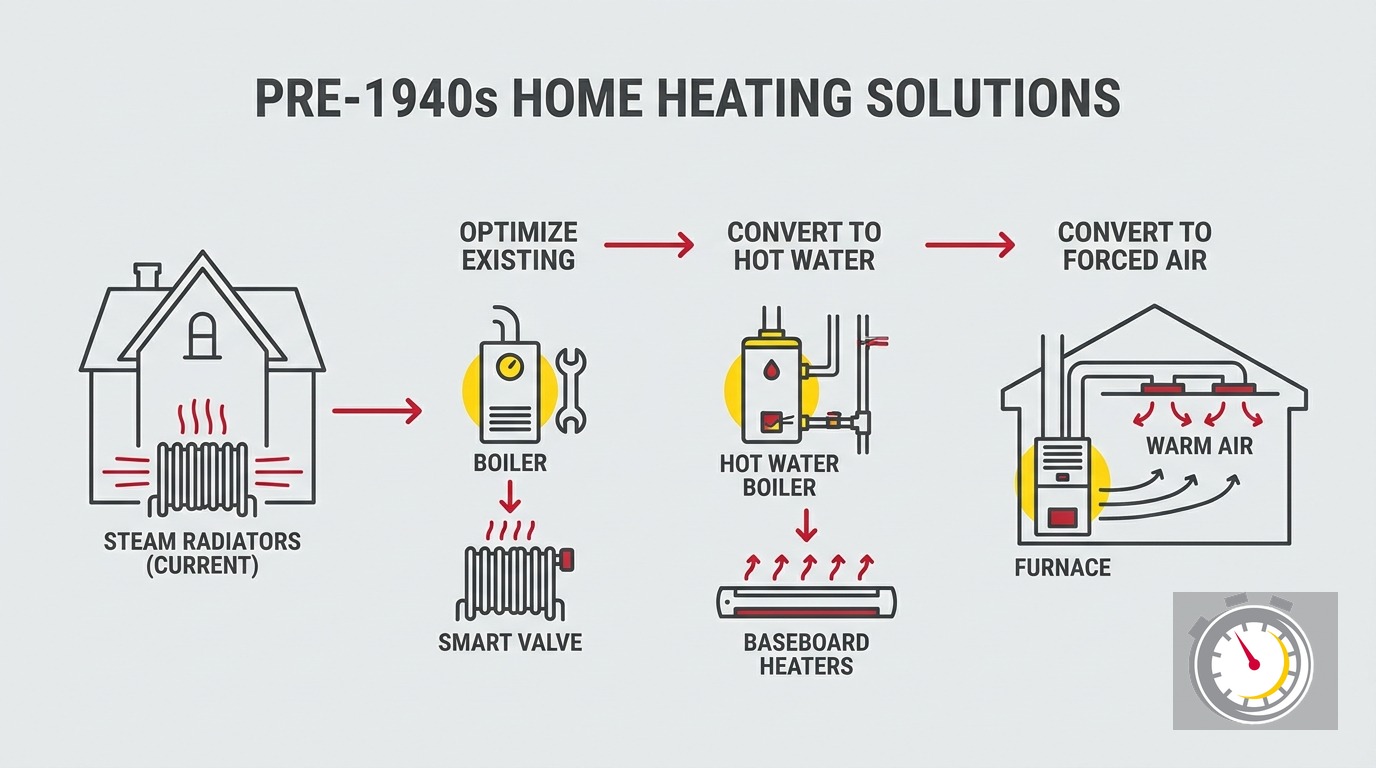
- Tier 1: Optimize the existing system (air vents, pressuretrol calibration, outdoor reset) before buying new equipment
- Tier 2: Replace with a condensing boiler, staying steam or converting to hot-water radiators, $9,100 to $15,600 installed
- Tier 3: Full forced-air or heat pump conversion, highest cost and disruption, adds central cooling
- CenterPoint Energy offers $300 to $500 in boiler rebates through December 31, 2026
- Xcel Energy ended residential gas boiler rebates on January 1, 2026
- Minneapolis homeowners can stack a $1,000 to $2,500 bonus rebate from the MNCEE program
- The federal 25C tax credit for residential boilers expired December 31, 2025
- A mechanical permit is required for all boiler replacements in Minnesota, including direct swaps
Steam Heat in Pre-1940s Minneapolis Homes: Where to Start
According to the U.S. Department of Energy, one-pipe steam heating dominated buildings constructed between 1900 and 1930. The distribution systems were never designed for efficiency. Most of them have not been changed since.
Your steam radiators may be over 80 years old and still working. That is a credit to cast iron. It also means the system has never been tuned for the house you live in today.
When Minneapolis homeowners search for help with steam heat, every contractor page says the same thing: here is a new boiler, here is a price. What none of them say is this. Before you spend $9,000 on new equipment, check three things that cost $50 total. That is where this guide starts.
Do You Have One-Pipe or Two-Pipe Steam?
One-pipe steam uses a single pipe for both steam delivery and condensate return. Two-pipe steam uses separate pipes for each. Most Minneapolis homes built before 1930 have one-pipe systems. Look at each radiator: one pipe entering from the floor or wall means one-pipe, two pipes means two-pipe. The fixes differ by type.
One-pipe steam is the most common configuration in older Minneapolis homes. One pipe carries steam up to the radiator and returns condensate back down the same pipe. Each radiator has an air vent on the side. That vent releases trapped air so steam can enter. When it clogs, the radiator goes cold. When it fails open, you lose pressure and hear hissing.
Two-pipe steam uses a separate return line to carry condensate away from each radiator. Each radiator uses a steam trap instead of an air vent. Two-pipe systems are typically quieter and work better with thermostatic radiator valves.
Not sure which you have? Our team can identify it on the first visit.
Is Your Steam System Worth Optimizing Before You Replace Anything?
Almost always yes. Clogged air vents, high boiler pressure, and no outdoor reset control cause most of the problems homeowners mistake for a failing boiler. These fixes run $50 to $300 and can transform an uneven, noisy system in a single service call.
Real Twin Cities homeowners post about these exact symptoms on heating forums: far rooms stuck in the mid-60s while rooms near the boiler are too warm to sleep in, condensate pumps running all night, water spitting from main vents, pipes banging at startup. All of these are fixable before a full boiler replacement. They trace to the distribution side, not the boiler itself.
Fix 1: Replace the Radiator Air Vents
The U.S. Department of Energy identifies clogged or undersized air vents as the most common energy problem in one-pipe steam systems. When a vent clogs, air gets trapped in the radiator. Steam cannot enter. The radiator stays cold. When a vent is too slow, steam hits condensate and bangs.
Replacement vents cost $10 to $50 each. A steam-knowledgeable technician installs them in minutes. Choosing faster vents for far radiators and slower vents for near ones balances heat distribution across the whole house. This single fix often resolves complaints that homeowners have lived with for years.
Fix 2: Calibrate the Pressuretrol
The pressuretrol is the pressure control that cycles your burner on and off. Most residential one-pipe systems run correctly at 0.5 to 2 psi. Many are set far higher, either from a factory default or a previous technician’s adjustment. High pressure forces steam too fast through the system. It causes banging and wastes fuel.
A technician checks and recalibrates this setting in under an hour. It is usually addressed during a standard boiler tune-up.
Fix 3: Add an Outdoor Reset Control
Outdoor reset controls on a steam boiler save approximately 15% on fuel costs. On cold days, the boiler adjusts its output instead of firing at full intensity. The result is longer, gentler cycles and more even heat throughout the house.
An outdoor reset control is a modest add-on to any boiler service visit. For a Twin Cities home running three to four hard heating months per year, the fuel savings are real.
Fix 4: Consider Thermostatic Radiator Valves
Thermostatic radiator valves reduce energy use by approximately 5% and stop overheated rooms. They replace the existing valve on each radiator and let you set a target temperature per room. If one bedroom runs 10 degrees warmer than the thermostat says, a TRV solves it without touching anything else.
On two-pipe systems, installation is straightforward. One-pipe systems require a specific TRV type that handles condensate flow back through the same pipe. The installation is more involved but works well.
A Note on Finding Steam Expertise in the Twin Cities
Finding steam-specific knowledge in this market is harder than it should be. Minneapolis and St. Paul homeowners report that no steam contractors appear in standard Find-a-Contractor tools within 100 miles; steam-knowledgeable work is most often referred through Pipefitters Local 539 in Minneapolis and Local 455 in St. Paul.
We are locally owned and operated in Ramsey, MN. We serve Minneapolis, St. Paul, Blaine, Maple Grove, Brooklyn Park, Plymouth, Woodbury, Bloomington, and the surrounding communities. Steam systems are part of our regional expertise. Call us at (763) 260-6662 if you want a straight answer on where your system stands.
Should I Replace My Steam Boiler?
Replace when your boiler is 20 to 25 years old, requires repeated repairs, or cannot hold steady pressure. A modern condensing boiler runs 91 to 95%+ AFUE versus 60 to 70% for an aging cast-iron unit. That efficiency gap cuts heating bills and qualifies for utility rebates that close December 31, 2026.
What Does a Condensing Boiler Replacement Cost in the Twin Cities?
A condensing boiler replacement in the Twin Cities runs $9,100 to $15,600 installed. That range depends on boiler size, brand, and whether the flue needs rerouting. Parts and labor are both included. For a deeper look at what drives that range, see our condensing boiler upgrade cost guide for Minnesota homeowners.
Stay Steam or Convert to Hot Water?
At tier two, you have two paths.
Keep it steam. A modern condensing steam boiler drops into roughly the same footprint as your current unit. You keep your existing radiators and pipes. There is no ductwork and no demolition. This is the most common approach for a direct swap in an older Minneapolis home.
Convert to hot water. Cast-iron steam radiators usually carry hot water without modification. A technician converts to a hydronic (hot water) boiler, adds circulator pumps, and caps the old steam tappings. Hot-water systems run at lower temperatures than steam, which means higher efficiency and finer temperature control. The conversion adds cost to the project but opens the door to better zone control later.
For more on the hot-water path, see our guide on adding central air to a radiator hot water heat home in the Twin Cities.
What 2026 Rebates Are Available for Boiler Replacement?
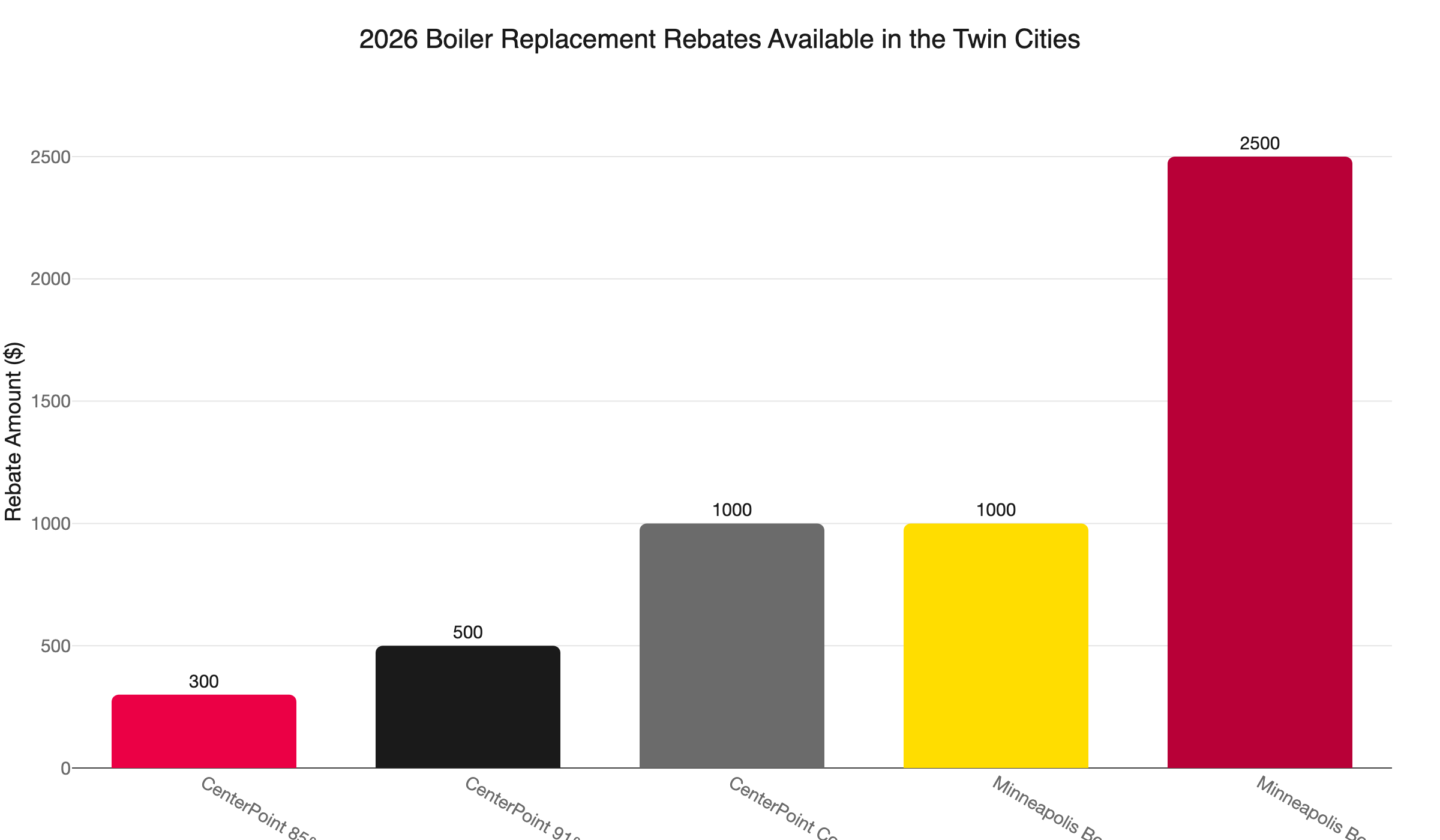
CenterPoint Energy offers rebates through December 31, 2026. Equipment must be new, listed on AHRI or ENERGY STAR, and installed between January 1 and December 31, 2026. Application must be postmarked by December 31, 2026.
- Replacement boiler at 85%+ AFUE: $300
- Replacement condensing boiler at 91%+ AFUE: $500
- Replacement combination boiler and water heater at 91%+ AFUE: $1,000
Full details in the CenterPoint Energy MN Residential Heating Rebate PDF.
Xcel Energy: Xcel Energy discontinued residential gas furnace and boiler rebates on January 1, 2026. If you are an Xcel customer, there is no rebate available on a gas boiler replacement this year.
Minneapolis Bonus Rebate (stackable): Minneapolis homeowners may qualify for an additional stacked rebate. A condensing boiler at 95%+ AFUE installed alongside a qualifying air source heat pump is eligible for this bonus. The amount is up to $2,500 in the Green Zone or $1,000 in the Non-Green Zone. This stacks on top of the CenterPoint utility rebate. Requirements: 1-4 unit residence in Minneapolis, work completed after December 15, 2025, by a licensed MN contractor, first-come first-served. Full details at the Minneapolis Bonus Rebate program through MNCEE.
Federal 25C tax credit: Expired. The Section 25C Energy Efficient Home Improvement Credit has eligibility requirements based on when property is placed in service. If you installed a qualifying boiler recently, you may still be able to claim it on your tax return.
Minnesota Permit Requirements for Boiler Replacement
Minnesota requires a mechanical permit for all boiler replacements, including direct swaps. This is not optional. A permit protects you at resale and ensures the work is inspected.
Low-pressure steam systems at 15 psi and under are permitted locally through the Minneapolis or St. Paul building department. High-pressure steam above 15 psi is permitted through the Minnesota Department of Labor and Industry. Nearly all residential steam systems run at low pressure.
Minneapolis requires a minimum 90% AFUE for new construction heating equipment under its Climate Action Plan. A condensing boiler at 91%+ AFUE clears that bar. We pull permits on every job. That is part of the service.
Is a Full Conversion to Forced Air or a Heat Pump Worth It?
Only consider full conversion when you want central cooling, your radiators or distribution need full replacement anyway, or a major renovation is already opening walls. It is the highest-cost, highest-disruption tier, but it is the only path that adds central cooling without a separate system.
Full conversion means adding ductwork, decommissioning the steam distribution, and installing a furnace, heat pump, or dual-fuel system. You get forced air, central cooling, and a modern efficiency platform. The tradeoff is project scale.
Ductwork for a home with no existing ducts runs $6,500 to $13,000 for the ductwork alone. A high-velocity HVAC system for an older Twin Cities home without existing ductwork uses smaller, flexible runs that cause less damage to plaster walls and original millwork. That is worth considering in a historic Minneapolis home where walls matter.
If you want cooling without touching the heating system, a ductless mini-split is often a better fit. It adds cooling to specific zones without disrupting the steam distribution at all. See our post on ductless mini-splits in older Twin Cities homes for what that looks like in practice.
How Do I Decide Which Tier Is Right for My Home?
Start at tier one every time. A tune-up and vent replacement often pays for itself within one heating season. Move up the tiers only when tier one is fully addressed or the boiler itself is the limiting factor.
Go to Tier 1 if:
- Your boiler is under 20 years old and holds steady pressure
- You have uneven heat, banging, or one persistently cold room
- You have never had a full steam system tune-up
Go to Tier 2 if:
- Your boiler is 20 to 25 years old or older
- You are spending $500 or more per year on repairs
- A tune-up helped but you want higher efficiency
- You want to capture the CenterPoint rebates before December 31, 2026
Go to Tier 3 if:
- You want central air conditioning added at the same time
- Radiators or distribution piping need full replacement regardless
- A major renovation is already opening walls and ceilings
Not sure which tier you are in? A diagnostic visit answers it in one appointment.
What Should I Do Before Calling a Contractor?
Gather a few quick data points before the visit. This speeds up the diagnosis, helps you compare quotes accurately, and keeps you from being oversold on equipment you may not need.
Walk through the house and note the following:
- Which rooms run coldest and how far they are from the boiler
- Which radiators hiss constantly or bang at startup
- Your boiler’s current pressure gauge reading (over 2 psi is too high on most residential systems)
- The boiler’s age, usually on a metal tag near the burner
- Whether one pipe or two pipes enter each radiator
- Any recent repairs and what was replaced
That information helps a technician work faster. It also gives you footing to evaluate quotes side by side.
Ready to Upgrade Your Steam Heat System in the Twin Cities?
We are locally owned and operated in Ramsey, MN. We serve Minneapolis, St. Paul, Blaine, Maple Grove, Brooklyn Park, Plymouth, Woodbury, Bloomington, and the surrounding Twin Cities area. Steam heating is part of our regional expertise, not a specialty we call in from somewhere else.
Every appointment is backed by our “Always On Time… Or You Don’t Pay a Dime!(R)” guarantee. You schedule the visit. We show up when we said we would.
Call (763) 260-6662 or book online to schedule a steam heating diagnostic or boiler replacement estimate. We will tell you honestly which tier fits your home. If a $40 vent replacement is all you need, that is what we will say.
Frequently Asked Questions
Do I need to replace my boiler or can I just fix what I have? +
What rebates are available for boiler replacement in Minnesota in 2026? +
How much does upgrading a steam heat system cost in the Twin Cities? +
Need a technician now?