
Boiler Expansion Tank Symptoms: $195 Fix or New Boiler?
Key Takeaways
- Pressure swings and a dripping relief valve are the two clearest boiler expansion tank symptoms.
- When the tank is waterlogged, system pressure can exceed 30 PSI, forcing the relief valve open on every heating cycle.
- Two quick tests, the tap test and the Schrader valve test, tell you whether the tank needs a recharge or full replacement.
- A bladder tank that gradually lost its air charge may only need a recharge to 12 PSI, not a new tank.
- A dripping relief valve, ignored long enough, can clog from mineral deposits and lose the ability to protect your boiler from dangerous overpressure.
- Tank replacement typically costs $300 to $800 installed. A full boiler replacement runs $5,000 to $10,000 or more.
- Minnesota code requires an expansion tank in every hot water heating system. Boiler work must be done by a licensed contractor.
Boiler expansion tank symptoms often look scarier than they are. Your pressure gauge climbs on every heating cycle. The relief valve drips onto the floor. Someone mentions a new boiler.
Before you start pricing a replacement that costs $5,000 to $10,000 or more, take a breath. In most cases, those symptoms trace back to a single part: the expansion tank. It typically costs $30 to $200. A licensed technician can replace it in an hour or two.
What Does a Boiler Expansion Tank Do?
The short answer: The expansion tank holds a pressurized air cushion that absorbs expanding water as your boiler heats up. Without it, pressure builds every time the heat fires. A working tank keeps system pressure in the safe range. A failed tank lets pressure climb until the relief valve vents it.
Water expands when it heats up. In a closed hydronic system, that expanding water has nowhere to go unless the system has a designated buffer. The expansion tank is that buffer. Inside the tank, a rubber bladder separates an air chamber from the water side. As hot water expands, it compresses the air cushion and holds system pressure steady.
When the bladder fails or the tank becomes waterlogged, the air cushion is gone. Expanding water has no safe place to go. Pressure climbs. The relief valve opens to release it. The auto-feed valve draws in makeup water to replace what was lost. The cycle repeats on every heating cycle.
That cycle is what produces the symptoms homeowners call us about.
What Are the Most Common Boiler Expansion Tank Symptoms?
The short answer: The clearest signs are a pressure gauge climbing above 20 to 22 PSI during heating, a relief valve that drips or spits regularly, and a system drawing in makeup water frequently. Any one of these is worth a tank inspection before you spend money on anything else.
Pressure gauge reads high during heating cycles
Normal residential boiler operating pressure is 20 to 22 PSI at operating temperature. Above 30 PSI is abnormal and usually points to the expansion tank. If your gauge climbs well past that mark on every heating cycle, start with the expansion tank before chasing anything else.
The pressure/temperature relief valve drips
The T&P relief valve is designed to open at roughly 30 PSI as a last-resort safety measure. When the expansion tank is waterlogged, system pressure can exceed 30 PSI on every heating cycle, forcing the valve to open regularly. That drip is the system trying to protect itself. It is not a coincidence.
The auto-feed valve cycles constantly
Each time the relief valve opens and water drains, system pressure drops. The auto-feed valve adds makeup water to compensate. If you hear the system frequently drawing in cold water, or you notice the pressure gauge dip and recover during a heating cycle, the expansion tank is a likely culprit.
Water stains or puddles near the relief valve
Mineral stains or a puddle near the relief valve discharge pipe means the valve has been opening and draining. That is water your expansion tank should have been absorbing.
Why Is My Pressure Relief Valve Dripping?
The short answer: A dripping T&P valve almost always means system pressure is hitting 30 PSI or higher on heating cycles. The expansion tank is the most common cause. Fix the tank and the valve typically stops dripping.
The relief valve is not designed to open regularly. It is a last-resort safety device. When it opens repeatedly, two things happen. First, water drains onto the floor or into a discharge pipe. Second, minerals in that water deposit around the valve seat each time it closes.
Over time, those deposits build up. The valve seat becomes coated and pitted. The valve that was supposed to open only at dangerous pressures can no longer seal properly, so it drips even at normal pressures. In the worst case, the deposits clog the valve seat completely.
That is when you move from a maintenance issue to a genuine safety concern. We cover that in the next section.
The right fix at the dripping-valve stage is to diagnose and repair the expansion tank. Replacing the T&P valve in isolation restarts the deposit cycle on a new valve and leaves the root cause untouched.
When Boiler Expansion Tank Symptoms Become a Safety Issue
Most articles describing boiler expansion tank symptoms mention the dripping relief valve and move on. This part is worth slowing down for.
The relief valve that is supposed to catch dangerous overpressure can become non-functional from the deposits left by the very leaks it is causing. Read that again.
A boiler running at dangerous overpressure without a working relief valve is at risk of a catastrophic failure. That failure mode is called a BLEVE (boiling liquid expanding vapor explosion). This is not a common outcome. It is, however, the exact outcome the relief valve exists to prevent. Letting that valve drip through a heating season does not just create a mess on the floor. It slowly removes the one device standing between your boiler and that failure.
A dripping relief valve is not a nuisance to schedule for next spring. Each heating cycle it opens deposits minerals on the valve seat. Get the expansion tank tested when you see the first drip.
How Do You Test a Boiler Expansion Tank at Home?
The short answer: Two quick tests take about two minutes each and require no special tools. The tap test tells you whether the tank is waterlogged. The Schrader valve test tells you whether the bladder has ruptured. Both must be done with the system cold.
Test 1: The Tap Test
Let the boiler cool until the system is at room temperature. Find the expansion tank. It is usually a football-shaped or cylindrical tank mounted near the boiler, connected to the supply pipe. Knock on it firmly with your knuckle or a coin, starting at the bottom and working up toward the top.
A healthy tank sounds hollow at the top, where the air cushion lives. A waterlogged tank sounds dull and solid throughout because water has displaced the air. If the entire tank sounds solid, the air cushion is gone.
Test 2: The Schrader Valve Test
Most bladder-type expansion tanks have a Schrader valve on the air side. It looks exactly like a tire valve stem. With the system cold:
- Locate the Schrader valve. It is usually on the end opposite the water connection.
- Press the center pin gently with a small screwdriver or the back end of a tire pressure gauge.
- If air comes out, the bladder may still be intact and the tank may only need a recharge.
- If water comes out, the bladder has ruptured and the tank must be replaced, not recharged.
Do not perform this test with the system hot and pressurized. Depressing the pin under pressure can release scalding water or steam.
Should You Recharge the Tank or Replace It?
The short answer: If the Schrader valve released air, try a recharge first. If it released water, the bladder is ruptured and the tank must be replaced. No amount of recharging will fix a ruptured bladder.
Recharging (bladder intact):
A bladder-type tank that gradually lost its air charge may only need a recharge to 12 PSI and can be perfectly serviceable. Use a bicycle pump or small air compressor. With the system cold and water-side pressure released, connect to the Schrader valve and pump until a tire gauge reads 12 PSI. The pre-charge pressure should match the system’s cold fill pressure, so verify your system fill pressure before you set the pre-charge.
After recharging, run the boiler through a full heating cycle and watch the gauge. If it holds in the 20 to 22 PSI range and the relief valve stays quiet, the recharge worked.
Replacing (bladder ruptured):
If water came out of the Schrader valve, the tank comes out. This means shutting down the boiler, releasing system pressure, disconnecting the tank, and installing a new unit set to the correct pre-charge pressure. Minnesota code requires a licensed contractor for this work.
One more note for owners of older homes: if your system has a steel atmospheric-type expansion tank rather than a bladder tank, that design requires periodic draining to restore the air cushion rather than a Schrader valve recharge. These older open-top tanks are still found in older Minnesota homes and need a different diagnostic approach. A licensed tech can confirm which type you have.
What Does Boiler Expansion Tank Replacement Cost?
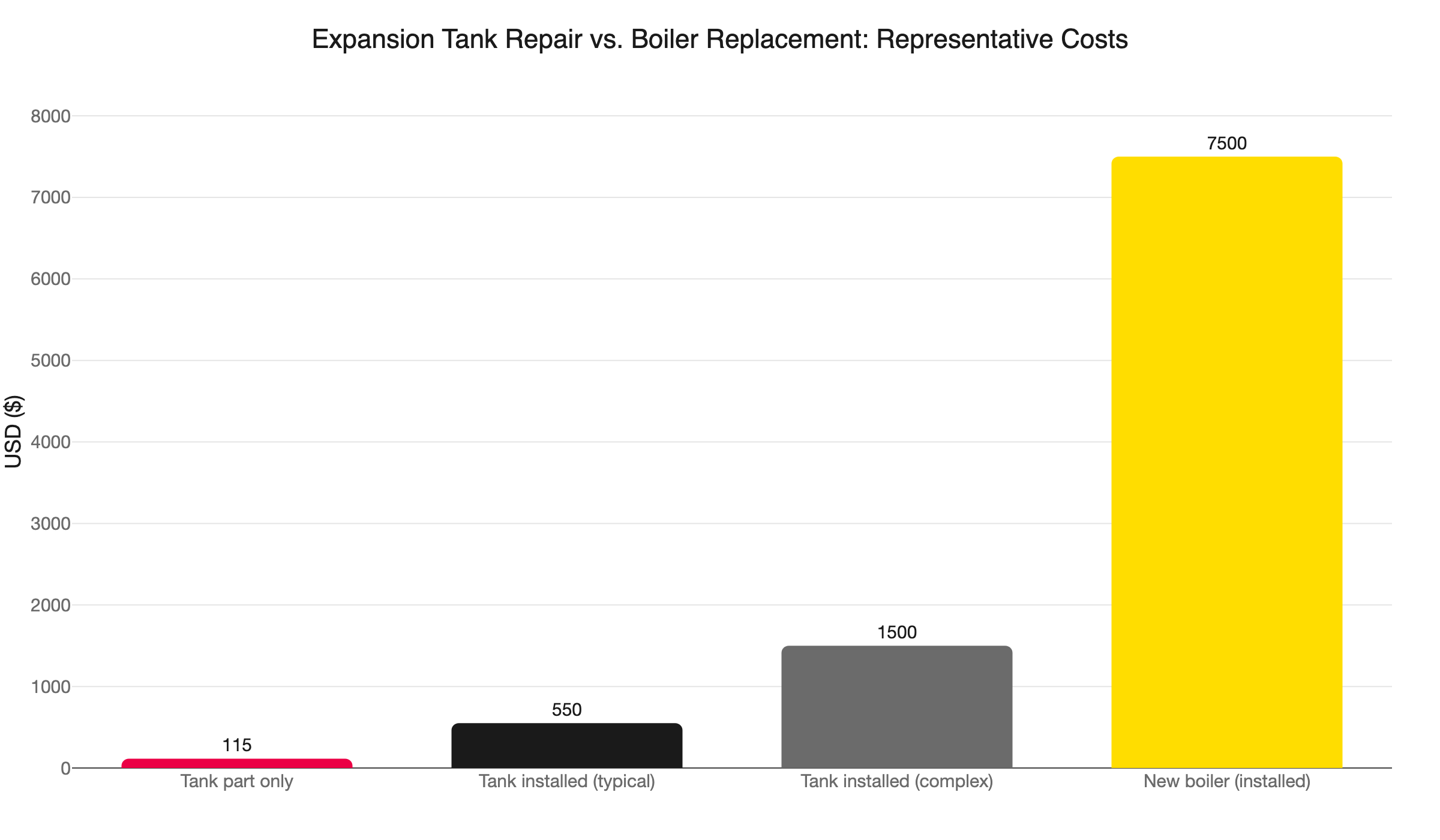
The short answer: The tank part alone runs $30 to $200. Installed, most homeowners pay $300 to $800. Complex multi-zone systems can push that to $1,500. Compare that to $5,000 to $10,000 or more for a new boiler, and the expansion tank fix is a very different conversation.
The expansion tank itself typically costs $30 to $200 for a residential unit. A common Amtrol No. 30 hydronic expansion tank retails for about $44 at home improvement stores. With parts and labor, most homeowners pay $300 to $800 for a standard swap, with complex multi-zone installs reaching up to $1,500.
Compare that to a full boiler replacement, which typically costs $5,000 to $10,000 or more installed.
There is one more reason the expansion tank fix matters beyond the immediate repair bill. Each time a waterlogged boiler vents through the relief valve, it draws in fresh makeup water through the auto-feed. That fresh water brings new oxygen and minerals into the system. Both accelerate internal corrosion. A failed expansion tank, ignored long enough, shortens the actual lifespan of the boiler behind it. The $150 part is also protecting the $8,000 system it is connected to.
Does Minnesota Require a Boiler Expansion Tank?
The short answer: Yes. Minnesota Mechanical Code requires an expansion tank in every hot water heating system. The state’s plumbing code adds requirements for homes with pressure regulators or backflow preventers, which covers most Twin Cities homes. Operating a closed system without a functioning expansion tank is a code violation.
Minnesota Mechanical Code Section 1009 requires an expansion tank in every hot water heating system. The plumbing code goes further. Minnesota State Plumbing Code Section 608.2 requires an expansion tank downstream of any pressure regulator. Section 608.3 requires one wherever a check valve or backflow preventer is on the supply line. Most Twin Cities homes meet at least one of these conditions.
Boiler installation and repair in Minnesota must be performed by a licensed contractor under MN Statutes 326B.94-326B.998, enforced by the Department of Labor and Industry. This is not a formality. Working on a boiler without a license voids manufacturer warranties and creates liability if something fails.
Minnesota’s climate adds one more dimension. Our heating degree days are among the highest in the lower 48. More heating cycles mean more compression-expansion cycles on the tank’s rubber bladder. Bladder fatigue happens faster here than in warmer climates.
Older Twin Cities homes may have atmospheric-type expansion tanks that predate modern bladder technology. These require draining rather than recharging. A licensed technician can confirm which type you have and whether it is still code-compliant.
How Long Does a Boiler Expansion Tank Last?
The short answer: Bladder-type tanks have a finite lifespan. Most work well for several years, but Minnesota’s heavy heating demand shortens that window. If your tank is more than a decade old and has never been tested, it is worth a check during your next boiler service visit.
Signs that a tank is approaching end of life rather than just needing a recharge include:
- The tank has needed a recharge more than once in the past two to three years.
- System pressure never fully stabilizes even after a recharge.
- The tank is over 10 years old and has never been pressure-tested.
- The tap test sounds solid from bottom to top even shortly after a recharge.
Annual boiler maintenance service is the most reliable way to catch expansion tank problems before they show up as a dripping valve on a January night. Our guide on what to expect from boiler annual maintenance in Minnesota covers what a technician inspects at each visit, including the expansion tank pressure check.
Schedule Your Boiler Inspection with Northern One Hour
A failed expansion tank is a small problem that grows into a larger, potentially dangerous one if you leave it. If your boiler pressure gauge climbs high on every cycle, your relief valve is dripping, or the system has not been inspected this season, this is the right time to call.
Northern One Hour is locally owned and operated in Ramsey, MN, and serves the full Twin Cities metro, including Minneapolis, St. Paul, Blaine, Maple Grove, Plymouth, Brooklyn Park, Woodbury, and Bloomington. We show up when we say we will. That promise is built into everything we do: “Always On Time… Or You Don’t Pay a Dime!(R)”
A boiler diagnostic visit gives you a straight answer. You will know whether it is a $195 expansion tank fix or something else entirely before you commit to any repair.
Call us at (763) 260-6662 or schedule service online.
If you are also seeing uneven heating across rooms or zones that are not responding, our post on boiler zone valve failure symptoms and costs in Minnesota covers that companion problem. And if you are weighing whether a boiler system is still the right fit for your home, the boiler vs. forced air furnace comparison for Minnesota walks through what each option costs and where each one wins.
Frequently Asked Questions
How do I know if my boiler expansion tank is bad? +
Can I recharge a boiler expansion tank instead of replacing it? +
How much does it cost to replace a boiler expansion tank? +
Need a technician now?