
Emergency Boiler Repair in the Twin Cities: What Counts
Key Takeaways
- No heat during a Minnesota cold snap is a health emergency, not a scheduling inconvenience. Call around the clock.
- Gas smell means leave immediately. Do not use your phone inside. Call CenterPoint from outside at 612-372-5050 or 800-296-9815.
- Carbon monoxide symptoms (headache, nausea, dizziness) mimic the flu. If your CO alarm sounds, get everyone out and call 911.
- A frozen condensate pipe is a common January and February lockout you may be able to clear yourself with warm water.
- Check the thermostat, circuit breaker, pressure gauge, and fault code before the tech arrives.
- Only licensed contractors may legally perform gas and mechanical boiler repair in Minnesota under statute 326B.
- Northern One Hour is locally owned and operated in Ramsey, MN, and our team is available around the clock.
What Counts as an Emergency Boiler Repair?
Call for help right now if your boiler has stopped producing heat and temperatures are below 20°F, if your CO alarm is sounding, if you smell gas, or if water is actively leaking near the unit or its connections.
Twin Cities January lows average -4°F to -8°F. Windchill routinely hits -20°F to -30°F. A home without heat can drop to dangerous temperatures within a few hours at those numbers. That is a life-safety issue for children, elderly residents, and anyone without a backup heat source.
Here is how to sort your situation quickly.
Call for emergency boiler repair now if:
- The boiler is not producing heat and outdoor temps are below 20°F
- Your CO alarm has activated, or anyone in the home has a sudden headache, nausea, or dizziness
- There is a gas odor anywhere in the home
- Water is actively leaking at the boiler, piping manifold, or radiators
- The pressure gauge reads well below 12 PSI and will not hold after a single repressurization attempt
This can likely wait until business hours if:
- One zone is cool but the rest of the home is comfortable and warm
- The boiler is making a new noise but still producing heat
- Pressure is dropping slowly with no visible leak
- A thermostat or non-critical valve needs replacement and outdoor temps are moderate
If you land in the first column, call (763) 260-6662. We are locally owned and operated in Ramsey, and our team is available around the clock.
What Are the Warning Signs of a Serious Problem?
The clearest red flags are complete loss of heat, a CO alarm, gas odor, or an active water leak. Any one of these is a call-tonight situation, not a wait-and-see.
Complete loss of heat. A boiler that will not fire after a single reset attempt is a medical risk during a hard freeze. Do not wait until morning.
CO alarm activation. Minnesota averages 14 CO deaths per year, with more than 300 people visiting emergency departments annually for CO poisoning. Gas boilers are a confirmed household CO source. If the alarm sounds, get everyone out and call 911 before you call any contractor.
CO symptoms without an alarm. CO poisoning symptoms - headache, nausea, and dizziness - closely mimic the flu. If multiple household members feel sick at the same time, treat it as CO exposure until emergency services confirm otherwise.
Gas odor. A gas smell is a utility emergency before it is a boiler repair. See the next section.
Active water leak. Water pooling at the boiler base, expansion tank fittings, or zone valve connections signals a pressure failure or a cracked component. Left overnight, a leak causes floor damage, mold, and accelerated system corrosion.
Pressure below 12 PSI. Normal residential boiler pressure is 1 to 2 bar, or roughly 12 to 30 PSI. Below 12 PSI, the system cannot circulate water properly. Most boilers lock out automatically before damage occurs, but low pressure is a sign something has failed.
What Should You Do When You Smell Gas?
Leave the house immediately. Do not flip any switches, use your phone, or stop to gather belongings. Once you are outside and away from the building, call CenterPoint at 612-372-5050 or 800-296-9815.
A gas smell is a utility call first and an HVAC call second. Follow this sequence exactly.
- Exit the home immediately and leave the door open to help ventilate.
- From outside or a neighbor’s home, call CenterPoint Energy at 612-372-5050 or 800-296-9815.
- If anyone feels ill or you cannot reach CenterPoint, call 911.
- Do not re-enter until CenterPoint technicians have cleared the building.
CenterPoint confirms that gas leak repair belongs to utility technicians, not homeowners or HVAC contractors. Once the utility clears the situation, call us to inspect and repair the boiler.
What to Do Before the Tech Arrives
These steps are safe for any homeowner to take while waiting for service. None require special tools, and they can save time and help our technician arrive with the right parts.
Check the thermostat. Confirm it is set to Heat mode and the setpoint is above the current room temperature. A dead battery or a mode switch that got bumped is a surprisingly common cause of a no-heat call.
Check the circuit breaker. Locate the breaker labeled for your boiler or heating system and confirm it has not tripped. Reset it once if it has. If it trips again immediately, stop and wait for the tech.
Read the pressure gauge. Normal operating range is 12 to 30 PSI. If it reads below 12, the system has lost water. You can slowly open the feed valve to add water, but if pressure will not hold, there is likely a leak somewhere in the system. Our guide on diagnosing a boiler that keeps losing pressure in Minnesota walks through each possible cause.
Press the reset button once. Most modern boilers have a red reset button on the control panel. Press it once and wait 30 to 60 seconds. If the boiler fires, monitor it for 10 minutes to confirm it stays running. Do not press the button repeatedly. Multiple resets can mask a serious underlying fault.
Write down the fault code. Newer boilers display a lockout or fault code on a small LED readout. Note the exact code before calling. It often lets our technician arrive with the right parts on the first trip.
Clear access to the boiler. Minnesota Mechanical Code requires an unobstructed 18-inch clearance passageway around boilers for inspection and service. Move stored boxes, bikes, or other equipment before the tech arrives. It reduces your service call time.
Is a Frozen Condensate Pipe a Boiler Emergency?
Often not. A frozen condensate line causes a fault lockout that looks identical to a complete boiler failure, but you may be able to clear it yourself with warm water in 10 to 15 minutes.
This is one of the most common calls we handle in January and February across the Twin Cities. In many cases, the homeowner resolves it before the tech ever arrives.
What happens: High-efficiency condensing boilers produce acidic condensate as a combustion byproduct. That liquid drains through a PVC pipe that exits through an exterior wall. When temperatures drop sharply, the pipe can freeze at the exit point. The boiler detects a blocked drain and shuts down in fault mode.
How to check: Find the white or gray PVC pipe that exits your exterior wall near the boiler, usually low on the wall. In a hard freeze, you may see visible frost or ice where the pipe exits the siding.
How to thaw it: Pour warm water, not boiling, over the exterior section of the pipe. Boiling water can crack PVC. You can also wrap a warm, wet cloth around the frozen section. Once the pipe clears, press the reset button and let the boiler restart.
How to prevent it: Wrap the exterior pipe section with outdoor-rated pipe insulation before winter. Our technicians can also reroute the condensate drain to an interior floor drain during a service visit. That eliminates the freeze risk entirely.
Does Minnesota Require a Licensed Contractor for Emergency Boiler Repair?
Yes. Minnesota statute 326B restricts gas and mechanical boiler repair to licensed contractors. Homeowners are limited to owner-maintenance tasks: checking pressure, swapping a thermostat, or bleeding radiators.
The line is clear.
Homeowners can legally do:
- Check and adjust system pressure via the feed valve
- Replace a thermostat without adding new wiring
- Bleed air from radiators
- Thaw a frozen condensate pipe
Only licensed contractors can legally do:
- Work on gas valves, gas connections, or the supply line
- Repair or replace the burner, heat exchanger, or combustion components
- Perform any work that requires a permit under Minnesota DLI
- Replace the boiler or make major system modifications
Hot water boilers over 200,000 BTU require a DLI permit for installation and major repair. Steam boilers over 100,000 BTU also require a permit. Permitted work must be performed by a licensed mechanical contractor who carries a $25,000 bond filed with the state.
When Northern One Hour technicians arrive at your door, they are licensed, bonded, and meet Minnesota’s requirements for gas and mechanical work. That is not optional. It is the baseline for every call we take.
What Does Emergency Boiler Repair Cost in the Twin Cities?
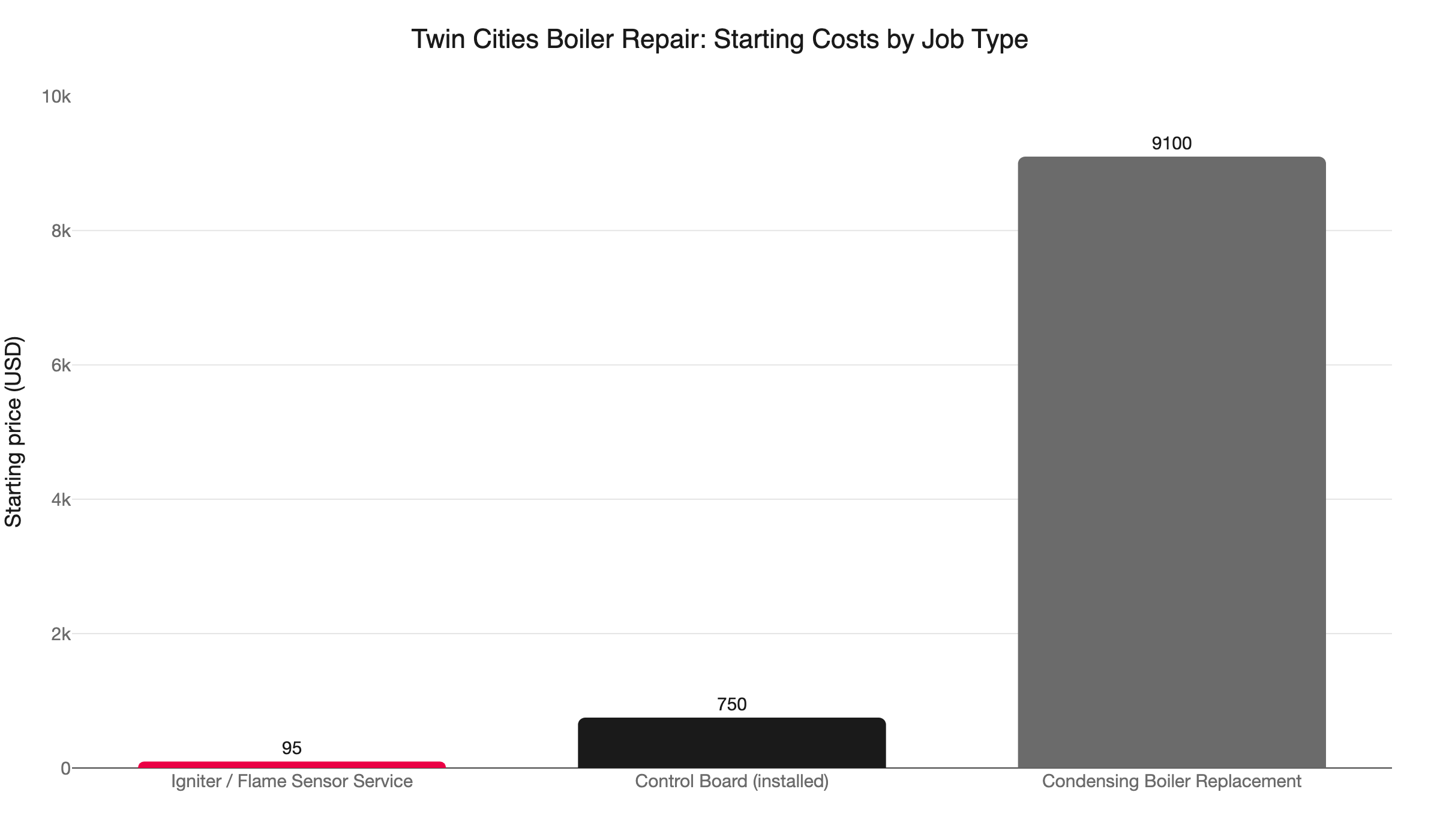
Igniter or flame sensor service runs $95-$325. A control board replacement runs around $750. After-hours emergency calls add $180-$270 per hour on top of standard rates. A full condensing boiler replacement starts at $9,100-$15,600 installed.
Here is what to expect by job type:
Minor service and component repairs:
- Flame sensor or igniter service: $95-$325
- Capacitor (where applicable): $195-$500
- Control board, installed: approximately $750
Motor and larger component repairs:
- Circulator or blower motor, installed: $1,100 and up depending on motor type
- Draft inducer motor: $375-$900, higher on certain boiler brands
After-hours premium: Emergency calls outside standard business hours carry an additional $180-$270 per hour on top of standard rates. Every legitimate contractor in the Twin Cities charges this. We tell you upfront so there are no surprises on the invoice.
Repair vs. replace: Boilers over 15 years old often make more financial sense to replace than repair. If the estimate approaches $1,500, run both options before committing. A new condensing boiler installed in the Twin Cities starts at $9,100-$15,600. Boiler size, fuel type, and the complexity of your existing hydronic system all move that number.
See our complete guide on boiler replacement cost in Minnesota to understand what drives pricing in either direction. We offer financing for larger replacements. Ask our team about current plans when you call.
How Does a Boiler Create Carbon Monoxide Risk?
A cracked heat exchanger, a blocked flue, or a burner running out of adjustment can all cause a boiler to produce CO. The risk peaks in winter, when systems run constantly and homes are sealed against the cold.
Minnesota Commerce has confirmed that heating season CO dangers rise sharply as heating systems run continuously and homes are insulated against cold weather. The Minnesota Department of Public Safety notes that CO incidents are most common in winter when heating systems malfunction and tight home sealing concentrates the gas.
CO is odorless and colorless. You cannot detect it without a working alarm. That is why detector placement matters.
Where to place CO detectors:
- One on each floor of the home
- One within 10 feet of every sleeping area
- One near the boiler room, but not directly on the unit itself
For exact placement guidelines and detector recommendations specific to boiler homes, see our guide on carbon monoxide detector placement for furnaces and boilers in Minnesota.
If your alarm sounds:
- Get everyone, including pets, out of the house immediately.
- Leave the door open as you exit to help ventilate.
- Call 911 from outside or a neighbor’s home.
- Do not re-enter until emergency services clear the building.
- Schedule a boiler inspection before the unit runs again.
Never assume a CO alarm is a sensor glitch. Every alarm is real until a licensed tech confirms otherwise.
Can Annual Maintenance Prevent Boiler Emergencies?
Yes. Most of the emergency boiler repair calls we handle in January and February trace back to problems a fall tune-up would have found: a failing igniter, a dirty burner, a waterlogged expansion tank, or a condensate drain that needed clearing.
A single tune-up visit runs $95-$250. An annual maintenance plan runs $195-$390 and typically includes priority scheduling when an emergency does come up. One prevented after-hours call pays for two or three years of maintenance coverage.
Our team provides boiler repair and maintenance service across the full Twin Cities metro, including Minneapolis, St. Paul, Blaine, Maple Grove, Plymouth, Brooklyn Park, Woodbury, and Bloomington.
Schedule your fall service before the first hard freeze. That is when demand spikes and wait times grow. Getting ahead of it by a few weeks is one of the easiest calls a Minnesota homeowner can make.
If your boiler has stopped working tonight, call (763) 260-6662 now. We are locally owned and operated, we are licensed and bonded, and we back every call with our guarantee: “Always On Time… Or You Don’t Pay a Dime!(R).”
Do not wait out a Minnesota cold snap with a failed boiler. Call us now or book online to get a technician on the way.
Frequently Asked Questions
What qualifies as an emergency boiler repair in Minnesota? +
What should I do first when my boiler stops working? +
Can a homeowner legally repair their own boiler in Minnesota? +
How much does emergency boiler repair cost in the Twin Cities? +
What is CenterPoint's gas emergency line number in Minnesota? +
Need a technician now?