
Boiler Losing Pressure in Minnesota: When to Call a Tech
Key Takeaways
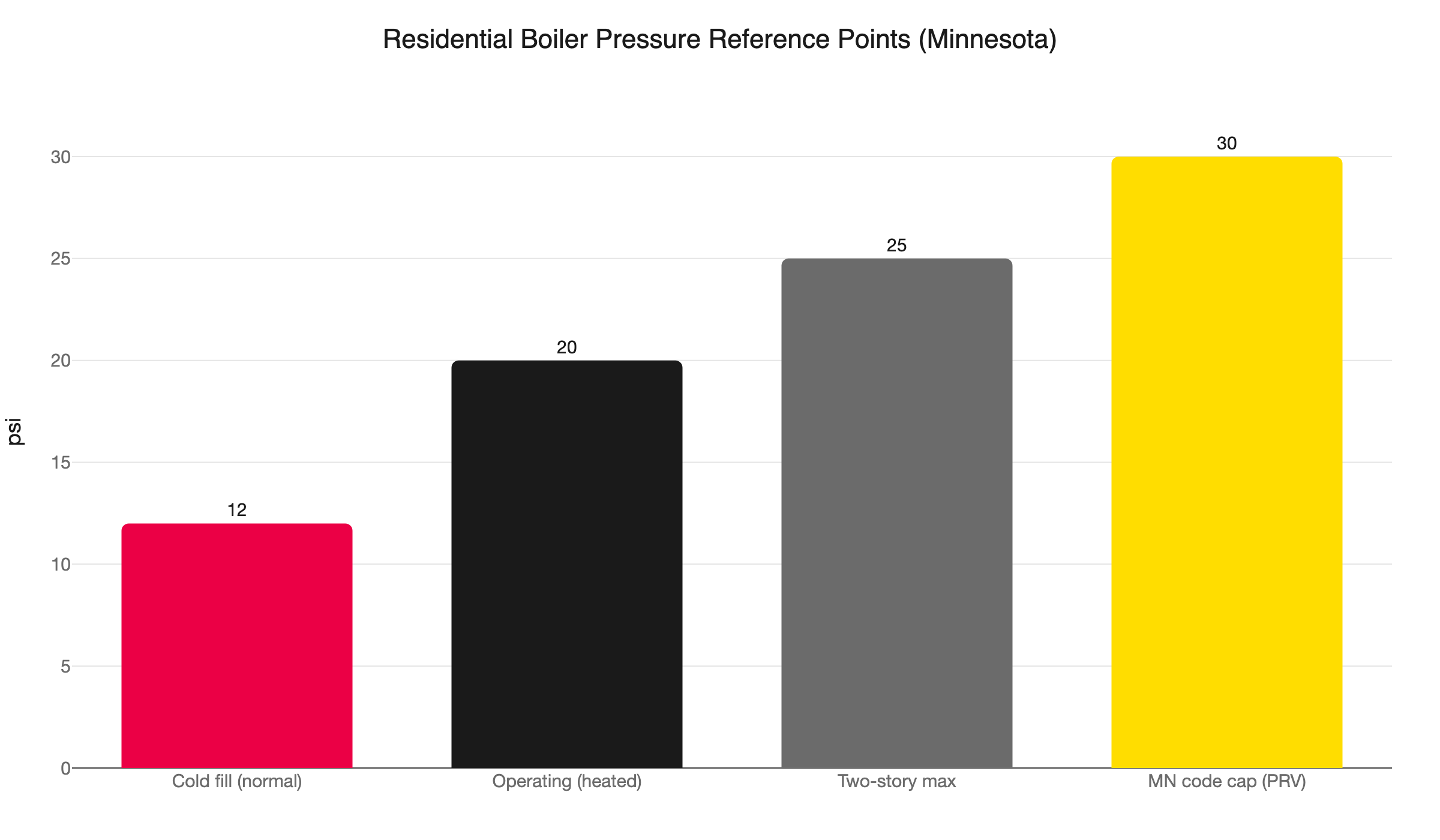
- Normal boiler pressure: 12-15 psi cold, 20-22 psi hot. Minnesota code caps residential systems at 30 psi via a required pressure relief valve (PRV).
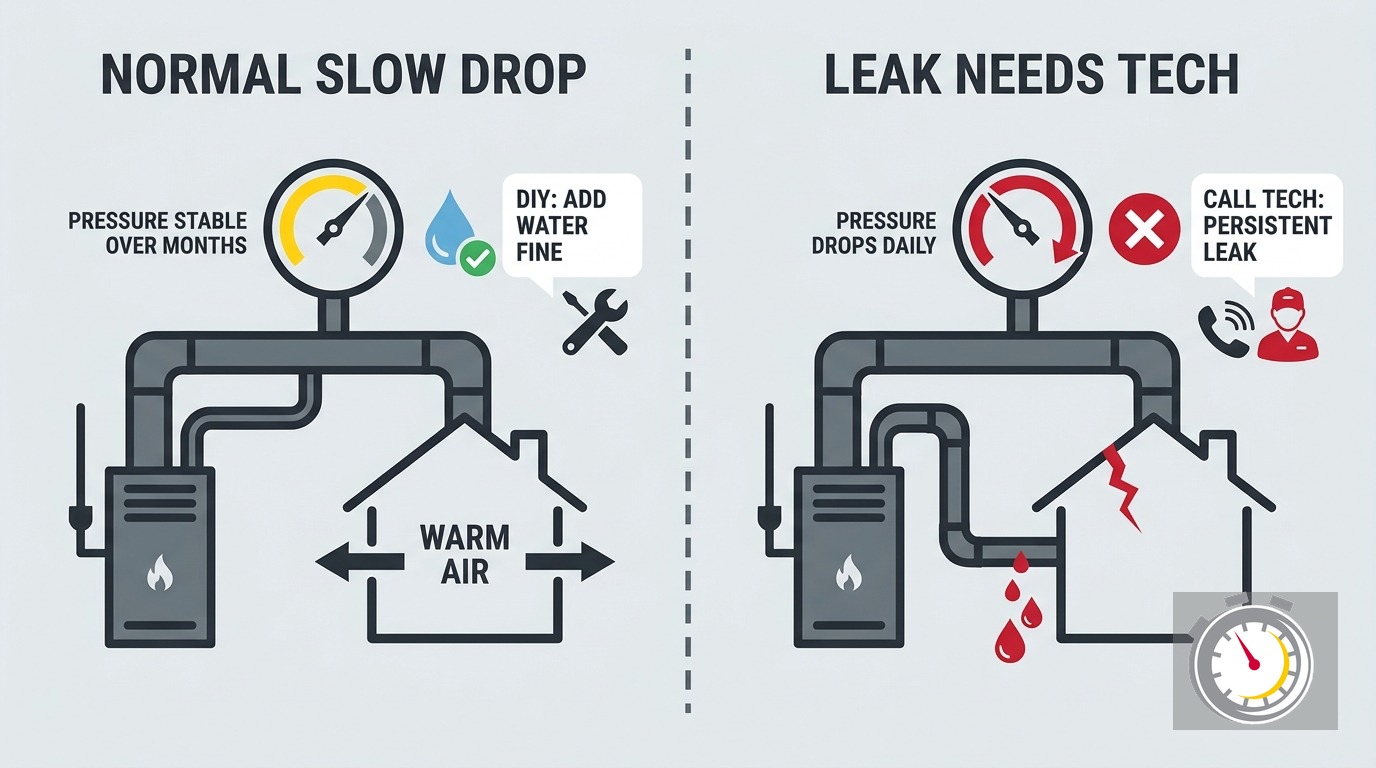
- Once-a-year top-up is normal. Once-a-month top-up is a problem that needs a diagnosis, not more water.
- The most common cause of recurring pressure loss is a waterlogged expansion tank - not a visible pipe leak.
- A dripping PRV is almost always a symptom of expansion tank failure. Replacing the PRV without fixing the tank will not solve it.
- Minneapolis and most Twin Cities suburbs have hard water (15+ GPG). Hard water accelerates mineral scale on PRV seats and heat exchangers.
- A repeatedly cycling PRV can clog with mineral scale and permanently fail, removing the boiler’s only pressure safety device.
- Residential expansion tanks typically last 5-8 years. If yours is in that range and you are losing pressure repeatedly, it is the first thing a tech should check.
- A boiler lockout at -10°F in January is not an inconvenience. It is a frozen-pipe risk. Do not defer this problem into winter.
Is Your Boiler Losing Pressure in Minnesota Normal?
The answer depends on frequency, not the number on the gauge. A once-a-year top-up on a sealed boiler is within normal range. If you are adding water monthly or more often, something is wrong. Frequency tells you more than the gauge reading alone.
If you are asking whether your boiler losing pressure in Minnesota is something to worry about, you are asking the right question. A hot-water boiler is a closed, sealed system. It is not designed to consume water the way a car burns oil. Slow, seasonal pressure loss is expected. Recurring monthly loss is not.
This post explains what the gauge is actually showing you. It covers why recurring pressure loss almost always traces to an expansion tank failure cycle most homeowners have never heard of. And it tells you exactly when to call a tech instead of reaching for the fill valve.
What Is Normal Boiler Pressure in Minnesota?
For most Twin Cities homes, normal operating pressure is 12-15 psi when cold and 20-22 psi when fully heated. Two-story homes may run up to 25 psi at operating temperature. Minnesota code caps residential hot-water boilers at 30 psi via an ASME-rated pressure relief valve.
Heating system guidelines recommend setting cold fill pressure at about 5 psi above what is needed to push water to the system’s highest point. A single-story ranch typically needs 12 psi. A two-story home often needs 15 psi.
A gauge that reads the same number hot and cold probably has a stuck needle. A gauge at zero when the system is cold has likely failed. Either way, verify the gauge is working before drawing conclusions from its reading. A basic pressure gauge swap is inexpensive compared to chasing a phantom pressure problem.
How Often Should a Boiler Lose Pressure?
Once a year or less is the normal range for a properly sealed system. If you are adding water more than twice in a single heating season, the system has a mechanical problem that needs diagnosis. Frequency is the signal that matters, not the pressure number alone.
Hot-water boilers run as closed loops. They are not designed to regularly consume water. Minimal loss over a full heating season - micro-seepage at fittings or evaporation at air vents - is within normal range. One top-up per year to restore the cold fill level is fine. Monthly top-ups are not.
Write down the date every time you add water. If the gauge returns to the low mark within 30 days of a top-up, stop adding water and call a tech. You are not managing a slow leak. You are masking a component failure.
Why Does a Boiler Keep Losing Pressure?
The four main causes are a waterlogged expansion tank, a dripping PRV, a slow pipe or fitting leak, and a stuck auto-fill valve. The expansion tank is the most commonly overlooked cause and the most important one to understand.
Expansion tank failure. When the tank’s internal diaphragm fails, it can no longer cushion the pressure rise from heated water. Pressure spikes every heating cycle. The PRV opens. The system cools, pressure drops. The fill valve adds water. From the outside, it looks like a persistent slow leak. It is not. It is a failed component driving a venting loop.
PRV dripping. A PRV that weeps steadily is almost always a symptom of expansion tank failure driving the pressure spike - not a standalone PRV problem. Replacing the PRV without addressing the tank will not fix it. The new PRV will start dripping within weeks for the same reason.
Pipe or fitting leak. A real leak shows up as water stains, mineral deposits, or wet spots near pipes, fittings, or radiator connections. Run your hand along accessible piping and check the boiler base. White or rust-colored mineral staining on a fitting means water has been weeping there for a while.
Auto-fill valve stuck open. The auto-fill valve lets fresh city water into the system when pressure drops below the set point. A stuck valve continuously adds new water, bringing dissolved oxygen and minerals into the closed loop. Over time that drives corrosion and scale buildup - especially in the Twin Cities, where most homes have hard water.
The Expansion Tank Failure Cycle: The Hidden Loop
This mechanic drives the majority of “I keep adding water but pressure keeps dropping” service calls. None of the articles homeowners typically find online explain it.
A healthy expansion tank has two chambers divided by a rubber diaphragm. The air side holds a pressurized cushion. The water side connects to the boiler loop. When the boiler fires and heats the water, the water expands. It grows roughly 4% by volume. That expansion pushes fluid against the diaphragm, compressing the air cushion. Pressure rises to normal operating range. When the boiler shuts off, the air cushion pushes fluid back. Pressure returns to the cold fill level. The PRV never opens.
When the diaphragm fails or the air charge bleeds off, the tank is waterlogged. It is a sealed steel vessel full of water, not a cushion. Every time the boiler fires, expanding water has nowhere to go except through the PRV. A waterlogged tank causes the PRV to vent water on every single heating cycle. InspectAPedia’s expansion tank diagnostic documentation describes this failure pattern in detail. The fill valve then replaces that vented water. The homeowner manually tops up the system when the gauge drops. Pressure normalizes temporarily. Two weeks later the cycle repeats.
This looks like a leak. It is a failed component creating a pressure venting loop.
The compounding risk is the PRV itself. A PRV that cycles repeatedly accumulates mineral scale on its seat and stem. It can eventually clog and fail permanently - either stuck open (constant weeping, no ability to hold pressure) or stuck closed (unable to relieve a true overpressure event). A PRV stuck closed is not a repair job. It is a safety incident. That is the argument for never letting a dripping PRV become the new normal.
Residential expansion tanks typically last 5-8 years. Diaphragm fatigue accounts for the majority of failures. If your boiler is in that age range and you are seeing recurring pressure loss, the expansion tank should be the first thing your tech checks. Our post on waterlogged expansion tank symptoms in Minnesota covers what that failure looks like in practice.
How Can I Tell If My Expansion Tank Has Failed?
Two quick DIY tests give you useful diagnostic information before you call a tech. Neither requires tools, and neither is definitive - but both point you toward an answer before you spend money on a service call.
The tap test. Find the expansion tank near the boiler. It usually hangs from a pipe and is often red or blue painted steel. Tap firmly on the bottom half with your knuckles. A hollow sound means the air cushion is still present. A dull, solid thud - the same sound as tapping a water-filled bottle - means the tank is waterlogged.
The Schrader valve test. Look for a valve stem on the tank that resembles a bicycle tire valve. Before testing: shut off the boiler. Let the system cool completely. Then bleed system pressure down to 0 psi at the drain valve. Press the center pin of the Schrader valve. Air comes out: the diaphragm is intact. Water comes out: the diaphragm has failed.
Never probe the Schrader valve while the system is pressurized. If the boiler is still hot or under pressure, wait. The tap test can be done at any time.
If either test suggests a waterlogged tank, call a tech. Expansion tank replacement requires depressurizing and draining the system. The tech removes the old tank and commissions the new one at the correct pre-charge pressure. That pre-charge must match your system’s cold fill pressure. Get it wrong and you recreate the same failure pattern.
Is It Safe to Keep Adding Water to My Boiler?
Adding water once or twice a heating season is fine and within normal range. Adding water monthly is not - and it actively makes the underlying problem worse, accelerating scale buildup and masking the real failure.
Every time you add fresh municipal water to a closed loop, you introduce dissolved oxygen and minerals. Oxygen drives internal corrosion. In most of the Twin Cities, the minerals are calcium and magnesium carbonate. They deposit as limescale wherever water is heated. That means your heat exchanger, the PRV seat, and the fill valve seat. Monthly top-ups over a single winter can accumulate more scale damage than three years of normal closed-loop operation.
There is also a diagnostic problem with repeated top-ups. Each one masks the symptom. Pressure normalizes. The PRV drip slows temporarily. Two weeks later the cycle starts again. The underlying failure - waterlogged tank, scaled PRV, failing fill valve - keeps degrading while appearing managed.
The practical rule: add water once, note the date, and watch the gauge. If pressure drops below your cold-fill target within 30 days, stop adding water and schedule a service call. The system is telling you something specific. It can not say it more clearly.
Minnesota Hard Water and Your Boiler
Most national articles on boiler pressure treat PRV failure and expansion tank degradation as generic HVAC problems. In the Twin Cities, there is a local factor that speeds every part of this failure pattern up: hard water.
Minneapolis city water tests at roughly 15 GPG hardness. Well water in the western and northern suburbs often reaches 18-20 GPG. St. Paul city water is softer - around 5-6 GPG after lime treatment - but still above the soft-water threshold. Hard water deposits calcium and magnesium carbonate as limescale wherever it is heated. That scale builds inside your heat exchanger, on your PRV seat, and inside your fill valve.
Scale on a PRV seat means the valve cannot close cleanly after it relieves pressure. A valve that cannot close cleanly drips. Replace the PRV without flushing the system first. The new valve often starts dripping within a year for the same reason.
Annual boiler maintenance is the practical counter to this pattern. Annual service catches scale buildup before it reaches the failure threshold. A tech checks corrosion inhibitor concentration, flushes accumulated scale, and inspects the PRV seat. Our guide to boiler annual maintenance in Minnesota explains what that visit covers and why it matters more here than the national averages suggest.
When Should You Call a Tech?
Three conditions mean call a tech instead of adding more water. First: you have added water more than twice this heating season. Second: the PRV is dripping or weeping. Third: pressure drops back to the low mark within 30 days of a top-up. Those three cover the majority of situations that need professional diagnosis.
The full call-now checklist:
- You have added water more than twice this heating season.
- The PRV is dripping, weeping, or discharging water to the discharge pipe or floor.
- Pressure drops below your cold-fill target within 30 days of a top-up.
- The tap test returns a solid, waterlogged thud on the expansion tank.
- The Schrader valve test (system fully depressurized first) produces water, not air.
- You can hear the PRV cycling - a brief hiss or drip - during or right after a heating call.
- You see mineral staining on fittings, the relief valve discharge pipe, or the boiler base.
- Your expansion tank is 7 or more years old and has never been serviced.
You can handle it yourself if pressure has dropped slowly over five or more months. There must be no visible drips or stains. And after a single top-up, the system must hold stable for at least 60 days. All three conditions together.
Cold zones, uneven heat, or banging pipes can share a root cause with pressure loss. Our post on boiler circulator pump failure signs and costs in Minnesota covers what to look for when the distribution side is also involved.
What Happens If I Ignore Boiler Losing Pressure in Minnesota?
In the short term, the boiler locks out on a low-pressure fault and stops heating the home. In Minnesota’s climate, a mid-winter lockout is a frozen-pipe risk - not an inconvenience.
Modern boilers refuse to fire when pressure drops below minimum operating level, typically around 10-12 psi. That protection is correct. The failure mode is discovering it at 2 AM in January. The thermostat has stopped satisfying. The house is already cooling.
At -10°F outside, an unheated home drops quickly. Water in uninsulated basement supply lines and exterior wall runs can begin to freeze within a few hours. Burst pipe damage often costs significantly more than the expansion tank or PRV repair that would have prevented the lockout.
The longer-term consequence is PRV degradation. A relief valve that cycles through multiple heating seasons accumulates scale on its seat and stem. At some point it stops functioning. Either it weeps constantly - uncontrolled pressure loss with water on the floor - or it seals shut, removing all overpressure protection. Either condition is more expensive to address than a proactive expansion tank replacement before the failure cascade starts.
The pattern is predictable. The fix is straightforward. The window to act before January is finite.
Schedule a Diagnosis Before January
If your boiler pressure gauge is telling you something is off, do not wait to find out exactly what.
Northern One Hour is locally owned and operated in Ramsey, MN. We serve Minneapolis, St. Paul, Blaine, Maple Grove, Plymouth, Brooklyn Park, Woodbury, Bloomington, and the broader Twin Cities metro. Our team backs every visit with the promise: “Always On Time… Or You Don’t Pay a Dime!(R)”
Call (763) 260-6662 or schedule online with our boiler repair and maintenance team. We handle pressure diagnostics, expansion tank testing and replacement, PRV inspection, and full annual boiler service. If you are overdue for your seasonal checkup, we can include it in the same visit.
Do not let a pressure problem become a January emergency.
Frequently Asked Questions
What is normal boiler pressure in a Minnesota home? +
How often should I need to add water to my boiler? +
What causes a boiler to keep losing pressure repeatedly? +
Is a dripping pressure relief valve on my boiler dangerous? +
Should I call a tech if my boiler loses pressure every month? +
Need a technician now?