
Boiler Tune-Up: What Does It Include for Twin Cities Homes
Key Takeaways
- A boiler tune-up includes nine tasks: combustion analysis, heat exchanger inspection, low-water cutoff test, expansion tank check, zone valve cycling, flue and vent inspection, thermostat calibration, pressure and temperature gauge check, and condensate drain inspection.
- CenterPoint Energy customers can claim a $25 Visa prepaid card for a qualifying boiler tune-up once every other year. Your tech must document the combustion efficiency and CO test.
- Minneapolis’s design heating temperature sits near -16°F. Twin Cities boilers run harder and longer than the national average demands. Annual service is not optional here.
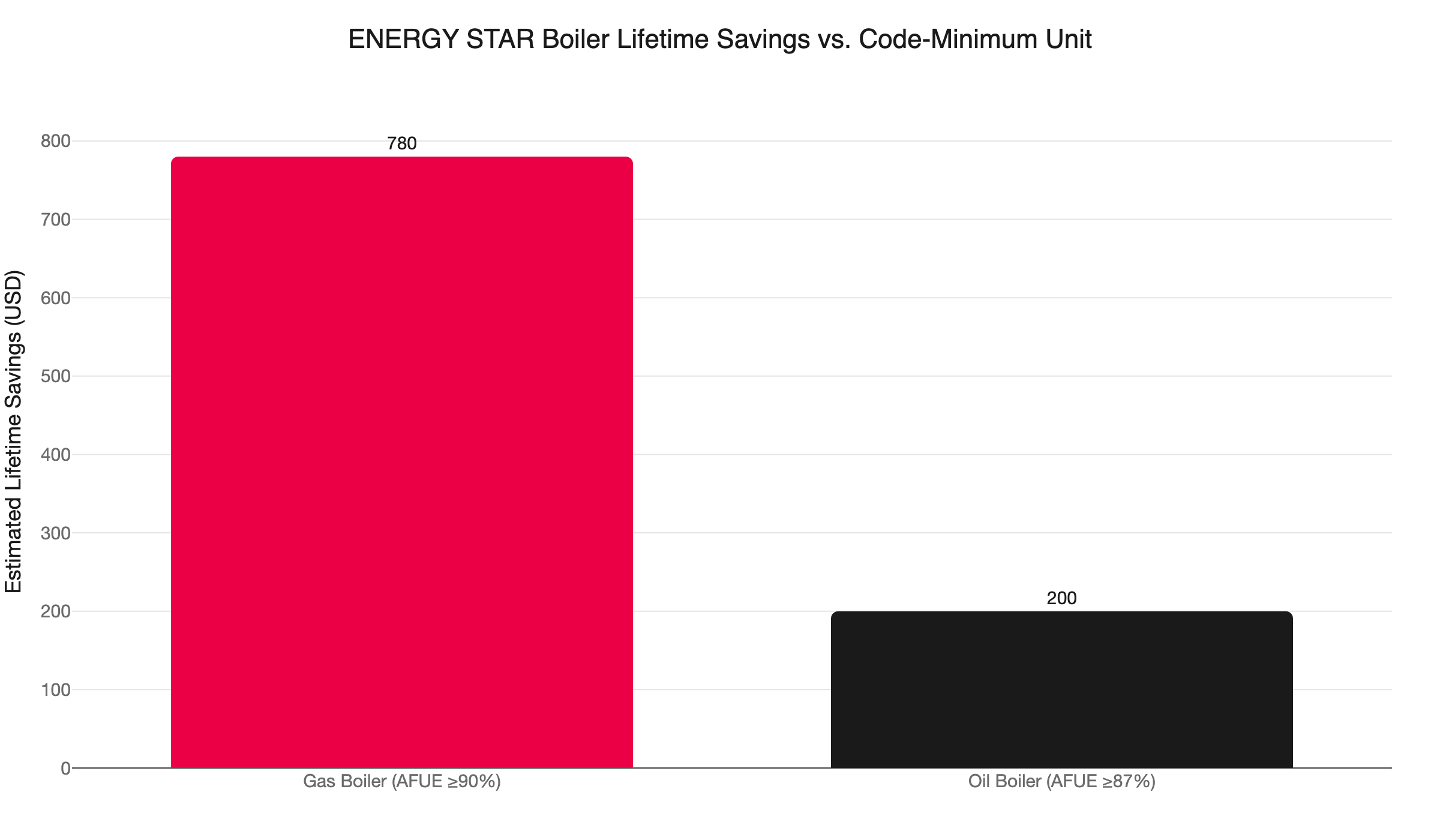
- ENERGY STAR certified gas boilers require AFUE of 90% or higher and save about $780 over their lifetime compared to a code-minimum unit.
- Call (763) 260-6662 or book your boiler tune-up online.
Why Boiler Maintenance Matters More in Minnesota
Minneapolis has a design heating temperature of about -16°F. Your boiler does not just run a few hours a day on cold days. It runs hard, near full capacity, for five to six months straight. That duty cycle accelerates wear on every component.
Add Twin Cities water to the picture. Minneapolis municipal water is moderately hard, around 150 to 180 milligrams per liter. That hardness leaves mineral scale on heat exchanger surfaces and inside radiators. Scale acts as insulation in the wrong place. It forces your boiler to burn more fuel to move the same amount of heat. That drives your monthly bill up without you noticing.
Annual boiler maintenance is the national recommendation. In Minnesota, it is table stakes.
What Does a Boiler Tune-Up Include?
A boiler tune-up typically includes a combustion analysis, heat exchanger inspection, low-water cutoff test, expansion tank check, zone valve cycling, flue and vent inspection, thermostat calibration, pressure and temperature gauge check, and condensate drain inspection. Most tune-ups take 60 to 90 minutes when the system is accessible.
Here is what your tech does at each step.
1. Combustion Analysis
This is the most critical test a tech runs on a boiler. An electronic flue gas analyzer measures oxygen levels and carbon monoxide parts per million in the exhaust stream. Those two numbers reveal whether your burner is mixing fuel and air at the right ratio.
A fuel-rich mix leaves unburned gas in the exhaust. A fuel-lean mix drops efficiency and can cause rough ignition. Both conditions produce elevated CO. Your tech adjusts the gas-to-air ratio until both readings fall within manufacturer spec. The adjustment is documented.
If you are a CenterPoint Energy customer, that documentation is what unlocks your $25 rebate. More on that below.
2. Heat Exchanger Inspection
The heat exchanger transfers heat from combustion gases to your water. Cracks or corrosion let combustion gases escape into the building. On a gas boiler, a cracked heat exchanger is a carbon monoxide hazard. Your tech inspects the exchanger visually and checks for scale buildup that reduces heat transfer.
If hard water has left significant mineral deposits, your tech may recommend a descaling treatment or water inhibitor injection. Our guide on carbon monoxide safety during furnace season covers the warning signs to watch for at home.
3. Low-Water Cutoff Test
Minnesota Mechanical Code requires a low-water cutoff valve on steam and hot-water boilers. This safety device shuts the burner down if water level drops below a safe threshold. That protects the heat exchanger from what techs call a “dry-fire.” A dry-fire can destroy a heat exchanger in minutes.
Your tech flushes the float mechanism or tests the probe to confirm the cutoff triggers correctly. This check protects the most expensive component in your system. It appears on every Northern One Hour boiler tune-up.
4. Expansion Tank Check
As water heats, it expands. The expansion tank absorbs that pressure change. If the tank’s air charge is depleted, the tank fills completely with water. It can no longer do its job. Pressure spikes then trip the relief valve and stress every fitting in the system.
The tap test reveals the tank’s condition quickly. A tech knocks on the tank with a knuckle. A healthy tank sounds hollow on top and solid at the bottom. A waterlogged tank sounds solid all the way through. The expansion tank tap test catches this before the relief valve starts weeping or the pressure gauge swings out of range. If the tank is waterlogged, the tech re-pressurizes the air charge or recommends replacement.
5. Zone Valve Cycling
Older Minneapolis and St. Paul homes with cast-iron radiators often run multiple zones controlled by zone valves. A zone valve controls which part of the house gets heat. Valves can stick open, overheating one zone. They can stick closed, leaving a zone cold. A failed end switch can stop the boiler from firing entirely.
Your tech operates every zone valve through a full open-and-close cycle. This confirms the valve moves freely, the end switch signals correctly, and the thermostat triggers the boiler to fire. This check appears on no local competitor’s published list.
6. Flue and Vent Inspection
Combustion exhaust must leave the building safely. Your tech checks flue pipes and vent connections for corrosion, gaps, and obstructions. On older boilers with draft hoods, the tech checks draft flow. On high-efficiency sealed-combustion boilers, the tech inspects the PVC intake and exhaust pipes for cracks, blockages, and proper slope for condensate drainage. A wasp nest inside an intake pipe over summer is a common fall surprise in the Twin Cities.
7. Pressure and Temperature Gauge Check
Your boiler operates within a specific pressure range: typically 12 to 15 psi at rest and up to 25 psi under load. Pressure that runs consistently high points to a waterlogged expansion tank, a faulty fill valve, or a stuck pressure-reducing valve. Your tech reads both gauges and cross-checks against the relief valve’s rated pressure. Anything outside normal range is flagged for follow-up.
8. Thermostat Calibration and Controls Test
Your tech checks the thermostat setpoint against actual room temperature. The tech also verifies the boiler fires and shuts off at the correct points. On systems with outdoor reset controls, the tech confirms the outdoor sensor reads correctly and the reset curve matches your home’s heat load. Outdoor reset is one of the most effective efficiency improvements on an older boiler. This diagnostic step is where that opportunity surfaces.
9. Condensate Drain Inspection
This step applies to high-efficiency condensing boilers. These units extract so much heat from exhaust that flue gases cool below the dew point. The result is acidic condensate that must drain properly. A clogged or frozen condensate drain can shut the boiler down on a cold night. Your tech checks the drain line for obstructions, confirms the neutralizer is not exhausted, and verifies the drain discharges to the correct location.
What Is a Combustion Analysis, and Why Should You Care?
A combustion analysis uses an electronic flue gas analyzer to measure oxygen concentration and carbon monoxide in boiler exhaust. The tech uses those numbers to optimize the fuel-to-air ratio, improving efficiency and confirming the system is not producing dangerous CO levels.
Most homeowners have never seen the test run. Here is the plain version.
Your boiler burns gas to heat water. How efficiently it burns that gas determines how much of each dollar of fuel actually heats your home. A burner running rich or lean wastes money and produces more CO. The analyzer gives your tech a number. The tech adjusts until the reading is in spec.
That matters especially in Minnesota. ENERGY STAR certified gas boilers require AFUE of 90% or higher. Letting combustion drift lowers effective efficiency even on a high-rated unit, and over a Minnesota heating season, that drift adds up on your gas bill.
Combustion analysis is also what CenterPoint Energy requires to verify a qualifying tune-up. The program requires the tech to test combustion efficiency and CO, and to adjust the gas-to-air mix if CO is elevated. Your tech’s written report is your proof of service for the rebate claim.
The $25 Rebate Most Twin Cities Homeowners Leave Behind
If your home is on CenterPoint Energy gas service, you may be eligible for a $25 Visa prepaid card through CenterPoint’s residential boiler tune-up rebate program. The rebate is available once every other year per system.
The qualifying criteria are specific. The tech must perform a combustion efficiency test and a CO test. If CO is elevated, the tech must adjust the gas-to-air mix. The work must be documented. That documentation is exactly what a complete boiler tune-up produces.
Most homeowners have no idea this rebate exists. None of the local HVAC companies currently advertising boiler tune-ups make the CenterPoint rebate a visible part of their offering. Northern One Hour documents the combustion test on every boiler tune-up as standard practice. Your rebate claim is ready to file when we finish.
Xcel Energy customers should check the Xcel Energy residential heating programs and rebates page for current amounts, as these are updated periodically. For a full breakdown of what is currently available in the Twin Cities, our post on Xcel and CenterPoint HVAC rebates in Minnesota has the current details.
How Often Should You Schedule a Boiler Tune-Up?
Schedule a boiler tune-up once a year, ideally in early fall before heating season begins. CenterPoint Energy customers can claim the $25 rebate once every other year, but annual service still protects your equipment and keeps your warranty intact.
Annual is the industry standard. Minnesota makes a strong case for sticking to it. Your boiler runs from roughly October through April in the Twin Cities, sometimes into May. That is six months of near-daily runtime. Components wear. Combustion settings drift. Mineral scale builds.
Skipping one year is not catastrophic. Skipping several years is how a $195 tune-up becomes a $1,950 repair or a premature $10,400 replacement.
The best time to schedule is August or September. Techs have availability. Your system is cold enough to service comfortably. Any problem found gets fixed before the first hard freeze hits in November.
What Does a Boiler Tune-Up Cost?
Boiler tune-ups in the Twin Cities typically run $130 to $250 for most residential systems. Combustion adjustments or minor part replacements may add to that cost. The CenterPoint $25 rebate reduces your net cost when your tech documents the required combustion and CO test.
If a component needs replacement, your tech quotes that separately before any work begins. Honest, upfront pricing is how we operate on every job.
A tune-up is the lowest-cost way to protect a high-value asset. A residential boiler replacement in the Twin Cities runs $6,500 to $13,000 or more installed. Annual service extends equipment life and keeps the warranty current on newer units. The math is simple.
Should You Repair or Replace After a Boiler Tune-Up?
If a tune-up surfaces a cracked heat exchanger, irreparable scale damage, or multiple failing components, the question shifts from maintenance to replacement. A boiler near or past 20 years old facing a major repair estimate may cost less to replace than to fix.
The tune-up is not a replacement trigger. It is an honest diagnostic. Most boilers in good shape come out of a tune-up running better than they went in.
If the tech finds something that warrants a replacement conversation, ask about efficiency and available incentives. ENERGY STAR certified gas boilers save approximately $780 over their lifetime compared to a code-minimum unit. ENERGY STAR certified oil boilers save approximately $200. High-efficiency replacements may also qualify for the federal 30% energy efficiency tax credit, capped at $600. Verify current eligibility at the ENERGY STAR federal tax credits page before assuming your unit qualifies, because IRS rules change from year to year.
If you are weighing whether a boiler is the right long-term system for your home, our comparison of boiler vs. forced-air furnaces in Minnesota walks through the trade-offs in detail.
Book Your Boiler Tune-Up Before the Rush
The shortest wait times are in August, September, and early October. By mid-November, every HVAC company in the Twin Cities is fielding no-heat calls. Booking now gets you a full diagnostic before heating season stress-tests your system.
Northern One Hour is locally owned and operated in Ramsey, MN. Our techs carry electronic flue gas analyzers on every boiler call. We document the combustion analysis and CO test so your CenterPoint rebate claim is ready to submit when we are done.
We stand behind every job with a 100% satisfaction guarantee and the on-time promise: “Always On Time… Or You Don’t Pay a Dime!(R)”
Call (763) 260-6662 or schedule your boiler tune-up online.
Frequently Asked Questions
What does a boiler tune-up include? +
How often should you get a boiler tune-up? +
Does CenterPoint Energy offer a boiler tune-up rebate in Minnesota? +
How much does a boiler tune-up cost in the Twin Cities? +
Need a technician now?