
Boiler Zone Valve Not Working? Here's What to Check
Key Takeaways
- A boiler zone valve not working means the boiler keeps firing, but heat never reaches one zone. The boiler itself is fine.
- Zone valves fail two ways: stuck closed (one zone goes cold) or stuck open (one zone overheats and your gas bill rises).
- An internal part called the end switch is what triggers your circulator pump. If the valve never reaches fully open, the pump never starts.
- Many zone valve powerheads snap off and can be replaced without draining your boiler system. Full valve body replacement is a bigger job.
- Dissolved oxygen in older systems corrodes zone valve components faster. A valve failure on a 20-plus-year-old system is worth a broader diagnostic.
- Minnesota requires a bonded mechanical contractor for boiler heating work. DIY zone valve replacement is uninsured under state law.
- If the diagnosis leads to a full boiler upgrade, CenterPoint Energy currently offers up to $300 back on qualifying high-efficiency boilers through December 2026.
What Is a Zone Valve and Why Does Your Boiler Have One?
Zone valves control which parts of your home receive heat. Without them, a boiler would push hot water through every room every time any thermostat called for heat. Zone valves let the system heat only the zones that need it. That saves energy and lets different areas of your home hold different temperatures.
A hot water boiler heats your home by circulating water through a network of pipes to radiators, baseboard heaters, or radiant floor tubing. In a multi-zone home, each zone has its own thermostat and its own zone valve. When the thermostat in one zone calls for heat, the valve for that zone opens. The circulator pump pushes hot water through. The zone warms up.
When no zones are calling for heat, all zone valves close. The pump stops. The boiler maintains standby water temperature but does not push it anywhere.
Most zone valves are motorized, roughly the size of a fist, and mounted directly on the boiler’s supply piping. In a two-zone home, you have two. In a four-zone home, you have four. They operate silently for years without a homeowner ever noticing them. That is exactly why the name is unfamiliar until one fails.
Is a Boiler Zone Valve Not Working to Blame for Your Cold Room?
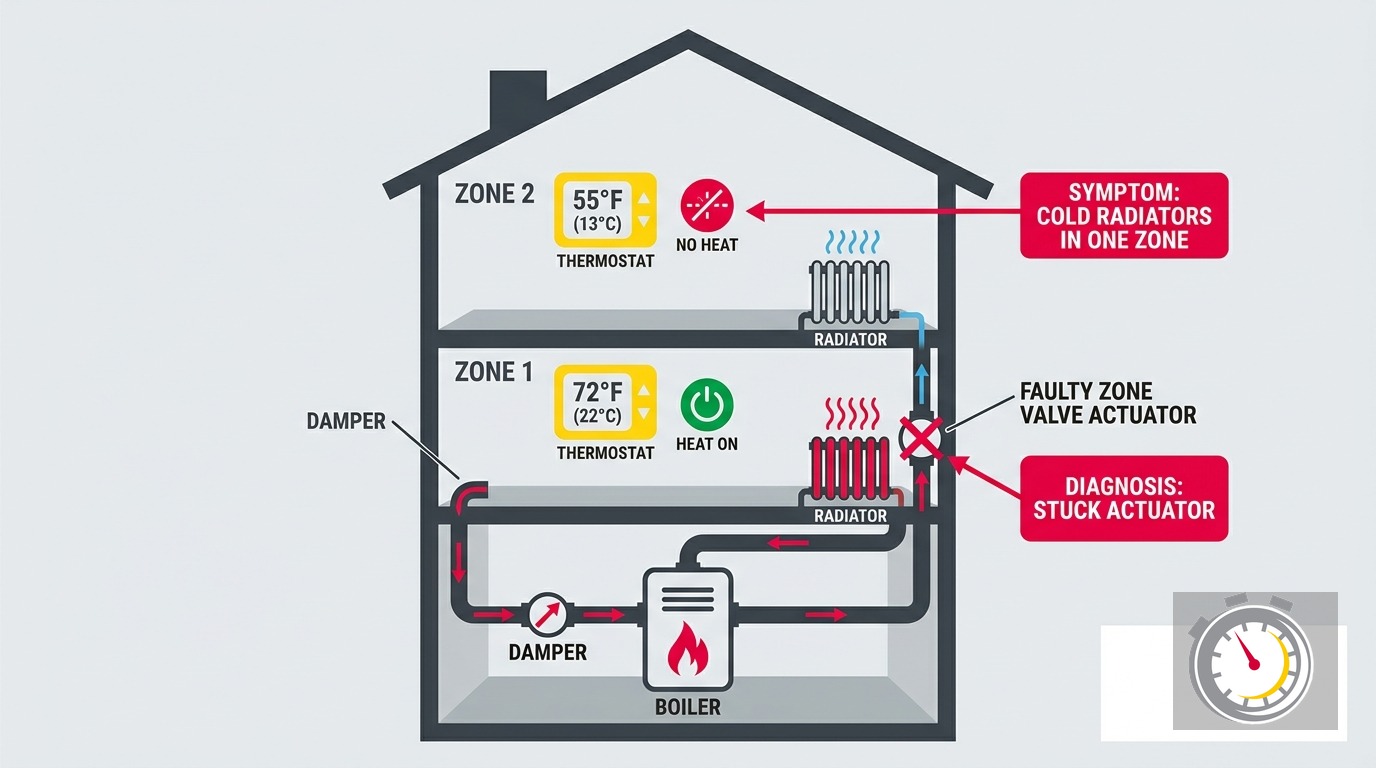
If your boiler is firing but one room or floor stays cold, a boiler zone valve not working is the most likely cause. The boiler never knows a zone is not receiving heat. It keeps cycling on signals from other zones, and the cold room stays cold until someone investigates the valve directly.
This symptom pattern is distinctive. Other boiler problems tend to affect the whole system. A failed circulator pump means no heat anywhere. A tripped circuit breaker means no heat at all. A boiler short-cycling affects every zone in different ways.
A zone valve failure is specific: one zone is cold, every other zone heats normally, and the boiler is clearly running. That specificity points straight at the zone valve and away from the boiler itself.
The first thing homeowners check is usually the thermostat battery. That is worth ruling out early. If replacing the batteries and setting the thermostat well above room temperature does not trigger heat in that zone within a few minutes, the thermostat is not the problem.
What Does a Boiler Zone Valve Not Working Actually Look Like?
A failed zone valve produces one of two symptom patterns: a zone that never heats, or a zone that never stops heating. Both confirm a zone valve problem. But they point to different failure modes and call for different repair approaches.
Stuck closed: the cold zone
This is the more obvious failure. The thermostat calls for heat. The boiler fires. Nothing warm reaches that zone. Radiators or baseboard units stay cold. Every other zone works.
A stuck-closed valve physically blocks hot water from entering the zone. The motor may have failed. The internal mechanism may be seized. Either way, no hot water gets through.
In Minnesota, this is not a minor inconvenience. The Twin Cities area logs roughly 7,581 heating degree days per heating season, which places it among the coldest major metro areas in the country. A single cold zone during a January cold snap is a health risk for occupants and a pipe-freeze risk near exterior walls.
Stuck open: the overheated zone
This failure is subtler. The valve fails in the open position, meaning hot water flows through that zone continuously. The zone’s thermostat is satisfied, but heat keeps coming. The room overheats. Occupants crack a window. Gas bills climb without explanation.
Nobody immediately suspects the zone valve because the heat is on, not off. InspectAPedia’s zone valve repair reference notes that a stuck-open valve can also starve other zones of heat. Hot water bleeds continuously through the open zone instead of being directed where it is needed.
A stuck-open valve in one zone plus an underheated room in another can look like a boiler capacity problem. A technician confirming which zone valves are actually operating correctly is the right first step before assuming the boiler is undersized.
The End Switch: The Part That Links Your Valve to the Pump
This is the detail most general guides skip. It explains why a failing zone valve can be hard to diagnose without knowing what to listen for.
Inside a motorized zone valve, a small component called the end switch does one job. When the valve motor drives the valve to fully open, the end switch closes an electrical circuit. That signal tells the circulator pump to start moving hot water through the zone.
If the valve motor fails partway, the valve may open slightly but never reach fully open. The end switch never closes. The pump never gets its signal. No hot water moves. The zone stays cold.
Here is a practical test: when a zone calls for heat, stand near the boiler and listen. You should hear the zone valve motor run for a few seconds, then hear the circulator pump start. If you hear the motor but the pump never follows, the valve is not reaching full open. If you hear nothing at all, the zone valve motor may not be receiving power.
InspectAPedia’s documentation on zone valve repairs identifies the end switch as a key diagnostic point. Getting this distinction right separates a stuck-valve failure from a wiring problem or a failed pump. Each of those has a different repair.
What homeowners should not do at this stage: pull wires or probe terminals without understanding the wiring sequence. Zone valve wiring loops through the boiler aquastat, the zone thermostat, and the circulator pump relay. Incorrect probing can short a 24-volt transformer and add an unrelated repair to the visit.
Can You Replace Just the Powerhead?
Yes, in many cases. Honeywell/Resideo V8043-series zone valves and many similar motorized valves use a removable actuator called a powerhead. It snaps off the valve body without cutting pipe or draining the system. A technician can often replace a failed powerhead in under an hour, at significantly lower cost than a full valve swap.
This middle path is the one most homeowners do not know exists. When the valve body is intact but the motor assembly has failed, a powerhead swap gets the zone running again without pulling the valve from the pipe.
The valve body — the part soldered or press-fit into the boiler’s supply piping — stays in place. Only the motorized actuator is removed and replaced. InspectAPedia confirms this no-drain-down approach as a significant labor-saver when the valve body itself is not the source of the failure.
Not every zone valve model supports a powerhead-only swap. Older valves, non-standard brands, or valve bodies that have corroded or developed a leak may require full removal from the pipe. A technician can determine within a few minutes whether your valve model supports the swap and whether the valve body is still sound.
For more on what a boiler service visit covers from start to finish, our boiler repair and maintenance page outlines the process for Twin Cities homeowners.
What Speeds Up Zone Valve Failure in Older Homes?
Dissolved oxygen is the primary accelerant. Zone valves are rated for closed hydronic systems: sealed loops where the same water circulates indefinitely. Every time a system is drained and refilled — for a repair, a leak fix, or a winter drain-down — fresh water brings dissolved oxygen that corrodes internal valve components faster than normal wear would.
Minneapolis and St. Paul have significant older housing stock. Many homes in the metro were built before 1970 with original cast-iron boilers still in service. Zone valves on these systems may have run for two or three decades with limited maintenance. In these homes, zone valve failure is often the first visible symptom of a system that deserves a broader review.
InspectAPedia’s zone valve repair guide notes that the manual override lever — the small tab on most zone valves that lets you force a valve open without power — often becomes stiff or unresponsive before the motor itself fails. A stiff manual lever is an early warning sign worth noting before the zone actually goes cold.
The manual override test has diagnostic value: if you can safely reach the zone valve and operate the lever, you can confirm whether hot water flows to the cold zone when the valve is forced open. If it does, the problem is the motor or wiring, not the valve body. If the lever is already seized, corrosion may have advanced to the valve body, which changes the repair scope and cost.
For context on what a full annual boiler service includes — and what early zone valve wear looks like during a professional inspection — our post on boiler annual maintenance in Minnesota covers the details.
The U.S. Department of Energy’s guidance on hydronic heating systems makes the point that zone-based hydronic systems are among the most efficient heating configurations in cold climates. That efficiency depends on all zones functioning correctly. A stuck-open or stuck-closed valve undermines the whole system.
Do You Need a Licensed Contractor for This Repair?
Yes. Minnesota requires boiler heating work to be performed by a bonded mechanical contractor. Zone valve replacement falls under that requirement. Doing it yourself is technically uninsured work, and your homeowner’s insurance may not cover resulting damage.
The specifics: Minnesota’s Department of Labor and Industry requires mechanical contractors to carry a $25,000 bond to perform heating work on boiler systems. This requirement exists because boiler systems operate at pressure. Improper repairs carry real risk.
On the permit question: most zone valve swaps on residential boilers do not trigger a DLI permit. The permit threshold for residential hot water heating boilers is 750,000 BTU input. Most single-family residential boilers fall well below that figure. No permit required does not mean no contractor required. The typical profile for zone valve repair in a single-family home is a licensed tech with no permit needed.
Before a technician arrives, these steps are reasonable and safe for a homeowner:
- Check the thermostat batteries and confirm the set point is above the current room temperature.
- Confirm the boiler is firing. You can usually hear it cycling or see indicator lights near the unit.
- Locate the zone valves. They are small motorized units on the supply piping near the boiler, one per zone.
- Listen for the circulator pump when the affected zone’s thermostat calls for heat.
- Note the valve model number if you can read it without removing anything.
Anything beyond observation — testing wiring continuity, operating the manual override on a pressurized and energized system, removing the powerhead — is safer in the hands of a technician who can confirm the system is de-energized before touching it.
We are locally owned and operated in Ramsey, MN. Our team carries the bonding and licensing Minnesota requires for boiler work. We serve Minneapolis, St. Paul, Blaine, Maple Grove, Plymouth, Brooklyn Park, Woodbury, Bloomington, and the surrounding metro. “Always On Time… Or You Don’t Pay a Dime!(R)” is not just a tagline — it is how we operate on every call.
What If the Problem Is Bigger Than One Zone Valve?
When a zone valve fails on a system that is 20 or more years old, the valve may not be the only problem. A technician who opens the boiler’s piping circuit to replace a valve is also in a position to assess the overall condition of the system — the heat exchanger, the expansion tank, the pressure relief valve, and the condition of the boiler itself.
If that assessment points toward boiler replacement, the economics are often better than homeowners expect. High-efficiency boilers run at 90% AFUE or better, which means most of the fuel you pay for goes directly into heating your home rather than escaping through the flue.
CenterPoint Energy currently offers up to $300 back on a qualifying residential gas boiler at 90% AFUE or better, with submissions due by December 31, 2026. If a zone valve diagnosis turns into a boiler conversation, that rebate is worth factoring into the cost discussion before any work begins.
For a full overview of current rebate programs available to Twin Cities homeowners on heating and cooling equipment, our post on Xcel Energy and CenterPoint HVAC rebates in Minnesota covers what is currently available and how to apply.
Ready to Get That Room Warm Again?
A boiler zone valve not working is one of those problems that sounds unfamiliar until it is not. Once you understand the part and what it does, the diagnostic path is usually clear: one valve is stuck, one room is cold, and the repair is specific.
Northern One Hour Heating and Air Conditioning is a locally owned and operated HVAC company based in Ramsey, MN. We serve homeowners across Minneapolis, St. Paul, Blaine, Maple Grove, Plymouth, Brooklyn Park, Woodbury, Bloomington, and the surrounding Twin Cities metro. We carry the bonding and licensing Minnesota requires for boiler work, and we back every visit with a 100% satisfaction guarantee and transparent pricing before any work begins.
Call us at (763) 260-6662 or schedule a boiler diagnostic online. We will tell you exactly what is wrong and what it costs to fix before we start any work — and we will be there when we say we will.
Frequently Asked Questions
What happens when a boiler zone valve stops working? +
Can a boiler zone valve be replaced without draining the system? +
Do I need a permit to replace a boiler zone valve in Minnesota? +
How do I know if my zone valve is stuck open or stuck closed? +
Need a technician now?