
Combi Boiler vs Separate Water Heater: Minnesota Guide
Key Takeaways
- A combi boiler combines home heating and domestic hot water in one condensing unit, eliminating the storage tank entirely.
- Minnesota groundwater runs approximately 48-50°F. Most combi specs are rated at a 70°F rise. Delivering 120°F water from 48°F incoming requires a 72°F rise, which pulls effective flow rate below the brochure number.
- Most combi boilers give hot water priority over space heating. During a -20°F Minnesota night with a system running near capacity, that pause matters more than it does in a mild climate.
- Combi setups work best in 1-2 bathroom homes of 1,200-2,000 sq ft with tight mechanical rooms and moderate hot water demand.
- Three or more bathrooms, recirculation lines, high heating loads, or a boiler still mid-life all tip the balance toward a solo boiler with a separate water heater.
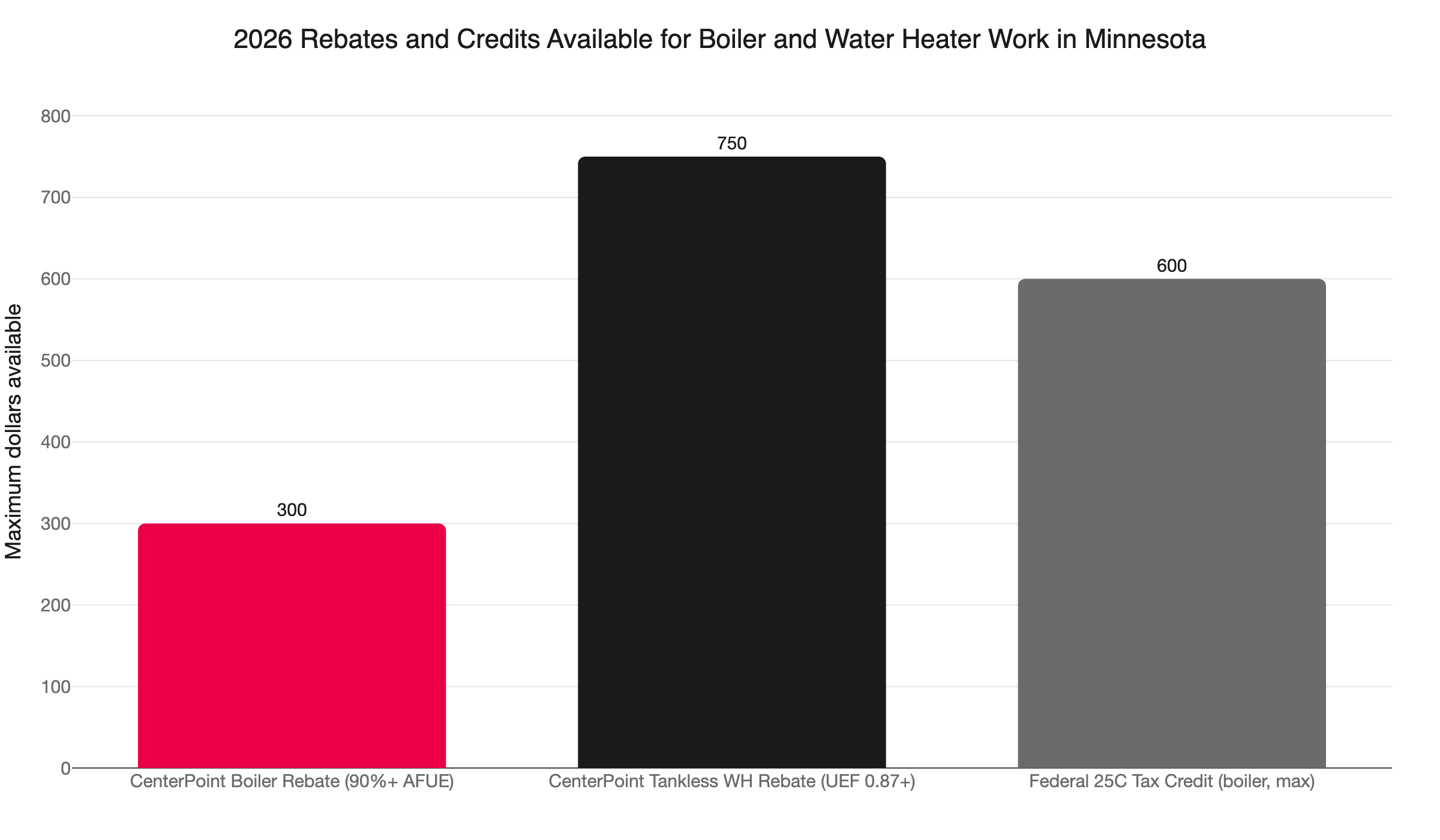
- Xcel Energy eliminated all gas boiler rebates in 2026. CenterPoint Energy still offers up to $300 for qualifying boilers and $750 for qualifying tankless water heaters.
- The federal 25C tax credit covers 30% of project cost, up to $600 for boilers, and stacks with CenterPoint rebates.
What Is a Combi Boiler, and How Is It Different from a Solo Boiler?
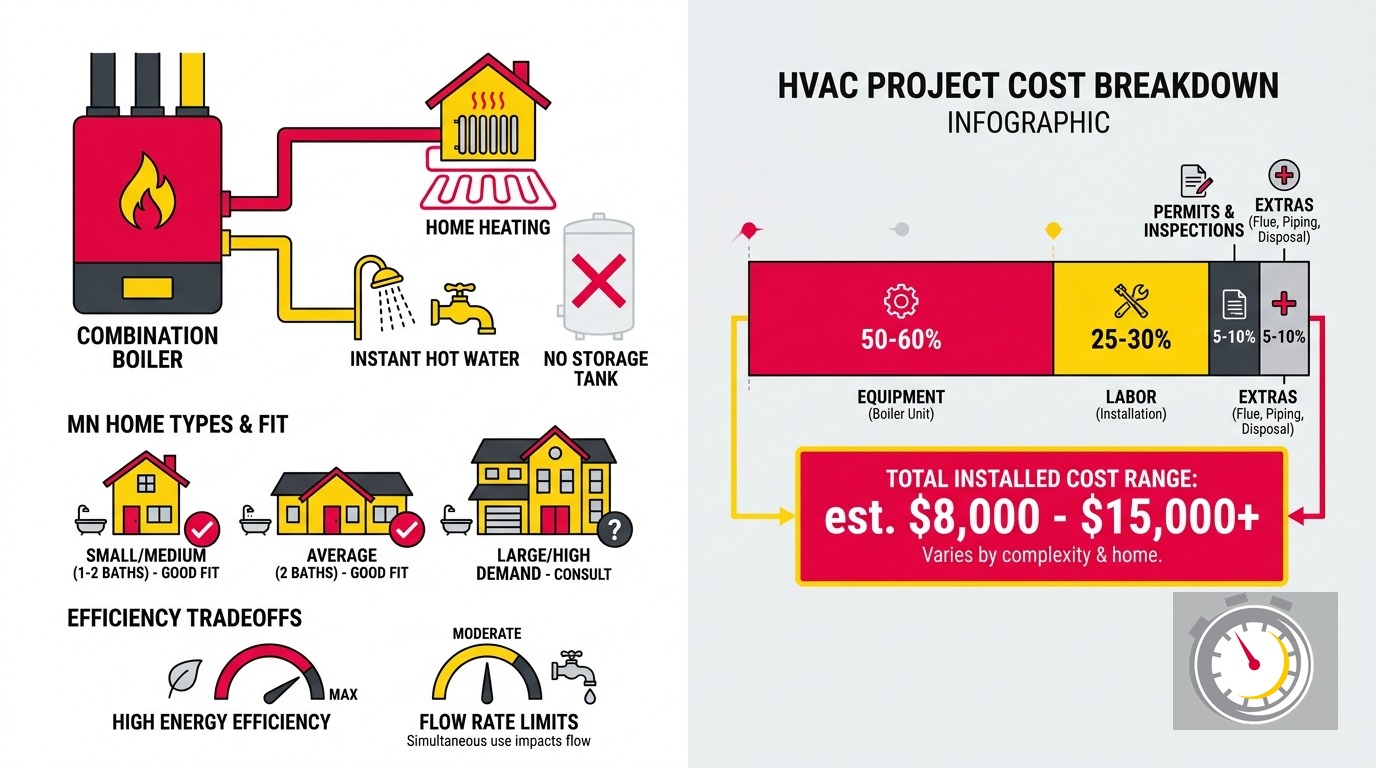
A combination boiler, or combi boiler, is a condensing gas appliance that does two things. It heats your home through radiators or in-floor tubing. It also heats domestic hot water on demand. There is no storage tank. When you open a faucet, the boiler fires and pushes water through a secondary heat exchanger before it reaches your tap.
The main appeal is simplicity. One appliance, one service call, one maintenance visit per year. In a tight mechanical room, eliminating a 40-50 gallon storage tank frees up real, usable space.
The tradeoff is that hot water output is capped. A combi does not store water; it heats it in real time. TriangleTube describes it plainly: the output is “endless up to a cap,” not infinite. That ceiling becomes a real constraint in Minnesota, which the sections below explain.
A solo boiler with an indirect tank works differently. The boiler heats a separate, insulated storage tank. Hot water sits ready at volume. You can run two showers and the dishwasher at the same time without hitting a flow ceiling. You can also add a recirculation line so hot water arrives at a distant faucet quickly.
Both setups run on natural gas. Both can achieve high AFUE ratings. The difference is in how they handle simultaneous demand, mechanical room space, and long-term complexity.
Combi Boiler vs Separate Water Heater: How Does Minnesota Cold Change the Math?
Quick answer: Minnesota groundwater sits at approximately 48-50°F. Most combi spec sheets rate flow at a 70°F temperature rise. Delivering 120°F water from 48°F incoming requires a 72°F rise - slightly above spec. Your actual flow rate will run a few tenths of a GPM lower than the brochure number.
The performance gap is real and worth understanding before you buy.
Navien’s NCB-H combi is rated at 5.4 GPM at a 70°F temperature rise. The manufacturer cites three simultaneous showers plus a dishwasher at that rate. But Twin Cities groundwater at 10-foot depth runs around 48-50°F. With a delivery target of 120°F, the required temperature rise is 72°F. That two-degree difference trims effective output below the rated spec.
Across brands, combi DHW flow ranges from roughly 2.6 to 5.5 GPM at a 45°F rise. That rate drops as the required rise increases. In Minnesota, you are always working at the high end of the rise requirement.
The practical ask before you buy: request the rated GPM at a 72°F temperature rise, not the 70°F figure on the spec sheet. A one-bathroom home will rarely notice the gap. A 2.5-bath home running concurrent loads on the coldest January morning can feel it clearly.
What Does a Combi Boiler Cost to Install in Minnesota?
Quick answer: Installed condensing boiler costs at Northern One Hour typically run $9,100-$15,600 for a residential Twin Cities replacement. Combi units fall in the same range. Equipment alone can be around $1,300 before labor and materials, but all-in costs compress the gap between a combi and a boiler-plus-tank setup.
Angi reports the average boiler replacement in Minneapolis at $7,896, with a market range of $3,201-$13,171 depending on unit type and scope. Minnesota construction costs run about 6% above the national average. Skilled HVAC labor in the metro averages approximately $51 per hour.
One cost item that catches homeowners off guard: recirculation. If your home has a hot water recirculation loop, a combi setup requires a buffer tank to support it. That adds parts and labor. A solo boiler with an indirect tank handles recirculation natively, without the buffer. The space savings and simplicity argument for the combi weakens considerably once the buffer tank goes back in.
For a deeper look at what drives installed cost up or down on condensing boiler work in the Twin Cities, see our guide on condensing boiler upgrades for Minnesota homes.
What Rebates Are Available for Boiler Work in Minnesota in 2026?
Quick answer: Xcel Energy dropped all gas boiler rebates on January 1, 2026. CenterPoint Energy still offers $200-$300 for qualifying boilers at 90%+ AFUE and $750 for qualifying tankless water heaters. The federal 25C tax credit adds up to $600 for boilers and stacks with utility rebates.
The rebate landscape shifted significantly this year. Xcel Energy eliminated all gas furnace and boiler rebates effective January 1, 2026. If your home runs on Xcel gas service, there is no utility rebate on the boiler side for 2026.
CenterPoint Energy customers still have options. CenterPoint’s 2026 program offers $200-$300 for boilers at 90%+ AFUE. Verify the exact tier with a CenterPoint Trade Ally before purchase. If the combi unit also qualifies as a tankless water heater at UEF 0.87 or higher, CenterPoint offers a $750 replacement rebate on that component separately.
On the federal side, the 25C tax credit covers 30% of project cost, capped at $600 for boilers. That stacks on top of any CenterPoint rebate. A CenterPoint customer who qualifies for both the boiler rebate and the tankless DHW rebate could see $950-$1,350 in combined incentives before applying the federal credit. Verify current terms in the official CenterPoint 2026 Trade Ally Resource Guide before you commit.
Efficiency: Is a Combi Boiler Actually More Efficient in Minnesota?
Gas condensing combis run 90-95% AFUE on the heating side. Eliminating the storage tank removes standby losses - the energy a tank burns keeping 40-50 gallons hot around the clock, whether or not anyone uses it. Condensing combis use roughly 10-15% less energy per liter than a conventional tankless or tank water heater at equivalent output.
In practice, the efficiency advantage is real but narrower than the marketing suggests. A condensing solo boiler paired with a well-insulated indirect tank also runs 90-95% AFUE. The standby loss from a modern indirect tank is lower than from a conventional atmospheric storage tank. Eliminating standby loss entirely is meaningful - but it is not the dramatic step-change the brochures imply.
The efficiency risk unique to combis is undersizing. A unit pushed to its ceiling on a -20°F night runs less efficiently than a properly sized unit with headroom. Minneapolis-Saint Paul has a 7+ month heating season with winter lows that regularly reach -20°F. Sizing a combi for that environment requires a Manual J heat load calculation specific to your home. A contractor who skips that step is guessing. An undersized combi costs you money every month.
Which Minnesota Homes Are a Good Fit for a Combi Boiler?
Quick answer: Combi boilers suit 1-2 bathroom homes of 1,200-2,000 sq ft where hot water demand is moderate, the mechanical room is tight, and the owner prefers one system to maintain. If five of the six criteria below describe your home, a combi is worth a detailed quote.
Here is the specific profile that makes a combi a sound choice in the Twin Cities:
- 1-2 bathrooms. Peak hot water demand stays within the unit’s flow ceiling.
- 1,200-2,000 sq ft. The heating load fits the combi’s capacity without running it at its limit on the coldest days.
- Tight mechanical room. Eliminating the storage tank is a genuine space gain, not a theoretical one.
- Moderate hot water demand. No simultaneous heavy draws - no two showers running while the laundry cycles.
- No recirculation need. Fixtures sit close enough to the mechanical room that the wait for hot water is acceptable.
- Preference for simplicity. One annual boiler maintenance visit covers both heating and hot water.
When most of those bullets describe your home, a combi is worth a serious look and a flow-rate conversation with your installer.
Combi Boiler vs Separate Water Heater: Which Homes Do Better with a Solo Setup?
Quick answer: Three or more bathrooms, simultaneous peak draws, recirculation lines, high heating loads, or a boiler still mid-life all tip the balance toward a solo boiler paired with a separate indirect tank or water heater.
Here is when the separate-system approach wins:
- 3+ bathrooms. Two showers running while the dishwasher cycles can push demand past what most combi units can deliver. The result is lukewarm water at the second fixture.
- Homes with recirculation lines. A solo boiler with an indirect tank supports hot-water recirculation natively. A combi can handle recirculation, but it requires a buffer tank - adding back the cost and complexity you were trying to eliminate.
- Large homes with high heating loads. When the boiler is already working hard to hold indoor temperature at -20°F, a DHW priority interruption becomes noticeable. Zones at the far end of the hydronic loop cool faster than they recover.
- Existing boiler still mid-life. If your current boiler has 5-8 useful years left and only the water heater needs replacing, swap the water heater. Replacing a working boiler just to eliminate the tank rarely pencils out, even with rebates.
- Fixtures far from the mechanical room. Long pipe runs without a recirculation loop mean a long wait for hot water. A combi has no stored volume to push through the line quickly.
The solo boiler with an indirect tank has been the standard in Minnesota homes for good reasons. It handles volume, peak loads, and recirculation without compromise.
The Peak-Load Problem That Minnesota Winters Expose
Most combi boilers prioritize domestic hot water over space heating. When you open a hot water tap, the boiler shifts its capacity to DHW. Space heating pauses.
In a mild climate, that pause is brief. No one notices.
In Minneapolis on a -20°F night, the system is often already running near full capacity just to hold 68°F indoors. A hot water draw interrupts that work. In a properly sized combi with headroom, the pause lasts a few seconds and the boiler catches up quickly. In an undersized combi - or in a larger home where the heating load already pushes the unit hard - the interruption is long enough that zones cool noticeably before heat resumes.
This is the scenario that national comparisons and manufacturer specs almost never address. It is not a reason to rule out a combi. It is a reason to insist on a Manual J calculation before sizing, and to right-size the unit for Minnesota’s design temperatures. Our team will not quote a combi without running that calculation first.
What Are the Permit Requirements for Boiler Replacement in the Twin Cities?
Quick answer: Local mechanical permits are required for boiler installation across the Twin Cities metro, regardless of state-level residential exemptions. Your licensed contractor pulls the permit before work begins. If a contractor offers to skip it to lower the price, that is a warning sign.
Minnesota Statutes 326B.988 exempts residential buildings with five or fewer units from state boiler pressure-vessel registration. That exemption does not remove the local mechanical permit requirement. Minneapolis and Saint Paul can set requirements above the state minimum, and in some cases they do. Verify with your local building department before any work is scheduled.
The Minnesota Department of Labor and Industry oversees boiler engineers and high-pressure permits at the state level. For residential hot water boilers - the type in most Twin Cities homes - the local mechanical permit is what matters in practice.
An unpermitted boiler can complicate a home sale, void the manufacturer warranty, and leave you without recourse if something goes wrong. For more on what to watch for when selecting a contractor, see our guide on HVAC contractor red flags in the Twin Cities.
Ready to Choose? Here Is How Northern One Hour Helps
The combi boiler vs. separate water heater question in Minnesota does not have a single right answer. It depends on your home’s size, bathroom count, hot water habits, mechanical room layout, and utility provider.
Here is how our locally owned and operated team works through it for Twin Cities homeowners:
- We assess your actual heating load and hot water demand - specific to your home, not a national average.
- We give you the rated flow at a 72°F temperature rise, not the 70°F figure on the spec sheet, so you know what to expect in a Minnesota winter.
- We lay out both options with real installed cost ranges and current rebate eligibility.
- We pull the permit, do the work, and back it with our 100% satisfaction guarantee.
Whether the answer is a combi or a solo boiler with an indirect tank, you will understand the reasoning before any equipment is ordered. We stand behind every job with our commitment: “Always On Time… Or You Don’t Pay a Dime!(R)”
Call us at (763) 260-6662 or schedule a boiler consultation online today. If you want to see what an annual service program looks like for your boiler system before you commit to a new unit, start with our overview of boiler maintenance for Minnesota homeowners.
Frequently Asked Questions
What is a combi boiler and how does it differ from a regular boiler? +
Are combi boilers effective in Minnesota winters? +
What does a combi boiler cost to install in the Twin Cities? +
What rebates are available for boiler work in Minnesota in 2026? +
Need a technician now?