
Indirect Water Heater With Boiler: Worth It in Minnesota?
Key Takeaways
- Pairing an indirect water heater with a boiler in Minnesota leverages a system that already runs seven months a year for space heating. Adding domestic hot water to that loop costs almost nothing extra during heating season.
- Water heating makes up a significant share of a home’s energy budget. Sharing that load with a boiler that is already running all winter can reduce it.
- The U.S. Department of Energy states that an indirect water heater with a high-efficiency boiler and a well-insulated tank can be the least expensive means of providing hot water, particularly when the boiler is set to cold-start.
- Minneapolis-St. Paul averages 7,399 heating degree days per year. That cold-climate baseline gives the indirect water heater a stronger economic case here than in most of the country.
- The honest caveat: during DHW calls, a mod/con boiler runs in non-condensing mode. Real-world DHW efficiency lands in the low-to-mid 80s, not the rated 95%-plus.
- CenterPoint Energy offers a $200 rebate for indirect storage tank installations, available to Minnesota residential natural gas customers through December 31, 2026.
- This is a dual-permit job in Minnesota: one plumbing permit, one mechanical permit.
- The setup makes the most sense when a condensing boiler is already installed, your household has three or more people, and you want to reduce total appliance count.
How Does an Indirect Water Heater Work With a Boiler?
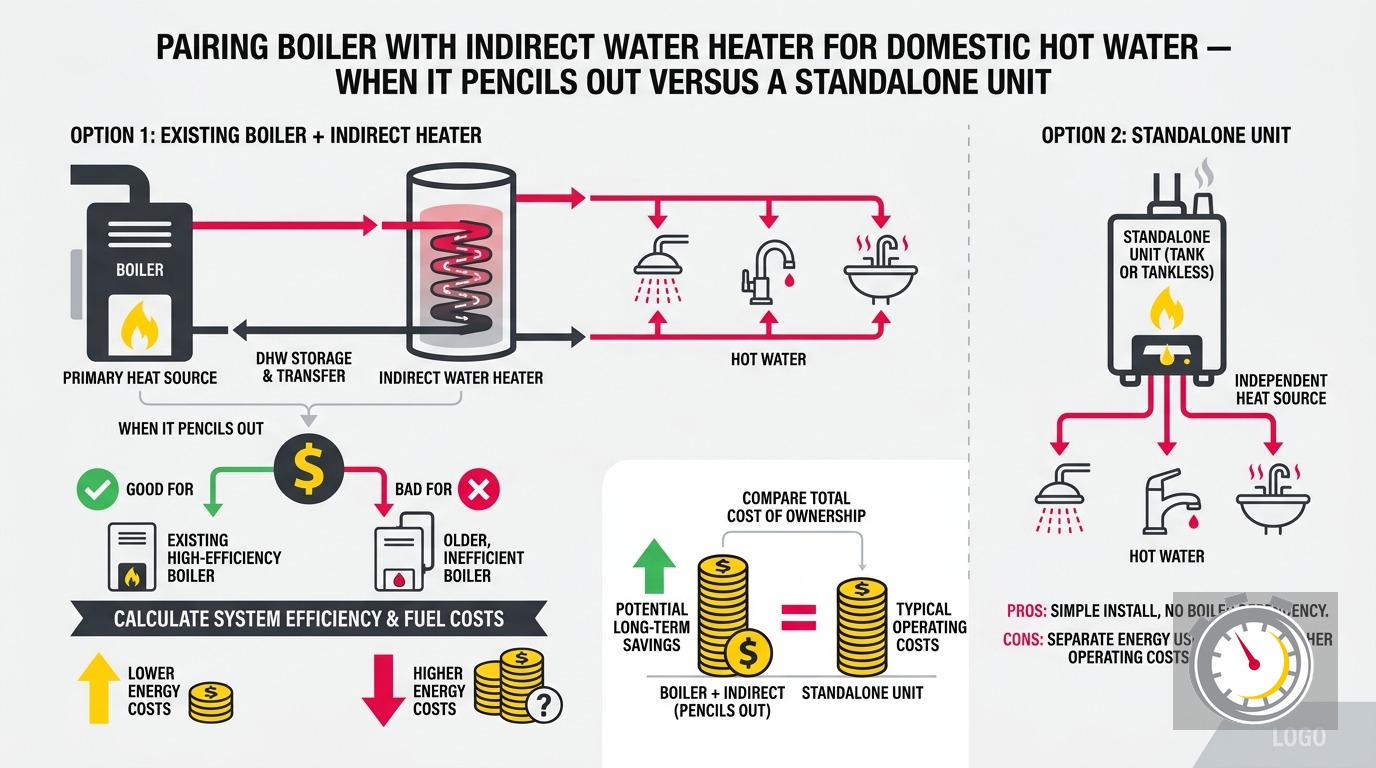
The short answer: The boiler heats water in its hydronic loop. A heat exchanger inside the insulated indirect tank transfers that heat to your potable water supply. The two water supplies never mix.
A standard tank water heater has its own burner. An indirect water heater does not. It taps the boiler’s output - the same hydronic loop that heats your radiators or baseboards - to warm a separate, well-insulated tank of potable water. A coil or plate heat exchanger handles the transfer. The heating loop and the drinking water never come into contact.
The insulated tank stores 30-80 gallons of domestic hot water, ready when you turn on a tap. The boiler does not run continuously. It fires to top off the tank temperature and shuts down. Good insulation keeps standby losses low and firing cycles short.
This setup is different from a combi boiler. A combi delivers hot water on demand with no storage. Our guide to combi boilers for the Twin Cities covers that option in detail. The indirect tank’s key advantage over a combi is stored volume. When two showers run simultaneously, the tank handles the load. A combi boiler can fall short under simultaneous demand - a real consideration for families with teenagers.
Does an Indirect Water Heater Save Money in Minnesota?
The short answer: Usually yes, especially when a condensing boiler is already in place. Water heating makes up a significant share of a home’s energy budget. Leveraging the boiler you already run all winter can cut that share meaningfully.
The Department of Energy has stated directly that an indirect water heater with a high-efficiency boiler and a well-insulated tank can be the least expensive means of providing hot water, particularly when the boiler is set to cold-start. Cold-start means the boiler holds no minimum operating temperature between calls. It fires on demand and fully shuts down. This cuts the standby losses that an always-hot boiler quietly accumulates around the clock.
The savings case is strongest when:
- You have a condensing boiler rated 90% AFUE or higher.
- Your household has three or more people - moderate to high hot water demand.
- Mechanical room space is tight and a second appliance would be a constraint.
- You are already replacing the boiler, so installation costs stack on one job.
If your boiler is an older, non-condensing cast iron unit, the calculation changes. We address that directly below.
Why Minnesota’s Heating Season Changes the Math
Minneapolis-St. Paul averages 7,399 heating degree days per year. That is one of the higher HDD baselines in the continental U.S., and it works squarely in your favor here. January alone accounts for 1,513 of those degree days. Every degree day is a day the boiler runs anyway.
What those 7,399 HDD mean practically: your boiler runs from roughly October through April - about seven months. During those seven months, the indirect tank costs almost nothing extra to operate. The boiler is already firing for space heating. Adding a DHW zone does add some runtime, but a well-insulated tank minimizes extra burner cycles. The incremental fuel cost is small enough that it rarely shows up on a monthly bill.
The remaining five months - May through September - are the period to examine honestly. The boiler sits idle except for DHW calls. It wakes up, fires to heat the tank, and shuts down. This is a less efficient operating mode, covered in detail next.
Here is the climate comparison that matters. A warmer city where a boiler only runs four months for space heating carries eight months of summer DHW-only firing. Minnesota’s climate gives you only five. The heating season - the efficient season - dominates the calendar here. That shifts the annual efficiency average in your favor.
What Happens in Summer When the Boiler Only Fires for Hot Water?
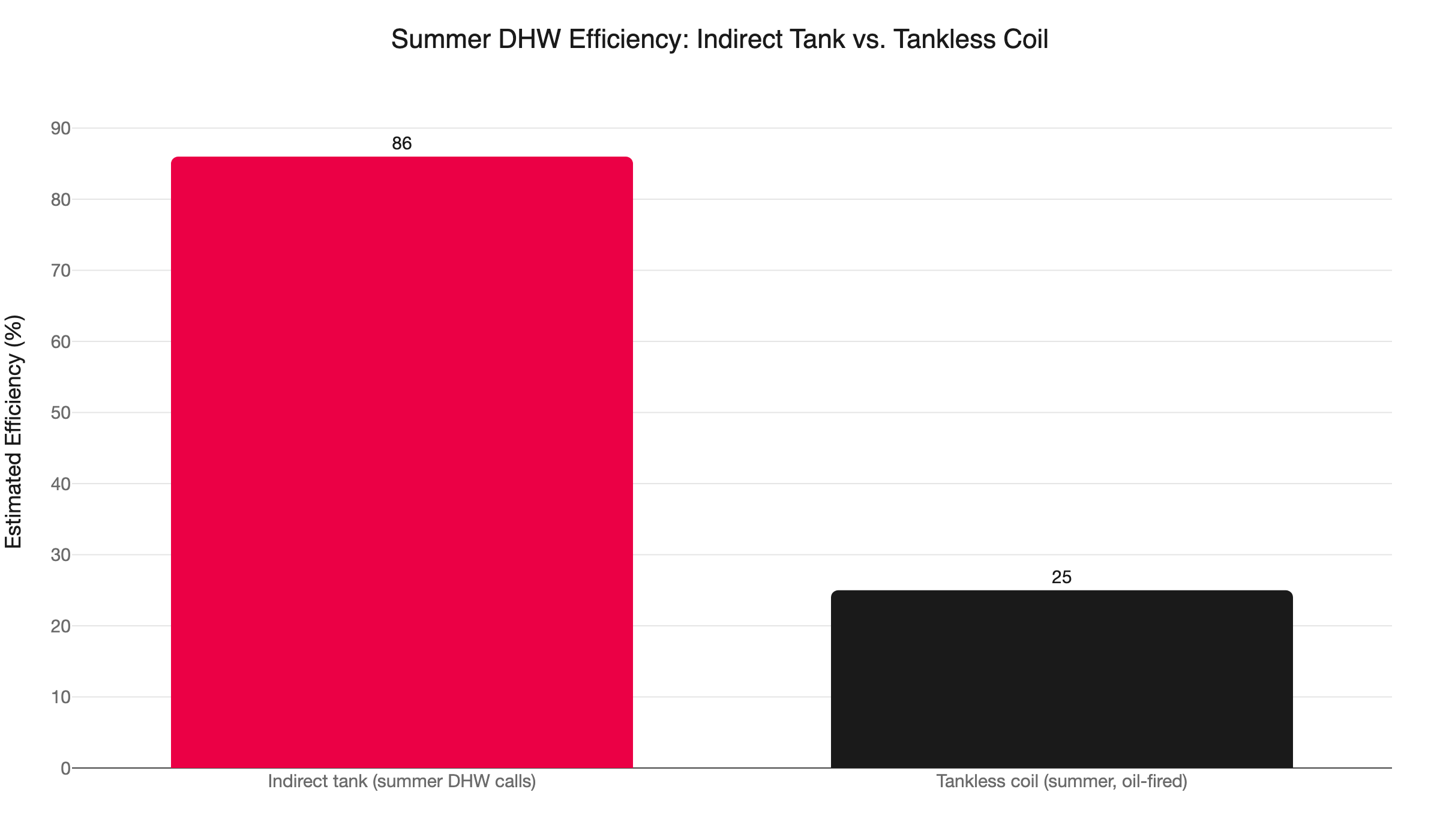
The short answer: Efficiency drops below the rated figure. In summer, short DHW calls rarely push the boiler into full condensing range. Expect real-world summer efficiency around 86%. That is well below the rated 95%-plus, but far above the worst alternative on the market.
Research from BuildingGreen confirms this trade-off. When a boiler fires solely for short DHW cycles in the off-season, it does not sustain the low return water temperatures needed for full condensing operation. The efficiency drop is real but not catastrophic.
For perspective, consider the tankless coil - a different setup where the boiler’s heat exchanger directly serves a tap, common on older oil-fired systems. A tankless coil can run summer oil-fired efficiency as low as 25% because the boiler must stay hot continuously to be ready for a DHW draw. The indirect tank avoids this entirely. Stored hot water means the boiler fires periodically rather than idling hot all day.
The practical rule: a well-insulated tank is not optional. It is the component that keeps summer firing cycles short. Low standby loss means fewer cycles and less waste. Ask your installer about tank insulation specs before selecting equipment - this is where the summer performance either holds or erodes.
The Mod/Con Caveat: What No One Else Is Telling You
A condensing boiler achieves rated 95%+ efficiency by recovering heat from combustion gases as they cool below the dew point. This requires low return water temperatures - typically below 130°F.
Here is the problem during DHW calls. The indirect tank demands a supply setpoint of 160-180°F to transfer heat quickly and reach safe potable storage temperatures. At those supply temps, the return water comes back above the condensing threshold. The boiler runs in non-condensing mode for the entire DHW call.
Heating Help documents this directly: real-world DHW efficiency on a mod/con indirect setup lands in the low-to-mid 80s. That roughly matches a quality standalone non-condensing power-vent tank.
This does not make the indirect a bad choice. It means the advantage is different from the one often advertised. The real advantages are:
- Shared infrastructure with the space heating system - no second heat source to maintain.
- Reduced appliance count and fewer maintenance touchpoints.
- During the heating season, DHW rides on a system already running for the home.
- Long tank life - typically 20-30 years - versus 10-15 years for a conventional tank.
The practical action item: confirm with your installer that the boiler is programmed to cold-start. A cold-start boiler holds no standing temperature between calls. It fires on demand and shuts fully down. This captures the seasonal efficiency that an always-hot boiler wastes - and it is a setting that sometimes gets overlooked at installation.
Is Your Current Boiler a Good Match for an Indirect Tank?
The short answer: A condensing boiler is the best match. An older 80% AFUE non-condensing boiler can work, but the efficiency difference between it and a standalone tank narrows considerably. If the boiler is near end of life, replace it with a condensing unit first, then add the indirect tank.
Use this framework before calling for a quote:
Strong fit:
- Condensing boiler already installed, or being replaced at the same time as the tank installation.
- Three or more people in the household with moderate to high hot water demand.
- Tight mechanical room where adding a second appliance creates a real constraint.
- You want fewer appliances to schedule annual service for over the long haul.
Conditional - run the numbers first:
- Non-condensing boiler in good condition with at least 5-8 years of service life remaining. Summer DHW efficiency will run around 80%. Compare that against a standalone 80% power-vent tank at its installed cost before committing.
- Two-person household with low hot water demand. A standalone tank may offer a shorter payback at a lower upfront price.
Not the right time:
- Aging 80% AFUE boiler approaching the end of its service life. Adding an indirect tank to a boiler you will replace in two or three years wastes the installation cost. Wait, upgrade to a condensing boiler, then add the indirect tank on the same project.
Our boiler replacement cost guide covers the repair-vs.-replace decision in detail. If you are unsure whether the existing boiler has enough life left to justify the indirect tank, that is the right starting point.
What Does Installation Cost in the Twin Cities?
The short answer: Adding an indirect tank to an existing system - zone valve, piping, and tank - typically starts above $1,000. Pairing it with a new condensing boiler stacks costs onto one mobilization and one permit pull, which is more efficient than scheduling two separate jobs months apart.
A good indirect unit including an additional zone on the heating system typically runs over $1,000 installed. That is a starting-point figure. Actual quotes vary with tank size, zone valve configuration, mixing valve requirements, and the complexity of the existing plumbing and piping layout.
If you are replacing a condensing boiler at the same time, plan for $9,100-$15,600 installed in the Twin Cities for the boiler alone. Adding the indirect tank to that project is more cost-efficient than a return visit - one service window, one set of permits, one labor mobilization.
A word on the dual-permit cost: both the boiler modifications and the potable water connections require permits, and each carries a fee. Factor this into your comparison when evaluating the indirect setup against a straight standalone tank swap. A standalone tank swap typically needs only a plumbing permit. The indirect job needs two.
Financing is available for larger heating projects. Call us at (763) 260-6662 or book online to discuss options and get a project quote.
Minnesota Code: It Takes Two Permits
Minnesota Mechanical Code Section 1002.2 requires that combined potable and space-heating systems be listed and labeled for dual use. They must be installed per manufacturer instructions and the International Plumbing Code. They must be sized so the space-heating load cannot reduce the potable water-heating capacity of the system.
If the boiler water temperature exceeds 140°F, a temperature-actuated mixing valve conforming to ASSE 1017 is required. This valve tempers the potable supply down to 140°F or below before it reaches fixtures. For indirect DHW calls, boiler supply setpoints typically run 160-180°F, so this valve is almost always part of the installation.
Permit breakdown for a typical project:
- Plumbing permit: Required for any work on the potable water supply. Pulled by a licensed plumber.
- Mechanical permit: Required for boiler modifications. Pulled by a licensed mechanical contractor.
Any installer who tells you only one permit is needed is incorrect. Pulling both protects you at resale, keeps the system insurable, and confirms the installation meets code from day one.
One useful local data point: a Twin Cities installer with multiple indirect installations in the metro notes that local insulation code requirements sometimes cited as a barrier to indirects are not a practical obstacle in Minneapolis-St. Paul. Local contractors navigate this routinely.
Our boiler installation and replacement service includes permit management as part of the job. We pull both and handle the inspections.
Can You Get a Rebate on an Indirect Water Heater in Minnesota?
The short answer: Yes. CenterPoint Energy’s 2026 residential rebate program offers $200 for indirect storage tank installations. It is available through December 31, 2026, with no minimum efficiency requirement, and it stacks with boiler rebates if you are replacing both systems at once.
The rebate is open to Minnesota residential natural gas customers. Installation must be completed January 1-December 31, 2026. Apply through your licensed plumber or by mail to: CenterPoint Energy Residential Water Heater Rebate Program, PO Box 59038, Minneapolis MN 55459.
Two hundred dollars will not move the project economics on its own. But rebates stack, and that is where the real opportunity is. If you are also replacing a condensing boiler, additional utility rebates on the boiler equipment may apply on the same project. Our guide to stacking utility rebates and federal tax credits in Minnesota walks through how to combine them without leaving money behind.
The federal 25C tax credit does not currently cover standalone indirect water heater installations. If this project is part of a broader qualifying heating system upgrade, consult your tax advisor. Credit rules change year to year - always confirm at filing time.
Talk to a Local Team That Knows These Systems
Pairing an indirect water heater with a boiler is a job where installation details matter as much as equipment selection. Cold-start programming, mixing valve sizing, zone configuration, and tank insulation all affect whether the efficiency gains actually show up in your energy bills over the years.
Northern One Hour is locally owned and operated in Ramsey, Minnesota. Our team works with Twin Cities boiler systems every day. We can evaluate your current setup honestly and tell you whether it is the right foundation for an indirect tank now, or whether a condensing boiler upgrade comes first.
We show up when we say we will. “Always On Time… Or You Don’t Pay a Dime!(R)”
Call (763) 260-6662 or book online to schedule a consultation. Financing is available for qualifying projects.
Frequently Asked Questions
Can I add an indirect water heater to any boiler? +
How long does an indirect water heater tank last? +
Does Minnesota require permits to install an indirect water heater with a boiler? +
Need a technician now?