
Geothermal vs Air Source Heat Pump Minnesota: 10-Year Cost
Key Takeaways
- Both the federal geothermal credit (Section 25D, 30%) and the cold-climate ASHP credit (Section 25C, up to $2,000) expired December 31, 2025. There is no federal offset right now.
- Most Twin Cities suburban lots cannot fit horizontal ground loops. Vertical drilling adds $8,000-$12,000 to the geothermal quote.
- Geothermal installed in the Twin Cities typically runs $22,000-$30,000. A cold-climate ASHP typically runs around $14,000.
- Xcel Energy offers up to $2,600 for qualifying ASHPs. CenterPoint offers $1,500 for ASHPs in a dual-fuel hybrid setup. Neither utility rebates standalone residential geothermal.
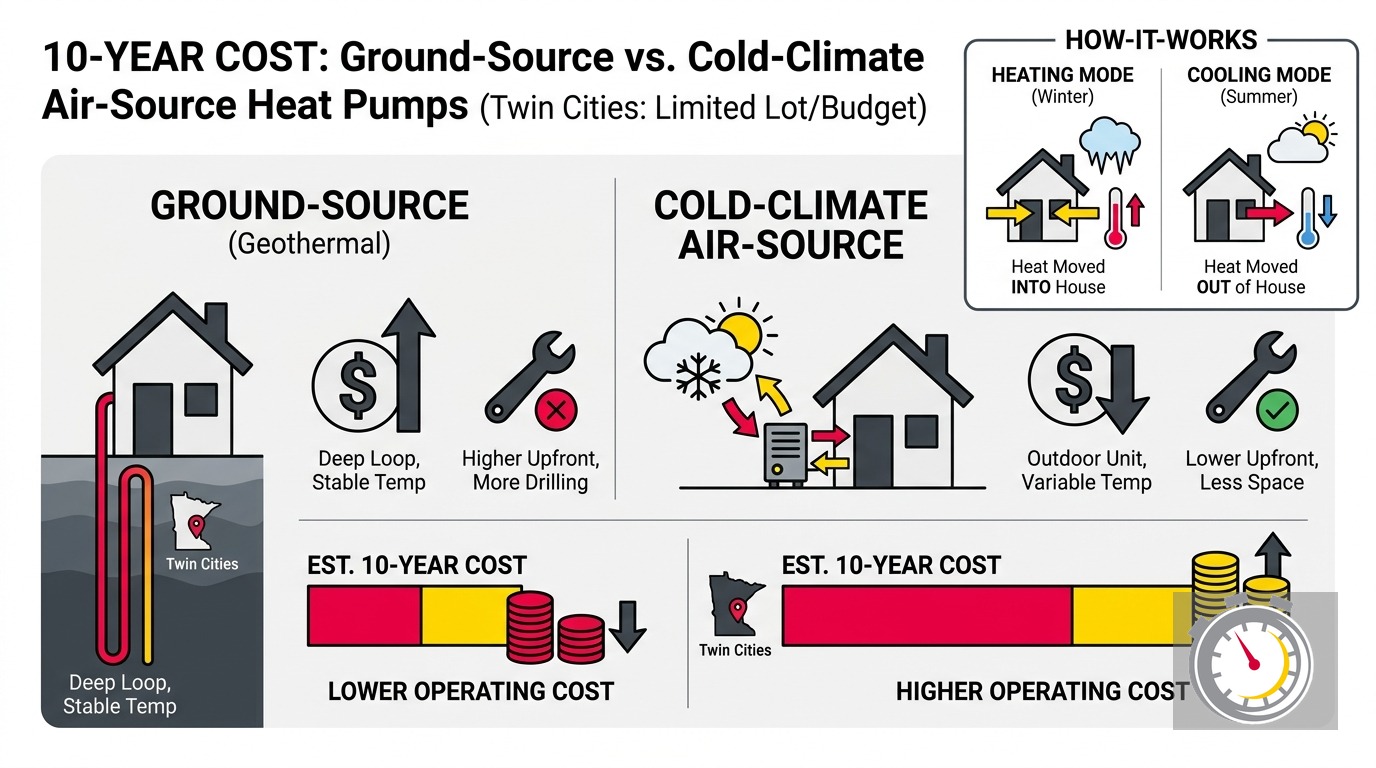
- For most homeowners who need vertical drilling, the ASHP comes out ahead through year 10.
- Geothermal’s ground loop carries a 300-year service life expectation. The 10-year math captures unit costs, not that longevity.
Geothermal vs Air Source Heat Pump Minnesota: The 2026 Picture
The comparison between geothermal and cold-climate air-source heat pumps has shifted more in the past year than in the decade before it. Both federal tax credits that once helped close the cost gap expired December 31, 2025. Utility rebates for cold-climate ASHPs are still active. And most Twin Cities suburban lots cannot accommodate horizontal ground loops, which pushes geothermal toward the more expensive vertical drilling option.
This post walks through the 10-year cost math for both systems on a typical Twin Cities lot. The numbers use real installed cost ranges from Minnesota contractors, 2026 incentives only, and the lot-size reality most suburban homeowners face.
Does Your Lot Have Room for Geothermal?
Short answer: Probably not for horizontal loops. A 3-ton system needs roughly 5,000-9,000 square feet of clear, diggable ground. Most Twin Cities suburban lots are in that total size range. A house, garage, driveway, and setbacks have already claimed most of it.
This question belongs first. It shapes every cost number that follows.
Horizontal closed-loop geothermal is the more affordable loop type. It requires roughly 1,500-3,000 square feet of trench area per ton of capacity. A 3-ton system for a typical 2,000 square foot home needs 5,000-9,000 square feet of open, accessible yard. Minnesota frost penetration pushes trench depth to 7-8 feet, which adds excavation cost.
The median suburban Twin Cities lot runs around 7,000-9,000 square feet total. Subtract the house footprint, an attached garage, a driveway, and required setbacks. Most homeowners end up with 2,000-4,000 square feet of usable open yard. Horizontal loops do not fit.
Setbacks from wells, septic systems, and property lines further reduce available area. If any of those features exist on your lot, a site review from a licensed geothermal contractor is a necessary step before any quote is useful.
That forces vertical drilling. Vertical boreholes go straight down, typically 150-250 feet each. A 3-ton system usually needs two or three boreholes. In Twin Cities glacial sediment, vertical drilling runs $15-$30 per linear foot. That puts the loop field alone at $6,750-$22,500 before you factor in the heat pump unit, any ductwork work, or permits.
Vertical drilling adds $8,000-$12,000 to the total installed cost compared to a horizontal loop system. That difference drives most of the payback math.
What Does Geothermal Actually Cost Installed in the Twin Cities?
Short answer: Expect $18,000-$35,000 before incentives for a typical 3-ton system. Minnesota installs typically land $22,000-$30,000 because regional geology often demands deeper bore depths. Most homeowners who need vertical drilling fall into that upper range.
GeothermalFinder’s state-level cost data puts the Twin Cities range at $18,000-$35,000 before incentives. Minnesota and Wisconsin installs tend toward the upper half because deeper bore depths are more common due to regional geology.
A cold-climate ASHP in the Twin Cities runs considerably less. Local installer data puts the range at $9,000-$18,000, with a median around $14,000. Systems that hold heating capacity at -13°F or lower sit in the middle to upper portion of that range. That cold-weather threshold matters in Minnesota. Design heating loads here are set against temperatures well below zero.
The raw upfront gap before any incentives: roughly $8,000-$16,000 in favor of the ASHP.
Are There Still Tax Credits or Rebates for Heat Pumps in 2026?
Short answer: No federal credits for either system. Both expired at the end of 2025. Utility rebates for cold-climate ASHPs from Xcel and CenterPoint are still active. Neither utility currently rebates standalone residential geothermal.
This is where the comparison shifts hardest against geothermal right now.
Xcel Energy customers
Xcel’s rebate program pays up to $2,000 for a qualifying cold-climate ASHP. The unit must reach a COP of at least 1.75 at 5°F and retain 70% of its rated capacity at 5°F versus its 47°F rating. Add $600 if you pair the installation with insulation improvements. Total potential: $2,600. See Xcel’s heat pump program for qualifying models and documentation requirements.
Gas furnace rebates from Xcel were discontinued January 1, 2026. The rebate program now points toward heat pump technology.
CenterPoint Energy customers
CenterPoint’s rebate pays $1,500 for a ducted ASHP in a dual-fuel hybrid setup. The setup requires a paired gas furnace at 92% AFUE or better, with the ASHP’s switchover temperature set at 40°F or below. Standalone ASHP-only systems do not qualify. Standalone geothermal does not qualify either.
This arrangement has a practical advantage beyond the rebate. The gas furnace carries the load on the coldest nights, when air-source performance drops. The ASHP handles shoulder seasons and moderate-cold days at high efficiency. That hybrid setup is a reasonable answer to Minnesota’s wide temperature swings.
City of Minneapolis
Minneapolis offers a bonus rebate of up to $1,000 for qualifying ASHPs. In designated Green Zones, that bonus rises to up to $5,000. These stack with Xcel rebates. Check MN Air Source Heat Pump Collaborative for current city and utility stacking requirements.
Geothermal rebates in 2026
Xcel does not offer a residential geothermal rebate. CenterPoint does not offer one either. The federal 30% credit is gone. CenterPoint is running a community-scale geothermal pilot in Minnesota, but that is a utility infrastructure project, not a homeowner rebate.
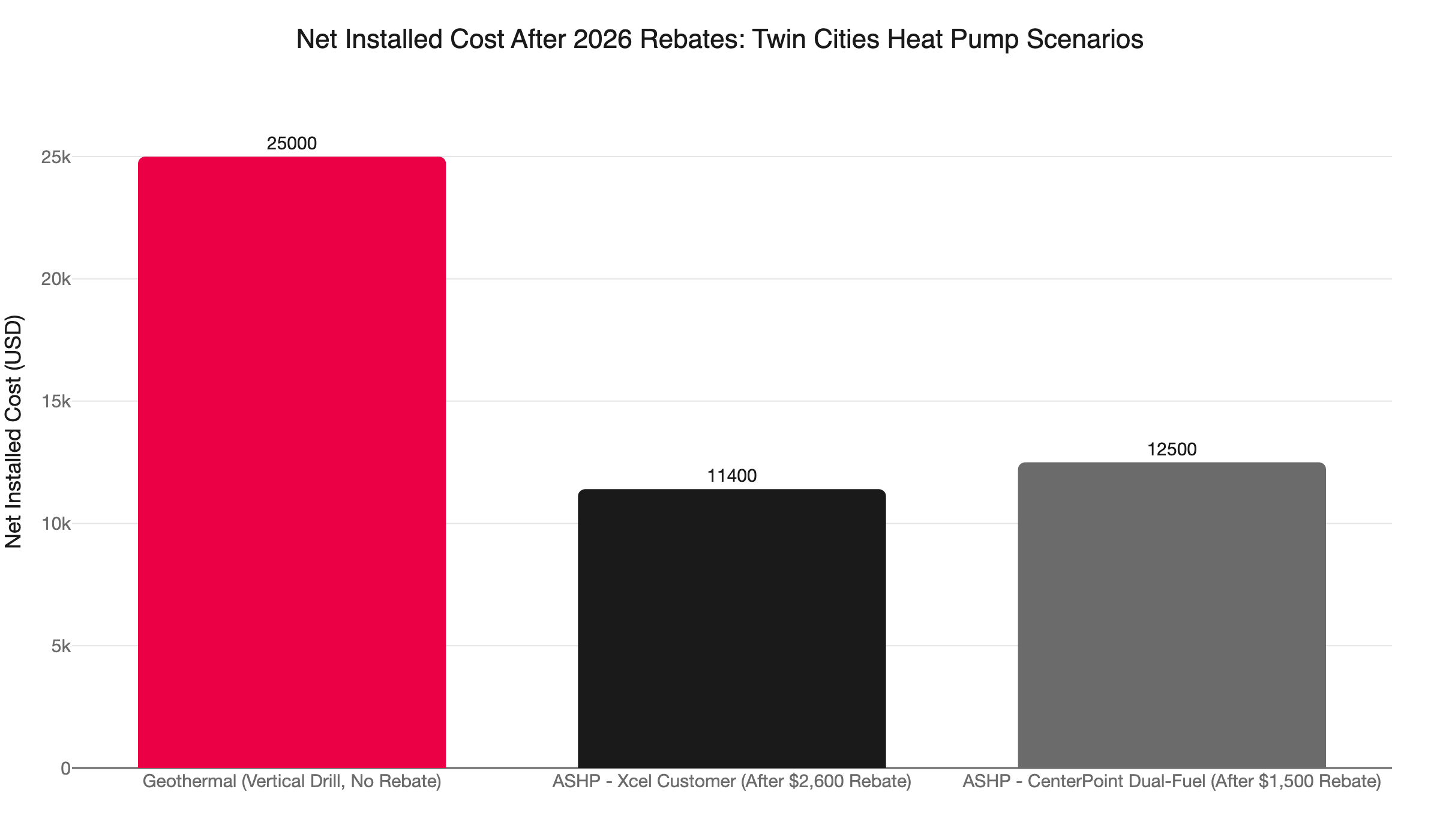
Net installed cost after available 2026 rebates:
- Geothermal (Twin Cities, vertical drill, median): approximately $25,000 (no rebate offset)
- Cold-climate ASHP, Xcel customer: approximately $11,400 (after $2,600 rebate)
- Cold-climate ASHP, CenterPoint dual-fuel: approximately $12,500 (after $1,500 rebate)
The net gap is roughly $12,500-$13,600 in favor of the ASHP. To close that gap inside 10 years through energy savings alone, geothermal would need to save $1,250-$1,360 more per year than a cold-climate ASHP. That is a significant annual threshold.
How Does the 10-Year Cost Math Work Out?
Short answer: For most Twin Cities homeowners who need vertical drilling and have no federal credit offset, the ASHP comes out ahead through year 10. Geothermal’s edge builds over 20-30 years, especially when you factor in the ground loop’s long service life.
Here is a scenario for a 2,000 square foot Twin Cities home replacing a gas system with a heat pump.
Geothermal path
- Installed cost (vertical drill, 3-ton, median): $25,000
- Available rebates in 2026: $0
- Net year-zero cost: $25,000
Cold-climate ASHP path (Xcel customer)
- Installed cost (median): $14,000
- Xcel rebate: -$2,600
- Net year-zero cost: $11,400
Year-zero gap in favor of the ASHP: $13,600.
The efficiency case for geothermal is real. The Department of Energy notes that ground-source heat pumps reduce energy consumption 25-50% compared to air-source heat pumps. Ground temperature holds steady at 50-59°F year-round, even when outdoor air hits -20°F. That advantage does not compress in February the way an ASHP’s efficiency curve does.
One Minnesota family, profiled by Clean Energy Resource Teams in a 4,600 square foot home, reported $944 per year in combined heating, cooling, and domestic hot water costs after their geothermal install. That is a strong result. A smaller home with a smaller system sees proportionally smaller absolute savings. The annual efficiency gap between geo and ASHP narrows when total consumption is lower.
To recover a $13,600 premium over 10 years, geothermal needs to save about $1,360 more annually than the ASHP. Whether that threshold is reachable depends on home size, your current energy source, and the ASHP’s cold-weather performance at your specific site.
For most average-sized Twin Cities homes, the ASHP wins through year 10. Geothermal closes the gap somewhere between years 20 and 25 for many households.
Three factors that shift the math
- Larger home, higher heating load. A bigger home spends more on heat each year. The percentage advantage geothermal holds compounds against a larger base. That widens the annual savings gap and shortens the payback timeline.
- Ground loop longevity. The DOE’s geothermal consumer guide notes that in-ground loop fields carry very long service lives. Minnesota installations commonly cite a 300-year loop expectation. The heat pump unit runs 20-30 years. You pay once for infrastructure the equipment outlives several times over. If you plan to stay in the home for decades, that changes the true lifetime cost picture significantly.
- No vertical drilling premium. If your lot fits horizontal loops, the installed cost falls to $18,000-$20,000. At that level, the payback timeline shortens materially and the calculus gets closer.
What Is the Permitting Timeline for Geothermal in Minnesota?
Short answer: Plan for 2-4 extra weeks of lead time. Geothermal bored heat exchangers require both a Minnesota Commissioner of Health permit under Minn. Stat. §103I.641 and a DLI mechanical permit. That is two agencies and two review queues before a drill rig can show up.
Most HVAC replacements require only a local or state mechanical permit. Geothermal adds a second layer.
Under Minn. Stat. §103I.641, geothermal bored heat exchangers fall under Minnesota’s well and boring jurisdiction. The Minnesota Department of Health reviews the boring permit independently from the Department of Labor and Industry mechanical permit required for the HVAC equipment. Two agencies means two review queues. Depending on workload, that adds two to four weeks before installation can begin.
If you have a failed furnace in November and need heat before the first serious cold snap, geothermal is not a fast answer. A cold-climate ASHP or a dual-fuel hybrid does not carry this dual-agency requirement. It can move to install on a much shorter schedule.
Geothermal vs. Air Source Heat Pump: Which Is Right for Your Minnesota Home?
Short answer: For a standard Twin Cities suburban lot with limited open yard and strong rebate eligibility, a cold-climate ASHP almost always wins through year 10. Geothermal makes a stronger case on larger lots, in high-usage homes, and for homeowners planning to stay 20 or more years.
Use this to frame your own decision:
Lean toward a cold-climate ASHP if:
- Your yard cannot fit horizontal loops, which applies to most Twin Cities lots
- You are an Xcel Energy customer eligible for up to $2,600 in rebates
- You want a dual-fuel hybrid and the CenterPoint $1,500 rebate matters to your budget
- You need the system installed this season, not after a two-agency permit process
- Your planning horizon is 10-15 years
Lean toward geothermal if:
- Your lot has documented open area for horizontal loops, or the vertical drilling premium fits your budget comfortably
- You are building new and can fold loop cost into the overall construction budget
- You plan to stay 20 or more years and want to pay once for infrastructure the equipment outlives
- Your home has a high heating load where the annual efficiency gain is substantial
For homeowners who are not ready to commit to a full heat pump conversion, a dual-fuel heat pump and gas furnace hybrid is a practical middle path. The ASHP runs efficiently during shoulder seasons and moderate winter days. The gas furnace takes over on the extreme cold nights when air-source efficiency drops. CenterPoint’s $1,500 rebate is specifically structured for this setup.
If you want to compare current rebate programs side by side, our Xcel and CenterPoint rebate guide covers 2026 qualifying requirements in plain terms. For a look at cold-climate ASHP brand performance at low Minnesota temperatures, our Minnesota heat pump rebates and tax credits overview is a useful companion.
Before getting quotes for either system, ask for a Manual J load calculation. A properly sized system is the first requirement for any heat pump to perform as advertised in a Minnesota winter.
Ready to Talk Through Your Options?
The ranges in this post reflect typical Twin Cities installations. Your actual numbers depend on your home’s heating load, your lot’s layout, your utility provider, and how long you plan to stay.
Our team is locally owned and operated in Ramsey, MN. We serve Minneapolis, St. Paul, Blaine, Maple Grove, Plymouth, Brooklyn Park, Woodbury, Bloomington, and the surrounding metro. We give you a straight answer on what makes sense for your home. Not a pitch for whatever has the higher margin.
Call (763) 260-6662 or book a home assessment to get started. We back every appointment with a simple promise: “Always On Time… Or You Don’t Pay a Dime!(R)”
Frequently Asked Questions
Can I put geothermal on a typical Twin Cities suburban lot? +
Are there still federal tax credits for geothermal or heat pumps in 2026? +
Which is cheaper over 10 years: geothermal or an ASHP in Minnesota? +
Need a technician now?