
High Efficiency Furnace Condensate Neutralizer: MN Guide
Key Takeaways
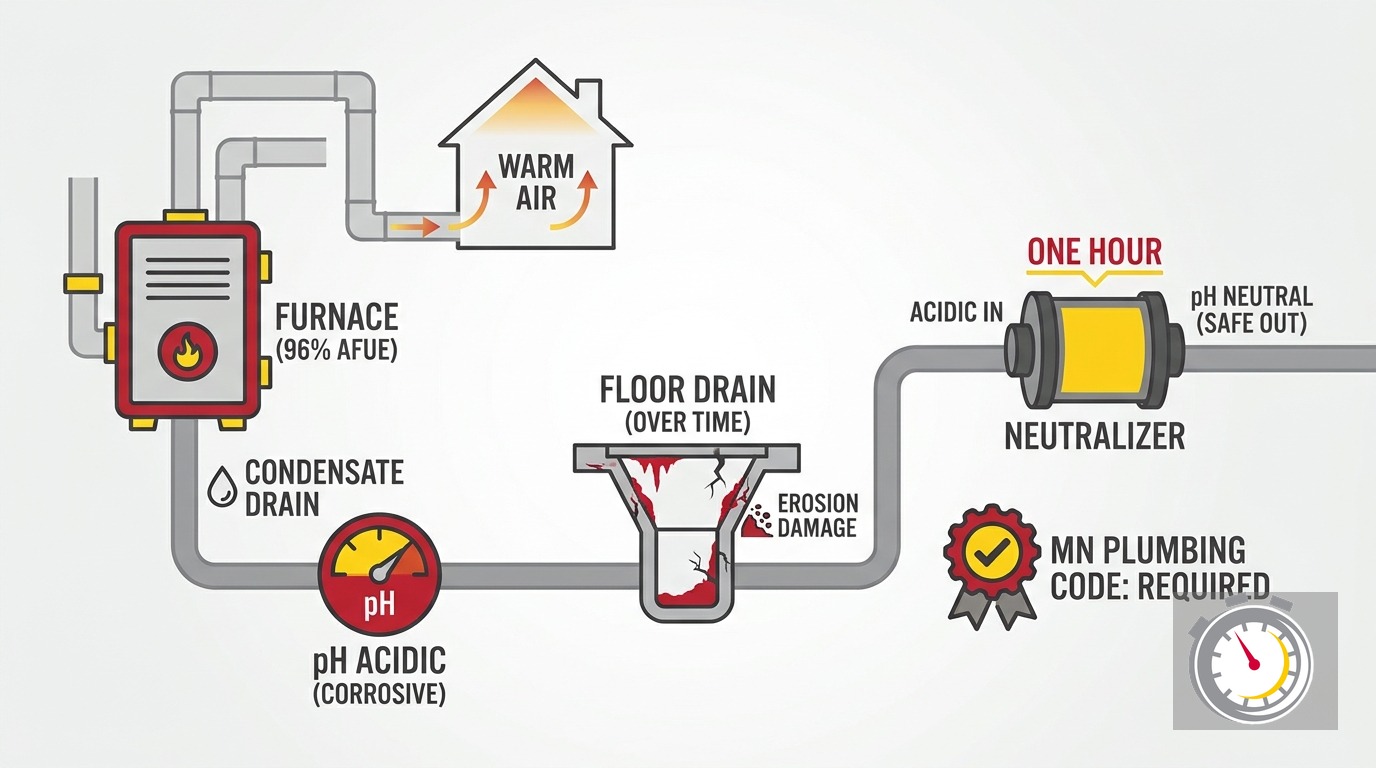
- Condensate from a 96% AFUE furnace is acidic. Vendor sources put the pH roughly between 2.9 and 4.0.
- A neutralizer raises that pH before the water reaches your drain, pipes, or sewer.
- We found no Minnesota rule that requires a neutralizer by name. Do not trust anyone who says the code does.
- Minnesota plumbing code does require an indirect waste pipe and an air gap or air break.
- Code also bars substances that destroy drain pipes or their joints. Acidic water on old cast iron fits that concern.
- A neutralizer needs yearly checks. Media wears out, and a spent neutralizer protects nothing.
- Ask your local mechanical inspector or your furnace manual for the final word on your home.
What is the main function of a condensate neutralizer?
A condensate neutralizer raises the pH of the acidic water your high efficiency furnace makes. Condensate flows through a small chamber of alkaline media, usually calcium carbonate. The media neutralizes the acid before the water reaches your drain pipes and the sewer. It is a small, low-cost device that protects the plumbing downstream.
If you own a 90%-plus furnace in the Twin Cities, this applies to you. Your furnace makes condensate every time it runs, and a Minnesota winter means a lot of runtime.
We are a locally owned and operated Twin Cities HVAC company. We install these systems every season, so we will give you the straight story, including where Minnesota code stays silent.
Why does a high efficiency furnace produce condensation?
A high efficiency furnace makes condensation because it pulls so much heat out of the exhaust that the exhaust cools below its dew point. The water vapor in the flue gas turns to liquid. Older furnaces vent that hot gas up a chimney. Condensing furnaces capture the heat and drain the water.
Natural gas burns into carbon dioxide and water vapor. A standard 80% furnace sends all of it outside while still hot, so the vapor never turns to liquid in the vent.
A 96% AFUE furnace works differently. A second heat exchanger wrings extra heat out of the exhaust, which is why you pay less to heat your home. If you want to compare the two types, our 80% versus 96% AFUE breakdown walks through the tradeoffs.
The cooled exhaust can no longer hold its water. The water drips out of the heat exchanger and collects in a drain system. Because the exhaust is cool, we vent it through plastic pipe instead of a metal flue.
How much water is that? One manufacturer article says a residential appliance can produce up to 18 gallons per day. That is a ceiling for large equipment under heavy load, and a typical home furnace makes less. It still runs for months, and the water has to go somewhere.
Why is 96% AFUE condensate acidic?
The condensate is acidic because combustion gases dissolve into the water as it forms. Natural gas exhaust carries trace compounds along with the vapor. When the vapor condenses, those compounds enter the liquid and lower its pH. The result is mildly corrosive water.
How acidic? Two vendor sources give similar numbers. One neutralizer maker describes the condensate as “corrosive (i.e. 2.9-4.0 pH).” Another manufacturer article says it can reach a pH “as low as 2.5.”
Both sources sell neutralizers, so read the figures as a range, not a lab result for your furnace. The direction is clear, though. The water is closer to vinegar than to tap water.
For scale, neutral water is pH 7. Each whole number lower is ten times more acidic. Water at pH 3 is far more aggressive than water at pH 6.
A single drip is harmless. Gallons per day, through a whole heating season, for ten or twenty years, are a different matter. That is where drain damage starts.
What does acidic condensate do to a floor drain over time?
Over time, acidic condensate eats at the metal and mineral surfaces it touches. It can roughen and thin the inside of a metal trap. It can attack cast iron stacks. It can break down the mortar-like material in older drain joints. The damage is slow, so you rarely see it until a leak shows up.
Here is what we see in Twin Cities homes. Many older houses have a floor drain in the basement near the furnace. Installers often run the condensate line there because it is easy. The water goes in, and nobody thinks about it again.
The path that water takes matters:
- The floor drain grate and basin. These see the first and heaviest exposure.
- The trap. It holds standing water. Acidic water can sit in it between furnace cycles.
- The cast iron stack. Older homes often have cast iron below the floor. It rusts from the inside.
- Joints and seals. These wear first, and they cause the leaks that homeowners notice.
No source we reviewed measures how fast this happens, and competitor articles skip the topic. We will not invent a timeline. We can say that sustained acidic flow does not help old metal pipe. Newer homes often have plastic pipe, which resists acid better. Many older Twin Cities homes still have cast iron in the walls and under the slab.
A neutralizer costs little next to replacing a drain stack. If your home has an older metal drain, ask us to look at it during a visit.
Does Minnesota plumbing code require a condensate neutralizer?
No. We found no Minnesota rule that requires a neutralizer by name. The plumbing code does require a few things that shape how condensate gets handled. Those rules point toward protecting pipes and the sewer, and a neutralizer is one common way to do that.
Many online articles say “code requires a neutralizer” without naming a rule. We checked the Minnesota rules directly. Here is what they say.
Indirect waste. The plumbing code says that where discharged into the drainage system, equipment shall drain by means of an indirect waste pipe. In plain terms, your condensate line cannot connect solidly to a drain pipe. There must be a break.
Air gap or air break. The same part says waste pipes connect through an air gap or air break to a trapped and vented receptor, a fixture tailpiece, or an exterior place of disposal approved by the Minnesota Pollution Control Agency. It also says condensate waste shall not drain over a public way or in areas causing a nuisance.
No mention of pH. That page says nothing about pH or neutralizing. Neutralizers are simply not named.
A general protective principle. The plumbing code also states a broader principle. No substance that will “destroy the pipes or their joints” may enter the drainage system. The wording does not mention condensate. It is still the general hook for the floor drain concern above.
What Minnesota deleted. The state mechanical code says IMC section 307.3 is deleted in its entirety. The fuel gas code deletes IFGC section 307.6 on condensate pumps the same way. Minnesota removed some model-code condensate text, so national code language you read online may not apply here.
Taken together: Minnesota requires a proper indirect drain with an air gap or break. It bars substances that destroy pipes. It does not name a neutralizer. Your furnace manufacturer’s instructions may call for one, and your city inspector may expect one. We recommend asking.
Is acidic condensate allowed to go into the sewer?
Federal pretreatment rules limit very acidic discharges into public sewer systems. The federal rule bars pollutants that cause corrosive structural damage to the treatment works, and says in no case discharges with pH lower than 5.0, unless the works is designed to accommodate such discharges.
That rule targets industrial dischargers, and nobody is going to test your basement drain. It still shows where the line sits. Furnace condensate at pH 2.9 to 4.0 falls below that number before it mixes with the rest of your household water.
In practice, the condensate joins other household wastewater, which dilutes it. We do not claim a homeowner breaks a federal rule by draining a furnace. We do say that pH 5.0 is a useful benchmark for what the sewer system is built to take.
Local rules may be stricter. The Twin Cities sewer system has its own discharge rules. We could not confirm the pH limit in those rules, so we will not quote a number. Your city or the regional wastewater utility can tell you what applies to your address.
What should a Minnesota homeowner check? A condensate checklist
Use this checklist to review your own setup. It works for a new install or a furnace you have owned for years.
- Where does the line end? Follow the drain tube from the furnace. Note whether it ends at a floor drain, a laundry tub, a standpipe, or a pump.
- Is there an air gap or air break? The line should not connect solidly to the drain. There should be a visible break.
- Is there a trap? The receptor needs to be trapped and vented. A dry trap lets sewer gas back into the house.
- Is there a neutralizer? Look for a small canister inline with the drain tube.
- When was the media last checked? If nobody knows, assume it is overdue.
- Is the line sloped? Water should run downhill without sagging. Low spots hold water and can freeze or clog.
- Does the water stay inside the house path? Code says condensate shall not drain where it creates a nuisance. In winter, outdoor discharge can ice over a walkway.
A frozen line is a real Minnesota problem. If yours backs up in a cold snap, read our guide on a frozen high efficiency furnace condensate drain.
How do you maintain a condensate neutralizer?
Check the neutralizer once a year. Look at the media level, test the outlet water, and confirm water flows through. The media dissolves as it works, so it runs out. Follow the replacement schedule in the maker’s instructions for your exact model.
We will not give you a universal interval. None of the top articles we reviewed gave a verified one either. The right answer depends on your furnace size, runtime, and the neutralizer model.
Here is a simple yearly routine:
- Inspect the canister. Look for cracks, leaks, or stained fittings.
- Check the media. Many canisters have a clear body or a removable cap. Top off or replace the media if it looks thin or caked.
- Test the outlet pH. Pet-store or pool pH strips work for a rough check. Catch a sample of the water leaving the neutralizer. You want it near neutral, not strongly acidic.
- Clear the line. Flush the tube so debris does not block it.
- Run the furnace. Watch the water move from the furnace to the drain.
The easy time for all this is your fall tune-up. Our furnace tune-up service covers the condensate path along with the rest of the system. Skip a year and you can end up with spent media and no warning.
A neutralizer that is out of media looks fine from the outside. It just stops working. That is the most common failure we see.
What are the symptoms of a clogged furnace condensate drain?
A clogged condensate drain usually shows up as water near the furnace, a furnace that shuts off, or a gurgling sound. The furnace has a safety switch that stops it when water backs up. So a clog often looks like a furnace that will not run.
Watch for these signs:
- Water pooling around the furnace. Look for a puddle or damp spot on the floor.
- A furnace that shuts off or will not start. The overflow safety switch may be doing its job.
- Gurgling or bubbling. Air and water fighting through a partial blockage can make noise.
- A musty smell. Standing water breeds slime and mildew.
- Visible slime or debris in the drain tube. Clear tubing makes this easy to spot.
- Water in the neutralizer canister that does not drain. This suggests a clog downstream.
Clogs come from slime, dust, and spent media that breaks into bits. In winter, a frozen line causes the same symptoms. So does a failed pump. Our condensate pump troubleshooting guide covers that case.
If water is leaking, turn the furnace off and call us. Do not keep running a furnace that is backing up.
What about the new 95% furnace efficiency rule?
The federal efficiency rule may push more homes toward condensing furnaces. The Department of Energy rule requires non-weatherized gas furnaces to reach an annual fuel utilization efficiency of 95 percent, with an effective date listed as late 2028.
Do not treat that date as settled. Court action has left the timeline unsettled, as trade press coverage of the Supreme Court decision shows. A delay is possible, and we do not know how it will end.
What we do know is simple. Condensing furnaces are already the standard choice for new installs in Minnesota. Whatever happens with the rule, more homes will have condensate to manage. If you are planning a replacement, see our furnace replacement cost guide for pricing. We also offer financing options for larger jobs like a new furnace.
How Northern One Hour helps
We handle condensate the right way, so you do not have to think about it. When we install or service a high efficiency furnace, we look at the whole path: the drain tube, the air gap, the trap, the neutralizer, and any pump.
Here is what you can expect from our team:
- A clear look at your setup. We trace the line and tell you what we find.
- Honest advice on a neutralizer. We explain the tradeoffs and let you decide.
- Attention to your older drains. If your home has cast iron, we flag it.
- Work that follows the manufacturer’s instructions. Those instructions, plus your local inspector, set the final rules.
We are locally owned and operated, and we know Twin Cities homes. We know the old basements, the cast iron stacks, and the hard freezes.
You can count on us to show up. Our promise is “Always On Time… Or You Don’t Pay a Dime!(R)” In plain terms, we arrive within the time window you select. If our technician does not show up on time, you do not pay for the service. We also back our work with a 100% satisfaction guarantee.
Not sure where your furnace drains, or whether it has a neutralizer? Call (763) 260-6662 or book online. We will take a look and give you a straight answer.
Final word
Condensate from a high efficiency furnace is acidic. Vendor sources put the pH in the 2.5 to 4.0 range, and a floor drain, trap, or old cast iron stack can wear down under that flow.
Minnesota code does not name a neutralizer. It does require an indirect waste pipe, an air gap or break, and protection for drain pipes. A neutralizer is a simple, common way to meet the spirit of those rules.
Check your setup this fall. Look at where the line ends, whether there is an air gap and a trap, and whether the neutralizer has fresh media. If you are not sure, we are glad to help.
Frequently Asked Questions
What is the best condensate pump for a furnace? +
Does a 96% AFUE furnace always need a neutralizer? +
How often should I check a condensate neutralizer? +
Can I drain furnace condensate into a floor drain? +
Need a technician now?