
Furnace Exhaust Pipe Frost Buildup Outside: What It Means
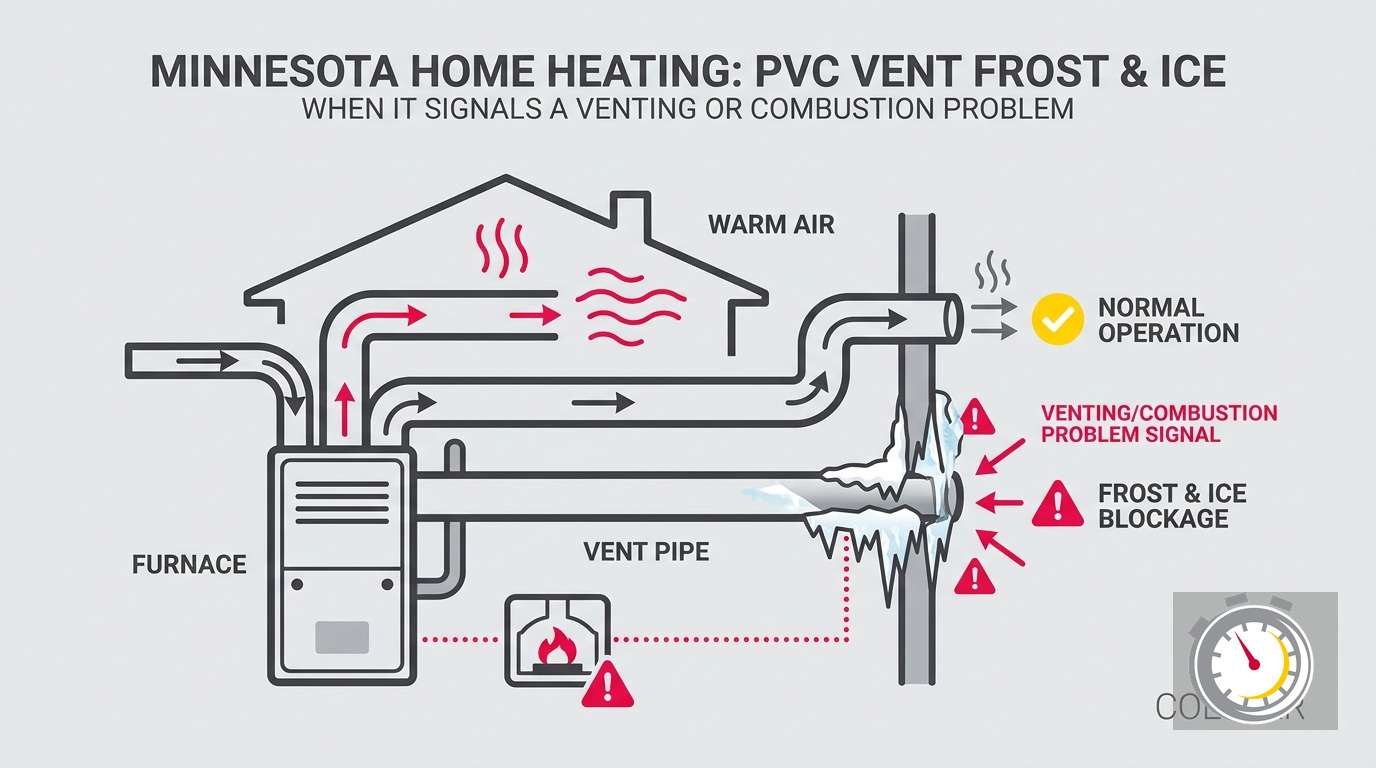
Key Takeaways
- Light frost on a sidewall PVC vent is common on high-efficiency furnaces in Minnesota winters.
- Ice that returns again and again usually points to an install or design issue, not bad luck.
- Ice plus soot, odor, lockouts, or CO alarm activity is a safety problem. Call right away.
- Clear loose snow and ice by hand. Do not pry, chip, or use flame or boiling water.
- Check your gas meter and regulator too. Snow or ice over them can stop your heat.
- Minnesota law requires working CO alarms near sleeping areas.
- If you are unsure what you are seeing, treat it as a reason to call.
Is Frost on Your Furnace Exhaust Pipe Normal?
Light frost on the outside of a high-efficiency furnace vent is often normal. The exhaust is cool and full of water vapor, so it can freeze at the pipe opening in cold weather. Heavy ice that keeps returning, or any ice paired with warning signs, is not normal. Those cases need a professional look.
That is the short answer for furnace exhaust pipe frost outside your Twin Cities home. The longer answer depends on what you see. A thin white coat is one thing. A thick ice collar creeping toward the intake pipe is another.
We are Northern One Hour Heating & Air Conditioning, locally owned and operated in Ramsey. We see these calls every winter. Below, you can sort the harmless from the risky and learn what is safe to clear.
Why Does a High-Efficiency Furnace Frost Up Outside?
A high-efficiency furnace pulls so much heat from its exhaust that the gases leave cool. Cool exhaust carries water vapor. When that vapor meets freezing air at the pipe opening, it condenses and can freeze. The furnace is designed to work this way.
Most of these furnaces are direct-vent models with two sealed pipes. One brings in outdoor air for combustion. The other carries exhaust directly to the outside, according to the U.S. Department of Energy.
The same page notes that condensing direct-vent furnaces are Category 4 appliances. Their efficiency (AFUE) runs from 90% to 98%. That efficiency lowers your gas bill. It also makes the exhaust cool enough to frost.
Older, mid-efficiency furnaces vent hot gases through a chimney or metal flue. They rarely frost at all. White PVC pipes on your sidewall mean you have the newer kind.
You may see a little steam or mist when the furnace runs on a cold morning. That is also normal. It is water vapor, not smoke.
What Are the Three Things You Might Be Seeing?
Most articles on this topic tell you to “clear the pipe and call a pro.” That skips the useful part. Frost can mean three different situations, and each one calls for a different response.
Use this guide to place what you see.
Tier 1: Light Frost That Comes and Goes
You see a thin white coat of frost on the pipe end or the siding nearby. It shows up on the coldest mornings. It melts or fades when temperatures rise.
What it means: Normal condensing exhaust meeting cold air.
What to do: Nothing urgent. Check the pipes after each snowfall and make sure the opening stays clear. Watch how the frost changes over the week.
Tier 2: Ice That Keeps Coming Back
You clear it, and it returns within days. The ice grows into a thick collar or a growing lump. It may spread toward the intake pipe or onto the wall.
What it means: A design or install problem is likely. The usual causes are where the pipe ends, how far it extends, how it slopes, or how close exhaust sits to the intake. In some cases, exhaust gets pulled back into the intake pipe.
What to do: Do not keep chipping at it all winter. Call for an inspection. A change to the vent setup usually fixes it.
Tier 3: Ice Plus Warning Signs
You see ice along with any of these:
- The furnace locks out or shuts down mid-cycle.
- You see soot or dark staining near the vent.
- You smell exhaust, smoke, or something sharp inside the home.
- Your CO alarm sounds, or anyone has headaches, nausea, or feels sick.
What it means: This may be a combustion or venting fault. It is a safety issue.
What to do: Treat any CO alarm seriously. Get everyone outside into fresh air, and call 911 if anyone feels sick. Then call us. Our guide to what to do when a CO alarm goes off walks through the steps.
What to Do When Snow or Ice Blocks Your Furnace Vent?
If snow or ice covers a vent opening, clear it gently by hand. Remove loose snow and ice from the pipe ends and the area around them. Do not pry at the PVC. If the furnace stays off, keeps cycling, or you feel sick, stop and call for help.
A blocked vent can do real harm. Exhaust has to leave the house. When it cannot, the furnace may shut off, or exhaust gases may back up.
Minnesota has seen what that looks like. In January 2014, snow drifts around a New Ulm home’s exhaust and intake vents let carbon monoxide build up. Three people were sickened. An elderly couple, ages 93 and 90, went to the hospital. Their son was treated and released. Officials urged homeowners to check outdoor furnace vents and keep them clear of snow.
The metro sees it too. Woodbury’s EMS and Fire Chief Chris Klein told KSTP in a February 2023 report that snow can block exhaust pipes. That can shut the furnace off or let CO into the home. He said the city gets a couple calls a year from people who have not cleared their pipes or vents. He named headaches, sickness, and nausea as the first symptoms.
A Safe Clearing Routine
Follow these steps after a heavy snow, or after wind drifts snow against the house:
- Dress for it. Wear boots and gloves. Watch for ice underfoot near the wall.
- Turn the thermostat down. If the furnace is clearly struggling, set it to off before you clear.
- Find both pipes. Look for the intake and the exhaust on the sidewall. Clear both.
- Brush away loose snow. Use your hands or a soft brush. Keep the area around each opening open.
- Remove loose ice by hand. Be gentle. Do not hit, pry, or chip at the pipe.
- Skip heat tools. Do not use boiling water or a flame.
- Look for drifts. Clear snow piled against the wall below and beside the vents.
A 2019 report on Manitoba Hydro and Winnipeg fire guidance said newer furnaces typically shut off when vents are clogged. Owners should still check, especially after new snowfall. That is a general point, not a guarantee. Do not count on a safety shutoff to protect you. Keep the vents clear.
If the ice is thick, hard, or out of reach, do not force it. Call us. For more on snow-blocked vents and cold-weather shutoffs, see our guide to snow and ice blocking a high-efficiency furnace vent.
How Do You Restart Your Furnace After Clearing the Vent?
After you clear the vent, give the furnace a minute, then turn the thermostat back up. Watch the first full heating cycle. If the furnace runs normally and the vent stays clear, you are likely fine. If it shuts down again, shows an error code, or smells off, call us.
Here is a simple restart routine:
- Confirm both pipes are clear of snow and loose ice.
- Check that nothing else covers the vents, such as drifted snow or a stored item.
- Make sure the furnace switch is on and the door panel is closed.
- Set the thermostat to heat and raise it a few degrees above room temperature.
- Stand by and listen. You should hear the inducer fan start, then ignition, then the blower.
- Go outside once the furnace is running. Check that exhaust is leaving the pipe.
- Check again after an hour and after the next snowfall.
Most furnaces start on their own once the vent clears. If yours does not, look at the control board light. It may flash a code. Our furnace error code guide explains what many of the blinks mean.
Check the condensate line too. A high-efficiency furnace makes acidic water as a byproduct. If the drain line freezes, the furnace can stop even when the vent is clear. That is a separate issue with a separate fix.
Do not reset the furnace again and again. A repeated lockout means something is wrong. Call a technician. Our furnace repair team can find the cause and fix it.
How Should You Insulate a Furnace Exhaust Pipe?
Do not wrap, cover, cap, or add anything to your furnace exhaust pipe on your own. The manufacturer’s installation instructions and current code decide what is allowed. A licensed technician should check the setup first. Adding material the wrong way can trap exhaust or create a new hazard.
This is a common question, and it is where well-meant fixes go wrong. A homeowner sees ice and thinks the pipe needs a blanket. But the ice is a symptom. The cause is usually where the pipe ends and how it is set up.
Here is what we would look at first:
- Is the pipe set up as the manufacturer intended?
- Does it end in a spot where snow drifts and wind pile up?
- Is there room around the opening for exhaust to disperse?
- Is the exhaust pipe too close to the intake?
- Does the pipe slope the right way for condensate to drain back?
We cannot give you a single number for any of these. The right figures vary by furnace model and by code. Your furnace’s installation manual is the source. A licensed tech should confirm the details before anyone changes the vent.
Some vent runs travel through cold spaces such as an attic or exterior wall. A cold run can collect more condensation. The manufacturer’s instructions say whether and how that run may be insulated. Ask before you buy anything at the hardware store.
Why Does Recurring Ice Usually Mean an Install Fix?
If ice keeps coming back, the cause is usually how the vent was installed, not the furnace itself. The common culprits are where the pipe ends, how far it extends, how it slopes, and how close the exhaust sits to the intake. A technician fixes these, and weather does not.
Every high-efficiency furnace in Minnesota faces the same cold. Some frost heavily. Many do not. The difference often comes down to the vent setup.
Here are the usual causes of repeat ice:
- Termination location. A pipe that ends in a sheltered corner or under an overhang can trap vapor and snow.
- Pipe length and extension. A pipe that sits too close to the wall can let ice build against the siding.
- Slope. Condensate should drain back toward the furnace. If it pools in the pipe, it can freeze at the end.
- Intake and exhaust spacing. If the two pipes sit too close, exhaust can be drawn back into the intake. That adds moisture and can upset combustion.
- Long runs through cold spaces. More cold surface means more condensation.
Many of these fixes are simple. A technician may reposition or extend the pipe, correct the slope, or separate the intake and exhaust. We can explain the options and the reason for each one.
Fixes tied to the vent system itself are not always cheap. If the repair grows into a larger job, ask us about financing options. We will walk you through them.
Cracked or aging vent pipe can also cause trouble. Our guide to PVC vent pipe problems on high-efficiency furnaces shows what to look for.
Can Snow or Ice on Your Gas Meter Shut Off Your Heat?
Yes. Snow or ice that covers your gas meter or regulator can keep it from venting. That can interrupt gas flow to your furnace. Clear loose snow from the meter gently by hand. If you see heavy ice, or you smell gas, leave the home and call your gas utility.
Most frost articles stop at the furnace vents and miss the meter. KSTP’s reporting noted that snow or ice over a gas meter can keep it from venting. A Minnesota Department of Public Safety item said the same thing.
Here is what to do:
- Brush loose snow off the meter and regulator with your hand or a soft brush.
- Do not chip at ice on the meter. Do not use tools or hot water on it.
- Keep snow from piling back up. Watch the spot after storms and during drifting wind.
- If your furnace shuts off during a cold snap and the vents are clear, check the meter next.
A gas smell is an emergency. Leave the home right away. Call your gas utility or 911 from outside. Do not flip switches or use a phone inside.
We cover this in more detail in our guide to a frozen gas meter or regulator that shuts off your furnace.
What Does Minnesota Law Say About CO Alarms?
Minnesota law requires an approved, working carbon monoxide alarm within ten feet of each room used for sleeping. This applies to every single-family home and every dwelling unit in a multifamily building. A first violation brings a safety warning. Later violations can be a petty misdemeanor.
That comes from Minnesota Statutes 299F.51. An alarm is your backup when a vent is blocked and you cannot see it.
Frost on a vent is a smaller worry when your alarms work. Frost with a silent, dead, or missing alarm is a bigger one. Check your alarms this week:
- Press the test button on each alarm.
- Confirm there is one within ten feet of each bedroom door.
- Replace batteries on the schedule the maker recommends.
- Check the date on the alarm. Replace units that have passed their end-of-life date.
- Never ignore an alarm because “it’s probably the battery.”
Not sure where to put them? Our guide to CO detector placement near a furnace or boiler helps you decide.
CO is odorless. Early symptoms look like the flu: headaches, sickness, and nausea. If several people in the house feel sick at once, and the feeling eases when you leave, suspect CO. Go outside and call 911.
Which Problems Can You Handle, and Which Need a Technician?
You can safely brush away loose snow and remove loose ice by hand. Anything past that needs a technician: recurring ice, lockouts, soot, odors, CO alarms, or ice you cannot reach or remove without force. When in doubt, call.
Use this quick split:
Fine for you to do:
- Brush loose snow from the vent openings and the meter.
- Gently remove loose ice by hand.
- Check that both pipes stay open after each storm.
- Test your CO alarms and replace weak batteries.
- Watch the furnace through one full heating cycle after clearing.
Call a technician for:
- Ice that returns within days of clearing.
- Thick ice collars or ice reaching the intake pipe.
- Furnace lockouts or shutdowns during cold weather.
- Soot, staining, or a smell of exhaust or smoke.
- A cracked, loose, or sagging vent pipe.
- Any CO alarm activity or symptoms in the household.
- Dripping or pooling at the vent that does not stop.
Do not do:
- Pry, chip, or hammer at the pipe.
- Use boiling water or a flame.
- Cap, cover, or wrap the vent.
- Block the vents with stored items or piled snow.
- Silence a CO alarm and move on.
A smoke or burning smell near the vents needs its own attention. Our guide to smoke smells coming from furnace vents explains the common causes.
How Does Northern One Hour Help With Vent Problems?
We inspect the vent, find the cause of the ice, and fix it. We start with how the pipes are placed. Then we check the furnace for any sign of a combustion problem. You get a clear answer in plain language, not a guess.
We are locally owned and operated. Our crews live and work in the Twin Cities. We know how our winters drift snow against sidewalls, and we know where vent setups tend to struggle.
Cold snaps do not wait for a convenient time. When you book, you choose your time window. Our promise is simple: “Always On Time… Or You Don’t Pay a Dime!(R)” We arrive within the window you select. If our technician does not show up on time, you do not pay for the service.
Here is how to get started:
- Call (763) 260-6662 or book online.
- Tell us what you see: frost, ice, a lockout, or a smell.
- Pick your time window.
- Stay outside and call 911 first if anyone feels sick or your CO alarm sounds.
We back our work with a 100% satisfaction guarantee and honest, transparent pricing. If your vent needs a bigger repair, we explain the options before we start. We can also talk through financing for larger jobs.
If you want a pro to check your system before the deep cold arrives, schedule a furnace tune-up. A tune-up lets us look at the vents, the condensate line, and the combustion side in one visit.
Call (763) 260-6662 or book online. We will take it from there.
Frequently Asked Questions
Why does water drip from my furnace vent pipe when it rains? +
Can I pour hot water on the ice to melt it? +
How often should I check my furnace vents in winter? +
Need a technician now?