
Water Dripping From Furnace Vent Pipe Roof: MN Causes
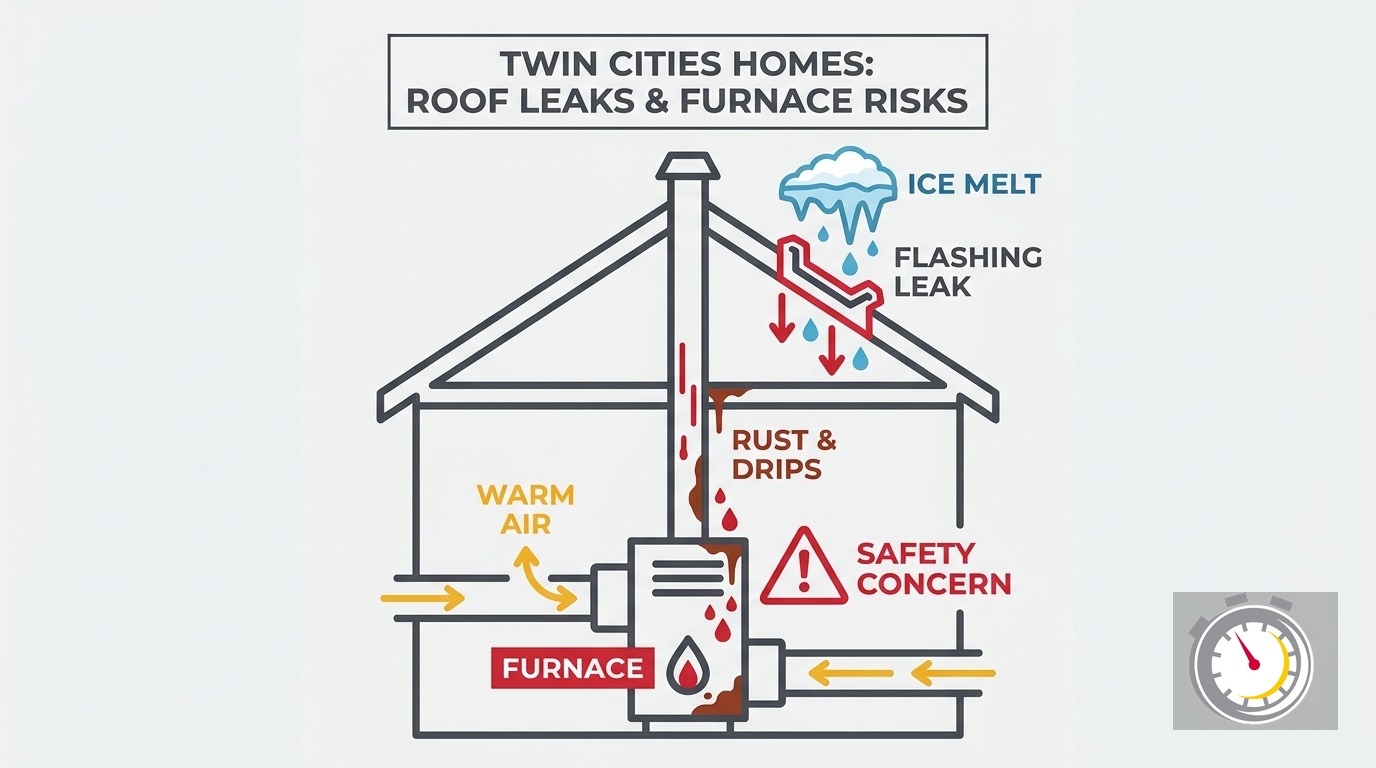
Key Takeaways
- Water dripping from a furnace vent pipe usually comes from one of two sources: outside water getting in at the roof, or exhaust condensation inside the pipe.
- A drip during rain or a thaw points to the cap, flashing, or sealant. A drip during a cold run points to condensation.
- Water in a flue can cause rust. A rusted or leaking flue can let carbon monoxide (CO) into your home.
- Do not ignore it. Turn the furnace off if water is heavy, and call a professional the same day.
- Make sure CO alarms work on every level and near every bedroom.
- Minor fixes like a new cap or sealant are far cheaper than replacing a corroded vent or furnace parts.
Why is water dripping from my furnace vent pipe on the roof?
Short answer: Water at the roof vent comes from rain or snowmelt getting in, or from exhaust gas condensing inside a cold pipe. Both can corrode the flue over time. Check when the dripping happens. That timing tells you which cause is most likely and how urgent the fix is.
Your furnace burns gas and pushes hot exhaust up and out through a vent pipe. The pipe runs through your attic and out the roof. Water can get in, or form, anywhere along that path.
There are two basic sources:
- Water from outside: Rain, melting snow, or ice melt runs down the pipe from the roof.
- Water from inside: Warm, moist exhaust meets a cold pipe and turns to liquid.
Both show up as drips, stains, or puddles. The fixes differ, and so do the risks.
In the Twin Cities, you can get both. Heavy snow, deep cold, and quick thaws are hard on a roof penetration every winter.
Why is my roof vent leaking water?
Short answer: A roof vent usually leaks because of a missing or damaged cap, worn flashing, cracked sealant, or lifted shingles near the pipe. Each one lets rain or snowmelt run down the outside of the flue and into your attic or furnace area.
Picture the roof vent as a small chimney with a collar around it. If any one piece fails, water finds a way in.
The vent cap
The cap sits on top of the pipe. It keeps rain and debris out while letting exhaust escape. A missing, cracked, or loose cap lets rain drop straight down the pipe.
Wind, hail, and critters can all knock a cap loose. Our guide to animals nesting in furnace flue pipes covers another common cap problem.
The flashing
Flashing is the metal collar where the pipe meets the roof. It steers water around the pipe instead of into the hole. Over the years, it can rust, bend, or pull away.
A gap of even a quarter inch can let in meltwater. Freeze-thaw cycles widen it each winter.
The sealant
Roofers seal the edges of flashing with a flexible sealant. Age and sun dry it out and crack it. Minnesota temperature swings speed that up.
The shingles
Shingles near the pipe can lift or crack. Exposed nail heads can also let water in. The water then follows the pipe downward.
What you may notice indoors
- A brown or yellow ring on the ceiling near the flue
- Damp insulation around the pipe in the attic
- Drips at the furnace or on the floor below
- Rust streaks on the pipe or draft hood
- A musty smell near the furnace closet
Roof leaks are the roofer’s turf. Once water travels down the flue, though, it becomes a furnace problem too.
Is it rain, condensation, or ice melt?
Short answer: Match the timing. Drips during rain or a thaw point to the cap, flashing, or sealant. Drips while the furnace runs in deep cold point to condensation inside the pipe. Drips after a heavy snow melts point to a roof-level gap.
In Minnesota, winter is when most of these problems show up. Timing is the easiest way to sort them out.
Drips during a thaw or after snow melts
If the dripping starts when temperatures rise, melting snow or ice is the likely source. Snow packs around the pipe. Warm exhaust and roof heat melt it. The water then finds any weak spot in the flashing or boot.
This is a common-sense mechanism, not a lab finding, but it fits what we see in the field. Water that freezes in a gap expands and pries the gap wider. The next thaw sends more water in.
Drips during rain only
If it only drips in rain, suspect the cap or the flashing. A drip that stops a day after the rain also points to the roof. Insulation around the pipe may stay wet longer than the pipe itself.
Drips while the furnace runs on a cold day
This pattern points to condensation. Furnace exhaust holds a lot of moisture. When it hits a cold pipe in an unheated attic, some of it turns to water and runs back down.
Condensation is more likely when:
- The pipe runs a long way through a cold attic
- The pipe is uninsulated or poorly sealed
- The furnace is a high-efficiency model, which makes cooler exhaust
- Outdoor temperatures are well below freezing
Our post on high-efficiency furnace PVC vent pipe problems explains why those systems are more prone to this.
Drips that show up at the furnace only
If the water appears at the furnace and not in the attic, look at the condensate drain. High-efficiency furnaces make water during normal operation. A clogged line or a bad slope can back it up. Our guide on water leaking from a furnace walks through those causes.
A quick diagnostic table in words
- Rain only: Cap, flashing, or sealant
- Thaw or snowmelt: Flashing, boot, or cap gap
- Cold run, no precipitation: Condensation in a cold pipe
- Puddle at furnace base: Condensate drain or heat exchanger issue
- Rust-colored water: Corrosion has already started
If you are unsure, do not guess. A technician can confirm the cause in one visit.
How does a roof leak turn into rust, drips, and a CO risk?
Short answer: Water in a flue can corrode the metal. Corrosion can open holes or loosen joints. A leaking or disconnected flue can let exhaust, including carbon monoxide, escape into your home instead of going outside.
This chain is why we take small drips seriously. It runs like this.
- Water enters the vent. It may come from the roof or from condensation.
- Water sits or runs along the metal. Exhaust moisture is slightly acidic. It eats at the pipe from the inside.
- Rust forms. You may see flaking, orange stains, or pinholes.
- The pipe weakens. Seams open. Joints loosen.
- Exhaust leaks out. Gases that should leave through the roof enter the attic or living space.
Carbon monoxide is the dangerous part, and you cannot see or smell it. The EPA lists leaking chimneys and furnaces among the sources of CO in homes. It also names back-drafting from furnaces and water heaters.
The EPA also lists a flue that is improperly sized, blocked, disconnected, or leaking as a cause of CO problems. A rusted-through pipe is a leaking flue.
Back-drafting happens when exhaust flows the wrong way. A damaged or blocked vent can cause it, and so can a weak draft in a cold flue. Our article on furnace flue pipe rust and corrosion signs shows what to look for.
Signs that the problem has gone further
- Rust flakes or orange dust around the furnace or draft hood
- Soot or scorch marks near the flue connection
- A flame that looks lazy or yellow
- Stuffy air, headaches, or nausea when the furnace runs
- A CO alarm that sounds, even once
If you notice the last two, treat them as an emergency. Get everyone outside, then call 911. Our post on a CO alarm going off near your furnace explains what to do and what not to do.
Should I worry if my furnace is leaking water?
Short answer: Yes, take it seriously, but do not panic. A small drip from a bad cap is a repair job. Heavy water, rust, or any CO alarm is urgent. Water in a flue or furnace can damage parts and create safety risks if left alone.
How worried to be depends on what you see.
Low urgency: schedule a visit this week
- A faint ceiling stain that is dry now
- Drips only after heavy rain
- No rust at the furnace
- All CO alarms working and quiet
Even here, do not wait for spring. Water damage spreads, and winter makes roof access harder.
Medium urgency: call within a day
- Steady dripping while the furnace runs
- Wet insulation around the flue
- Rust streaks on the pipe or draft hood
- Water pooling at the base of the furnace
High urgency: stop and call now
- A CO alarm is sounding
- Anyone feels dizzy, sick, or has a headache
- You smell exhaust or gas
- The vent pipe is detached or leaning
- Water is running into the furnace in a steady stream
For any gas smell, leave the house and call your gas utility or 911. Our guide on what to do about a gas smell lists the steps.
Water that gets into a furnace can corrode burners, sensors, and the heat exchanger. A cracked heat exchanger is a serious safety issue. Learn more in our post on cracked heat exchanger signs.
What should you do right now?
Short answer: Stay safe first. Check your CO alarms, turn off the furnace if water is heavy, and keep clear of the roof. Then document the problem and call a professional who can inspect the vent and the furnace.
Work through these steps in order.
- Check your CO alarms. Minnesota law requires at least one carbon monoxide alarm within 10 feet of every bedroom, according to MPR News. Test them now.
- Check alarm age. MPR News reports that most alarms need replacing every five to seven years. If yours is older, swap it.
- Look at the furnace. If water is running into it, turn the thermostat to off. Shut off power at the furnace switch.
- Open a window if you smell exhaust. Then leave the house and call for help.
- Take photos. Capture stains, drips, and any rust. This helps your technician and your insurer.
- Stay off the roof. Winter roofs are slick, and a fall is a bigger danger than a drip.
- Call for an inspection. Do not wait for the next storm.
You can place alarms with help from our guide to carbon monoxide detector placement near furnaces and boilers.
If your furnace is off and the house is cold, our post on what to do if your furnace is out tonight can help you stay warm safely.
Who do you call: a roofer or an HVAC technician?
Short answer: Call both when needed. A roofer fixes flashing, shingles, and roof sealant. An HVAC technician checks the vent pipe, the furnace, and combustion safety. If water has reached the furnace or you have rust or CO concerns, start with HVAC.
The two trades split the work cleanly.
The roofer handles
- Flashing replacement
- Shingle repair near the penetration
- Roof-level sealant
- Roof decking damage
We are an HVAC company. We do not do roof work, and we will tell you when a roofer is the right call.
The HVAC technician handles
- Vent cap and vent pipe inspection
- Vent pipe repair or replacement
- Condensate drain problems
- Rust and corrosion checks at the furnace
- Combustion and draft safety
- Furnace parts damaged by water
When to start with HVAC
Call us first if you see rust at the furnace, hear odd noises, or smell exhaust. Do the same if any CO alarm has gone off. A safety check should not wait for a roofer’s schedule.
When to start with a roofer
Call a roofer first if the only symptom is a ceiling stain after rain and the furnace area is dry. Then have us check the vent once the roof is sealed.
Many jobs need both. We are happy to work from a roofer’s findings, and a good handoff saves time and money.
Our furnace repair team can inspect the vent system and the furnace in one visit.
How much does it cost to fix a furnace vent pipe?
Short answer: Minor fixes like a new cap or sealant touch-up often run from about $195 to $500. Replacing vent sections, adding a liner, or repairing water damage costs more. We give you a firm price after inspecting the vent and the furnace.
Cost depends on what failed.
Smaller fixes
A loose or missing cap, a sealed joint, or a corrected pipe slope falls here. Many of these jobs cost about what a small furnace repair costs. For reference, our capacitor repair range is $195 to $500, part and labor. Vent work of this size lands in the same neighborhood.
Mid-size and larger fixes
Replacing a rusted vent section takes more time and parts. Adding a liner takes more still, and water damage inside the furnace adds to the bill. Parts like draft inducer motors can run $375 to $900, and some brand-specific parts run higher.
Roof height, attic access, pipe length, and material all affect the price. That is why we inspect first.
Fix now or pay later
Small leaks get bigger. A $300 cap repair can turn into a rusted flue, a failed part, and a bigger bill. Our furnace repair cost guide covers common repair prices in more detail.
When replacement makes sense
If the furnace is old and water has damaged key parts, replacement may be smarter than repair. Our standard range for furnace replacement is $3,900 to $7,800 installed. Our guide to furnace replacement cost in the Twin Cities explains the tiers.
We offer financing for larger jobs. See our overview of HVAC financing options. If you are weighing repair against replacement, our repair or replace guide can help you decide.
Keep your roofer’s quote separate
The roofer prices roof work, and we cannot quote it. Ask for an itemized quote so you know what each trade is doing.
Do Minnesota rules cover vent repair and permits?
Short answer: Minnesota has a mechanical code that governs heating equipment and venting. Some cities also require permits for vent or flue work. Rules differ by city, so check with yours or ask your contractor to confirm before work starts.
The Minnesota Mechanical Code is Minnesota Rules Chapter 1346. It sets the baseline for heating equipment installation across the state, and local building departments enforce it.
We will not quote code sections for roof flashing here. Those details depend on your roof, your vent type, and your city. Your technician and your local building office can confirm them.
Permits
Some Twin Cities suburbs require a mechanical permit for work on furnaces, chimneys, liners, or vent connectors. Requirements vary, so ask your city before work begins.
Our post on when an HVAC permit is required in Minnesota explains how this usually works. A licensed contractor typically pulls the permit. Be cautious of anyone who tells you to skip it.
Why it matters
Permits and inspections exist for safety. A vent that is installed wrong can leak exhaust into your home, and an inspection gives it a second set of eyes.
Does a yearly inspection really help?
Short answer: Yes. The EPA advises an annual professional inspection and tune-up of central heating systems, including flues and chimneys. Catching a failing vent early can prevent corrosion, leaks, and CO risk.
The EPA advises that you have a trained professional inspect, clean, and tune up your central heating system each year. That includes the furnace, flues, and chimneys. It also says to repair any leaks promptly.
MPR News reports the same idea. It advises having a technician check fuel-burning appliances like furnaces once a year to make sure they are properly vented. It also says to check chimney flues for blockage. That is reporting, not a code, but it matches sound practice.
A vent that looks fine from the ground may hide trouble. During a tune-up, a technician can check:
- The vent pipe path and slope
- Joints and seams
- Rust or staining
- The cap and its condition, where it can be seen safely
- Draft and combustion at the furnace
- The condensate drain on high-efficiency models
Our furnace tune-up service covers these checks. Learn what to expect in our furnace tune-up cost guide. A maintenance plan can keep this on your calendar each fall. Our annual plans run $195 to $390.
How can you prevent vent leaks before the next winter?
Short answer: Schedule a fall inspection, keep the roof penetration in good shape, insulate exposed vent runs where appropriate, and test your CO alarms. A little prevention each year prevents most flue water problems.
Here is a practical checklist for Twin Cities homeowners.
In early fall
- Book a furnace inspection and tune-up
- Ask your technician to check the vent pipe, joints, and cap
- Have a roofer check flashing and sealant if you have a stain history
- Replace old CO alarms
- Clear gutters and keep branches off the roof
Our fall HVAC shutdown and startup checklist lays out more steps.
Through the winter
- Watch for ceiling stains near the flue
- Keep an eye on attic insulation around the pipe
- Check the furnace area for drips or rust after thaws
- Test CO alarms monthly
After big storms
- Look for a leaning pipe or missing cap from the ground
- Check for new stains
- Listen for unusual noises when the furnace runs
Attic and insulation notes
Good attic insulation and air sealing keep warm, moist air away from cold surfaces. That helps limit condensation. Our guide on attic insulation, ventilation, and ice dams explains the link between your attic and your roof.
Know your system type
Older, standard-efficiency furnaces often vent through a metal pipe or a chimney. Newer high-efficiency units vent through plastic pipe. Each has different weak points. Our AFUE rating guide explains the difference in plain language.
What happens when you call Northern One Hour?
Short answer: You book a time window, and we arrive within it. A technician inspects the vent and furnace, explains what we find, and gives you a clear price before work begins. If we are late, you do not pay for the service.
We are locally owned and operated, and we serve homeowners across the Twin Cities. That includes Minneapolis, St. Paul, Ramsey, Blaine, Maple Grove, Plymouth, Brooklyn Park, Woodbury, and Bloomington. We know what a Minnesota winter does to a vent pipe.
We are backed by the national One Hour Heating & Air Conditioning franchise, but our team lives and works in your community.
Here is how we handle a vent leak call:
- You tell us what you see and when it happens.
- You pick a time window that works for you.
- We arrive within that window. Our promise is “Always On Time… Or You Don’t Pay a Dime!(R)”. If the technician does not show up on time, you do not pay for the service.
- We check the vent, the furnace, and combustion safety.
- We explain the problem in plain language and give honest, transparent pricing.
- We tell you if a roofer needs to handle part of the fix.
- We back our work with a 100% satisfaction guarantee.
Read more about why this matters in our post on why on-time service matters.
If your problem is bigger than a vent, we can help with that too. Our heating repair team handles furnace and boiler issues. Our furnace replacement team can help when repair no longer makes sense.
We handle heating, cooling, indoor air quality, heat pumps, and thermostats. For roof, electrical, or plumbing work, we will point you to the right trade.
The bottom line
Water dripping from a furnace vent pipe means something is off. It may be a failed cap, tired flashing, or condensation in a cold pipe. Left alone, it can lead to rust, a leaking flue, and a CO risk.
Check your alarms, note when the drips happen, and get a professional to look at the vent and the furnace.
Call Northern One Hour at (763) 260-6662 or book online. We will find the cause, explain your options, and show up when we say we will.
Frequently Asked Questions
Why is the exhaust pipe of my furnace leaking? +
Can I climb on the roof to check the vent pipe myself? +
Will a drip from the vent pipe damage my furnace? +
Need a technician now?