
Animals Nesting in Furnace Flue Vent: What to Do Before Fall
Key Takeaways
- High-efficiency furnace PVC exhaust pipes sit completely idle from May through September, making them prime nesting spots for wasps, birds, and squirrels.
- The highest-risk window is early fall: squirrel second nesting season (August-September) and wasp colony peak (August-September) overlap directly with first furnace startup.
- A blocked vent triggers a pressure-switch shutdown at best. If that safety switch fails, combustion gases, including carbon monoxide, can backdraft into your home.
- Removing an active bird nest with eggs or chicks is illegal under the Migratory Bird Treaty Act. House sparrows and European starlings are the exception: they are not protected and can be removed without a permit.
- DIY wire-mesh screens freeze solid on condensing furnace exhausts in Minnesota winters. Use only manufacturer-approved, UL-listed termination guards.
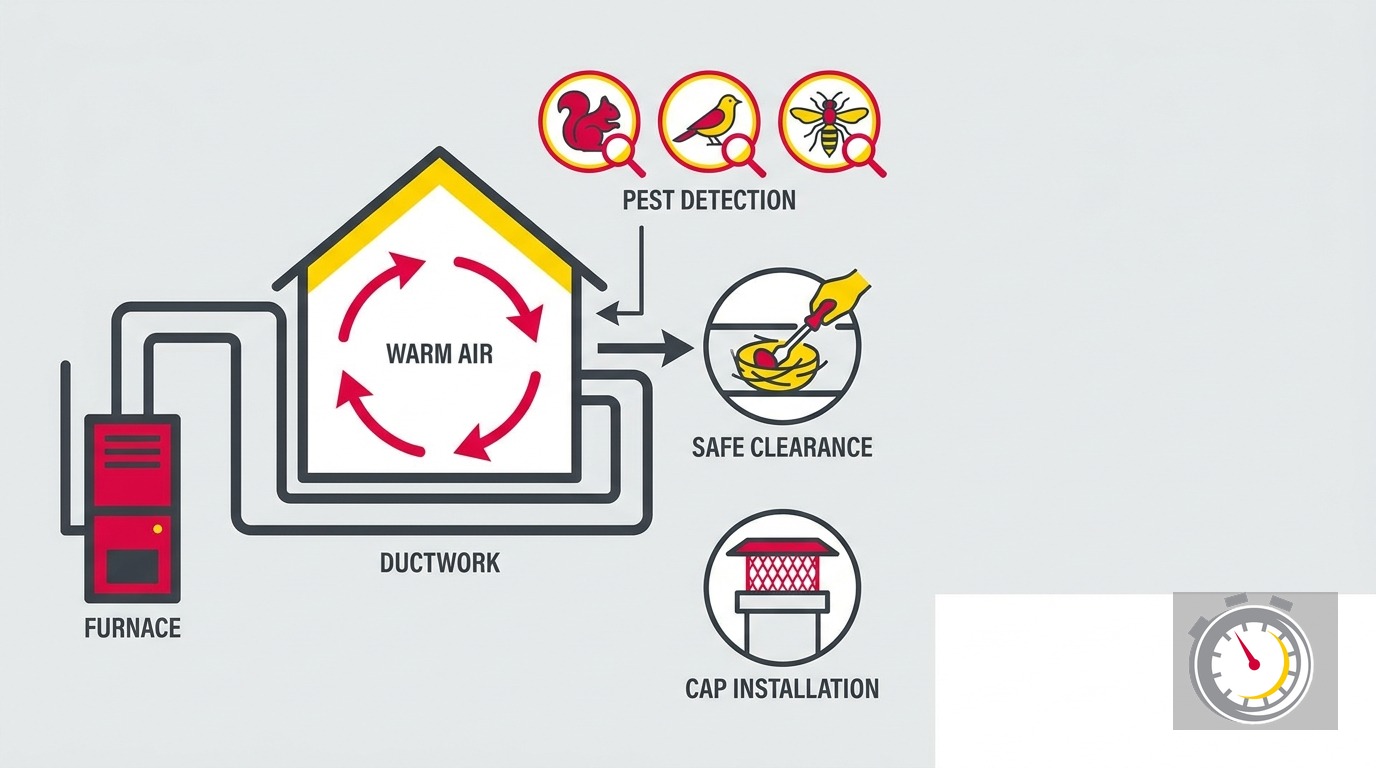
- Clearance is a two-trade job: HVAC tech confirms the blockage first, wildlife professional removes any active nest second, HVAC tech returns for cap installation and system test.
- A fall furnace tune-up with flue inspection is the easiest way to catch a blockage before it leaves you without heat.
A furnace that has sat idle all summer is exactly what animals nesting in furnace flue vents are looking for. The white PVC exhaust pipe on the side of your house has had no airflow, no heat, and no human attention since April. In the Twin Cities, early September means squirrels are in their second nesting season, wasp colonies are at peak size, and the furnace is about to run for the first time in months. That combination has consequences.
Why Do Animals Nest in Furnace Flue Vents?
Short answer: A high-efficiency furnace’s PVC exhaust pipe is completely dormant from spring through early fall. No airflow, no heat, no predators, and a dry plastic tube that holds no traffic. To wasps, birds, and squirrels, that combination checks every box for a protected nesting site, just one that will cause a serious problem when the heat kicks on in October.
Your furnace exhausts through one white or gray PVC pipe in the side wall or rim joist, usually near the foundation. A second pipe pulls in combustion air. From the day you switched off the heat in April through the first cool night that triggers the furnace in late September, nothing moves through either pipe.
To a paper wasp colony scouting build sites in May, that pipe is nearly ideal: dry, shaded, protected from wind and rain, and completely ignored by the household above it. Research confirms that high-efficiency furnaces attract wasps precisely because they are completely idle in summer: no heat, no airflow, no threat. Colony size peaks in August and September, which is exactly when you are not thinking about your furnace.
Birds look for cavities in early spring. Squirrels need warm, sheltered den sites twice a year. An unprotected pipe termination is an open door for all of them.
What Animals Are Most Common in Twin Cities Furnace Vents?
Short answer: Wasps, house sparrows, European starlings, and gray squirrels are the most frequent offenders in the Twin Cities. Each follows a different nesting calendar, which means different threat windows and, critically, different removal rules.
Here is the Minnesota seasonal clock for furnace vent nesters:
Paper wasps begin scouting and building in May. Colony size grows through the summer and peaks in August-September. A colony that started in June can be a substantial nest by September, filling the first several inches of the pipe with papery cells packed tightly enough to block airflow.
House sparrows and European starlings nest actively from April through June. Both are aggressive cavity nesters. Starlings especially will pack nesting material deep into a pipe in a matter of days. Both species tend to return to the same site in subsequent years, so a cleared vent without a proper cap is at high risk again the following spring.
Gray squirrels have two nesting seasons per year: March through April, and August through September. The second nesting window overlaps directly with fall furnace startup, making it the most dangerous combination on this list. Squirrels can chew through plastic and aluminum vent covers, so a standard plastic cap is not a reliable barrier against them.
Knowing which animal you are dealing with shapes every decision that follows, including the legal one.
The October Surprise: What Happens When a Blocked Vent Meets First Heat Call
This is where the problem stops being inconvenient and starts being dangerous.
When your furnace fires up and the exhaust path is blocked, the pressure switch should detect the restriction and shut the system down. You get no heat, a blinking error code, and a service call. That is the best-case outcome. Our post on furnace pressure switch failures explains what those error signals look like and how to read them.
The worse case: the pressure switch is stuck or failing. The furnace keeps running. Combustion gases have nowhere to go but back into the heat exchanger. From there, they can enter your living space.
The EPA identifies blocked flues and chimneys as a direct cause of accidental carbon monoxide poisoning. The agency specifically recommends inspecting flues and chimneys at the start of every heating season. Carbon monoxide is colorless and odorless. You will not detect it before it affects you.
Modern furnaces include pressure-switch safety shutoffs. But those switches can fail or stick. That means CO backdraft is a realistic failure mode, not just a theoretical worst case. A blocked vent plus a stuck safety switch is the combination you want to catch during an inspection, not on a January night when temperatures are dropping and the house is full. If you have not checked your CO detectors recently, our post on carbon monoxide safety during furnace season covers placement and testing.
Do not override a furnace lockout and keep forcing restarts. When the furnace trips and locks out, it is telling you something is wrong. Shut it off and call.
How Can You Tell If Something Has Nested in Your Furnace Flue?
Short answer: Walk outside and inspect the vent termination before first startup. Look for nesting material at the pipe opening, chew marks on the cap, wasp activity around the pipe, or a cracked or dislodged cover. Inside, a furnace that attempts to start and immediately shuts off is a classic pressure-switch trip and often the first sign of a blocked vent.
At the exterior termination, here is what to look for:
- Nesting material at the opening. Grass, twigs, leaves, feathers, or mud at or just inside the pipe rim.
- Wasp activity. Wasps flying in and out of the pipe during late summer is unambiguous confirmation.
- Squirrel gnaw marks. A cracked or chewed plastic cap with rough edges along the rim indicates squirrel access.
- Packed depth. A bird or wasp nest can extend several inches into the pipe. Shine a flashlight into the opening to see depth that is not visible at a glance from outside.
- A damaged or missing cap. A cap blown off or partially dislodged over the winter leaves the pipe fully open for whatever comes along first in spring.
Inside the house, watch for these symptoms on first startup of the season:
- The furnace ignites, runs briefly, then shuts off without completing a full heating cycle.
- A blinking error code on the control board. Your owner’s manual decodes the pattern, or call us and read us the sequence.
- Multiple failed start attempts followed by a hard lockout that requires a manual reset.
- An unusual smell near the furnace or at the supply registers on first fire-up.
If you see any of these signs, shut the furnace off and go back outside to inspect the vent termination before calling for service.
The Legal Wrinkle: Federal Bird Protection Law
This is the part that surprises most homeowners, and it is the detail that no general HVAC guide covers.
If a bird has built an active nest in your furnace vent, and that nest contains eggs or chicks that still depend on it for survival, you cannot legally remove it yourself. The Migratory Bird Treaty Act prohibits destroying an active nest with eggs or dependent young. The law covers most native North American bird species. Penalties can be significant, and not knowing the law is not a legal defense.
There is an important exception that applies specifically to the Twin Cities: house sparrows and European starlings are not protected under the MBTA. Both are non-native, introduced species that the federal government excludes from protection. If you can positively identify the nest as belonging to one of those two species, removal requires no federal permit.
The problem is species identification. Most homeowners cannot reliably tell a house sparrow nest from a protected species nest by peering into the end of a PVC pipe with a flashlight. The safer path is to call a licensed wildlife professional who makes that determination correctly, with the training and permits to handle protected species legally if needed.
The good news for September inspections: bird nesting season for most species ends by late June. An empty, inactive nest from any species can be removed without a permit. If your inspection finds an old, dry, unoccupied nest, it can come out immediately. The MBTA protection applies only to active nests with eggs or live chicks.
Wasps are not covered by any wildlife protection law. A pest control company can address an active wasp colony without permits. Squirrels fall under Minnesota wildlife regulations. A licensed wildlife control operator knows the rules for your county and handles removal correctly.
In the Twin Cities, companies like Varment Guard (formerly BEAST Wildlife Solutions in Eagan) specifically list furnace vents and dryer vents as primary call types for bird and squirrel removal. They are the right second call, after your HVAC technician has confirmed the blockage and shut down the system.
The Right Clearance Sequence: Two Trades, One Job
Clearance is a two-trade job. The temptation is to reach into the pipe yourself, pull the material out, and call it done. That skips the vent inspection step, and if a protected bird nest is involved, it puts you in federal violation.
Here is the correct sequence:
Step 1: HVAC tech first. Before anyone touches the vent, a heating technician confirms the blockage, shuts down the furnace safely, and inspects the full condition of the vent pipe. Animal activity can crack, compress, or chew through PVC vent sections. A compromised vent pipe cannot safely carry combustion gases out of your home, even after the nest or colony is removed. The tech documents what needs to be repaired or replaced before the furnace runs again. This step also protects the wildlife professional: knowing the exact nature and location of the blockage before removal avoids disturbing anything unnecessarily.
Step 2: Wildlife professional second. If the nest is active, if species identification is uncertain, or if squirrels are involved, a licensed wildlife removal company handles extraction. In the Twin Cities, that means a pest control company for wasp colonies and a licensed wildlife control operator for birds and squirrels.
Step 3: HVAC tech returns. After clearance, the HVAC tech comes back to install a manufacturer-approved termination guard, inspect the full vent run for cracks and animal damage, and run a complete system test before the heating season starts. This includes verifying the pressure switch, checking combustion, and confirming CO readings. This return visit pairs naturally with a furnace tune-up that covers the full system, so the furnace goes into winter fully inspected.
Why DIY Wire-Mesh Screens Fail in a Minnesota Winter
Short answer: A tight wire-mesh screen traps condensation on the PVC exhaust of a high-efficiency furnace. At sub-zero temperatures, that condensation freezes into an ice plug within hours and fully blocks the vent. In Minnesota, this is near-certain failure, not a remote risk. DIY screens also frequently void the manufacturer warranty.
After clearing a nest, the instinct is to staple hardware cloth or window screen over the pipe opening. For a Minnesota homeowner with a high-efficiency condensing furnace, that instinct leads to a bigger problem.
A condensing furnace produces water vapor during combustion. That vapor condenses inside the PVC pipe and exits at the termination. In a mild climate, this is a manageable side effect. At -15 degrees in January, moisture hitting tight mesh screen freezes almost immediately. Within a few hours, the mesh can form a solid ice plug that fully blocks the vent. The result is identical to an animal blockage: pressure-switch trip, furnace lockout, no heat on the coldest night of the year.
Manufacturer guidelines require approved termination guards with wide-angled slats, not tight mesh. Wide slats allow vapor to escape and moisture to drain while still blocking animals. A hardware-store screen does neither correctly.
Code matters here as well. Minnesota Mechanical Code requires PVC exhaust terminations to sit a minimum of 12 inches above grade, 12 inches from openings, and to use an approved, UL-listed cap. Manufacturer installation instructions control when they are more restrictive than code. A DIY screen that is not UL-listed for this application does not meet that standard and can void the equipment warranty.
For squirrel-prone areas, choose stainless steel. Squirrels chew through plastic and aluminum. Stainless steel resists gnawing reliably.
How to Prevent Animals From Nesting in Your Furnace Flue Vent
Short answer: The key is an approved termination guard installed before the first nest is built, combined with a late-April inspection each year before nesting season opens. A fall furnace tune-up with flue check handles the other end of the calendar. Together, those two visits close the window.
Here is what effective prevention looks like in practice:
Install a manufacturer-approved termination guard. Every furnace brand specifies which guards are acceptable for its equipment. An HVAC technician installs the correct guard for your pipe diameter and model. The guard listed in the installation manual is the right one, not whatever fits at the hardware store.
Choose stainless steel in squirrel-active areas. If you see regular squirrel activity in your yard, especially in northern Twin Cities communities like Brooklyn Park, Blaine, Maple Grove, and Ramsey, upgrade to stainless steel. The cost difference is modest. The difference in durability against gnawing is significant.
Inspect in late April. The window before nesting season peaks is the ideal time to verify that your termination guard survived winter intact. A guard cracked by ice expansion or partially dislodged by frost heave is an open invitation to whatever species is looking in May.
Include the vent in your annual tune-up. Our post on what a furnace tune-up includes covers what a complete pre-season inspection looks like. Flue condition and termination cap are part of every tune-up visit we do.
What to Do Right Now if You Suspect Animals Nesting in Your Furnace Flue Vent
If the furnace has not run since April and you have not inspected the vent this fall, treat it as unverified. That is the correct starting position for most Twin Cities homeowners in September.
Short answer: Inspect the exterior vent termination with a flashlight before running the furnace this fall. If you find any blockage, call an HVAC technician before anything else. Do not force-restart the furnace until the vent is confirmed clear and the pressure switch is tested.
Here is the checklist:
- Walk outside and look at the vent termination. Bring a flashlight. Look for nesting material, gnaw marks, wasp activity, or a cracked or missing cap.
- Do not force-start the furnace if you see any sign of blockage. Shut the system off at the thermostat and call for service.
- Call a licensed HVAC company first, before pest control. The HVAC tech confirms the blockage, makes the system safe, and inspects the vent pipe condition before anything is disturbed.
- If a wildlife professional is needed, coordinate the call after the HVAC tech’s visit. In the Twin Cities, licensed wildlife removal companies that list furnace vents as a specialty are the right resource for active bird or squirrel nests.
- After clearance, have the HVAC tech return for cap installation and a full system test before the heating season starts.
We are locally owned and operated in Ramsey, and our team serves homeowners throughout Minneapolis, St. Paul, Blaine, Maple Grove, Plymouth, Brooklyn Park, Woodbury, Bloomington, and the surrounding metro. “Always On Time… Or You Don’t Pay a Dime!(R)” is our operational standard, not just a tagline, and that applies from your first call through the final system test after clearance.
If the furnace is past 15 years or the vent pipe has sustained animal damage, this is also the right moment for a replacement assessment alongside the inspection. A cracked or chewed vent run is a CO hazard every time the system fires, regardless of whether the nest is cleared.
Call us at (763) 260-6662 or book your fall furnace inspection online. We check the vent termination, inspect the flue run, and get your system tested before Minnesota winter arrives.
Frequently Asked Questions
Is it illegal to remove a bird nest from my furnace vent? +
Can a blocked furnace vent cause carbon monoxide poisoning? +
What kind of screen should I put over my furnace exhaust pipe? +
When should I inspect my furnace vent for animal nests? +
Need a technician now?