
Furnace Burning Smell When First Turned On Minnesota
Key Takeaways
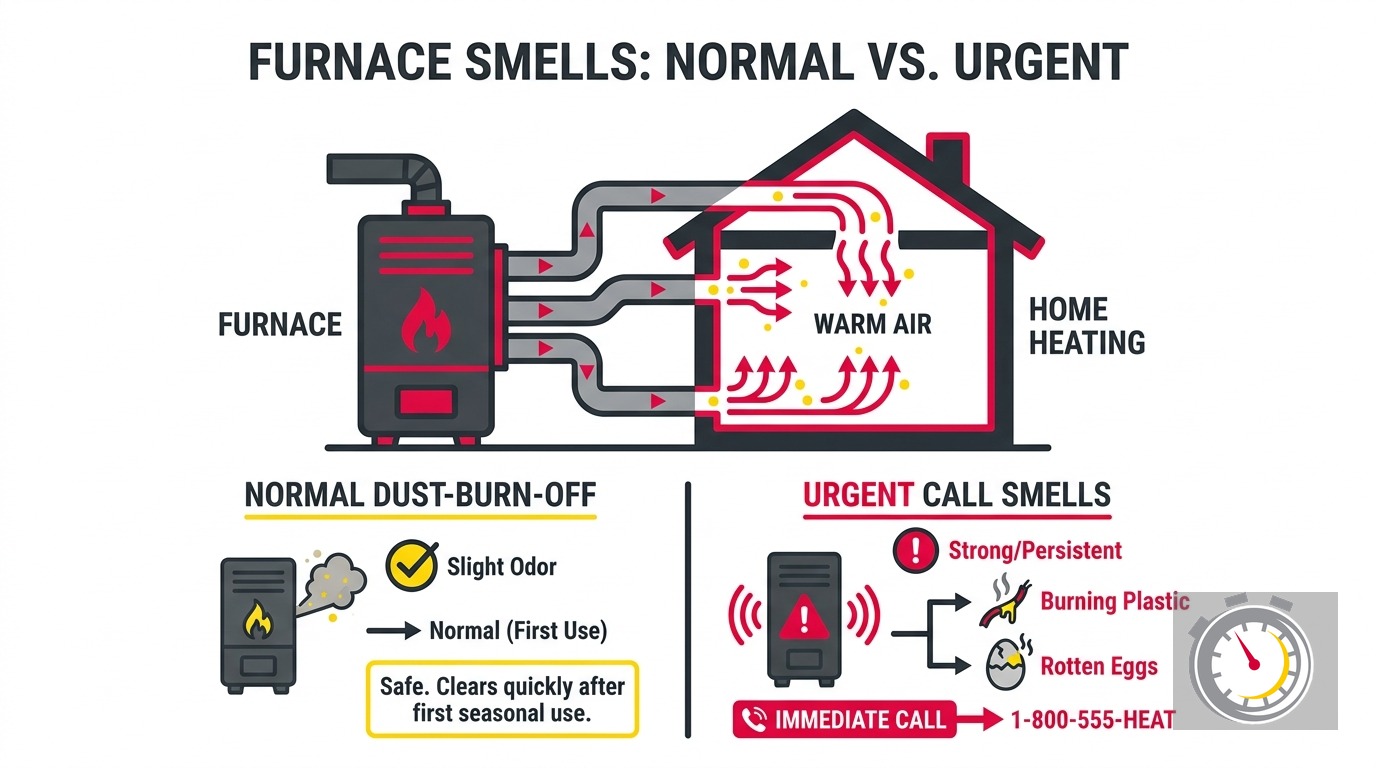
- A dusty, scorched smell at first startup is normal. Dust settles on the heat exchanger and burners all summer and burns off when the furnace ignites for the first time.
- The smell should fade within 30 to 60 minutes. If it lingers past an hour or grows stronger over time, that is a warning sign, not a normal startup.
- A rotten-egg or sulfur smell near your furnace means a possible gas leak. Leave the house immediately, do not use any electronics indoors, call 911, then CenterPoint Energy at 888-876-5786 from outside.
- A burning plastic smell signals electrical component failure. Shut the furnace off and call for service before running it again.
- A sharp metallic or chemical odor can indicate a cracked heat exchanger, which is a carbon monoxide hazard. Shut down and call a technician.
- Minnesota law requires CO detectors in all single-family homes with fuel-burning appliances.
- Twin Cities furnaces sit idle for five or more months before October. That longer dormancy means a stronger first-startup smell is entirely expected.
- If your furnace is over 15 years old, take any unusual first-startup smell more seriously. Older heat exchangers in cold-climate homes are prime candidates for cracks.
Why Does My Furnace Smell Like It’s Burning When First Turned On?
Short answer: Dust settles on the heat exchanger and burners during the long summer idle. The first ignition burns that dust off. The smell is real, but it is usually harmless and should clear within 30 to 60 minutes.
Every fall, furnaces across the Twin Cities wake up from a long sleep. From roughly May through early October, most Minnesota heating systems sit completely idle. That is five or more months for dust, pet dander, debris, and other particles to accumulate on every hot surface inside the unit.
When the burners fire for the first time, all of that material burns off at once. The result is a dusty, slightly scorched smell that drifts through the house. According to Carrier, this smell typically lasts 30 minutes to a few hours on first startup of the season. After that, it should be gone for the rest of the heating year.
This is an area where the Minnesota experience is different from what most national articles describe. A furnace in a mild-winter state may sit idle for two to three months. A Twin Cities furnace often sits idle for five to six months. More dust accumulates over that longer window. The first-startup smell will often be noticeably stronger here. That is not a sign of a problem. That is a sign of our climate.
The 30-Minute Test: What Normal Startup Looks Like
The clock starts the moment you hear the furnace kick on. Here is what a healthy first startup looks like:
- 0 to 10 minutes: The smell peaks. A strong dusty or scorched odor as accumulated debris burns off the heat exchanger and burners.
- 10 to 30 minutes: The smell fades noticeably. The house begins to warm. Airflow from the vents smells less strong.
- 30 to 60 minutes: The odor is barely detectable or gone entirely.
- Beyond 60 minutes: If the burning smell is still present or getting stronger, you are no longer in normal dust burn-off territory. Something needs attention.
Set a timer when you first notice the smell. Many homeowners catch the startup odor, assume it will pass, and never circle back to check. When the smell is still present two hours later, it is a bigger problem than it needed to be.
One practical habit worth starting: run the furnace for the first time in late September, when outdoor temperatures are still in the 50s. If something is off, you have weeks to schedule service before the first real cold snap. We come back to this idea below.
What Does a Burning Plastic Smell Mean?
Short answer: Burning plastic points to an electrical component failing inside the furnace, such as a motor, wiring, or control board. Shut the furnace off immediately and call a technician. Do not run it again until the cause is identified.
Dust burn-off has a familiar smell: slightly earthy, like a warm radiator. Burning plastic is sharper and more chemical, similar to a melting appliance cord or an overheating motor. If that is what you smell, the distinction matters.
Carrier identifies burning plastic as a sign of electrical component failure. Common culprits include the blower motor, the control board, or wiring that has developed a fault over a long summer of sitting idle. These problems do not go away on their own. Running the furnace through a burning electrical smell risks additional damage and, in the worst case, a fire.
Turn the furnace off at the thermostat. If the smell is strong or you notice any discoloration near the unit, cut power at the breaker. Then call for service.
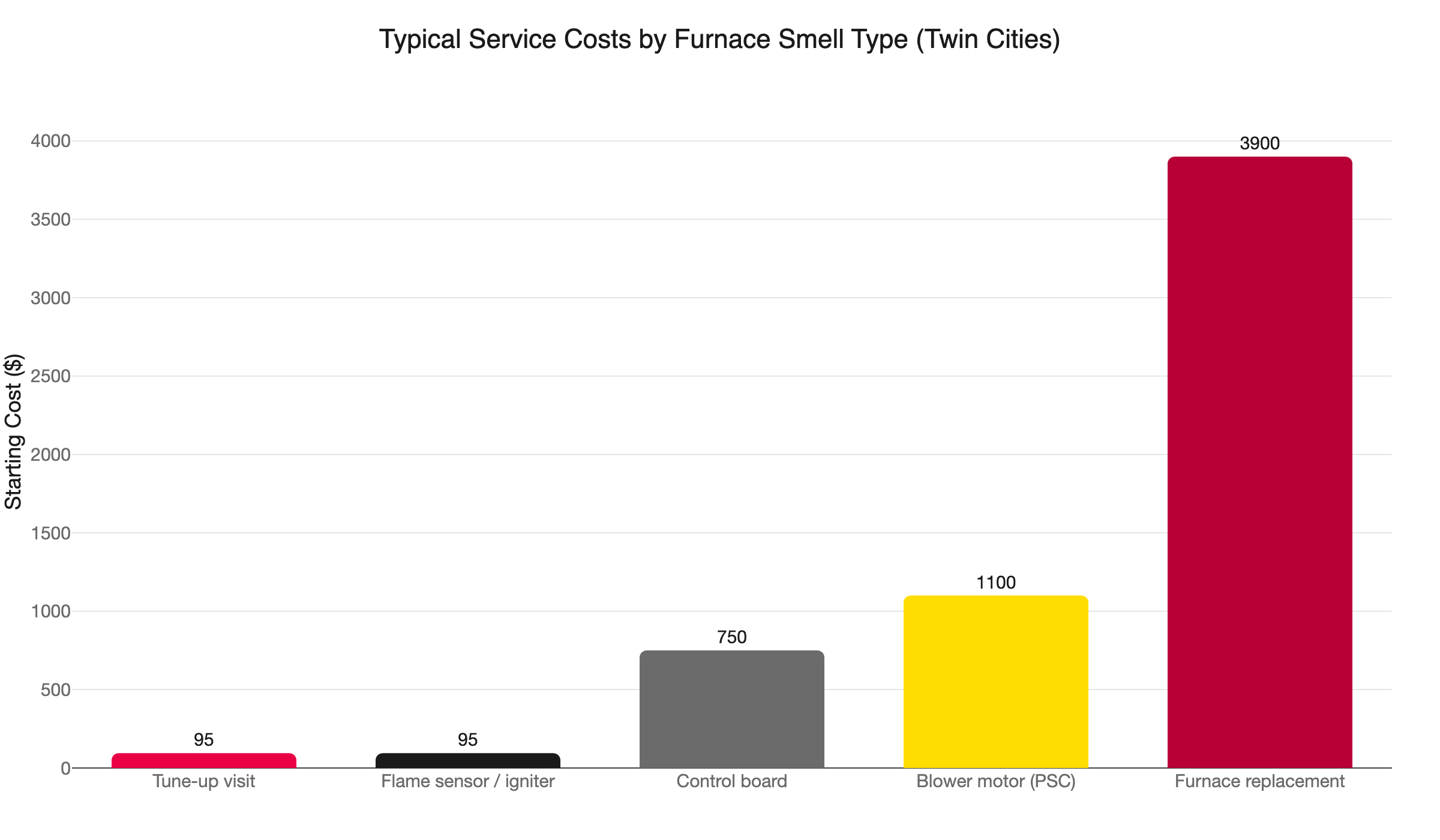
A failing blower motor is one of the more common sources of this smell on units that have been dormant for months. A motor that started seizing before last heating season ended is now being asked to run again. First startup is often where the problem becomes undeniable. Blower motor replacement (PSC type) starts around $1,100 installed. A control board runs roughly $750. Neither of those repairs is cheap, but catching them early keeps the rest of the system intact.
Is That Rotten Egg Smell from Your Furnace a Gas Leak?
Short answer: Yes. A rotten-egg or sulfur smell near your furnace means a possible gas leak. Natural gas is odorless on its own. Utility companies add mercaptan so leaks are detectable by smell. Treat every rotten-egg smell as an emergency, every time.
Do not try to find the leak. Do not flip any light switches. Do not unplug appliances. Do not use your cell phone while still inside the building. Even the small electrical spark from a light switch can ignite trapped gas. This is not an exaggeration.
Exactly what to do:
- Leave the house immediately, along with everyone in the building, including pets.
- Leave doors open as you exit. Do not stop to gather belongings.
- Once you are safely outside and away from the structure, call 911.
- Call CenterPoint Energy at 888-876-5786. CenterPoint is the primary gas utility for a large portion of the Twin Cities and operates 24/7 emergency response.
- Do not re-enter the building until utility technicians and emergency responders have cleared it.
Xcel Energy serves gas customers in parts of the metro as well. Their gas emergency number is 800-895-2999. Check your utility bill to confirm which company serves your address, and save both numbers in your phone before you need them.
This is one situation where waiting costs lives. A gas leak near an ignition source can escalate in seconds.
What Causes a Chemical or Metallic Smell Near My Furnace?
Short answer: A sharp, metallic, or formaldehyde-like chemical odor is one of the early warning signs of a cracked heat exchanger. This is a serious safety issue. A cracked heat exchanger allows carbon monoxide and combustion gases to mix with your breathing air. Shut the furnace off and call a technician before running it again.
The heat exchanger is the barrier inside your furnace that separates combustion gases from the conditioned air flowing through your home. When it develops a crack, those gases, including CO, can escape directly into your living space.
The metallic or chemical smell comes from the failing metal itself. Carbon monoxide is completely odorless. That metallic smell may be the only warning sign you get before CO levels in the home rise to a dangerous level. Do not ignore it.
Heat exchanger cracks develop through thermal fatigue. Years of heating cycles cause the metal to expand and contract repeatedly. Over time, that stress opens small cracks. Overheating from poor airflow or incorrect gas pressure accelerates the process. In Minnesota, the thermal demand on a heat exchanger is more extreme than in a milder climate. A furnace heating against -20°F winters for 15 or 20 years has been through thousands of thermal cycles.
If your furnace is over 15 years old, take this smell especially seriously. The inner-ring suburbs of Minneapolis and St. Paul hold a lot of housing stock from the 1950s through the 1970s. Furnaces that have not been replaced in those homes are running aging heat exchangers against serious Minnesota cold. A cracked heat exchanger typically points toward furnace replacement rather than repair. A replacement system starts around $3,900 installed. A technician can inspect with a combustion analyzer and camera and give you a clear answer before you spend a dollar on a repair estimate.
Why Does My Furnace Smell Musty?
Short answer: A musty smell usually points to mold or mildew in the ductwork or on the evaporator coil. This is most common at first startup in fall, after the AC coil has been damp for weeks. Unpleasant, but not an emergency.
Minnesota summers bring real humidity. That moisture collects on the evaporator coil and inside ductwork. When the furnace fires in October and air starts moving through those spaces, any mold or mildew smell travels through the house.
Carrier specifically flags musty odor as a sign of mold in ductwork or on the evaporator coil. A one-time musty smell on first startup that clears after a day or two is often just the coil drying out. If the smell persists across multiple days of heating, or if anyone in the household has worsening allergy or asthma symptoms, it is worth having the ductwork and coil inspected.
Duct cleaning and coil cleaning are the standard fixes. They are also good preventive steps for any system that has not been professionally serviced in a few years.
Should You Test Your Furnace Before the First Cold Night?
Short answer: Yes. HVAC technicians in Minnesota recommend running the furnace for the first time in September, while outdoor temperatures are still in the 50s. Finding a problem at 55°F gives you time to schedule a repair. Finding one at -10°F does not.
The approach is simple. In late September, before you actually need heat, turn the thermostat up and run a full heating cycle. Pay attention to smells, sounds, and whether the house heats evenly. Set a timer and check back after 30 minutes to confirm any startup smell has cleared.
If something is off, you have weeks to schedule a service call, source the part, and have the repair completed before cold weather arrives. That window disappears fast in Minnesota. The first true cold snap often lands in October, and by November a failed furnace can put pipes at risk within days.
A fall furnace tune-up is the right time for a technician to inspect the heat exchanger, clean the burners and flame sensor, verify CO levels, and test all safety controls. A tune-up starts at $95 to $250. Catching a cracked heat exchanger or a failing motor before the first freeze is worth considerably more than that visit costs.
Do CO Detectors Matter If My Furnace Smells?
Short answer: Yes, and not just when the furnace smells. Carbon monoxide is completely odorless. A cracked heat exchanger can be leaking CO into your home with no detectable smell at all. A working CO detector is the only reliable alert for that scenario.
The U.S. Consumer Product Safety Commission estimates approximately 170 people die each year from CO produced by non-automotive consumer products, including furnaces, water heaters, and room heaters. Thousands more are treated in emergency rooms annually for CO exposure.
Minnesota requires CO detectors in all one- and two-family dwellings under MN Statute 299F.50. You can read the current text at revisor.mn.gov.
The CPSC recommends alarms that meet the UL 2034 standard. Place detectors on every level of the home, and within 10 feet of each sleeping area. Replace batteries annually. Replace the unit itself every five to seven years, or per the manufacturer’s guidance.
A working CO detector is not a substitute for annual furnace maintenance. It is your last line of defense when the heat exchanger fails between service visits. Our guide to furnace season carbon monoxide safety goes deeper on detector placement, alarm response, and what to tell the technician when CO levels are found.
What to Do When the Smell Does Not Clear
If the smell is normal dust burn-off, it clears within 30 to 60 minutes and you move on. If it does not clear, here is how to triage the situation:
Dusty or scorched smell that lingers past two hours: Not an emergency, but a tune-up is overdue. Schedule a service visit before the heating season is in full swing.
Burning plastic smell: Turn the furnace off at the thermostat. Call for service before running the furnace again. Do not wait to see if it clears on its own.
Rotten egg or sulfur smell: Leave the house immediately without using any electronics inside. Call 911, then CenterPoint at 888-876-5786, from outside.
Metallic or chemical smell: Turn the furnace off. Do not run it again until a technician has inspected and cleared the heat exchanger.
Musty smell that persists beyond the first week of heating: Schedule duct cleaning and coil inspection. Not urgent, but worth addressing before cold weather drives the furnace into heavy use.
Northern One Hour is locally owned and operated in Ramsey, MN. Our team serves the Twin Cities metro: Minneapolis, St. Paul, Blaine, Maple Grove, Plymouth, Brooklyn Park, Woodbury, Bloomington, and the communities in between. We show up when we say we will. That is the promise behind “Always On Time… Or You Don’t Pay a Dime!(R)”.
If your first-startup smell has you asking questions, call us at (763) 260-6662 or book a service visit online. Our team can inspect, diagnose, and give you a straight answer before the hard cold of a Minnesota winter arrives.
Frequently Asked Questions
How long should a burning smell from a furnace last when first turned on? +
Can a burning smell from my furnace mean carbon monoxide is leaking? +
What should I do if my furnace smells like rotten eggs? +
Is it normal for a furnace to smell on first startup in Minnesota? +
Need a technician now?