
Smoke Smell Coming from Furnace Vents in Minnesota
Key Takeaways
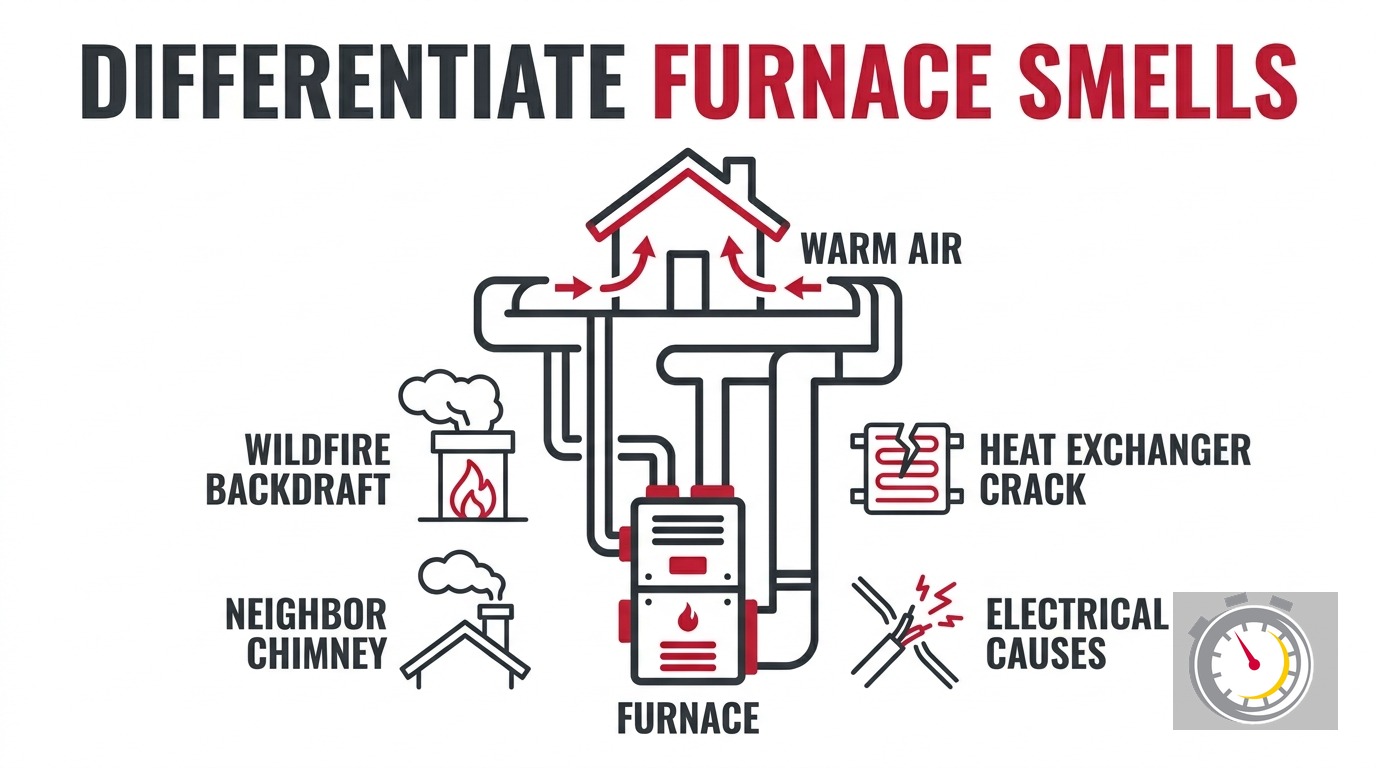
- A smoke smell from furnace vents comes from one of two buckets: something outside getting pulled in through the HVAC system, or something inside the furnace failing. The diagnosis takes five minutes.
- Wildfire smoke and a neighbor’s wood stove can enter through the fresh-air intake or an HRV or ERV. The fix: recirculate mode, HRV off, MERV 13 filter.
- A chemical, metallic, or formaldehyde-like smell from the vents when the heat runs is the signature of a cracked heat exchanger. Shut the furnace off.
- A burning plastic or rubber smell points to an electrical fault. Shut the furnace off.
- Carbon monoxide is odorless. A cracked heat exchanger raises CO levels before you smell anything. CO detectors on every level are non-negotiable.
- If your CO detector alarms or anyone in the home has a headache, nausea, or dizziness: get out, call 911, then call Northern One Hour.
Why Does My Furnace Smell Like Smoke?
The short answer: Smoke at your vents comes from one of four sources. Wildfire smoke pulled through the HVAC system. A neighbor’s chimney gas drifting into the fresh-air intake. A cracked heat exchanger releasing combustion gases into the airstream. Or an overheating electrical component. Knowing which one determines whether you change a filter or shut the furnace off entirely.
Most homeowners search for a “furnace smoke smell” and land on articles about burning dust at first startup. That article describes a different event: settled dust burning off the heat exchanger on the first cool morning of fall. It clears in 20-30 minutes and does not return.
This post covers a smoke smell that persists or comes back every time the furnace runs. One that smells like a campfire, a chemical burn, or melting plastic. The right response ranges from swapping a filter to evacuating the home. Knowing which situation you are in before you call saves time and keeps your family safe.
We are locally owned and operated in Ramsey, MN. We serve the Twin Cities metro every day, and this call spikes every fall as furnaces come back online. The diagnostic framework below reflects what our technicians actually check when a homeowner reports smoke from the vents.
The Two-Bucket Diagnosis: Is the Smoke Coming Through or From Your Furnace?
Before calling anyone, place the smell in one of two buckets.
Bucket 1 - Coming through. The furnace acts as a fan. It pulls outdoor air, or nearby combustion air, into your home. The smoke originates outside the system. The furnace itself is fine.
Bucket 2 - Coming from. The smoke originates inside the furnace or ductwork. This is a mechanical or combustion failure. The furnace needs to be shut down and inspected.
Here is the fastest triage:
| Smell | Where it concentrates | Furnace running? | Likely bucket |
|---|---|---|---|
| Wood smoke or campfire | Whole house | Doesn’t matter | External source |
| Chemical, formaldehyde, or metallic | From vents when heat runs | Yes | Internal - cracked exchanger |
| Burning plastic or rubber | From one vent, starts suddenly | Yes | Internal - electrical fault |
If you are not certain which bucket applies, treat it as an internal failure until a technician confirms otherwise. The downside of being wrong about Bucket 1 is a wasted service call. The downside of being wrong about Bucket 2 is CO in your living space.
Is Wildfire Smoke Getting into Your Home Through the HVAC System?
The short answer: Yes, and more often than homeowners realize. Your furnace’s fresh-air intake and any HRV or ERV unit actively pull outdoor air inside. When wildfire smoke is in the air, those pathways bring it directly into your ductwork.
Minnesota has seen more air quality alerts from wildfire smoke in the past five years than ever before. Smoke arrives from Canada and the western US during hotter, drier fire seasons and lingers for days. September is a critical crossover month in the Twin Cities. The tail of wildfire smoke season overlaps with the first weeks you fire up the furnace for fall.
HRVs and ERVs: the smoke pathway most homeowners miss
Homes built after roughly 2000 in Minnesota are sealed tight enough to require mechanical ventilation. Many have a heat recovery ventilator (HRV) or energy recovery ventilator (ERV) wired into the duct system. These units continuously bring outdoor air inside. That is their job.
During a smoke event, that same intake pulls contaminated outdoor air directly into your duct system. Experts recommend turning HRVs and ERVs off entirely during high-smoke periods and running the furnace fan on recirculate mode instead. If you smell wood smoke in your home and outdoor air quality is elevated, the HRV or ERV is a more likely culprit than the furnace itself.
Our post on whole-home HRV ventilation in Minnesota explains how to adjust ventilation settings without letting indoor air quality deteriorate long-term.
MERV 13: the right filter during smoke season
MERV ratings measure a filter’s ability to capture particles between 0.3 and 10 microns. MERV 13 is the minimum rating needed to capture fine wildfire smoke particles (PM2.5). Higher-rated filters restrict airflow and stress the blower motor. MERV 13 is the practical ceiling for most residential systems.
A local Minneapolis HVAC technician confirmed that MERV 13 “gives you the best of both worlds at cleaning the air in your home but also not stressing your system out.”
During active smoke events, check and replace the filter at least monthly. A MERV 13 filter loaded with wildfire particulate loses effectiveness quickly.
Steps to take during a wildfire smoke event
- Switch your thermostat fan to “recirculate.” This stops the fresh-air intake from pulling smoke inside.
- Turn off any HRV or ERV.
- Install a MERV 13 filter if you do not already have one.
- Check the filter every two to three weeks. Replace it when it looks gray or black.
- Keep windows and doors closed during peak smoke hours.
Once air quality improves, you can return the fan setting to “auto” and restart the HRV or ERV.
Could a Neighbor’s Wood Stove Be the Source?
The short answer: Yes. Wood-burning is common in older Minneapolis and St. Paul neighborhoods. On calm evenings with little wind, chimney exhaust drifts sideways toward adjacent homes’ fresh-air intakes rather than rising straight up.
This situation differs from wildfire smoke in a few ways. It is localized to one neighbor and one wind direction. It is most noticeable on calm, cold evenings when little air is moving. It smells like a clean wood fire in a fireplace, not the acrid smell of smoke that has traveled hundreds of miles.
The EPA’s indoor air quality guide identifies back-drafting from nearby combustion appliances as a documented source of combustion gases entering living spaces. A neighbor’s wood stove or fireplace exhausts into the air. That air can find its way through your fresh-air intake, a leaky duct run near an exterior wall, or any infiltration point it can reach.
If the smell correlates with a neighbor’s fireplace use, peaks on calm cold evenings, and smells like clean wood fire rather than something burning inside your own home, a ventilation audit is the next step. A trained technician can locate where outdoor air is entering and recommend a fix.
What Does a Cracked Heat Exchanger Smell Like?
The short answer: Not like wood smoke. A cracked heat exchanger releases combustion gases into the airstream, producing a chemical, metallic, or formaldehyde-like odor. If you notice that smell from the vents and it appears only when the heat runs, shut the furnace off immediately.
The heat exchanger is the metal barrier that keeps combustion gases separate from the air circulating through your home. When it develops a crack, those gases, including carbon monoxide, escape into the airstream. The disturbed flame pattern that results causes incomplete combustion. That means the cracked furnace produces more CO than a properly burning one would.
Warning signs of a cracked heat exchanger
- CO detector alarm or a reading above 30 ppm
- A chemical, metallic, or formaldehyde-like odor from vents when the heat is running
- Soot deposits around the burners or near vent outlets
- Unexplained headaches, nausea, or dizziness that improve when you leave the house
- Furnace short-cycling or shutting down before the home reaches temperature
- Visible rust or corrosion on the flue pipes
Soot in the ductwork is its own warning. Soot escaping into vents signals incomplete combustion, and soot is combustible. Accumulated soot in ductwork creates a fire hazard.
What CO exposure levels actually mean
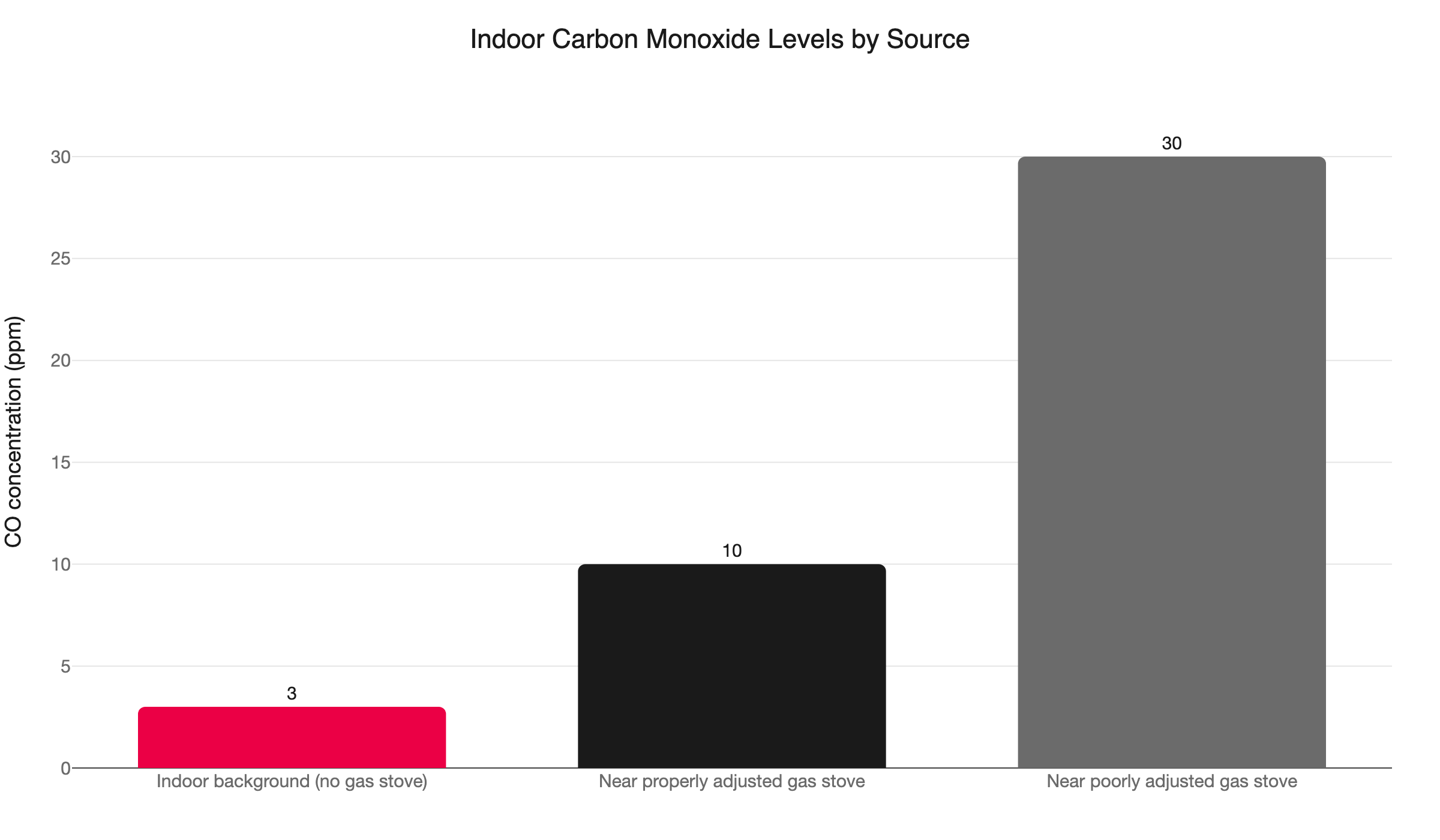
Indoor CO in homes without gas stoves typically runs 0.5-5 ppm. Near a properly adjusted gas stove, 5-15 ppm. Near a poorly adjusted stove, 30 ppm or higher. At those higher levels, CO symptoms mimic the flu: headaches, dizziness, nausea, and fatigue. They are routinely misdiagnosed.
A cracked heat exchanger can push living-space CO into symptomatic territory before the chemical smell tips you off. That is why CO detectors are not optional. Minnesota requires them on each level of a home. If yours are past their expiration date (most are rated for 5-7 years), replace them before heating season.
Our post on carbon monoxide safety and furnace season covers detector placement, what CO symptoms look like, and the exact steps to take if the alarm sounds.
What to do if you suspect a cracked heat exchanger
- Turn the furnace off at the thermostat. Do not restart it.
- Check every CO detector in the home. If any has sounded or anyone has symptoms, get everyone out and call 911 before anything else.
- Once the home is confirmed safe, call a licensed HVAC technician. The furnace stays off until the heat exchanger has been inspected.
If the exchanger is cracked, the decision is repair versus full furnace replacement. On a furnace past 15 years, the math usually favors replacement. A new furnace installed in the Twin Cities starts at $3,900-$7,800. Parts and labor for an exchanger replacement on an aging unit can approach that figure without adding years of reliable service life.
For more on what to look for and how to evaluate the repair-versus-replace decision, see our post on cracked heat exchanger signs in Minnesota.
Could an Electrical Problem Cause a Smoke Smell?
The short answer: Yes. An overheating blower motor, failing capacitor, or wiring fault produces a burning plastic or rubber smell. It is distinct from wood smoke or a chemical exchanger smell. It usually concentrates near one vent and starts suddenly during a normal heat cycle.
If you smell burning plastic or rubber from a vent, turn the furnace off. An electrical fault left running can escalate to a fire. Do not restart the furnace until a technician has diagnosed the source.
Signs this is an electrical issue rather than an external smoke source or a cracked exchanger:
- The smell is burning plastic, rubber, or hot metal, not wood smoke or formaldehyde
- It is strongest near one vent, not spread evenly through the house
- It started suddenly during normal operation, not at first startup of the season
- The furnace trips the breaker or shows an error code
Blower motor replacement, if that is the source, runs $1,100-$2,200 installed depending on motor type. A failing capacitor is less expensive: $195-$500 including parts and labor. Either way, the diagnosis requires a technician. Do not restart the system before the fault is found.
What Should You Do When You Smell Smoke from Vents?
The short answer: Identify the smell first. Wood fire or campfire: likely external, start with the fresh-air pathway. Chemical or formaldehyde: shut the furnace off now. Burning plastic: shut the furnace off now.
Here is the full decision path:
If it smells like wood smoke or campfire:
- Check outdoor air quality at AirNow.gov or the Minnesota Department of Health wildfire smoke page.
- Switch the thermostat fan to recirculate. Turn off any HRV or ERV.
- Install a MERV 13 filter if you do not already have one.
- Consider whether a neighbor’s wood stove or fireplace is the source.
- Call Northern One Hour if the smell continues after closing off external pathways.
If it smells chemical, metallic, or like formaldehyde:
- Turn the furnace off at the thermostat immediately.
- Check every CO detector in the home. If any alarms or reads above 30 ppm, get everyone out, call 911, then call us.
- Do not restart the furnace until a technician has inspected the heat exchanger.
If it smells like burning plastic or rubber:
- Turn the furnace off at the thermostat immediately.
- Call Northern One Hour. An electrical fault requires a technician before the system runs again.
What a Professional Furnace Inspection Covers
When our team responds to a smoke smell call, here is what the inspection includes.
- Heat exchanger check. Visual and combustion analysis for cracks, corrosion, and abnormal flame patterns. CO is measured at the supply registers while the furnace runs. Elevated readings above background confirm a combustion leak.
- Flue and vent inspection. We check the flue pipe for blockages, leaks, and back-drafting points where combustion gas can re-enter the living space.
- Fresh-air intake check. We confirm the intake is unobstructed, positioned correctly, and not drawing from a contaminated source.
- Blower motor and electrical check. We look for overheating, worn wire insulation, and failing components that could cause a burning electrical smell.
- Filter and ventilation review. If the smoke source is external, we confirm the filter is the right MERV rating and verify HRV or ERV settings.
The EPA recommends having a trained professional inspect, clean, and tune the central heating system, including the furnace, flue, and chimney, annually. That annual tune-up catches a developing crack or venting problem before it becomes an emergency. See our furnace tune-up page to schedule one.
We are locally owned and operated in Ramsey, MN. Our team serves Minneapolis, St. Paul, Blaine, Maple Grove, Plymouth, Brooklyn Park, Woodbury, Bloomington, and the surrounding Twin Cities metro.
A smoke smell from your vents is not something to sit on. Call us at (763) 260-6662 or book online. We stand behind “Always On Time… Or You Don’t Pay a Dime!(R)” and we will be there when we say.
Frequently Asked Questions
Why does my furnace smell like smoke when it first turns on? +
Can wildfire smoke enter my home through the furnace? +
What does a cracked heat exchanger smell like? +
Need a technician now?