
Furnace Smells Musty? Causes and Fixes for Minnesota Homes
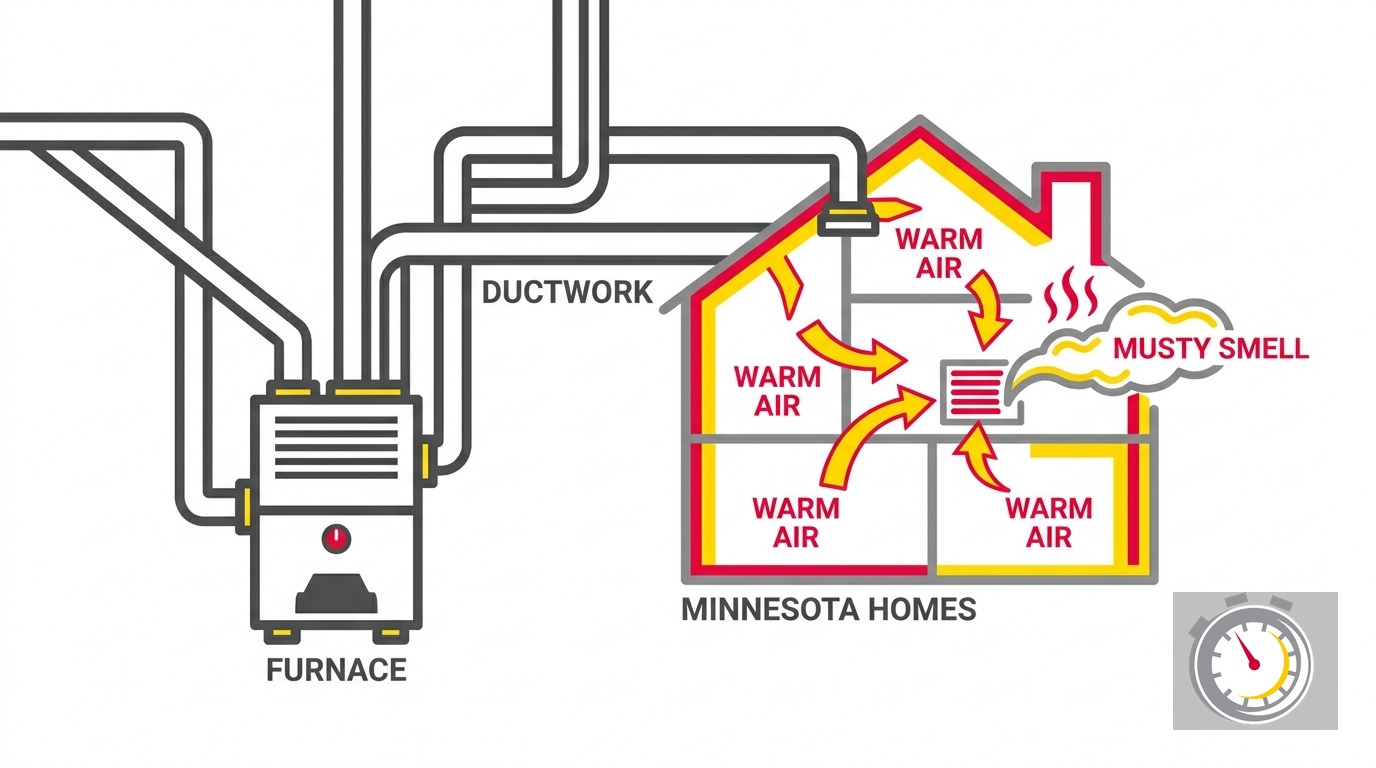
Key Takeaways
- When your furnace smells musty, the timing of the smell is your best diagnostic clue. A smell that fades within a few hours is normal. A smell that lingers, gets worse, or appears only in one room is not.
- Dirty Sock Syndrome is a heat pump and AC evaporator coil problem, not a furnace problem. It peaks in October when Minnesota homeowners first fire up the heat after a humid summer.
- The EPA recommends shutting off your HVAC system if mold contamination is known or suspected. Running the system spreads spores through every room in the house.
- Minnesota’s deep-winter indoor humidity (often 15-25% without a humidifier) actually suppresses mold growth. The real danger windows are fall startup in October and early spring, when moisture levels are elevated.
- Mold patches under 10 sq ft are appropriate for careful DIY cleanup. Anything larger requires professional remediation.
- A fall furnace tune-up with professional coil cleaning is the single most effective preventive step you can take.
Why Does Your Furnace Smell Musty?
Short answer: Moisture got into a part of the system where it was not supposed to stay. The most common sources are a contaminated AC evaporator coil, a wet or dirty air filter, mold in the ductwork, or a clogged condensate drain pan. The timing of the smell tells you which one.
There is an important distinction to make before anything else. When you turn on the furnace for the first time each fall, you will likely notice a faint dusty or slightly acrid smell. That is normal. Dust settles on the heat exchanger over the summer, and the first heat cycle burns it off. It clears within a few hours of continuous operation.
A musty smell is different in character. It has a biological quality: damp, stale, sometimes earthy. It is the smell of something growing, not something burning off. If it lingers past the first few hours of operation, returns every time the furnace cycles, or is present all winter, something in the system has been wet long enough to support mold or bacteria.
The good news is that timing is a reliable diagnostic tool. Matching when the smell appears to its most likely cause is the fastest path to the right fix. The cause and the solution are completely different depending on whether you notice it at first startup, mid-winter, or only in one room.
A Diagnostic by When the Smell Appears
No competitor’s guide covers this clearly, but it is the single most useful framework for a Minnesota homeowner. Match your situation to the timing column and you will know where to start.
| When you smell it | Most likely cause | First step |
|---|---|---|
| First heat cycle of fall, fades within a few hours | Dust burning off the heat exchanger | Normal. Let it run. |
| First heat cycle of fall, lingers or gets worse | Mold on evaporator coil (Dirty Sock Syndrome) | Professional coil cleaning |
| Constant throughout mid-winter | Wet or dirty filter, or mold deeper in ductwork | Replace filter. Call if it persists. |
| After a leak, flood, or extended high-humidity period | Mold in duct lining or condensate drain pan | Do NOT run the system. Call for inspection. |
| Only coming from one room | Debris or mold in that register boot or duct branch | Targeted cleaning of that section |
What Is Dirty Sock Syndrome?
Short answer: Dirty Sock Syndrome happens when bacteria and mold colonize the AC evaporator coil during the cooling season. When you switch to heating in October, warmth releases microbial volatile organic compounds (MVOCs) from the coil and pushes them through every vent in the home. It is an AC component problem, not a furnace problem, even though the furnace is what triggers it.
This distinction matters for Minnesota homeowners because the timing is nearly identical to furnace startup. People naturally blame the furnace. The real culprit sits upstream of the furnace in the air handler.
HVAC School explains that gas furnace heat exchanger temperatures are generally high enough to kill biological material on the furnace itself. The evaporator coil operates at much lower temperatures during the cooling season and stays wet from condensation. That combination, damp surface plus lower temperatures, is ideal for mold and bacteria to colonize.
When the heating season begins, warm air from the furnace blows across that contaminated coil and volatilizes the MVOCs. The smell peaks on the first few heating days and can range from musty to sharp and unpleasant. Some homeowners describe it as a locker room smell. Others say dirty laundry. Both are accurate.
Beyond the odor, contaminated coils reduce heat exchange efficiency and can clog the condensate drain pan with biological debris. Prolonged exposure to MVOCs can trigger eye and nose irritation, headaches, and asthma flare-ups in sensitive household members.
The fix is a professional coil cleaning. A UV germicidal lamp installed in the air handler prevents re-colonization between cooling and heating seasons by continuously breaking down biological material on the coil surface. Learn more about whether UV light and air purification systems make sense for your home.
Why Does Your Furnace Smell Musty in Only One Room?
Short answer: A musty smell isolated to a single room points to that room’s register boot, return duct, or a specific duct branch, not the central system. Check the vent cover and the visible duct section behind it for moisture, debris, or visible mold. If the rest of your home smells fine, the problem is local.
Remove the register cover and inspect inside with a flashlight. Dust and debris you can often clear yourself with a vacuum and a damp cloth. Visible mold growth on the duct walls requires professional cleaning. Do not run the system if you see active mold, because airflow will distribute spores into the rest of the house.
Low spots in flex ductwork can collect condensation over time. A poorly fitted register boot lets moisture from a spill, a basement humidity event, or a slow plumbing drip pool inside the duct. Both are localized problems. A targeted cleaning of that branch resolves them without requiring a whole-system service call.
If you are not sure what you are looking at inside the duct, call for an inspection. A technician with a camera can see what a flashlight misses.
Does Your Furnace Smell Musty Mid-Winter? Here Is What to Check First.
Short answer: A musty smell that develops in January or February is most likely a wet or clogged air filter. A filter that has trapped too much moisture and debris becomes a surface where mold grows and cycles into your air. Replace the filter first. If the smell persists after two or three heat cycles, the source is deeper in the system.
Before calling for service, work through this short sequence:
- Replace the air filter. A filter that looks gray, feels heavy, or shows any visible discoloration needs to come out immediately. Swap it for a fresh filter of the same MERV rating and run the system for a day. Many mid-winter musty smells clear within a few cycles.
- Check the condensate drain and drain pan. High-efficiency furnaces produce condensate as a byproduct of combustion. If the drain line is clogged, water pools in the drain pan and breeds mold. Standing water near the base of the furnace is a clear sign of a drain issue.
- Look for moisture sources near the air handler. A slow plumbing drip, a damp basement wall, a humidifier running above its target setting, or condensation on cold pipes near the unit can all introduce moisture into the system.
If the smell is still present after a filter swap and a visual check around the unit, it is time to call for a professional inspection. A musty smell that persists through multiple heat cycles after a new filter has been installed is not going to resolve itself.
The Minnesota Humidity Factor
Minnesota homeowners face a seasonal humidity pattern that most national HVAC content does not address. Understanding it tells you when your mold risk is actually highest, and when it is lower than you might think.
Deep winter is not your highest-risk window for mold. Cold outdoor air holds very little moisture. When it infiltrates a Minnesota home and gets heated by the furnace, indoor relative humidity drops quickly, sometimes to 15-25% in a well-sealed house without a whole-home humidifier. The Minnesota Department of Health recommends keeping indoor humidity between 20-40% in winter. At those levels, mold growth is significantly suppressed.
The real danger windows are at the season transitions.
October startup. Outdoor humidity is still relatively elevated as summer gives way to fall. Your evaporator coil has been sitting damp since the last cooling cycle. Indoor air is still humid enough to support biological activity. The first weeks of heating season are when Dirty Sock Syndrome and coil contamination are most likely to make themselves known. This is the highest-risk window of the year for a musty furnace smell.
March and April. As outdoor temperatures rise, outdoor humidity climbs again. Indoor surfaces that stayed cool and damp all winter can develop mold before the AC has been turned on to dehumidify the house. A musty smell that appears in early spring often traces back to the ductwork, the area around the air handler, or a condensate system that drained improperly through the heating season.
The practical implication for your maintenance schedule: a fall tune-up scheduled in September or early October is more valuable in Minnesota than in a warmer climate. You are catching potential biological contamination before the October startup window puts it on repeat all winter.
Is a Musty Smell from Furnace Vents a Health Risk?
Short answer: Yes, if the source is active mold growth. A brief, dusty smell at the very first furnace startup poses low risk. A persistent musty smell from mold on the evaporator coil or inside the ductwork distributes allergens and irritants through every room in your home with each heat cycle. For households with asthmatics or young children, that is a meaningful health concern.
Mold exposure can cause allergic reactions, asthma episodes, and irritation of the eyes, skin, nose, throat, and lungs, in both allergic and non-allergic people. People with asthma, respiratory sensitivities, weakened immune systems, or young children at home face a higher level of risk.
The EPA also notes that indoor air can be 2-5 times more polluted than outdoor air. A contaminated HVAC system running continuously on winter days when windows are closed makes that significantly worse.
The cost of an inspection and coil cleaning is a fraction of the cost of a health setback. If anyone in your household has a respiratory condition and you notice a persistent musty smell, treat it as urgent.
What Should You NOT Do When Your Furnace Smells Musty?
Short answer: Do not keep running the system if you see visible mold or have had a moisture event like a flood or major leak. The EPA is explicit: do not operate an HVAC system when mold contamination is known or suspected. Running it forces spores through every vent in the building, spreading the problem to rooms that were not yet affected.
A few other things to avoid:
- Do not use bleach on ductwork or the evaporator coil. Bleach does not penetrate porous materials and does not kill mold roots in duct lining or insulation. It also creates fumes that distribute through the system. Neither the EPA nor the MDH recommends bleach as a standard mold treatment in HVAC systems.
- Do not skip the visual inspection in favor of mold testing. The Minnesota Department of Health recommends visual inspection over laboratory testing as a first response. Mold testing is expensive. In most cases, visible growth or a persistent smell already tells you what you need to know. Testing rarely changes the action plan.
- Do not mask the smell with air fresheners or candles. Covering the odor does nothing to stop the source. The biological growth continues. You just stop noticing the warning sign.
- Do not leave a dirty filter in place. Every heat cycle pushes air through a contaminated filter and distributes whatever is on it throughout the house.
When Can You Handle It Yourself, and When Do You Call a Professional?
The EPA’s 10 sq ft threshold is the standard dividing line. Mold covering less than 10 sq ft of surface area is appropriate for careful DIY cleanup using gloves, an N95 mask, and proper containment. More than 10 sq ft requires professional remediation.
In practice, HVAC mold is difficult to assess on your own. The evaporator coil, the duct interior, and the condensate drain pan are all partially or fully inaccessible without tools and training. Here is a practical split:
Handle yourself:
- Replacing a dirty or wet air filter
- Wiping visible mold off an accessible register cover (under 10 sq ft, with proper PPE)
- Checking and clearing a condensate drain line
Call a professional:
- Any suspected mold on the evaporator coil
- Mold visible inside the ductwork
- A musty smell that persists more than a few days after a fresh filter is installed
- Any moisture event that may have reached the duct interior or air handler
- A whole-system musty smell without an obvious localized source
If you suspect mold has spread into the duct system itself, our guide to mold in HVAC ducts explains what a professional inspection covers and when remediation is the right call.
How Can You Prevent a Musty Furnace Smell?
Short answer: The two most effective steps are a fall HVAC tune-up (including evaporator coil cleaning) before the heating season starts, and consistent filter replacement throughout the year. Controlling indoor humidity in the 30-50% range year-round removes the conditions mold needs to establish itself on coil surfaces, filter media, and duct walls.
Here are the specific habits that make the biggest difference:
Schedule a fall tune-up before first startup. A technician cleans the evaporator coil, flushes the condensate drain, inspects duct connections for moisture, and identifies biological contamination before you run the system all winter on a compromised coil. A furnace tune-up runs $95-$250 and is the single best investment for this problem. Schedule it in September or early October, before the first cold nights arrive.
Change your filter on schedule. For most households, that means every one to three months depending on filter type and whether you have pets. A clogged, moisture-laden filter is a direct mold risk. Do not let it go beyond 90 days.
Manage indoor humidity actively. Target 30-50% RH year-round, narrowing to 20-40% in winter per MDH guidance. A humidistat paired with a whole-home humidifier keeps you in range during the dry months. In summer, confirm that your AC is actually dehumidifying the house. A system that is short-cycling or undersized may cool the air without removing enough moisture.
Consider a UV germicidal lamp for the air handler. A UV-C system installed upstream of the evaporator coil continuously prevents biological growth on the coil surface between seasons. It is a one-time installation that directly addresses the most common cause of recurring Dirty Sock Syndrome. Our team can assess whether your system is a good candidate during a tune-up visit.
Keep the area around the air handler dry. Resolve any basement moisture issues, plumbing drips, or condensation on cold pipes near the unit before the heating season starts. A damp mechanical room contributes moisture to everything nearby.
The Bottom Line
If your furnace smells musty, do not wait to see if it gets better. The fix might be as simple as a filter swap. It might be a professional coil cleaning, a condensate drain flush, or a duct cleaning for a system that has not been serviced in years. The timing of the smell tells you where to start.
Minnesota’s humidity swings make October startup and early spring the two highest-risk windows for biological contamination in your HVAC system. A fall tune-up is the most reliable way to catch a problem before it spends the entire winter cycling through every room in the house.
Northern One Hour Heating & Air Conditioning is locally owned and operated in Ramsey, MN. We serve Minneapolis, St. Paul, Blaine, Maple Grove, Plymouth, Brooklyn Park, Woodbury, Bloomington, and the surrounding Twin Cities metro.
Call (763) 260-6662 or book online to schedule a diagnostic visit or tune-up. We show up when we say we will. That is the promise behind “Always On Time… Or You Don’t Pay a Dime!(R)”.
Frequently Asked Questions
Why does my furnace smell musty only at the start of heating season? +
Is a musty smell from furnace vents dangerous? +
Should I keep running my furnace if it smells musty? +
How do I stop my furnace from smelling musty every fall? +
Need a technician now?