
Furnace Flue Pipe Rust Corrosion: Minnesota Basement Guide
Key Takeaways
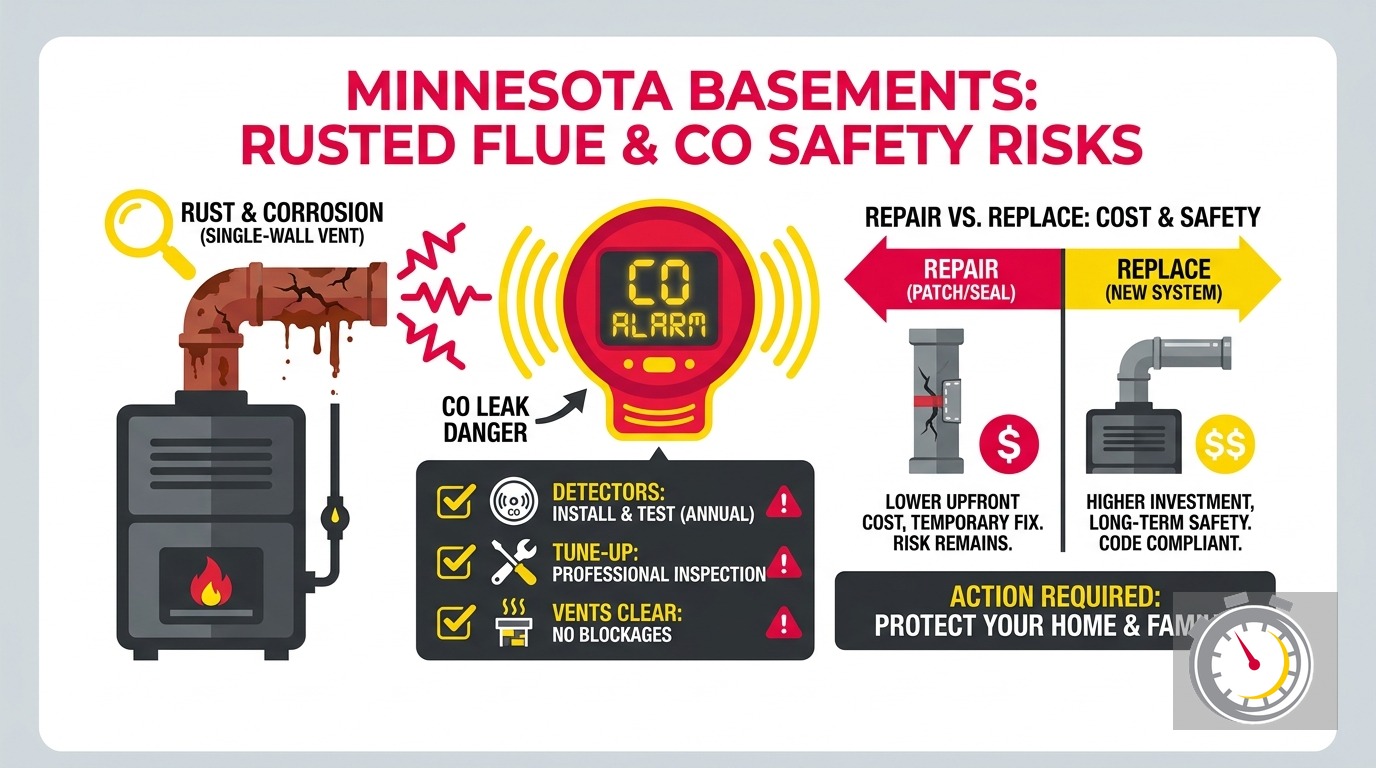
- Rust on your flue pipe is a warning sign. It often points to moisture, weak draft, or a leak.
- The Minnesota Department of Health lists rusting on flue pipes as a sign of a carbon monoxide (CO) problem.
- Check elbows, seams, the collar at the furnace, and the spot where the pipe enters the chimney.
- Orange flaking, white crust, pinholes, sagging, and soot streaks all deserve a call.
- Do not patch a rusted-through pipe with tape or sealant. Replace the damaged section or the whole connector.
- Fixing the pipe alone may not fix the cause. A good inspection checks draft and combustion too.
- Install CO alarms, and schedule a yearly heating check.
What is a single-wall flue connector, and why does it rust?
A single-wall flue connector is a bare metal pipe that carries exhaust from your furnace or water heater to the chimney or vent. It has no insulation layer. Moisture in the exhaust can condense on its cool metal walls, and that water slowly rusts the pipe from the inside.
Gas appliances burn fuel and produce exhaust. The exhaust is hot, but it also carries water vapor. The flue pipe has one job: move those gases outside, safely and steadily.
Many older homes use galvanized steel for this connector. It is thin, inexpensive, and common in basements. With no insulation, it takes on the temperature of the room around it.
Rust needs three things: metal, oxygen, and moisture. A flue pipe has all three. Kept warm and dry, the pipe can last a long time. Run cold and wet, it fails early.
So rust is rarely random. Something is feeding the pipe moisture. Finding that source matters as much as fixing the metal.
Why do Minnesota basements make flue pipe rust worse?
Minnesota basements and utility rooms often run cool for months. A cool room cools the pipe, and a cool pipe invites condensation inside. Long heating seasons, short furnace run cycles, and oversized or changed venting can all add to the moisture and speed up rust.
Our winters are long. Many basements and utility rooms stay cool, and some are close to unheated. Exhaust that meets a cold pipe wall can drop below the point where its moisture turns to water. That water collects at joints, seams, and low spots.
Picture a cold glass on a summer porch. The same physics works inside a pipe. This is our reasoning from how condensation works. It is not a number we can quote from a study.
Several Twin Cities situations make it worse:
- A furnace upgrade. A new, more efficient furnace may send cooler exhaust through an old connector. Pipe sized for the old unit may no longer fit.
- A water heater swap. A smaller flue load can leave a big old pipe or chimney under-drafting. With weak draft, exhaust lingers and cools.
- Long pipe runs. The farther exhaust travels through a cold room, the more heat it loses.
- Humid basements. Summer dampness can rust a pipe from the outside while it sits idle.
- Short cycling. Frequent short runs never let the pipe warm up and dry out.
If your basement stays damp in July, our guide on basement humidity control in summer covers the humidity side. A damp room hurts pipes from both sides.
How do you spot furnace flue pipe rust corrosion?
Look at the full length of the pipe with a flashlight. Check elbows, seams, the collar at the furnace, and the thimble where the pipe meets the chimney. Orange or white crust, pinholes, flaking metal, sagging sections, and soot streaks are all signs of trouble.
You need no tools for a first look. Turn the furnace off and let the pipe cool. Never touch a hot flue. Then walk the pipe from the appliance to the wall or chimney.
Here is where to look, in order:
- The collar at the furnace and water heater. Look for crust, stains, or a loose fit where the pipe meets the appliance.
- Elbows. Water tends to collect and sit at bends, so they often rust first.
- Joints and seams. Look for orange lines, white powder, or drips where pieces connect.
- The chimney thimble. This is the opening where the pipe enters the chimney or wall. Look for rust streaks or crumbling mortar around it.
- The underside of horizontal runs. Condensation drips and pools here.
- The floor beneath the pipe. Orange flakes or dark specks on the floor mean the pipe is shedding metal.
What each sign usually means
- Light orange surface rust. Moisture has been present. The pipe may still be sound. Have a pro check the cause.
- White or chalky crust. This is mineral residue left by evaporating condensate. It points to repeated wetting.
- Flaking or thin metal. The wall is losing thickness. Gentle pressure should never crumble it. If it does, stop and call.
- Pinholes. Exhaust can leak into your living space through these.
- Soot streaks. Exhaust has escaped at that spot. Treat this as urgent.
- Sagging or loose sections. Corrosion or failed supports may have separated joints.
Take clear photos. They let you compare from season to season and see how fast things change.
What does rust on a flue pipe mean for CO safety?
It can mean exhaust is not leaving your home the way it should. The Minnesota Department of Health lists rusting on flue pipes or appliance jacks as a sign of a CO problem. Rust alone does not prove a leak, but it is a reason to inspect.
Carbon monoxide is a colorless, odorless gas produced when fuel burns. A healthy venting system carries it outside.
The Minnesota Department of Health lists “rusting on flue pipes or appliance jacks” among the signs of a CO problem. The same page says fuel-burning appliances should be vented to the outside.
The risk is real. The Consumer Product Safety Commission says more than 200 people in the United States die every year from accidental non-fire related CO poisoning associated with consumer products.
A rusted pipe can fail in two ways:
- It can leak. Holes and open seams let exhaust into the basement, and basement air can travel upstairs.
- It can stop drafting well. A damaged or poorly sized pipe may let exhaust spill back instead of rising out.
Neither problem always shows symptoms right away. That is why CO alarms and regular inspections matter.
Know the Minnesota alarm rule
Minnesota law sets a minimum. The Department of Health page notes that Minnesota Statute 299F.50 requires at least one operational CO alarm within 10 feet of every room legally used for sleeping.
The CPSC goes further. It advises CO alarms on every level of the home and outside sleeping areas. Follow the stricter advice. A basement furnace deserves an alarm on that level too.
Our guides on CO detector placement near a furnace or boiler show where to put them.
If an alarm sounds, get everyone outside first. Then call for help. Do not wait to see if it stops.
Rust Is a Symptom: What Usually Causes It
Rust is usually the result of something else. Replace only the pipe, and the new pipe may rust too.
Common root causes include:
- Under-drafting. The chimney or vent is too big, too cold, or partly blocked. Exhaust moves slowly and cools.
- Oversized connector. A pipe too large for the appliance lets exhaust cool and condense.
- Wrong slope or poor supports. Water collects at low spots instead of draining away.
- Orphaned water heater. When a furnace moves to a sealed vent, the water heater may be left alone in a big masonry chimney. That chimney can run cold and wet. See our guide on chimney liners and orphaned water heaters.
- Chimney problems. Cracked liners, nests, or debris can restrict flow. Birds and animals sometimes block a flue.
- Humid air around the pipe. A wet basement rusts the pipe’s outer surface.
That is why we look beyond the metal. A repair that ignores the cause is a short-term fix at best.
Can you patch a rusted flue pipe, or must you replace it?
Light surface rust may be cleaned if the metal is still solid and the cause is fixed. Holes, flaking, rusted-through seams, and loose joints need a section swap or a full replacement. Tape, putty, and sealants are not a safe fix for a vent connector.
The decision falls into three tiers.
Tier 1: Clean and monitor
This fits light surface rust on sound metal. A pro cleans it, checks the joints, and confirms draft is healthy. We also look for the moisture source and note it for the next visit.
Tier 2: Replace a section
This fits one bad elbow, one rotted joint, or a short damaged run. We cut out the weak part and fit new pipe with proper fasteners. Then we recheck draft and venting.
Tier 3: Replace the whole connector
This fits widespread rust, pinholes in several places, or a connector that is wrong for the appliance. The right call is a new, correctly sized connector with proper slope and clearances. The new run may use a different material, depending on the setup.
A quick decision guide
- One spot of surface rust, metal firm: clean and monitor.
- One bad elbow or joint: replace that section.
- Rust in several places or flaking metal: replace the connector.
- Rust plus soot, weak draft, or a CO alarm: stop using the appliance and call us.
- Rust plus a chimney problem: the chimney may need a liner. That is a bigger job.
Rust can also appear on the furnace itself. If you see rust or soot on the furnace body, read about cracked heat exchanger signs too. We keep that topic separate, but a good inspection covers both.
How much does flue pipe repair or replacement cost in the Twin Cities?
Costs vary with the pipe length, the number of fittings, and what is causing the rust. As rough planning figures, expect about $195 to $500 for a small repair or section swap, and about $375 to $900 for a full connector replacement. Chimney work costs more.
We found no government or utility source that publishes flue repair prices. Treat these as typical planning ranges, not quotes. Your price depends on your home.
| Job | Typical planning range |
|---|---|
| Clean, inspect, and tighten a lightly rusted connector | Often part of a tune-up visit |
| Small repair or one-section swap | $195-$500 |
| Full single-wall connector replacement | $375-$900 |
| Replacement plus draft or venting corrections | Quoted after inspection |
| Chimney relining | Quoted after inspection |
A few things push a price up:
- Longer or harder runs. More pipe and more fittings mean more labor.
- Tight access. Pipes above finished ceilings or near framing take longer.
- Draft problems. If the root cause is a chimney or an inducer motor, that repair is separate.
- Permits. Replacing a vent connector may need a mechanical permit through your local building department. We did not verify permit rules for every city, so confirm with yours. Our guide on when an HVAC permit is required can help.
When the pipe is not the real problem
Sometimes the inspection points to a bigger issue. A furnace that is old, rusted inside, or failing a combustion check may not be worth more repair money.
In that case, replacement may be the smarter spend. Our furnace replacement cost guide for the Twin Cities lays out the numbers. A furnace replacement, installed, typically runs about $3,900 to $7,800, and higher-efficiency models cost more.
Larger jobs raise budget questions. We offer financing options, so ask us about them when we quote the work. We will never push a replacement when a repair is the honest answer.
What should you do today if you find rust?
Look at the pipe, take photos, and check that your CO alarms work. If you see holes, soot, a loose pipe, or smell exhaust, turn off the appliance and call us. For light rust, schedule an inspection soon.
Start with these steps.
Do this now
- Test your CO alarms. Press the test button. Replace dead batteries. Make sure you have one on the basement level.
- Take photos. Capture the whole pipe, then close-ups of any rust.
- Look at the floor. Check for flakes, drips, or soot below the pipe.
- Check for other signs. Note any musty smell, headaches, or a furnace that struggles to run.
Do not do this
- Do not wrap the pipe with tape or foil. It hides the problem and traps heat.
- Do not seal holes with putty or caulk. These products are not made for hot exhaust.
- Do not ignore soot. Soot means exhaust has escaped.
- Do not run the appliance if an alarm has sounded. Leave the home and call for help.
Call us right away if
- A CO alarm has sounded.
- You see soot streaks or pinholes.
- A section of pipe is loose, sagging, or separated.
- You smell exhaust or notice symptoms like headaches or dizziness.
Our emergency furnace repair warning signs guide covers other red flags to watch for during a Minnesota winter.
What Does a Professional Flue Inspection Include?
A pro looks at far more than the pipe’s color. We check the whole path of the exhaust, from the furnace to the outdoors.
A thorough visit includes:
- A visual check of every pipe section. We look at joints, seams, supports, and slope.
- A check of the appliance connections. Loose collars and stained jackets tell a story.
- A draft check. We confirm that exhaust rises and leaves the way it should.
- A look at the chimney or vent. We watch for blockages, damaged liners, or cold masonry.
- A combustion check. We test the gases the furnace produces. Our guide on what a gas furnace combustion analysis tests explains the readings.
Minnesota’s mechanical code supports this approach. Minnesota rules say the flue gas, venting, safety, and operating controls of an appliance shall be checked to confirm proper and safe operation.
The same rule sets a flue-gas CO limit of 0.04 percent. For atmospheric-type appliances, the reading must be not greater than 0.04 percent on an air-free basis. That is the code’s check limit. It does not describe every routine annual visit.
The EPA makes a similar point. It advises having a trained professional inspect, clean, and tune up central heating systems, including furnaces, flues, and chimneys, annually. It also says to repair any leaks promptly.
The Department of Health agrees on timing. It advises checking fuel-burning appliances every year with a qualified heating contractor.
That is why we fold a flue check into our furnace tune-ups. Catching light rust in October costs far less than finding a failed pipe in January.
Why Fall Is the Right Time to Check
Minnesota heating season is long and hard on equipment. Fall gives you a window to look at the flue before the furnace runs every day.
A fall check has real benefits:
- Rust shows up before cold weather. You can fix it without losing heat.
- Parts and schedules are easier. Winter emergencies fill calendars fast.
- You can test your alarms. Do this when you set your clocks back, too.
- You can fix the cause. Draft and moisture problems are easier to solve in mild weather.
If you missed the fall window, do not wait for spring. A flue problem is a safety issue, not a comfort issue.
Schedule a Flue Check With Northern One Hour
Rust on a flue pipe is easy to ignore and costly to miss. A short look now can tell you whether you have a cosmetic issue or a real venting problem.
We are a locally owned and operated Twin Cities HVAC company. Our team knows how Minnesota basements, winters, and older chimneys affect your equipment. We keep our advice plain and our pricing honest.
We also stand behind our schedule. Our promise is “Always On Time… Or You Don’t Pay a Dime!(R)” We arrive within the time window you select. If our technician does not show up on time, you do not pay for the service.
Ready to have your flue pipe checked?
- Call (763) 260-6662 to talk with our team.
- Book online to pick a time that works for you.
Do not wait if you see soot, pinholes, or a loose pipe, or if a CO alarm has sounded. Leave the home, then call for help.
Tell us what you found, and send photos if you have them. We will help you decide whether to clean, repair, or replace, and we will explain why in plain language.
Frequently Asked Questions
Is a rusty furnace flue pipe dangerous? +
Can I patch a rusted flue pipe with tape or sealant? +
Why does the flue pipe in my basement rust? +
How often should a furnace flue be inspected in Minnesota? +
Need a technician now?