
Furnace PVC Vent Pipe Cracked or Deteriorating: MN Guide
Key Takeaways
- A furnace PVC vent pipe cracked or deteriorating is not a minor maintenance issue. It is a potential carbon monoxide pathway into your home.
- High-efficiency condensing furnaces produce acidic condensate at pH 3-5, close to vinegar. That liquid destroys metal pipe, which is why PVC is required.
- Minnesota winters create a failure mode warmer climates never see: pooled condensate in a low-slope run freezes, expands, and splits the pipe from the inside.
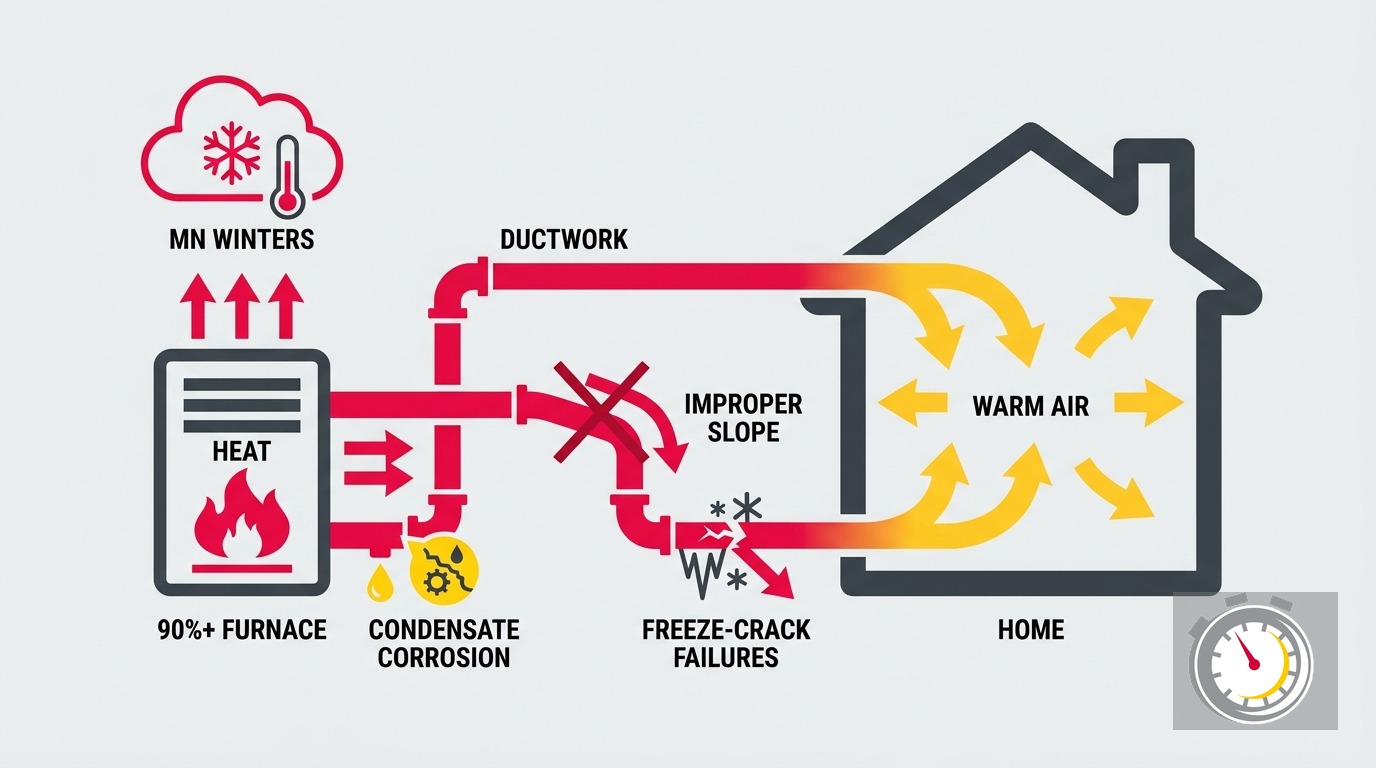
- Three distinct failure modes exist: condensate corrosion at cemented joints, improper slope causing drain backup, and freeze-crack in cold exterior or attic runs.
- Older Twin Cities homes with cast iron drain stacks face a double risk. Acidic condensate corrodes the iron downstream while freeze-crack damages the PVC vent upstream.
- Minnesota code requires sidewall vent terminations 12 inches above finished grade with manufacturer-specified sealing. Most vent repairs are not legal DIY work.
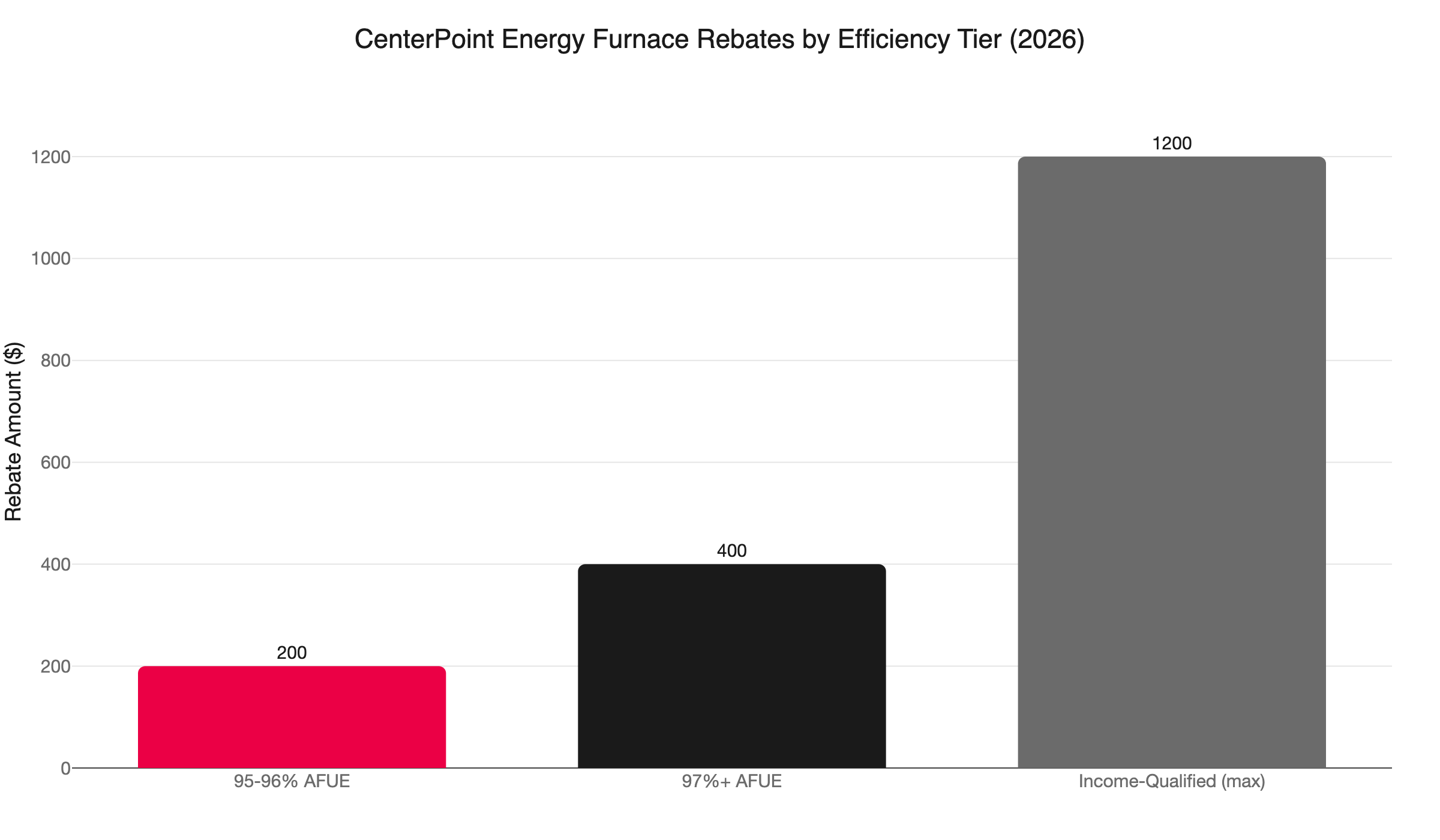
- If your furnace is old enough to have aging PVC vent pipe, CenterPoint Energy rebates of $200-$400 (up to $1,200 for income-qualified households) can offset a high-efficiency replacement.
Why High-Efficiency Furnaces Use PVC Vent Pipe
A standard 80% AFUE furnace vents exhaust gases through a metal flue. Those gases leave the heat exchanger around 400°F. At that temperature, condensation is not a concern, and metal holds up fine.
A high-efficiency condensing furnace (90% AFUE or better) works differently. It extracts so much heat from combustion that exhaust gases exit the heat exchanger at only 100°F to 130°F. Water vapor in those gases condenses into liquid inside the vent pipe.
That liquid is not plain water. Condensate from a condensing furnace measures pH 3-5, roughly equal to vinegar or black coffee. At that acidity, the liquid corrodes metal quickly. It attacks brass, iron, copper, and galvanized fittings in ways that cause leaks and structural pipe failure within a few years.
The U.S. Department of Energy and Building America research confirm that high-efficiency gas furnaces require stainless-steel heat exchangers and plastic flue vent piping for this reason. PVC is not a cost-cutting substitution. It is the only vent material that holds up to the chemistry of condensing combustion.
What Does a Healthy PVC Vent System Look Like?
A properly installed condensing furnace vent has two PVC pipes exiting through the sidewall. One brings in combustion air. One exhausts flue gases. Both are cemented at every joint, sloped 1/4 inch per foot back toward the furnace, and supported every four feet. The exterior termination sits at least 12 inches above finished grade.
Proper exhaust slope means 1/4 inch per foot pitched back toward the furnace so condensate drains into the internal drain system rather than pooling in the pipe run. When that slope is correct, condensate never accumulates. When it is off by even a small margin, problems start. In Minnesota, a small slope error becomes a serious structural failure when January arrives.
What Causes a Furnace PVC Vent Pipe to Crack or Deteriorate?
Three root causes account for most furnace PVC vent pipe failures in the Twin Cities. Condensate corrosion attacks cemented joints over years. Improper slope causes condensate to pool and back up. Minnesota winter turns that pooled condensate into a pipe-splitting ice plug. The third cause is specific to cold-climate markets and does not appear in national HVAC content.
The Minnesota Winter Cascade
Here is how a simple slope error becomes a freeze-crack failure in a Minneapolis winter.
Step one: the slope is wrong. The installer cuts the vent run a quarter-inch too flat. Or the pipe settles over years. Or a long horizontal run in a cold attic sags between supports. Condensate pools in the low spot instead of draining toward the furnace.
Step two: the pool grows. Every heating cycle produces more condensate. It collects in the low spot. Over time, standing liquid begins to seep through imperfect joint seals and causes drips.
Step three: Minnesota winter turns the pool into a plug. The Twin Cities average January low is 9°F, with extremes regularly below -11°F and severe winters reaching below -22°F, with roughly 7,500-7,900 heating degree days per season. A vent pipe running through an exterior wall, a garage, or a cold attic drops below freezing in a polar vortex event. The pooled condensate freezes solid.
Step four: the plug cracks the pipe. Water expands roughly 9% when it freezes. In a rigid PVC pipe, that expansion has nowhere to go. The pipe splits along the freeze zone.
Step five: the furnace shuts down or vents into the house. A blocked vent triggers a pressure switch fault and the furnace locks out. Or, if the crack is downstream of the blockage, exhaust bypasses the plug and exits through the crack into conditioned space instead of outside.
Installers in Atlanta or Dallas never see steps three through five. In our market, any vent run that crosses a cold zone is a freeze-crack risk if the slope is not precise.
Why Is a Cracked Furnace PVC Vent Pipe Dangerous?
A cracked furnace PVC vent pipe is a direct pathway for carbon monoxide to enter your living space. It is not a drip problem. It is a safety emergency when cracks are present.
High-efficiency furnaces operate under positive pressure. The inducer motor pushes exhaust gas through the pipe. Any crack means exhaust exits at that crack, not at the termination cap outside. In a well-sealed modern home, that carbon monoxide has nowhere to go.
Carbon monoxide is colorless and odorless. It does not trigger a smell warning the way a gas leak does. Concentration can build before any symptoms appear.
If you find visible cracks in the vent pipe and you notice any unusual odor near the furnace or feel unexplained headaches or nausea, get everyone out of the home and call 911. Do not stop to turn off the furnace. Once the home is clear and gas is shut from outside, call (763) 260-6662.
If you see dripping or mineral deposits at a joint but no visible cracks and no symptoms, schedule a diagnostic call and avoid running the furnace until the system is inspected.
What Are the Three Main Ways a Furnace PVC Vent Pipe Fails?
Furnace PVC vent pipe fails three ways: condensate corrosion eats through cemented joints over time, improper slope causes condensate to pool and back up into the furnace, and freeze-crack splits the pipe from the inside when pooled condensate turns to ice in a Minnesota winter. Each failure mode has distinct warning signs.
1. Condensate corrosion at joints
The cemented joint is the weakest point in any PVC vent run. Over years, acidic condensate seeps into any imperfect seal and erodes the bond. The joint opens slowly. Water stains or drips appear on the wall or ceiling near the vent path.
Signs to look for:
- Water stains or white mineral deposits at elbows and couplings
- Visible gap or separation at a joint
- Rust or corrosion on adjacent metal components near the vent
2. Improper slope causing drain backup
If the exhaust pipe slopes away from the furnace, condensate flows toward the exterior and pools at the termination or at a low elbow. The internal drain system cannot remove it. Water backs up into the heat exchanger or out of the condensate drain port.
Signs to look for:
- Water puddling near the base of the furnace
- Pressure switch or drain error codes that repeat
- Condensate drain port overflowing with no other clear cause
3. Freeze-crack in exterior or attic runs
Low-slope run, pooled condensate, a January cold snap, ice plug, split pipe. This failure tends to appear suddenly at the start of a polar vortex. The furnace shuts down when you need it most.
Signs to look for:
- Furnace lockout in cold weather with no other obvious cause
- Visible split or crack on the pipe near an exterior wall or in a cold attic space
- Ice visible at or near the exterior vent termination cap
Do Older Twin Cities Homes Face Extra Risk?
Yes. Many Twin Cities homes built before 1990 have cast iron drain stacks. Acidic furnace condensate at pH 3-5 corrodes cast iron quickly. If the condensate drain discharges into a cast iron stack without a neutralizer in place, damage happens on two fronts at once: freeze-crack in the PVC vent pipe and acid corrosion inside the cast iron drain.
A condensate neutralizer is a small cartridge inline on the condensate drain line. It raises the pH before water enters any metal drain. If your high-efficiency furnace drains directly into a cast iron stack and you do not see a neutralizer on the condensate line, ask your technician about adding one.
This failure mode is quiet. The condensate eats cast iron slowly, often inside the wall, until a plumber discovers a corroded stack years later. The furnace usually gets blamed. The root cause is usually a condensate drain plumbed without the right materials or without a neutralizer.
What Does a Proper PVC Vent Repair Look Like?
A proper repair fixes the visible damage and corrects the root cause. Patching a cracked joint without correcting the slope that caused the freeze means the same section cracks again the following January.
For cracked or separated joints, the technician cuts out the damaged section and cements a new fitting with correct primer and PVC cement. That is enough only when the joint failed from age, not from a slope-driven freeze event.
For freeze-crack caused by a low-slope run, HVAC School documents two field fixes proven in northern climates:
- Exit at a 45-degree downward angle. Routing the exhaust pipe to exit the structure on a downward pitch increases condensate velocity. Liquid drains before it pools and freezes.
- Upsize the pipe. Increasing interior diameter from 3/4-inch to 1.5-2-inch PVC adds volume. A small ice plug that fully seals a narrow pipe does not block a larger one. The furnace can continue to operate or at least drain.
Both fixes require rerouting sections of vent pipe. That often means opening wall cavities or attic access panels. If cast iron drain lines are present, add a condensate neutralizer at the same visit.
Can I Fix a Cracked Furnace PVC Vent Pipe Myself?
Most furnace PVC vent repairs are not legal DIY work in Minnesota. The 2020 Minnesota Mechanical Code requires sidewall vent terminations at least 12 inches above finished grade, minimum horizontal clearances from windows and doors, and manufacturer-specified sealing for positive-pressure vent systems. An improperly sealed joint creates a direct carbon monoxide pathway.
PVC cement requires correct priming and bonding technique to form a pressure-rated seal. A joint that looks closed can fail under the pressure cycling of a condensing furnace if it was not done correctly.
Beyond the code question, the slope error that caused a freeze-crack requires accurate measurement and rerouting judgment. Fixing the visible crack without correcting the slope means repeating the repair next winter.
Our team is locally owned and operated in Ramsey and serves the Twin Cities every day. We know the code requirements in Hennepin, Ramsey, Anoka, and Washington counties. “Always On Time… Or You Don’t Pay a Dime!(R)” is what we commit to on every call, not just a tagline.
When Does Vent Damage Point Toward Furnace Replacement?
If your furnace is 15 or more years old and the PVC vent pipe is cracking or deteriorating, the repair may cost more than the system is worth. A cracked vent on an aging furnace is often one of several components failing at the same time.
Consider the full picture before committing to a vent repair:
- Age. Most furnaces last 15-20 years. A 17-year-old unit with a cracked vent and an aging heat exchanger is usually a replacement candidate. See our repair-or-replace guide for a straightforward framework.
- Repair history. If you have had multiple vent, igniter, or blower motor calls in recent seasons, the cumulative cost may already approach replacement value.
- Efficiency gap. An 80% AFUE furnace from 2008 wastes 20 cents of every gas dollar. A 95-96% AFUE replacement captures most of that loss starting in the first month.
Furnace replacement cost in the Twin Cities starts around $4,950 installed for an 80% AFUE unit, $6,500 for a 95-96% model, and $9,100 for a 97-98% high-efficiency unit. Those figures reflect real Twin Cities market pricing.
How Do CenterPoint Rebates Lower the Cost of Replacement?
CenterPoint Energy pays $200 back on a 95-96% AFUE furnace replacement and $400 back on a 97%+ AFUE unit in 2026. Income-qualified households can receive up to $1,200. Rebates must be submitted within 60 days of installation and stack with the federal 25C tax credit.
If your furnace is old enough to have deteriorating PVC vent pipe, it is likely old enough to qualify for these replacement incentives.
CenterPoint Energy’s 2026 rebate program pays $200 for a 95-96% AFUE replacement and $400 for a 97%+ AFUE unit. Income-qualified households can receive up to $1,200, with a 60-day submission window from the installation date.
The federal 25C tax credit adds another layer: 30% of qualifying costs, up to $600, for a high-efficiency replacement. Minnesota rebate guides confirm this combination is available in 2026 and the two incentives stack without conflict.
We walk through the rebate math during your service call, before any decision is made.
What to Do If You Suspect a Cracked Furnace PVC Vent Pipe
Start with a visual inspection. Walk the visible length of your furnace exhaust pipe and look for:
- Cracks, splits, or discoloration on the white PVC
- Water stains or mineral deposits at joints and elbows
- Disconnected or partially separated couplings
- Ice buildup at the exterior vent cap during cold weather
- Furnace error codes related to pressure switch or venting
If you find visible cracks, do not tape over the pipe and wait for spring. A compromised vent is a carbon monoxide risk that is active every time the furnace fires.
Call (763) 260-6662. Northern One Hour serves the Twin Cities from Ramsey. We are a locally owned and operated team backed by the national One Hour Heating & Air Conditioning network. Our furnace repair service includes a full vent system inspection. We explain what we find before quoting any work.
If the diagnosis points toward replacement, we go through available rebates and financing options the same day. No pressure. No surprises.
Frequently Asked Questions
Why does a high-efficiency furnace use PVC vent pipe instead of metal? +
How do I know if my furnace PVC vent pipe is cracked or deteriorating? +
Can I repair a cracked furnace PVC vent pipe myself in Minnesota? +
How much does furnace PVC vent pipe repair cost in the Twin Cities? +
Need a technician now?