
Furnace Repair Cost Twin Cities: 2026 Part-by-Part Guide
Key Takeaways
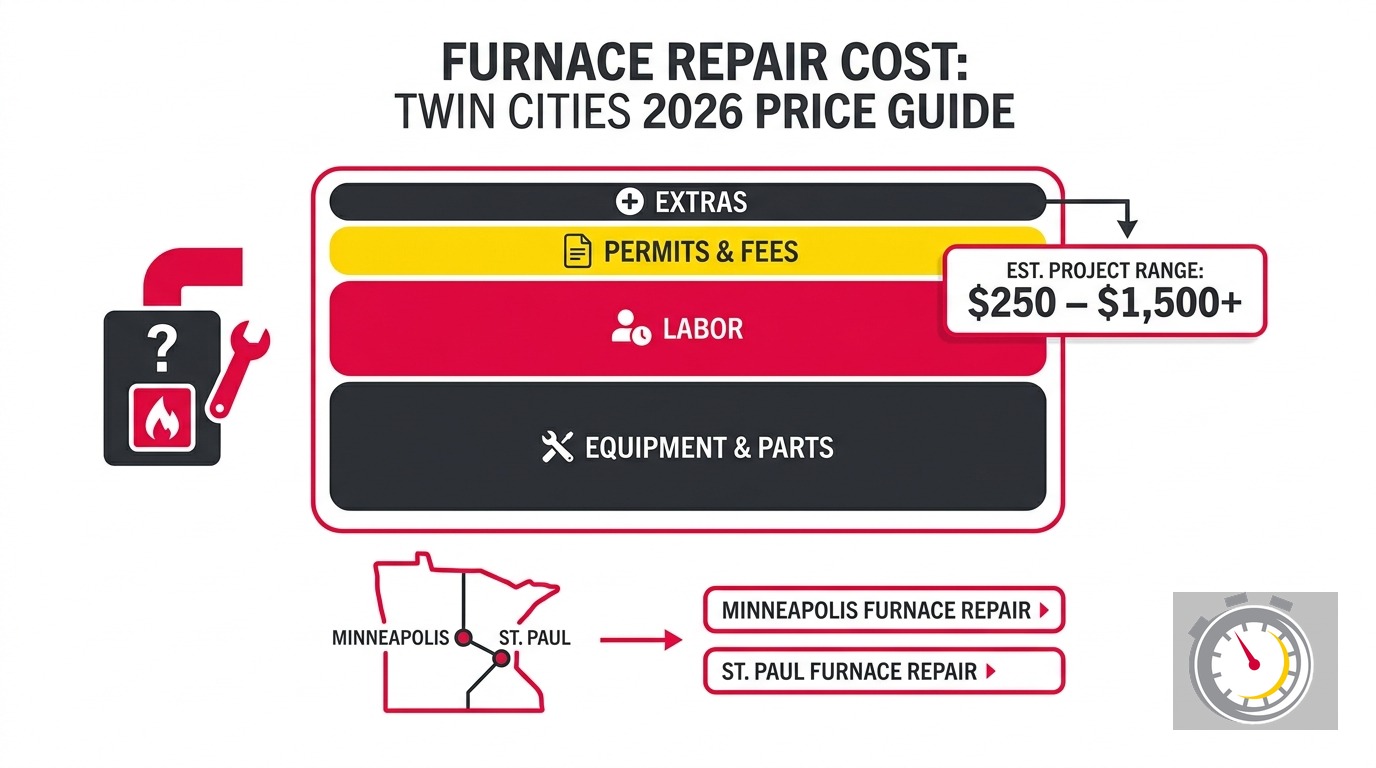
- Twin Cities furnace repairs average around $367. That is about 5% above the national average. Minnesota furnaces run harder and longer than furnaces in milder climates, which pushes costs up.
- Most single-part repairs fall between $150 and $900. A blower motor replacement starts at $1,100 installed. Heat exchanger issues usually lead to a replacement conversation rather than a repair.
- Diagnostic calls run $95-$200 upfront. After-hours emergency visits add $180-$270 per hour on top of standard rates.
- A cracked heat exchanger is a carbon monoxide safety event. Minnesota law requires at least one working CO alarm within 10 feet of every sleeping area.
- The 25C federal tax credit expired December 31, 2025. Xcel Energy and CenterPoint still offer active rebates of $200-$400 on qualifying high-efficiency replacements.
- Permits are required for full furnace replacements in Minnesota, not for component-level repairs.
- Use the 5,000 rule: multiply the repair cost by the furnace’s age in years. If the result exceeds $5,000, replacement is usually the better financial call.
What Does Furnace Repair Cost in the Twin Cities?
Short answer: Plan for $95-$200 upfront for a diagnostic call, plus $150-$900 for most single-part repairs. Twin Cities homeowners pay about 5% more than the national average because Minnesota furnaces log far more hours per heating season.
The national average furnace repair runs around $318, with most jobs landing between $133 and $505. In the Twin Cities, that average climbs to roughly $367. The gap is modest but consistent across part categories. A Minneapolis furnace can run hard from late October through April. That is six-plus months of regular ignition cycles, sustained blower hours, and repeated thermal stress on the heat exchanger. The extra run time accelerates wear on every mechanical part.
Diagnostic fees are quoted upfront. In most cases, the fee applies toward the repair when you authorize the work. Emergency visits during a cold snap add a premium of $180-$270 per hour on top of standard rates. When the furnace is not heating but there is no immediate safety risk, waiting until regular business hours often makes financial sense.
Furnace Repair Cost by Part: Twin Cities Price Breakdown
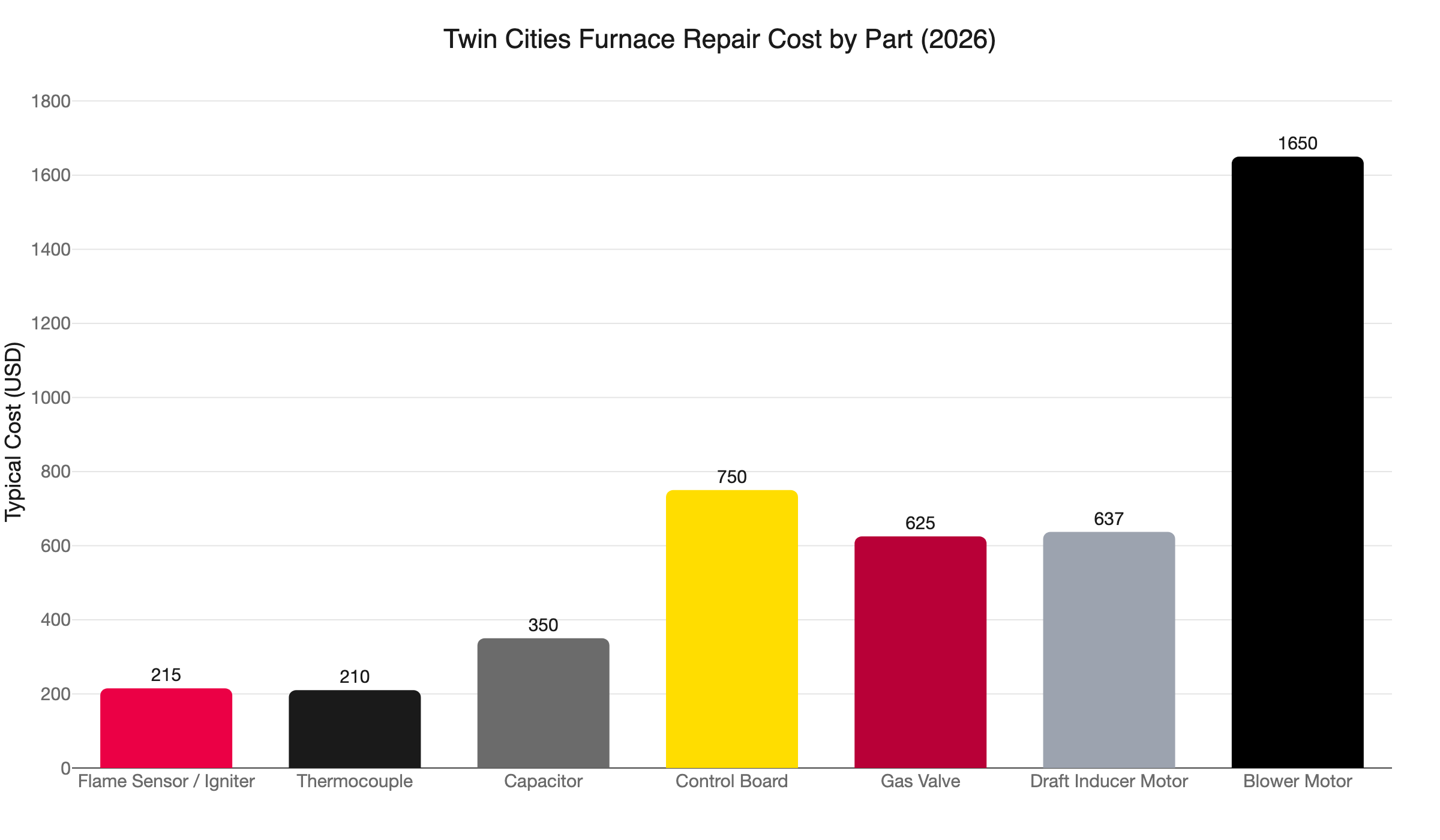
Short answer: The specific failed part drives the bill more than any other factor. Costs range from around $150 for a flame sensor to $1,100-$2,200 for a blower motor. Here is the part-by-part guide for the Minneapolis-St. Paul area.
The prices below include parts and labor. Midwest technician labor rates run $75-$150 per hour, below coastal markets but reflecting a real licensed-trade market in Minnesota.
Flame sensor or hot surface igniter: $150-$325
These are the two most common single-visit furnace repairs. The hot surface igniter heats to ignite the gas burners. The flame sensor confirms combustion is happening and holds the gas valve open. If your furnace fires briefly and then shuts off, one of these two parts is usually the cause. Both are relatively small components. A significant portion of the total bill is the diagnostic visit and trip.
Thermocouple: $150-$275
Thermocouples belong to older standing-pilot furnaces, typically pre-2000 equipment. They tell the gas valve that the pilot flame is present. If the pilot light keeps going out on an older unit, a thermocouple replacement is often the fix. Newer furnaces use hot surface igniters instead and do not have a thermocouple.
Capacitor: $195-$500
A capacitor gives the blower motor the electrical kick it needs to start spinning. The part itself is inexpensive. Most of the cost is the service call. A sluggish blower or one that fails to start at all is a common symptom of a failing capacitor.
Control board: around $750
The control board coordinates every component in the furnace. It processes signals from the thermostat and manages the ignition sequence, blower timing, and safety shutoffs. Diagnosing a board failure takes time because the symptoms overlap with other problems. The blinking LED on most modern furnaces flashes an error code that narrows the diagnosis before our technician arrives.
Gas valve: $450-$800
A faulty gas valve prevents gas from reaching the burners. The blower runs, but no heat is produced. Gas valve work always requires a licensed technician. If you smell gas anywhere in the home, leave immediately and call your gas utility before calling for HVAC service.
Draft inducer motor: $375-$900 (brand-specific models can reach $500-$1,650)
The draft inducer pulls combustion gases out through the flue before the burners fire. A failed inducer trips the pressure switch. The furnace shuts down before the heating cycle can complete. Your furnace’s error code will usually point here when the inducer is the problem.
Blower motor: $1,100-$2,200 installed
The blower circulates heated air through your ductwork. Single-speed PSC motors sit at the lower end of this range. Variable-speed ECM motors cost more to replace but run more quietly and efficiently over their service life. A blower motor job is a meaningful repair. Confirm the quote covers both parts and labor before authorizing work.
Heat exchanger: $1,500 and up
Heat exchanger repairs are uncommon. At the cost of replacing one, which can rival or exceed the price of a new furnace, most technicians recommend replacing the full unit. The decision deserves careful consideration. See the repair-vs.-replace section below for how to think through it.
What Does a Diagnostic Call Actually Cover?
Short answer: A thorough diagnostic goes well beyond identifying a single failed part. A complete visit examines the full ignition sequence, heat exchanger condition, blower performance, gas pressure, and flue draft - not only the symptom that prompted the call.
This matters because a furnace that presents with a bad igniter sometimes has other problems developing at the same time: a weakening flame sensor, a cracked heat exchanger, or a blower motor drawing too much current. Catching those at the same visit prevents a second service call weeks later.
A complete diagnostic typically covers:
- Thermostat operation and calibration
- Full ignition sequence from call-for-heat through burner flame
- Flame sensor signal strength
- Flue draft and pressure switch operation
- Blower motor amperage draw
- Heat exchanger visual inspection
- Filter condition and airflow restriction
- Gas pressure at the manifold
Arriving prepared helps. Know when the problem started, whether any error codes are blinking on the furnace, and whether the unit has been making unusual noises before the failure.
Is a Cracked Heat Exchanger Dangerous?
Short answer: Yes. A crack can allow combustion gases, including carbon monoxide, to enter your living air. This is a safety event, not a maintenance item to defer. Confirm your CO alarms are working before anything else.
The Minnesota Department of Commerce cites about 500 national deaths annually from CO poisoning and specifically names fuel-burning appliances as a source. Minnesota law requires at least one working CO alarm within 10 feet of every sleeping area. If yours are not in place or are past their test date, fix that today, regardless of your furnace’s condition.
Signs that point to a compromised heat exchanger include:
- Burner flame flickers or dances when the blower starts running
- Soot deposits around the burner compartment
- A formaldehyde-like odor from the supply vents
- CO detector activation
If a technician flags the heat exchanger, ask for a written report with photos before making any decision. The relationship between heat exchanger cracks and CO exposure is real but varies significantly by severity - not every crack poses the same risk. Our post on cracked heat exchanger signs in Minnesota walks through exactly what to ask your technician during that conversation.
Should I Repair or Replace My Furnace?
Short answer: Use the 5,000 rule. Multiply the repair cost by the furnace’s age in years. If the result tops $5,000, replacement is almost always the better financial decision.
This straightforward formula gives you a quick filter before committing to either path. A $900 blower motor on a 4-year-old furnace works out to $3,600 - repair it. That same $900 repair on a 15-year-old furnace works out to $13,500 - replacement makes more sense on a life-of-system cost basis.
Additional signals that favor replacement:
- Repair costs are stacking year over year
- The furnace runs at 80% AFUE or below
- Parts for the specific model have become hard to source
- The heat exchanger is compromised
- The system is 15-20 years old or older
Minnesota homeowners should also know about a coming equipment change. The state sits in the DOE’s northern zone. When a replacement does happen, an 80% AFUE furnace cannot legally be installed as a replacement under current northern-zone standards. A 95% AFUE minimum takes effect May 1, 2028, under the DOE 2023 Final Rule. That will shape which equipment is available and at what price point when replacement time arrives.
For the full cost breakdown on new equipment, read our furnace replacement cost guide for the Twin Cities.
Do Furnace Repairs Require a Permit in Minnesota?
Short answer: Component-level repairs - igniter, thermostat, capacitor, filter - do not require a permit. A full furnace replacement does require a mechanical permit. Most Twin Cities municipalities charge $120-$450.
Permit costs vary by city. Minneapolis typically runs $120-$400. Brooklyn Park, Blaine, Maple Grove, and Plymouth each set their own fee schedules, with most in the $150-$450 range. Permit costs are separate from and in addition to the replacement quote itself.
Before authorizing any major HVAC work, confirm your contractor is licensed in Minnesota. HVAC contractors must hold a $25,000 mechanical contractor bond with the MN Department of Labor and Industry. You can verify any contractor’s license at dli.mn.gov before signing anything.
Are There Rebates Available If I Need to Replace?
Short answer: Yes. Xcel Energy and CenterPoint both offer active 2026 rebates of $200-$400 on qualifying high-efficiency furnaces. The 25C federal tax credit expired December 31, 2025. Do not plan your budget around it.
If a repair estimate leads you toward replacement, here is what is currently available from the two main Twin Cities utilities:
Xcel Energy: $200 rebate for a 95% AFUE furnace, $300 for 96%, $400 for 97%+ AFUE. Applies to existing homes. Application deadline is September 30 of the calendar year following installation.
CenterPoint Energy: $200 for 95-96% AFUE, $400 for 97%+ AFUE. Income-qualified households can receive up to $1,200. Paperwork must be filed by December 31 of the install year.
Any source still promoting “up to $600 federal credit” under Section 25C is citing expired law. That credit ended December 31, 2025. Our rebate stacking guide for Minnesota homeowners covers every program still active in 2026.
Financing is available for replacement jobs. Ask our team about current options when you call.
What Drives Furnace Repair Costs Higher in Minnesota?
Short answer: Run hours. A Minnesota furnace logs far more operating time per year than furnaces in moderate climates. More cycles mean more wear on every mechanical part, and more wear means more repairs.
Twin Cities temperatures regularly drop to -20°F or colder in a hard winter. Your furnace runs more ignition cycles, more sustained blower hours, and more maximum-load periods than a furnace in a mild climate. That operating profile shows up in wear rates on igniters, heat exchangers, draft inducer motors, and blower motors alike.
Labor rates in the Midwest run $75-$150 per hour, below coastal markets but reflecting real licensing and bond requirements. Emergency demand spikes during cold snaps, and that after-hours premium of $180-$270 per hour compounds the total bill.
A maintenance plan is the most direct way to control repair costs. An annual tune-up at $95-$250 catches small problems - a weakening igniter, a marginal capacitor, a partially blocked flue - before they fail on a January night. Ask our team about maintenance plan options when you call.
How to Protect Yourself on a Furnace Repair Bill
A few practical steps keep costs under control before and during a service call.
Get the full quote in writing before authorizing work. Ask for the part name, the part number, and a written estimate. A legitimate contractor provides this without hesitation.
Verify the license at dli.mn.gov. Minnesota requires a $25,000 mechanical contractor bond with MN DLI. Check it before signing a contract.
Ask whether the diagnostic fee applies toward a replacement. If the repair cost and the furnace’s age together push past the 5,000-rule threshold, confirm whether the diagnostic fee transfers to the replacement quote.
Know the after-hours premium before you call. Emergency visits add $180-$270 per hour. If the furnace is not working but the situation is not an immediate safety risk, waiting until morning business hours often saves real money.
Consider an annual tune-up as insurance. A $95-$250 maintenance visit each fall is a direct hedge against a larger repair bill mid-winter. A technician who already knows your system is faster and more accurate when something goes wrong.
As a locally owned and operated Twin Cities HVAC company, we quote honestly and show up when we say we will. “Always On Time… Or You Don’t Pay a Dime!(R)” is the guarantee we back every service call with. Call us at (763) 260-6662 or schedule your service appointment online.
Key Takeaways
- Twin Cities furnace repairs average $367, about 5% above the national average. Minnesota furnaces work harder, and that shows up in the bill.
- Most single-part repairs run $150-$900. Blower motor jobs start at $1,100 installed.
- Diagnostic visits are $95-$200 upfront. Emergency calls add $180-$270 per hour on top.
- A cracked heat exchanger is a CO safety event. Confirm your CO alarms are working today.
- The 5,000 rule: repair cost times furnace age. Over $5,000, replace.
- The 25C federal credit is gone. Xcel and CenterPoint still offer $200-$400 on qualifying replacements.
- Permits are required for replacements in Minnesota, not for component repairs.
- Call (763) 260-6662 or book your service appointment to get a flat-rate diagnostic quote.
Frequently Asked Questions
What is the average furnace repair cost in the Twin Cities? +
Does a furnace repair require a permit in Minnesota? +
Is a cracked heat exchanger dangerous? +
What happened to the 25C federal tax credit for furnaces? +
Need a technician now?