
Smell Gas Near Your Furnace? What to Do Right Now
Key Takeaways
- A rotten-egg smell near your furnace means natural gas. Leave the house immediately on foot. Do not flip switches, use your phone, or start your car.
- From a safe location, call CenterPoint Energy at 612-372-5050 or Xcel Energy at 1-800-895-2999, and call 911.
- CenterPoint checks your home for a gas leak at no charge to you.
- Olfactory fatigue is real: your nose can stop detecting a leak that is still present. Act on the first smell, not the persistent one.
- Odor fade means a real leak can produce no detectable smell at all, especially in new or corroded pipe.
- A cracked heat exchanger is the highest-risk furnace source and creates both a gas odor and a carbon monoxide risk.
- CO detectors and gas detectors are separate devices. You need both in any home with a gas furnace.
- A one-time smell at fall startup that clears and never returns is likely dust burn-off. Any smell that returns or lingers is not.
- Annual furnace maintenance is the most effective way to catch a failing component before it becomes a gas emergency.
What should I do if I smell gas near my furnace?
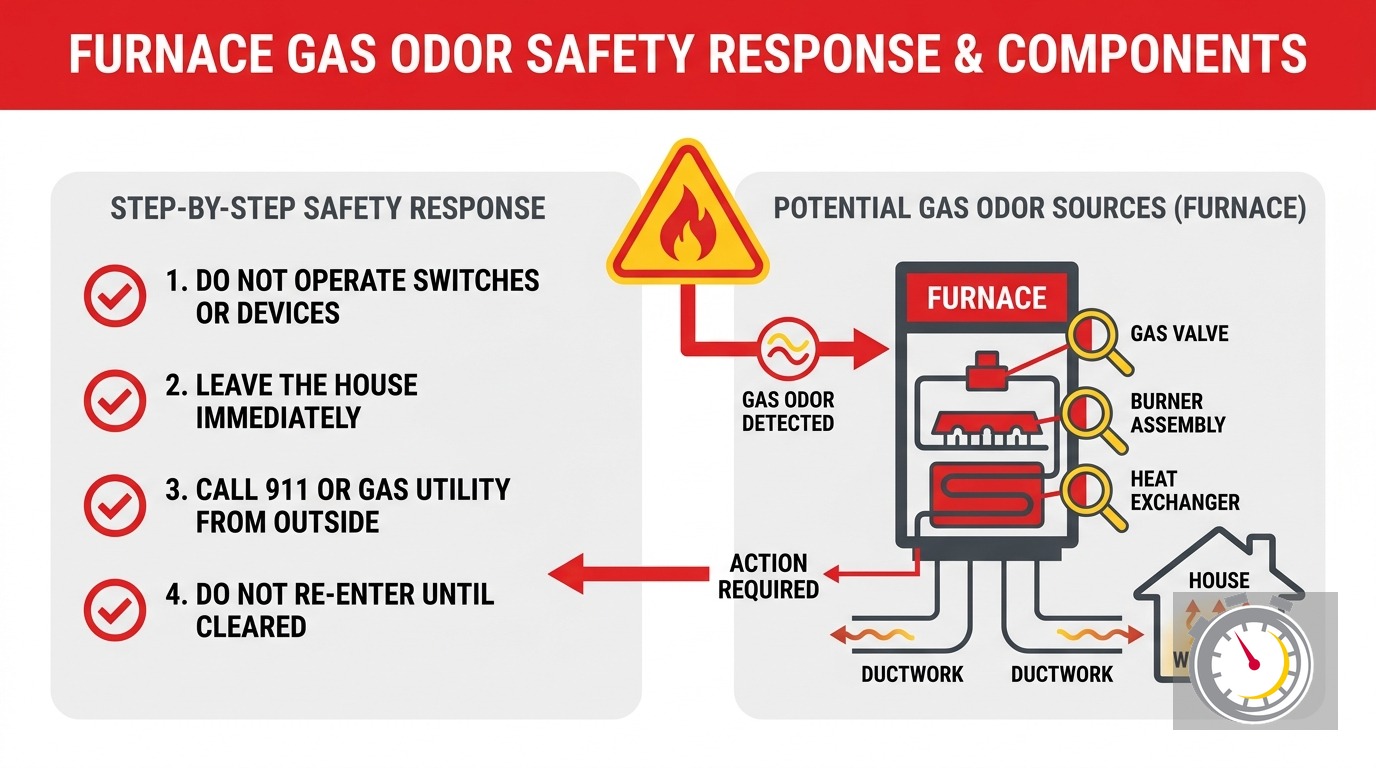
Leave the house immediately on foot. Do not flip switches, use your phone, or start your car. Walk to a safe location, then call CenterPoint Energy at 612-372-5050 or Xcel Energy at 1-800-895-2999, and call 911. Do not re-enter until emergency responders clear the building.
Natural gas has no smell of its own. CenterPoint Energy adds mercaptan, a sulfur compound, so you can detect a leak. That sharp, rotten-egg odor exists for one reason: to get you out of the building. When you smell it, do not investigate. Get out.
Here is CenterPoint’s four-step emergency protocol for Minnesota homeowners:
Step 1: Leave immediately on foot.
Do not stop for your phone, wallet, or shoes. Do not flip any light switches. Do not start your car if it sits in an attached garage. Even a phone screen activating can ignite gas that has built up indoors. Get every person and pet out the door and walk to a neighbor’s home or to the street.
Step 2: Go to a safe location, then call CenterPoint and 911.
Once you are clear of the building, CenterPoint’s Minnesota emergency line is 612-372-5050 (alternate: 1-800-296-9815). Xcel Energy customers call 1-800-895-2999. If the situation feels life-threatening, call 911 first. Save both utility numbers in your phone before you ever need them.
Step 3: Alert your neighbors.
Gas does not respect property lines. If your home shares walls with adjacent units, or if neighbors live close by, alert them. They may have gas entering their space from the same source.
Step 4: Do not attempt to find or repair the leak yourself.
Gas leak detection and repair require licensed equipment and training. Do not open windows to air things out. Do not go back in to investigate. Do not touch anything.
One critical fact: CenterPoint checks suspected gas leaks at no cost to the customer. If you are a CenterPoint customer, this service costs you nothing. Make the call.
Is it ever safe to ignore a gas smell near your furnace?
No. There is no safe threshold for an unexplained gas odor. A faint smell is not “probably fine.” A smell that fades is not proof the danger passed. When in doubt, treat it as a real leak and leave.
Some homeowners wait to see if the smell comes back. Others chalk up a faint odor to something benign. Both responses can be fatal. The two mechanisms below explain why a fading smell can signal a worsening situation, not an improving one.
Two hazards most articles skip: olfactory fatigue and odor fade
Every gas safety article covers the protocol. Most skip these two mechanisms entirely. Both are documented, and both lead homeowners to believe they are safe when they are not.
Olfactory fatigue
Your nose adapts to continuous odors. After prolonged exposure, it becomes temporarily unable to detect a smell it was registering just minutes before. CenterPoint’s safety guidance names olfactory fatigue as a documented risk. You can stop smelling a leak that is still actively present in your home.
This is a well-documented physiological response, not an edge case. The practical consequence is straightforward: act on the first smell. Do not wait for the smell to return or to grow stronger. If you smelled gas and it then seemed to fade, that is not confirmation the leak stopped. It may mean your nose adapted to it.
Odor fade
Odor fade is the inverse problem. In new gas pipe installations, or in pipes with rust or moisture buildup, mercaptan is chemically absorbed by the pipe material before it ever reaches you. The leak is real. The odor is absent.
Odor fade is most common in freshly installed pipe or in older pipe with significant corrosion. If you recently had HVAC work done that involved the gas line, and you later notice unexplained headaches, fatigue, or dizziness in your household, take those symptoms seriously even without a detectable smell. They may be the only warning you get.
Both hazards point to the same conclusion: trust your suspicion, not the absence of odor.
Which parts of your furnace are most likely causing the smell?
The five most likely sources, in rough order of risk, are the heat exchanger, the gas valve, the flexible gas connector, the flue or exhaust vent, and the burner or igniter assembly. A cracked heat exchanger is the highest-risk source and the most common failure in older Minnesota furnaces.
After the utility company has cleared your home and confirmed it is safe to re-enter, your next call is to an HVAC technician. Here is what they will look for, and what each failure looks like from the homeowner’s side.
1. Heat exchanger (highest risk)
The heat exchanger is a sealed metal chamber inside your furnace. It separates combustion gases from the heated air that circulates through your home. When it cracks, unburned gas and carbon monoxide enter your air supply and get pushed through every supply vent in the house.
Signs of a cracked heat exchanger include:
- A yellow or orange burner flame instead of a steady blue
- Soot or dark streaking on the furnace exterior
- Unexplained flu-like symptoms (headache, nausea, fatigue) in household members that improve when they leave the home
- A gas or burning smell coming from supply vents, not just from near the furnace cabinet
A cracked heat exchanger is rarely a product defect. It is the result of thousands of heating cycles stressing the same piece of metal until it fails. Our dedicated post on signs of a cracked heat exchanger in Minnesota covers this failure in full detail, including what a technician will look for during inspection.
2. Gas valve
The gas valve controls fuel flow to the burners. A faulty or aging valve can allow gas to seep past even when the furnace is not in a heating cycle. The smell tends to be strongest near the furnace cabinet and may be present even when the system has not recently run. Gas valve failures become more common as a furnace ages and after Minnesota winters that put heavy continuous demand on the system.
3. Flexible gas connector and supply line fittings
The flexible connector runs between the gas supply line and the furnace inlet. Years of vibration gradually loosen the fittings at both ends. Corrosion attacks the connector material from the outside, particularly in basements with elevated humidity. In homes built before 2000 across the Twin Cities, this connector may never have been inspected or replaced. A professional tune-up should include a visual check of the connector and all accessible fittings.
4. Flue and exhaust vent pipe
The flue carries combustion gases from the furnace to the outside. A blocked flue (from ice, a bird nest, or a damaged vent seal) allows combustion gases to backdraft into the living space. The resulting smell is a mix of combustion byproducts and, depending on the failure, unburned gas.
In Minnesota, ice blockage of high-efficiency furnace PVC exhaust vents is a documented seasonal problem. If the smell appears in January or February, and your PVC vent exits near ground level on the north side of the house, check the vent opening before anything else.
5. Burner and igniter assembly
A brief puff of unburned gas at startup is normal. It lasts less than one second before ignition occurs. If the smell persists after the burners light, or if the furnace makes a delayed thump when igniting, a burner or igniter component is failing. A dirty or degraded flame sensor often contributes to this problem. Our post on furnace flame sensor symptoms and cleaning costs in Minnesota covers this specific failure in detail.
What is the difference between a CO detector and a gas detector?
CO detectors detect carbon monoxide only. They cannot detect natural gas. A separate combustible gas detector is required for gas leak detection. You need both devices in any home with a gas furnace.
This point of confusion comes up regularly. Many homeowners assume a CO alarm would have triggered during a gas leak. It would not.
Carbon monoxide is a byproduct of combustion, produced when gas burns. Natural gas is an unburned fuel. They are different molecules that require different sensors. A CO detector has no gas-sensing capability. A gas detector has no CO-sensing capability. They serve completely separate functions.
Every Minnesota home with a gas furnace should have:
- CO detectors on every level of the home, including the basement and all sleeping areas
- At least one combustible gas detector near the furnace or in the utility room
- Both devices tested regularly and replaced on the manufacturer’s schedule
A plug-in combustible gas detector costs $25 to $60 at any hardware store. CO detectors carry expiration dates (typically seven to ten years from the manufacture date). Check the back of your current alarm. If it is past its expiration, it may not sound even if CO levels are dangerous.
Our post on carbon monoxide safety during furnace season covers CO detector placement, testing schedules, and what to do if an alarm triggers.
When is a furnace smell NOT an emergency?
The one non-emergency scenario: a brief, one-time burning smell at the very first startup of heating season that clears completely within one heating cycle and never returns. That is dust burn-off, not a gas leak.
Over the summer, dust settles on the furnace burners, the heat exchanger surface, and the ductwork. When the furnace runs for the first time in fall, that dust burns off and produces a faint, slightly acrid smell through the vents. It lasts less than one full heating cycle and does not repeat.
How to tell the difference between dust burn-off and a real concern:
- It happens exactly once, at the first startup of the season
- It clears within 20 to 30 minutes of the furnace running
- It smells more like burning dust than rotten eggs
- The next time the furnace runs, there is no smell at all
If you are uncertain which one you experienced, follow the emergency protocol. A false alarm costs you a phone call. Staying in a home with a real leak can cost far more.
Why do Twin Cities furnaces develop heat exchanger cracks faster than furnaces in milder climates?
Minnesota’s extreme cold forces Twin Cities furnaces to run harder and cycle more often than furnaces in warmer states. Each start and stop thermally stresses the heat exchanger metal. Over 15-plus years, that accumulated stress causes cracks. This is physics, not bad luck.
When January wind chills drop to -40 degrees, a Twin Cities furnace may run nearly continuously for days at a time. Each heating cycle thermally expands the heat exchanger metal. Each time the furnace stops, the metal contracts. Over a furnace’s operational life in Minnesota, that adds up to thousands of expansion and contraction cycles, the primary mechanism of heat exchanger cracking.
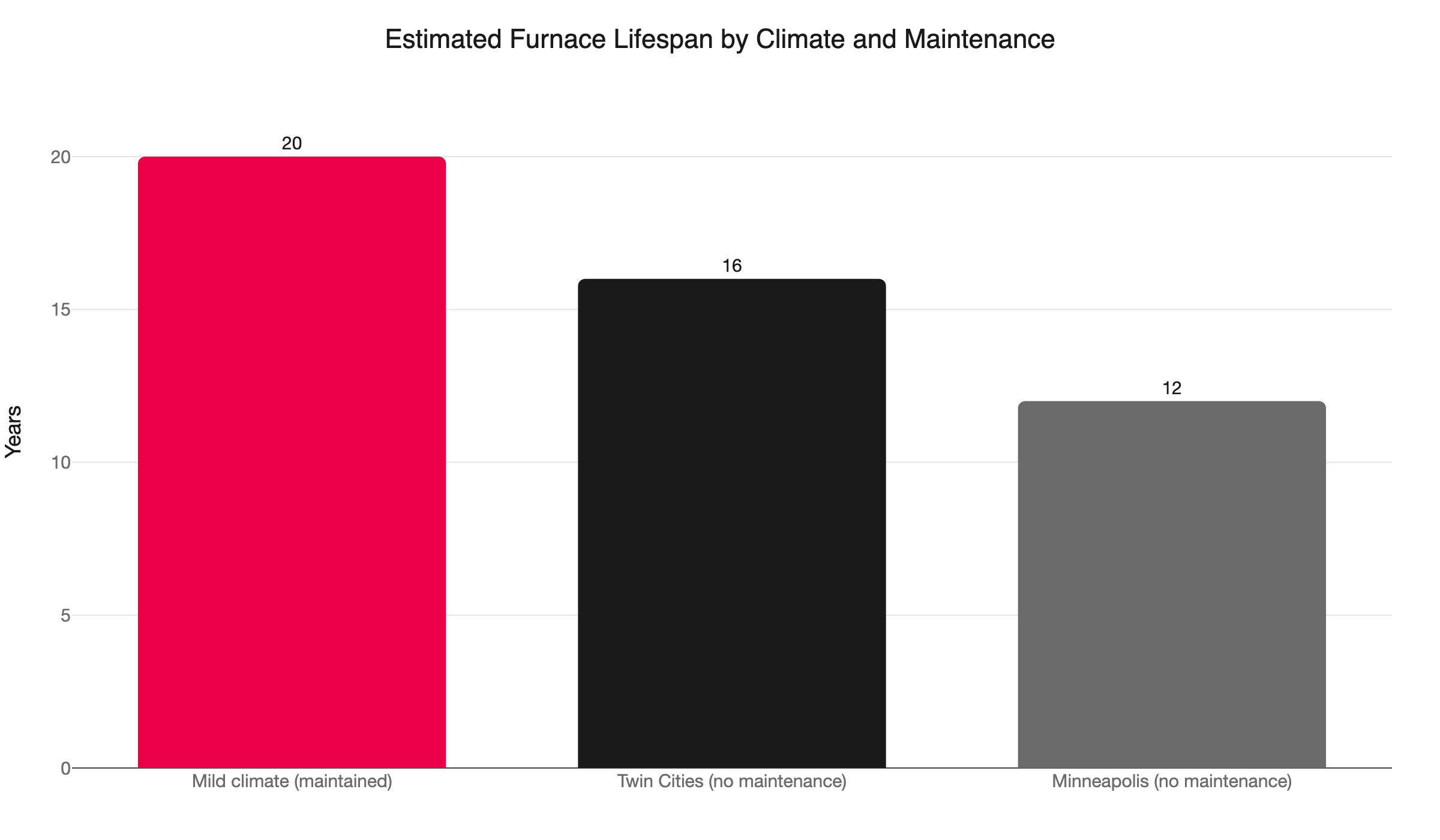
The lifespan numbers make the stakes concrete. A well-maintained furnace in a mild climate can last 20 years. Without proper preventive maintenance, that same furnace barely makes 12 years in Minneapolis. Even with regular tune-ups, Twin Cities furnaces typically run 15 to 17 years before replacement becomes the right call.
These are not manufacturer disclaimers. They are the result of a climate that does to furnaces what it does to roads, pipes, and building foundations. The freeze-thaw cycle wears metal down.
If your furnace is 15 years or older and you are smelling gas, the repair conversation and the replacement conversation are the same conversation. A technician can give you an honest read on which path makes more sense, without pressure. If a replacement is the right call, financing options are available to spread that cost over time.
How can I reduce the risk of a gas leak from my furnace?
Annual professional maintenance is the single most effective step. A technician inspects every component that can produce a gas odor: the heat exchanger, gas valve, flexible connector, flue, burners, and igniter. Catching a failing part before it leaks is always cheaper than an emergency repair.
Here is a practical checklist for Twin Cities homeowners:
- Schedule a fall tune-up every year. Our furnace tune-up service includes a full combustion safety check, heat exchanger inspection, and flue evaluation.
- Replace an aging furnace before it fails. In Minnesota, a furnace past its mid-teens carries real heat-exchanger risk. Waiting for a failure in January is the most expensive outcome.
- Install and test both CO detectors and gas detectors. Know each device’s expiration date and replace before it passes.
- Save your utility’s emergency number in your phone today. CenterPoint: 612-372-5050. Xcel Energy: 1-800-895-2999. Both should be in your contacts before you ever need them.
- Know what a normal first-startup smell looks like. Dust burn-off at the first fall ignition is normal. Gas odor on any other cycle is not.
One thing worth saying plainly: a gas leak is not a DIY situation under any circumstances. If a technician finds a cracked heat exchanger or a failed gas valve during a tune-up, the furnace should not run again until the problem is resolved.
Get a furnace inspection before the next cold snap
If you smelled gas near your furnace recently, the right next step is a professional inspection. Not a visual check, a full diagnostic with combustion testing, heat exchanger evaluation, and a gas valve assessment.
Northern One Hour is locally owned and operated in Ramsey, MN. We serve homeowners across Minneapolis, St. Paul, Blaine, Maple Grove, Plymouth, Brooklyn Park, Woodbury, Bloomington, and the surrounding Twin Cities metro. We are backed by the resources of the national One Hour franchise, and we are your neighbors.
Every visit is backed by the “Always On Time… Or You Don’t Pay a Dime!(R)” guarantee. We show up when we say we will, and we give you a straight answer on what we find, including when the honest answer is that your furnace is past the point where repair makes sense.
Call (763) 260-6662 or book online to schedule your inspection. If this season’s cold has you wondering whether your furnace is safe to keep running, have that conversation before the next Minnesota cold front arrives.
Frequently Asked Questions
What should I do if I smell gas near my furnace? +
Will my CO detector alert me to a gas leak? +
What furnace part most often causes a gas smell? +
Is a gas smell at first fall startup normal? +
Need a technician now?