
Furnace Pilot Light Keeps Going Out: A Diagnostic Guide
Key Takeaways
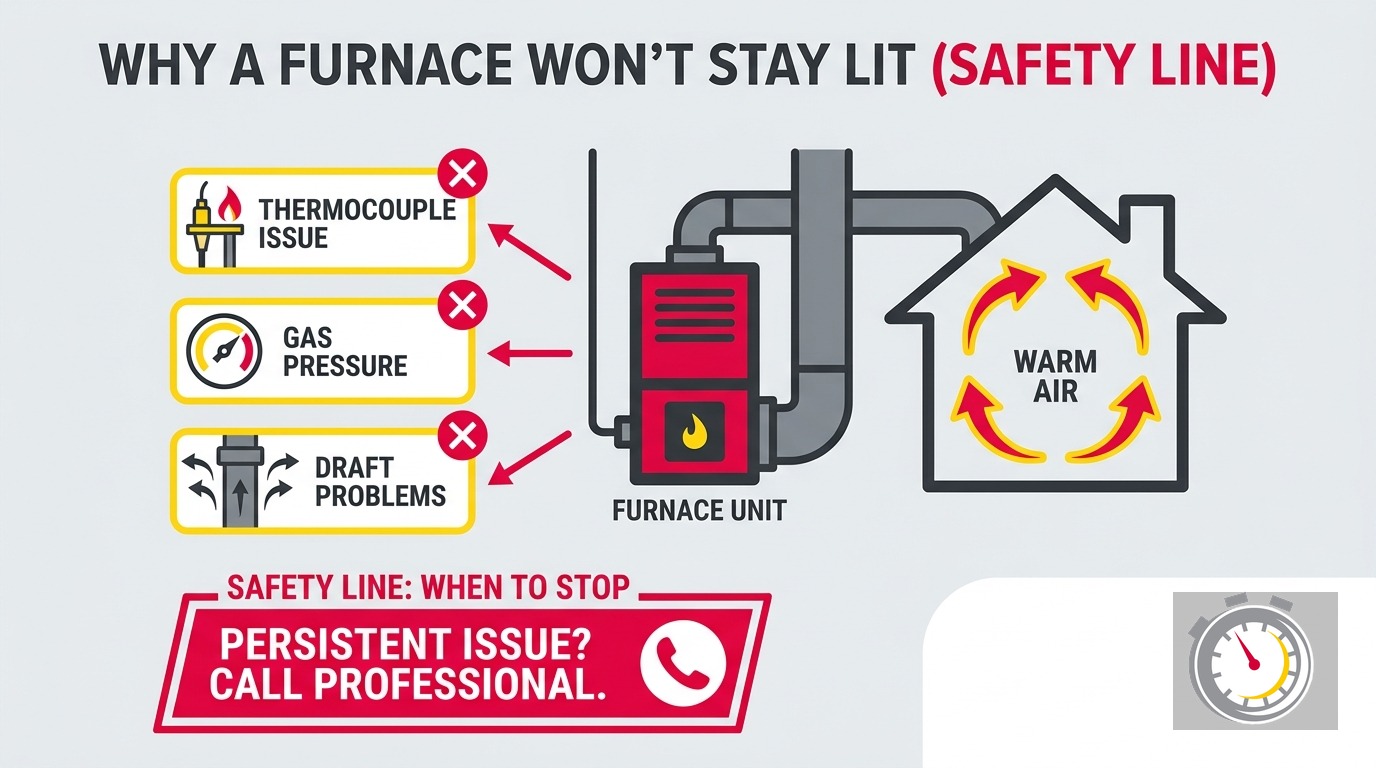
- A furnace pilot light that keeps going out most often points to a failing thermocouple, a clogged pilot orifice, negative air pressure, or low gas supply pressure.
- Furnaces built before roughly 1990-1995 have a standing pilot. Newer furnaces use electronic ignition and have no standing pilot at all.
- A healthy pilot flame burns steady and blue. Yellow, orange, or a dancing flame signals a problem.
- A thermocouple reading below 15 mV on an open-circuit test is failing and needs replacement.
- Minnesota homes are especially prone to negative-pressure pilot outages during extreme cold.
- Stop relighting after two or three failed attempts. If the pilot won’t hold, something mechanical is wrong.
- If your furnace is old enough to have a standing pilot, it may qualify for $400-$1,200 in Minnesota rebates toward a high-efficiency replacement.
Do You Have a Standing Pilot or an Electronic Ignition Furnace?
Short answer: Furnaces built before roughly 1990-1995 have a standing pilot, a small flame that burns all the time. Furnaces built after that era use an electronic ignition device and have no standing pilot. The two systems fail differently. Knowing which one you have is the starting point for any diagnosis.
This distinction matters more than most homeowners realize. When someone types “furnace pilot light keeps going out,” they may be describing either a standing-pilot system or an intermittent ignition device (IID) system. The repair path is different for each.
Standing-pilot furnaces burn a small flame 24 hours a day, 365 days a year. That flame heats a metal probe called a thermocouple. The thermocouple generates a small electrical signal, typically 25-30 millivolts when healthy. That signal holds the gas valve open. When the flame goes out, the signal drops. The valve closes automatically within 90 seconds. Gas cuts off to both the pilot and the main burner. This is the 100% safety shutoff built into every standing-pilot system.
If your furnace was installed before roughly 1990-1995, it almost certainly has a standing pilot. When the furnace is idle, look near the burner assembly. You should see a small blue flame burning continuously.
IID furnaces have no standing pilot. When the thermostat calls for heat, an electronic spark or hot-surface igniter lights the burner directly. These systems use a flame sensor on a microamp circuit. They do not use a millivolt thermocouple. If your furnace is from the mid-1990s or later and you see no flame when it is idle, you have an IID.
The repair path differs by system type:
- Standing pilot won’t stay lit: check the thermocouple, pilot orifice, gas pressure, and combustion air supply.
- IID furnace won’t light: check the flame sensor, igniter, control board, and gas valve.
This guide focuses on standing-pilot systems. If your furnace has an IID and is failing to light, our team can diagnose it on the same visit.
Why Your Furnace Pilot Light Keeps Going Out
Most pilot outages trace back to one of six causes. We see all of them across Twin Cities homes.
- A worn or dirty thermocouple (the most common cause)
- A clogged or misaligned pilot orifice
- Negative air pressure in the utility room
- Low gas supply pressure
- Draft disruption from a cracked heat exchanger
- An aging furnace that is past its useful life
The sections below cover each one: what to look for, what you can check yourself, and what requires a technician.
Is Your Thermocouple Worn Out?
Short answer: A thermocouple reading below 15 mV open-circuit is failing and needs replacement. Most gas valves drop out below about 10 mV. If the pilot lights when you hold the button and goes out the moment you release it, the thermocouple is the first thing to check.
The thermocouple sits in the pilot flame and generates the millivolt signal that holds the gas valve open. A healthy thermocouple produces 25-30 mV open-circuit. Under load, connected to the gas valve, that drops to 12-15 mV. The gas valve stays open as long as the signal holds above its dropout threshold, typically around 10 mV.
As the thermocouple ages, the tip corrodes and millivolt output falls. When output drops below the dropout threshold, the valve closes. The pilot goes out. You relight it. It goes out again. That cycle is one of the most common calls we get during Minnesota winters.
A technician tests millivolt output in minutes with a multimeter. A visual inspection alone will not give you a reliable answer.
What you can observe at home:
- Is the thermocouple tip sitting directly inside the hottest part of the flame? Even a slight shift in position reduces heat transfer.
- Does the flame fully surround the tip? The tip should be engulfed, not positioned beside the flame.
- Is there visible soot or corrosion on the tip? That points to an oxygen-starved or dirty flame.
Do not try to bend the thermocouple back into position by hand or sand the tip. Those are shortcuts that do not address the underlying failure. A replacement thermocouple is an inexpensive repair that a technician can complete in a single visit.
What Does a Healthy Pilot Flame Look Like?
Short answer: A healthy pilot flame is steady and blue with a small, defined inner cone. Yellow or orange means incomplete combustion, often from a clogged orifice or low gas pressure. A dancing or split flame points to a draft or pressure problem inside the utility room.
Flame color and stability tell you a lot before any instruments come out.
- Steady blue with a defined inner cone: Good. Combustion is clean and the fuel-to-air ratio is right.
- Yellow or orange: Incomplete combustion. The orifice may be partially clogged, or gas pressure is low. The thermocouple will not heat evenly.
- Flickering or dancing (not caused by opening a door): A pressure or draft problem in the utility room.
- Split flame, two tips instead of one: Often a partially blocked orifice. The flame is not focused on the thermocouple tip.
The pilot orifice is a small brass fitting with a tiny drilled hole. Dust, rust, and mineral debris can partially block it over decades of use. When that happens, the flame is weak, asymmetrical, or discolored. Cleaning or replacing the orifice requires disassembling part of the gas assembly. Do not attempt this while gas is flowing.
Is Negative Air Pressure Killing Your Pilot?
Short answer: If the utility room operates under negative pressure, the pilot flame can be pushed off the thermocouple tip or starved of combustion air. This is one of the most overlooked causes in tight Minnesota homes, especially during extreme cold or when multiple exhaust fans run at the same time.
Minnesota winters create a powerful stack effect. Warm air rises and exits through the upper floors and attic. Cold replacement air tries to enter at the lower levels. In a tightly sealed home, the utility room can end up operating under negative pressure. Air pressure inside falls below the pressure outside.
Research specific to Minneapolis homes identifies kitchen and bath exhaust fans as a significant depressurization source during furnace operation. Running those fans while the furnace is on can starve the pilot of combustion air. The Minnesota Fuel Gas Code requires pilot flames to be adequately protected from drafts and prohibits outage during normal on/off cycling.
A quick field test you can do right now: Crack a window 2-3 inches near the furnace. Hold a tissue to the gap. If air rushes inward, the space is under negative pressure. That depressurization is likely disturbing your pilot.
Other contributing factors common in Minnesota homes:
- Whole-home exhaust fans running simultaneously with the furnace
- A utility room with no dedicated combustion air intake
- A tightly sealed house envelope with few natural air infiltration paths
Repeatedly relighting the pilot does not solve a pressure problem. The fix is usually a dedicated combustion air intake duct. A technician will assess whether your system meets Minnesota’s requirements.
What About Low Gas Pressure?
Short answer: Low gas pressure produces a small, unstable pilot flame that cannot fully heat the thermocouple tip. That leads to low millivolt output and a gas valve that closes. The symptoms look identical to a failing thermocouple. Gas pressure testing requires a technician with a manometer.
Natural gas manifold pressure is typically 3.5 inches water column (W.C.). Inlet supply should fall between 5 and 7 inches W.C. The Minnesota Fuel Gas Code requires burner input to be set within plus or minus 2% of the manufacturer’s nameplate manifold pressure.
When supply pressure falls outside that range, the flame shrinks. A small flame means less heat on the thermocouple tip. Less heat means lower millivolt output. The valve closes. The pilot goes out.
A technician will check both inlet pressure at the gas valve and manifold pressure at the burner. Low supply pressure may point to a problem with the utility’s supply line, the regulator at the meter, or a partially closed shutoff valve on the gas line.
One thing you can check yourself: Confirm the shutoff valve on the gas line to the furnace is fully open. The handle should run parallel to the pipe. If it sits at a right angle to the pipe, the valve is closed or partially closed.
Are There Other Causes?
Short answer: Yes. A cracked heat exchanger can disrupt combustion airflow and disturb the pilot flame. A failing gas valve is possible but less common. Sometimes the honest answer is age: a furnace old enough to have a standing pilot is at minimum 30 years old and may be failing in multiple places at once.
A cracked heat exchanger changes the pressure and airflow inside the heat section. Combustion gases leaking through a crack disturb the flame. If a technician finds a cracked heat exchanger, the furnace must be shut down. This is a carbon monoxide risk, not a comfort issue. Our post on signs of a cracked heat exchanger in Minnesota homes covers what to watch for between now and your service appointment.
A failing gas valve is a less common finding. If the thermocouple, orifice, gas pressure, and combustion air all check out and the pilot still won’t hold, the gas valve itself may be at fault. Gas valve replacement is a major repair. On a furnace that is already 30-plus years old, replacement is usually the better financial decision.
Age alone is a real diagnosis. A standing-pilot furnace is at minimum around 30 years old. At that age, components fail in sequence. Fixing one this November does not guarantee the next January goes smoothly.
When Should You Stop Relighting and Call a Pro?
Short answer: Stop after two or three attempts. If the pilot won’t hold, something mechanical is wrong. Relighting cannot fix a failing thermocouple, a blocked orifice, or a pressure problem. There is also a safety line, and knowing where it is matters.
Stop relighting and call a technician when:
- The pilot goes out immediately after you release the reset button
- The pilot holds for a few minutes and then goes out repeatedly
- You hear a thump or boom when the burner tries to light (delayed ignition is a danger sign)
- Your CO detector activates
Evacuate immediately and call 911 when:
- You smell gas strongly throughout the home, not just faintly near the furnace
- Your CO detector alarms and people in the home feel lightheaded, nauseated, or confused
A faint gas smell near the furnace during a relighting attempt is expected and temporary. A gas smell filling your living space is not. Do not try to investigate the source. Get everyone out and call 911.
For a deeper look at carbon monoxide risks during furnace season, our post on carbon monoxide safety and your furnace explains what CO exposure looks like and how to respond before our team arrives.
Should You Repair or Replace?
Short answer: A thermocouple replacement on an otherwise sound furnace makes sense. On a furnace that is 25-35 years old with a standing pilot, the better question may be whether this repair is really the last one. In 2026, Minnesota rebates make replacement more affordable than it has been in years.
Here is a number worth knowing. A standing pilot burns 500-1,000 BTU per hour, every hour, all year long, including all summer. At Minnesota natural gas rates, that adds up to roughly $50-130 per year in gas spent on a flame that heats nothing in your home. That cost runs every year, regardless of how often you use the furnace.
A 95%+ AFUE furnace eliminates the standing pilot entirely. It also heats your home with far less fuel per unit of output. The efficiency gap between a 60-70% AFUE furnace from the early 1990s and a modern 95%+ system is not small. And the replace-versus-repair math shifts significantly when you account for what Minnesota is offering in 2026.
Current rebate and incentive programs:
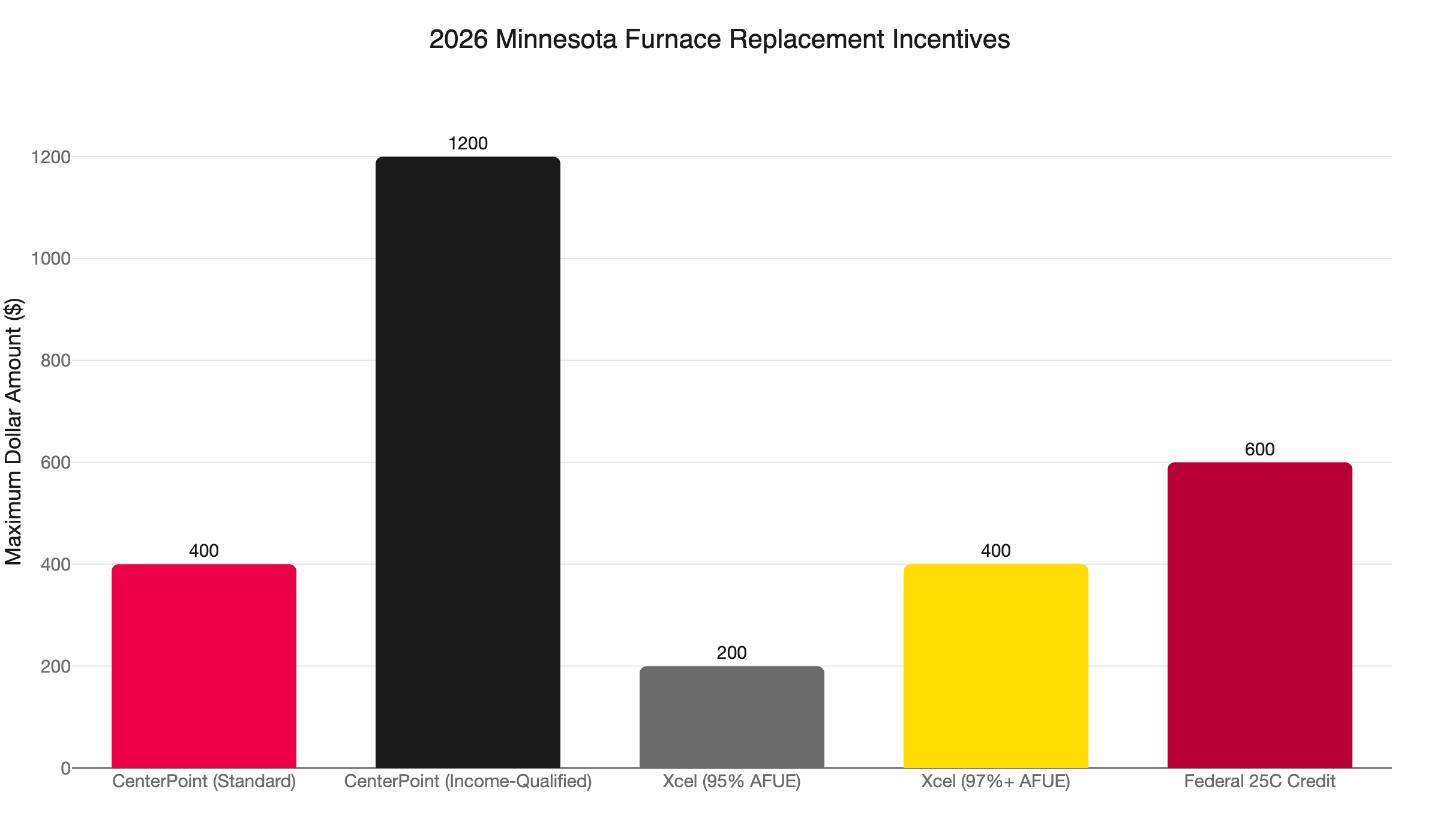
- CenterPoint Energy: up to $400 on a 95%+ AFUE furnace, or up to $1,200 for income-qualified households
- Xcel Energy: $200-$400 depending on efficiency tier (95% through 97%+)
- Federal 25C Energy Efficient Home Improvement Credit: 30% of equipment and installation cost, up to $600
These incentives stack. A qualifying replacement can net $1,000 or more in combined rebates and tax credits. That changes the math for a lot of homeowners who are looking at another repair on a system that is already aging out.
Our post on furnace replacement costs in the Twin Cities breaks down what to budget and how to evaluate the repair-versus-replace decision. If you are ready to explore your options, our furnace replacements page walks through our process and what to expect from start to finish.
We do not push replacement when a repair is the right call. We give you a straight answer and let you decide.
What to Expect When You Call Northern One Hour
We are locally owned and operated in Ramsey, MN. When you call about a pilot that won’t stay lit, here is what to expect.
We schedule a firm appointment window and show up when we say we will. That commitment is the foundation of “Always On Time… Or You Don’t Pay a Dime!(R).” It is not a line on a truck. It is how we run every job.
A technician arrives with the tools to test millivolt output, gas pressure, combustion air supply, and draft conditions in the utility room. We diagnose the root cause and give you a clear answer: what is wrong, what it costs to fix, and whether replacement makes more financial sense given the age of the system.
If the repair is a thermocouple replacement or an orifice cleaning, we can usually complete it the same visit. If the diagnosis points toward replacement, we walk you through the rebate math before you commit to anything. Our 100% satisfaction guarantee covers every visit.
Call (763) 260-6662 or book online to schedule service. We serve Minneapolis, St. Paul, Ramsey, Blaine, Maple Grove, Plymouth, Brooklyn Park, Woodbury, Bloomington, and the surrounding Twin Cities area.
Frequently Asked Questions
How do I know if I have a standing pilot or an electronic ignition furnace? +
How many times should I try relighting my pilot before calling a technician? +
What Minnesota rebates are available for replacing an old furnace in 2026? +
Need a technician now?