
Furnace Won't Ignite on Cold Mornings? Minnesota Fixes
Key Takeaways
- A furnace that won’t ignite on a cold morning often has a blocked or frozen part, not a dead furnace.
- Every start follows a set order: inducer, pressure switch, igniter, then gas valve. A failure at any step stops the heat.
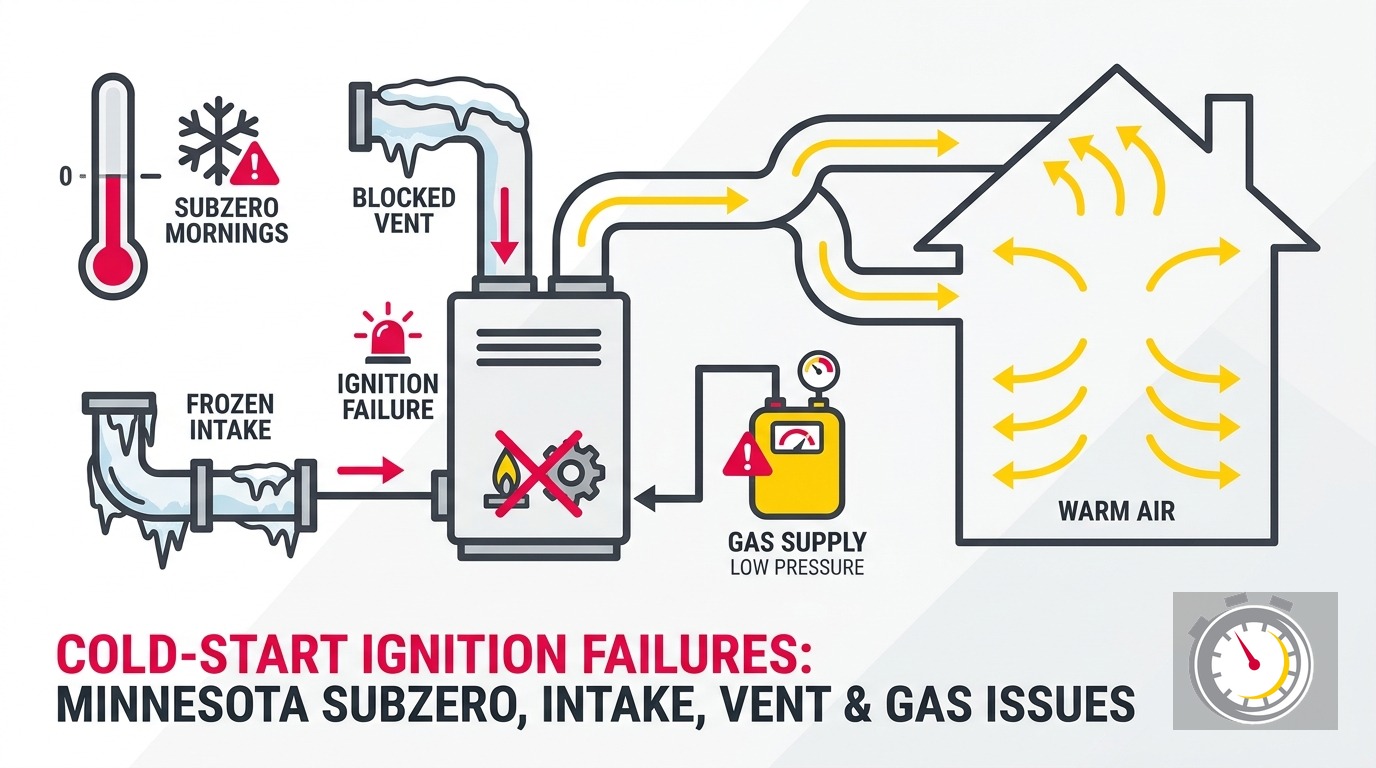
- Frozen intake pipes, vent pipes, and condensate traps can stop step one or two on the coldest morning, then clear by afternoon.
- A frozen gas meter vent is a utility-side problem. Never chip at the meter with a hard object.
- You can safely check the thermostat, the filter, the power switch, and snow around outdoor pipes.
- If you smell gas or your CO alarm sounds, leave the house and call for help.
- Northern One Hour is locally owned and operated. Our on-time promise covers the arrival window you pick.
Why does my furnace not start on the coldest mornings?
A furnace may fail to start on a subzero morning because something in its start sequence is blocked, frozen, or worn. Common causes are an iced-over vent or intake pipe, a frozen condensate trap, a weak igniter, a dirty sensor, or ice on the gas meter. Each one shows a different symptom.
Cold is hard on a furnace. It freezes moisture and raises demand on every part.
A furnace that works fine in October can fail in January. The part may have been weak for months, and the first deep freeze exposes it.
You wake up to a cold house. The thermostat calls for heat, but nothing happens. Or the furnace tries, clicks, and quits.
We serve homeowners across the Twin Cities, so the causes below are the ones we see in Minnesota winters. They come in the order a furnace meets them, and each comes with the checks that are safe for you to do.
What happens in the first minute of a cold start?
A modern gas furnace starts in a fixed order. The inducer fan runs first to clear the vent. A pressure switch confirms airflow. Then the igniter heats, the gas valve opens, and the burners light. If any step fails, the furnace stops and tries again or locks out.
Knowing this order helps you read the symptoms. These steps are general industry mechanics, so your model may differ. Here is the usual sequence:
- The thermostat calls for heat.
- The control board starts the draft inducer motor.
- The inducer pulls air through the furnace and pushes exhaust out the vent.
- The pressure switch senses that airflow and closes.
- The igniter heats up and glows.
- The gas valve opens, and the burners light.
- A flame sensor confirms the flame is steady.
- The blower starts after the heat exchanger warms up.
The control board acts as the referee. It will not move to the next step until the last one checks out. That is a safety feature.
Now picture a frozen vent. The inducer runs, but air cannot move freely. The pressure switch never closes. The board waits, then shuts down. The igniter never even tries.
That is why a furnace can run fine at 3 p.m. and fail at 6 a.m. Sun and daytime warmth melt ice. The overnight cold rebuilds it.
To see how this one part fails, read our guide to pressure switch failure symptoms.
Can a frozen intake or vent pipe stop the furnace?
Yes. A high-efficiency furnace pulls combustion air in through one pipe and sends exhaust out another. Frost, ice, or drifted snow can block either pipe. When airflow stops, the pressure switch stays open and the furnace will not light.
The U.S. Department of Energy explains the design. Direct-vent appliances bring “combustion air directly from outdoors to the sealed combustion chamber” and exhaust through a second sealed pipe. The same page says condensing furnaces are known as Category 4 appliances. It also lists their AFUE ratings as 90% to 98%.
That design saves fuel. It also runs two pipes through your wall into the cold.
Exhaust from a condensing furnace is cool and full of moisture. In subzero air, that moisture can freeze at the pipe end. Ice grows a little each cycle and can eventually narrow the opening.
Signs of a vent or intake problem:
- The inducer runs, but you never hear a click or see a flame.
- The furnace starts, runs briefly, then shuts off.
- You see frost or an ice build-up at the outdoor pipe ends.
- The problem clears by afternoon and returns the next cold morning.
- Snow has drifted against the wall where the pipes exit.
Wind makes it worse. A drift can bury a low pipe overnight. A downspout or roof valley can also dump snow and meltwater on the pipe area.
What you can do safely
You can look at the pipes from outside. Clear loose snow from around the openings with a broom or a gloved hand. Do not poke inside the pipe. Do not use a hot flame or a pry bar.
If the pipe is iced shut, call us. Ice often points to a slope, length, or termination issue that will return. A technician can fix the cause of the ice.
For more detail, see our post on a high-efficiency furnace exhaust vent blocked by snow and ice.
Why code matters here
Venting is not a DIY design job. Minnesota Rules Chapter 1346 is titled the “Minnesota Mechanical and Fuel Gas Codes” and is issued by the Department of Labor and Industry. Venting of appliances appears in part 1346.5503. Combustion air appears in 1346.5304.
We are not quoting an edition year, because the page does not state one. Vent routes, slopes, and clearances follow rules, and a pipe that ices up every winter may break one of them.
Can a frozen condensate drain keep the furnace from lighting?
Yes, it can. A condensing furnace makes water as it burns gas. That water leaves through a trap and a drain line. If the trap or line freezes, water backs up, and a safety switch can stop the burners from lighting.
This is common in basements and utility rooms that run cold. It is also common where the drain line runs along an exterior wall or through an unheated space.
Typical signs include:
- The inducer starts, but the furnace shuts down before lighting.
- You see water near the furnace or a full trap.
- The furnace lights after the room warms up for a while.
- A drain pipe feels hard or looks frosted.
A frozen drain is a symptom of a cold path. Heat tape, better slope, or rerouting may fix it. Thawing the line alone will not stop the next freeze.
If you see water around the furnace, shut off the power switch and call us. Our post on a frozen high-efficiency furnace condensate drain shows what the fix usually involves.
Could the gas meter be the problem?
Yes. Your gas meter has a regulator vent. If snow or ice blocks that vent, gas pressure to your home can drop or act oddly. Your furnace may then fail to light, or other gas appliances may act up too. This is a utility-side problem.
It matters in Minnesota because snow and freezing rain pile up on meters.
A news article quoting CenterPoint says the meter vent “must not be blocked by snow or ice to work properly”. The article advises using a broom or brush on the top of the meter and piping. It warns against snowblowers. It also says never to strike the meter or piping with a hard object.
That last point matters most. Do not chip ice off the meter. You could damage the regulator or a gas line.
The same article says to call the gas utility if the meter is coated in ice, sits below a downspout or roof valley, or is not fully covered by the eaves. It lists 800-296-9815. That article dates to March 2020, so check your gas bill for the current number.
A gas supply problem looks different from a furnace fault:
- Your gas range or water heater also acts strange.
- The furnace sounds normal, but the burners never light.
- The meter is buried, glazed in ice, or under a dripping gutter.
- The problem began after heavy snow or freezing rain.
If you smell gas at any point, do not troubleshoot. Leave the home and call from outside. Our guide on what to do about a gas smell near your furnace covers the steps.
For ice at the meter, read our post on a frozen gas meter regulator that shuts off your furnace. It explains who to call and what to expect.
What does each symptom tell you?
Your symptom points to the failed step. “Inducer runs, no click” suggests an airflow or pressure switch problem. “Clicks, no flame” suggests an igniter, gas valve, or gas supply issue. “Nothing at all” suggests power, a switch, a tripped safety, or the control board.
Use this triage list. It is general guidance, since models vary.
Inducer runs, but nothing else happens
- Likely step: the pressure switch will not close.
- Common causes: frozen or blocked vent or intake, a failing inducer, a clogged condensate trap, or a faulty switch.
- Safe checks: look at the outdoor pipes and clear loose snow. Check for water at the furnace.
- Call a technician if: the pipes are iced or the problem repeats.
You hear clicking, but no flame appears
- Likely step: ignition or gas.
- Common causes: a cracked or weak igniter, a failing gas valve, a gas supply problem, or a dirty sensor.
- Safe checks: look at the meter for ice or snow burial. Do not touch the meter with tools.
- Call a technician if: the furnace clicks and quits more than once.
The burners light, then shut off in seconds
- Likely step: flame proof.
- Common causes: a dirty flame sensor, a weak ground, or poor airflow.
- Safe checks: replace a dirty filter if you find one.
- Call a technician if: the cycle repeats. Our guide to a dirty flame sensor and cleaning cost explains this fix.
Nothing happens at all
- Likely step: power or the control board.
- Common causes: a tripped breaker, an off switch, a blown fuse on the board, a failed board, or a thermostat issue.
- Safe checks: confirm the thermostat is set to heat. Check the furnace switch. Check the breaker.
- Call a technician if: power is on but nothing responds.
Many furnaces have a blinking status light that can name the fault. Our furnace error codes and blinking light guide helps you read it.
Is the igniter the cause?
Often, yes. The igniter is a heating element that glows hot enough to light the gas. It is brittle, and it cycles on and off thousands of times. Cold air and vibration make a weakened one fail first.
A failing igniter has a few signs:
- It glows dim, or it never glows.
- You hear the inducer, then silence, then a retry.
- The furnace works some mornings and not others.
- The igniter shows a visible crack.
Some igniters weaken for weeks before they quit. A cold morning is just when the weakness shows. That feels random to a homeowner, but a technician sees a pattern.
Our post on furnace igniter failure signs and replacement cost walks through how to tell an igniter from a flame sensor. Read it if your furnace clicks but never lights.
Igniter and flame sensor service falls in a typical range of $95 to $325 in the Twin Cities. Your final price depends on the model and the part.
What can you safely check yourself?
You can safely check the thermostat, the power switch, the breaker, the air filter, and the outdoor pipes. Stop there. Do not open the burner area, bend wires, or touch the gas valve. Anything involving gas, combustion, or electrical parts belongs to a licensed technician.
Run this short checklist before you call:
- Thermostat: Set it to heat. Raise the setpoint a few degrees above room temperature. Replace dead batteries if it uses them.
- Furnace switch: Many furnaces have a light-switch style power switch near the unit. Make sure it is on.
- Breaker: Check the breaker for the furnace. Reset it once if tripped. If it trips again, stop.
- Filter: A clogged filter can trip safety limits. Swap in a clean one.
- Outdoor pipes: Look for snow, drifts, or ice at the intake and exhaust. Clear loose snow gently.
- Gas meter: Look, do not touch. If it is iced over, call the gas utility.
- Water near the furnace: If you see any, turn off power and call us.
Do not repeatedly reset the furnace. Each failed start sends more unburned gas through the system. One or two retries is fine. After that, wait and call.
Never bypass a safety switch either. The furnace may run, but you lose the protection those switches provide.
For a longer walk-through, see our furnace not turning on troubleshooting guide.
Is a furnace that won’t start an emergency?
It can be. A furnace that won’t start on a subzero night is urgent because your home loses heat and pipes can freeze. A gas smell or CO alarm is always an emergency. Leave the home and call 911 or your gas utility from outside.
Think of it in two tiers.
Call right away if:
- You smell gas, or hear a hiss near the furnace or meter.
- A carbon monoxide alarm sounds.
- Anyone in the home has headache, nausea, or dizziness that eases outdoors.
- You see scorch marks, smoke, or flames near the furnace.
- Indoor temperatures are falling and the forecast is subzero.
Call the same day if:
- The furnace cycles on and off without producing steady heat.
- You find water leaking at the furnace.
- The furnace works only after you reset it.
If your home gets cold, protect it while you wait. Close doors to unused rooms. Open cabinet doors under sinks on exterior walls. Let faucets drip a little if pipes are at risk.
Never use an oven or a grill to heat your home. That adds a carbon monoxide risk.
Our emergency steps for a furnace out tonight lay out what to do hour by hour.
After-hours help usually carries an extra charge. Emergency premiums run $180 to $270 per hour on top of standard rates. We will tell you before we start.
What does carbon monoxide safety look like in Minnesota?
Minnesota law requires an approved, working CO alarm within ten feet of each sleeping area. Furnaces burn fuel, so they can produce carbon monoxide if venting fails. A cold-start problem is a good time to check your alarms and your vent system.
Minnesota statute 299F.51 requires an approved, operational CO alarm “within ten feet of each room lawfully used for sleeping purposes”. A first violation brings a safety warning, not a fine.
Furnaces are one of several sources. MPR News reports that carbon monoxide “can be emitted by anything burning with a flame, such as stoves, furnaces and water heaters”. The same article says a technician should check fuel-burning appliances once a year for proper venting. It adds that most CO alarms need replacing every five to seven years.
Why does this tie to cold starts? A blocked vent is a venting problem. A furnace that struggles to start may also struggle to exhaust. Do not assume the safety switches will cover every case.
Use this short CO checklist each fall:
- Test every alarm. Replace any that are past their service life.
- Place an alarm within ten feet of each bedroom door.
- Keep outdoor vent pipes clear of snow all winter.
- Book a yearly check of every fuel-burning appliance.
- Never run a generator or car in an attached garage.
Our guide to carbon monoxide safety in furnace season goes deeper on alarms and placement.
What will a repair cost?
Costs depend on the fault. These are our Twin Cities ranges, installed with parts and labor. Your exact price depends on the model and the part.
| Repair | Typical range |
|---|---|
| Flame sensor or igniter service | $95-$325 |
| Draft inducer motor | $375-$900 |
| Brand-specific inducer motor | $500-$1,650 |
| Control board, installed | About $750 |
| Single tune-up visit | $95-$250 |
A frozen vent or drain often costs less than a part. The fix may be a reroute, a termination change, or heat tape. We will give you the price before we start work.
If your furnace is old and fails often, ask about replacement. A furnace replacement in the Twin Cities typically runs $3,900 to $7,800 installed. Higher-efficiency models cost more. We offer financing for larger jobs, so ask when you call.
Repair or replace is a real question. Many homeowners wait until a cold snap forces it, which is the worst time to shop. If your furnace keeps failing, price the options on a mild day.
How do you prevent cold-start failures?
Prevent cold-start failures with a fall tune-up, clear outdoor pipes, a clean filter, and a quick look at the gas meter after storms. A technician can test the igniter, sensor, inducer, and pressure switch before they fail on a freezing morning.
A tune-up is the best defense. It finds weak parts while the weather is mild. It also checks the vent and drain for ice-prone spots.
Here is a prevention plan for Twin Cities homeowners:
Early fall
- Book a furnace tune-up.
- Replace the filter.
- Test CO alarms and replace old ones.
- Look at the vent and intake pipes for damage or sagging.
After each snowstorm
- Brush snow away from the intake and exhaust pipes.
- Brush snow off the gas meter with a broom. Do not use a snowblower near it.
- Check for drifts against the wall.
On subzero days
- Keep the thermostat steady. Big setbacks make the furnace work harder.
- Keep the area around the furnace clear.
- Listen for new sounds on startup.
For what a visit includes, see our furnace tune-up cost guide for Minnesota. A single tune-up visit usually falls between $95 and $250. An annual maintenance plan runs $195 to $390.
Our furnace tune-up service covers the checks that matter most before winter. We test the ignition parts, inspect the vent path, and look at the condensate system.
If your furnace already fails, our furnace repair team can diagnose it fast.
Why choose a local team for a cold-morning failure?
When your furnace fails at 6 a.m., you need someone who shows up. Northern One Hour is locally owned and operated, and we serve homeowners across the Twin Cities. We know how Minnesota winters stress furnaces, vents, and gas meters.
We stand behind our timing. You pick an arrival window, and we arrive within it. If our technician does not show up on time, you do not pay for the service. That is our promise: “Always On Time… Or You Don’t Pay a Dime!(R)”
We also give you honest, upfront pricing. You hear the cause, the options, and the cost before work starts. We back our work with a 100% satisfaction guarantee.
We handle heating, cooling, indoor air quality, heat pumps, and thermostats. We do not do electrical or plumbing work. If your problem needs one of those trades, we will point you to the right sister company.
Get your heat back on
A furnace that won’t ignite on cold mornings is rarely random. Frozen pipes, a clogged trap, a worn igniter, or an iced meter can each break the chain.
Start with the safe checks and look outside. Stay away from the meter and the gas valve. If you smell gas or a CO alarm sounds, leave first and call from outside.
For everything else, call Northern One Hour at (763) 260-6662 or book online. Choose your window. We will arrive on time and find out why your furnace quit.
Frequently Asked Questions
What is the average lifespan of a furnace igniter? +
Where can I schedule a furnace tune-up before cold weather arrives? +
Need a technician now?