
Furnace Igniter Not Working: Igniter or Flame Sensor?
Key Takeaways
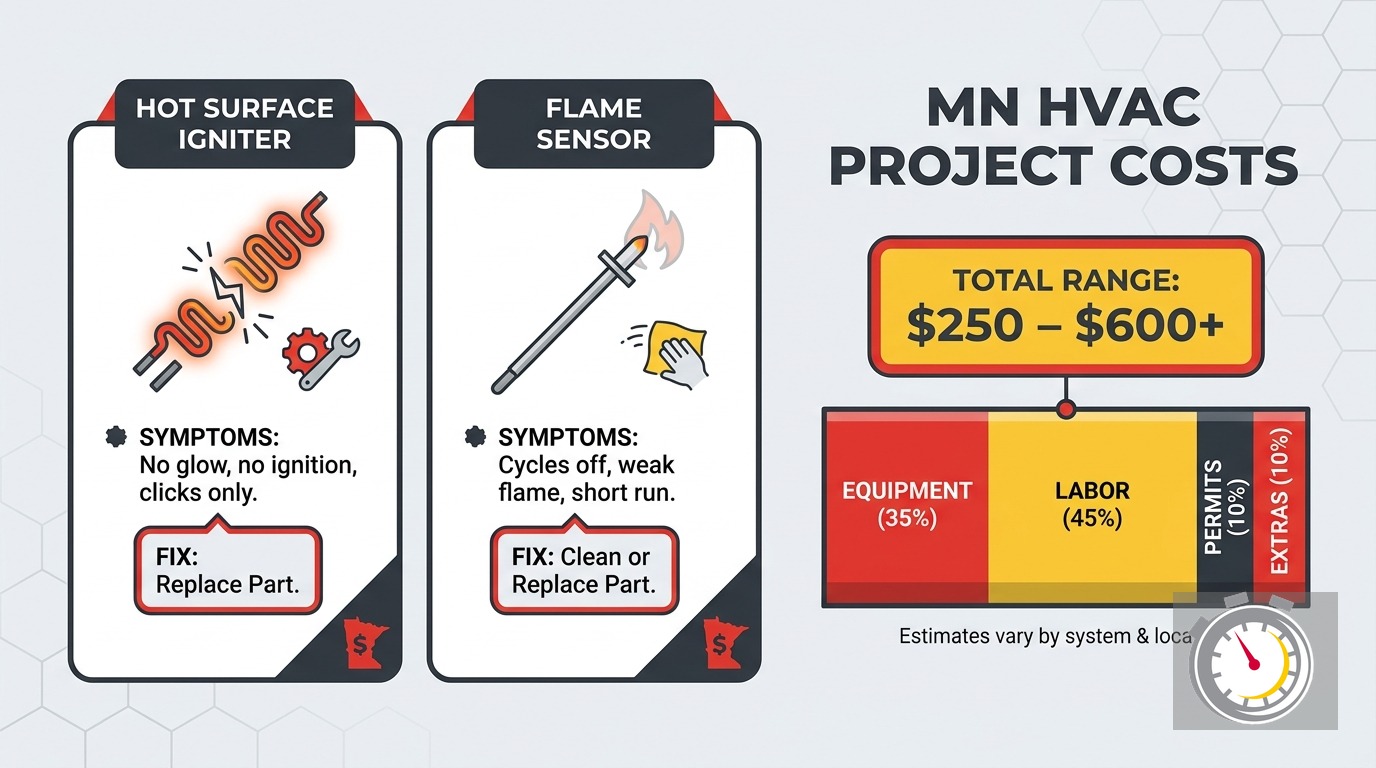
- Igniter failure: The furnace starts its sequence, no orange glow appears through the inspection window, and gas never lights.
- Flame sensor failure: The furnace fires and produces a visible flame, then shuts off within 5-30 seconds.
- A dirty flame sensor can often be cleaned for $0 in parts. A failed igniter must always be replaced.
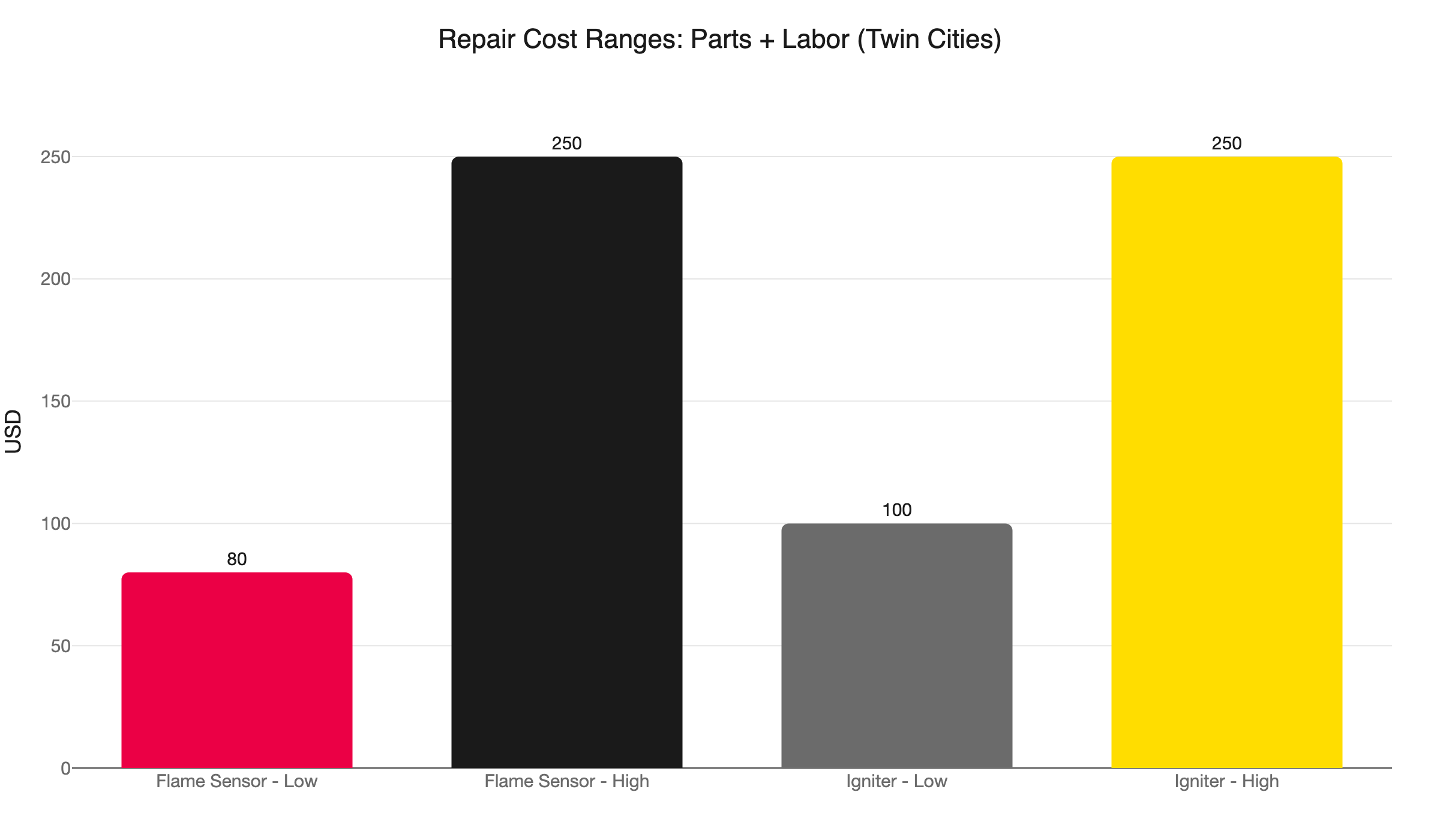
- Igniter replacement costs $100-$250 in the Twin Cities. Flame sensor repair runs $80-$250, but cleaning brings that down to labor-only.
- No mechanical permit is required for either repair in Minnesota. A licensed contractor is still required for any gas appliance work.
- If your furnace is 7 or more years old, replacing both parts on one visit is usually the smarter choice.
It is 9 p.m. on a January night in the Twin Cities. The wind chill is -10°F. Your thermostat clicked, the furnace started its cycle, and then nothing happened. No warm air. Or worse: the furnace fired, you felt one brief moment of relief, and then it shut off 30 seconds later. It tried again. Same result. After three attempts, the control board locked out and the house started cooling.
If you searched “furnace igniter not working,” the igniter may not actually be the problem. A dirty or failing flame sensor produces nearly identical symptoms and is often the cheaper fix. These two parts sit at opposite ends of the burner assembly. They fail in different ways, and the symptoms are different enough to tell apart if you know what to look for. This guide separates the two failure patterns, explains what each repair involves, and gives you honest cost ranges for both in Minnesota.
How the Ignition Sequence Works
Understanding the sequence makes it easier to pinpoint where the failure is happening.
When your thermostat calls for heat, the draft inducer motor spins up first. It pulls combustion gases out of the heat exchanger and through the flue. A pressure switch confirms airflow is present. Then the hot surface igniter energizes and heats over 15-30 seconds. If you look through the small glass inspection window on the front of the furnace cabinet during startup, you should see an orange glow coming from the burner area. That glow means the igniter is working.
Once the igniter reaches temperature, the gas valve opens. The burners light. The flame sensor steps in next. It sits directly in the burner flame path and reads the tiny electrical current that a live flame generates. That current, measured in microamps, signals the control board: combustion is confirmed, keep the gas valve open. The blower motor starts, and warm air moves through your ducts.
Every step in that chain depends on the one before it. A cracked or burned-out igniter stops the sequence before gas ever reaches the burners: no glow, no gas, no flame, no heat. A dirty or failed flame sensor stops the sequence after ignition: the flame lights, the sensor fails to confirm combustion, and the gas valve closes within seconds.
What Is a Hot Surface Igniter?
A hot surface igniter is the electric element that heats to between 1,800 and 2,500°F to ignite your furnace’s gas burners. It sits at one end of the burner rack, must be replaced as a unit when it fails, and cannot be cleaned back to life.
The igniter does not produce a spark. It glows, like a thick resistor passing high current through a ceramic element. Most homeowners who look through the inspection window during startup see an orange-to-white glow and assume the furnace is operating normally. If that glow never appears during the ignition phase, the igniter is the first suspect.
Furnaces built before roughly 2010 typically use silicon carbide (SiC) igniters. These are dark gray, narrow, and brittle. Skin oil from bare hands can cause a hairline fracture that only shows up during the next thermal cycle. Newer furnaces use silicon nitride (Si3N4) igniters, which are cream or tan colored and more resistant to handling and repeated temperature cycling.
Silicon carbide igniters last roughly 3-7 years under normal operating conditions. For a Twin Cities home running the furnace from October through April, that range translates to 3-4 full heating seasons before the first failure becomes plausible. The seven-month Minnesota heating season puts more annual cycles on a furnace than most other U.S. markets. Silicon nitride elements last longer, but they are not indefinite.
What Is a Flame Sensor, and Where Does It Sit?
A flame sensor is a thin metal rod with a porcelain base, positioned directly in the burner flame path at the opposite end of the burner rack from the igniter. Its job is to confirm combustion is present after the gas valve opens.
The rod connects to the control board through a single wire lead. When a flame is burning, the rod conducts a tiny electrical current back to the board. The board reads that signal, confirms combustion, and keeps the gas valve open. The current involved is measured in microamps, far smaller than most components in the furnace handle. The sensor does not need to be powerful. It needs to be clean.
Carbon deposits and oxidation build up on the rod over time, especially in furnaces that have not been serviced in a year or more. A coated rod cannot conduct the confirmation signal at sufficient strength. The control board cannot tell the difference between “no flame” and “dirty sensor,” so it shuts the gas off as if combustion failed entirely. The furnace attempts the cycle again, fails again, and locks out after several tries.
This is the failure pattern that most often gets misidentified as an igniter problem.
Is It the Igniter or the Flame Sensor? How to Tell
Watch the burner inspection window during a startup attempt. If the furnace cycles but no glow and no flame appear, suspect the igniter. If the furnace lights and then dies within 5-30 seconds, suspect the flame sensor.
This is the question the top search results for “furnace igniter not working” consistently fail to answer. Here is the diagnostic fork.
Pattern 1: Furnace runs its cycle, no flame appears
Find the small glass inspection window on the front of the furnace cabinet. Start a heating cycle and watch the burner area during the ignition phase. If you see no orange glow, the igniter is almost certainly failed or cracked. Without confirmed igniter temperature, the gas valve stays closed. No gas means no flame. The control board logs an ignition-failure error and locks out after 1-3 failed attempts. Match the blinking LED pattern on your control board to the codes in our furnace error codes guide to confirm the fault.
Pattern 2: Furnace lights, then shuts off
If you see a flame appear, then watch the furnace die 5-30 seconds later, the igniter did its job. The problem is downstream. The flame sensor is failing to send a valid confirmation signal to the control board, so the board cuts the gas as a safety measure. The furnace may attempt this 1-3 more times before locking out. This is not an igniter problem. It is a flame sensor problem.
This same short-cycling symptom appears in several scenarios. Our guide to furnace short cycling causes and fixes walks through the full list.
Can You Clean a Flame Sensor Instead of Replacing It?
Yes. A flame sensor coated with carbon or oxidation can often be cleaned with fine emery cloth or steel wool. The cleaning restores conductivity to the rod and costs nothing in parts.
Here is the general procedure, for reference:
- Turn off power to the furnace at the breaker or service disconnect switch.
- Remove the combustion access panel from the furnace cabinet.
- Locate the flame sensor. It is the thin metal rod positioned in the burner flame path with a single wire connector.
- Remove the one mounting screw and disconnect the wire.
- Lightly abrade the metal rod with fine emery cloth or steel wool. Work only on the rod itself, not the porcelain insulator. Remove visible gray or white oxidation.
- Reinstall the sensor, reconnect the wire, and restore power. Test a full heating cycle.
This cleaning step is standard practice for both homeowners and technicians when short-cycling points to a dirty sensor. If you are not comfortable working near a gas appliance with the power off, skip ahead and call a technician directly.
If cleaning restores normal operation, note the root cause: carbon accumulates faster on furnaces that are overdue for service. A clean sensor on a neglected furnace will need cleaning again before the heating season ends. Annual maintenance visits include flame sensor inspection and cleaning as a standard step. Our post on cleaning a furnace flame sensor in Minnesota and what it costs covers the full service in more detail.
What Does It Cost to Repair a Flame Sensor in Minnesota?
Flame sensor repair runs $80-$250 in the Twin Cities for parts and labor combined. The part itself costs $7-$30. If cleaning solves the problem, you pay for labor only, not parts.
National repair data places flame sensor replacement at $80-$250 total. In the Minneapolis-St. Paul metro, licensed HVAC technicians bill $90-$150 per hour. A flame sensor cleaning or replacement is typically completed within the first hour of a service call, keeping the total toward the lower end of the range when the diagnosis is clean.
Ask when booking whether the diagnostic fee is credited against the repair cost if work is performed on the same visit. Most reputable Twin Cities HVAC companies apply it that way.
What Does Igniter Replacement Cost in Minnesota?
Igniter replacement runs $100-$250 in the Twin Cities for parts and labor. The part itself costs $15-$100, depending on whether a universal igniter fits your furnace model or you need an OEM-matched part.
National averages place igniter replacement at $100-$250 total, with labor making up the larger share. A universal silicon nitride igniter typically costs $15-$35. An OEM part matched to your furnace brand and model can run $20-$100 or more. Twin Cities labor rates fall toward the higher end of national ranges.
One practical consideration: if your furnace still uses a silicon carbide igniter, ask the technician whether a silicon nitride replacement is compatible with your control board and gas valve timing. It often is, and Si3N4 elements handle the physical installation process much better than the fragile SiC design. Swapping to the newer type on the same service call is a reasonable upgrade when both igniters are the same voltage.
What Kills an Igniter Early?
A clogged air filter is the leading cause of premature igniter failure. Restricted airflow forces the furnace to overheat on every heating cycle, and repeated thermal stress cracks the igniter element years ahead of its expected lifespan.
Dirty filters cause the furnace to run hotter than it was designed for, and that accumulated overheating puts structural stress on the igniter. If you are scheduling an igniter replacement and the filter has not been changed in more than 60-90 days, change it before the technician arrives. A new igniter installed in a heat-stressed furnace will fail early for the same reason the original one did.
Our guide on how often to change your HVAC filter in Minnesota covers recommended replacement intervals by filter type and heating season intensity.
Do You Need a Permit for This Repair in Minnesota?
No. Replacing a hot surface igniter or flame sensor does not require a mechanical permit in Minnesota. Both are component-level repairs within the existing furnace cabinet, not equipment replacements or gas line modifications.
Minnesota requires a mechanical permit only when replacing the furnace unit itself, modifying venting, or disconnecting and reconnecting gas piping. Swapping a part inside the existing furnace cabinet does not trigger that requirement.
What is still required, regardless of permit status: the technician must hold a valid Minnesota mechanical contractor license under MN Statutes Chapter 326B. All work on gas appliance components must be performed by a licensed contractor. A licensed HVAC company handles this automatically. Using an unlicensed technician for a gas appliance repair can create coverage issues with homeowner’s insurance and leaves the work uninspectable by the jurisdiction.
Northern One Hour is locally owned and operated out of Ramsey, Minnesota. Every technician carries the required Minnesota licensure. You do not have to ask.
Should You Replace Both Parts on the Same Visit?
If your furnace is 7 or more years old, yes. The parts are inexpensive, and the labor is already paid for. If one part has reached end of life, the other has accumulated the same number of heating cycles.
When a technician is already in your home, the furnace is already open, and the diagnostic fee is already applied, adding the second part costs $7-$100 in materials. The alternative is waiting until the second part fails, which means another service call, another diagnostic fee, and another cold-weather interruption. In January in Minnesota, that is not a hypothetical inconvenience.
Most experienced HVAC technicians in the Twin Cities recommend replacing both parts together when the furnace is past the 7-year mark. By that point, both the igniter and the flame sensor have run through the same number of ignition cycles and the same number of Minnesota winters. One failure is a signal that the other is approaching the same threshold.
If your furnace is close to 15-20 years old, the conversation shifts from parts to system replacement. Our guide to when to replace your furnace and AC in the Twin Cities covers the repair-vs.-replace calculus in detail.
Get Your Furnace Running Again Today
A furnace igniter not working on a Minnesota winter night is not a problem to put off until morning. Northern One Hour is locally owned and operated in the Twin Cities, and we back every service visit with our on-time guarantee: “Always On Time… Or You Don’t Pay a Dime!(R)”
Call (763) 260-6662 or schedule your furnace repair online. We will diagnose the igniter, the flame sensor, or whatever else is keeping your heat off, and get it fixed right. Same-day service is available.
Frequently Asked Questions
Can I clean a furnace flame sensor myself? +
How do I know if my furnace igniter is bad? +
Does replacing a furnace igniter require a permit in Minnesota? +
Need a technician now?