
Air Filter Not Sealing Properly HVAC? Gaps, Signs, Fixes
Key Takeaways
- Air follows the path of least resistance. A gap beside the filter lets dust skip the filter entirely.
- Bypassed dust can coat the blower wheel and the indoor coil, which hurts comfort and efficiency.
- A filter that shifts, bends, or leaves visible space in its slot is a poor fit.
- Check the filter edges for dirt lines. A dusty edge or a clean center points to bypass.
- Measure the slot, then match the filter to the actual size, not just the nominal size on the label.
- Minor gaps often need a gasket or a sealed door. Undersized racks may need replacing.
- A tighter filter is not always better. High airflow resistance is a separate problem for a technician to solve.
- Our team can inspect your rack and coil, and we arrive within the time window you choose.
If your air filter is not sealing properly in your HVAC system, air takes the easy path around it. That air carries dust straight to your blower and your evaporator coil. Start with three checks: filter size, rack fit, and gaps you can see or feel.
We are Northern One Hour Heating & Air Conditioning, a locally owned and operated HVAC company in Ramsey, Minnesota. We see leaky filter racks in Twin Cities basements all the time. Most are easy to fix once you know what to look for.
Why does an air filter gap matter?
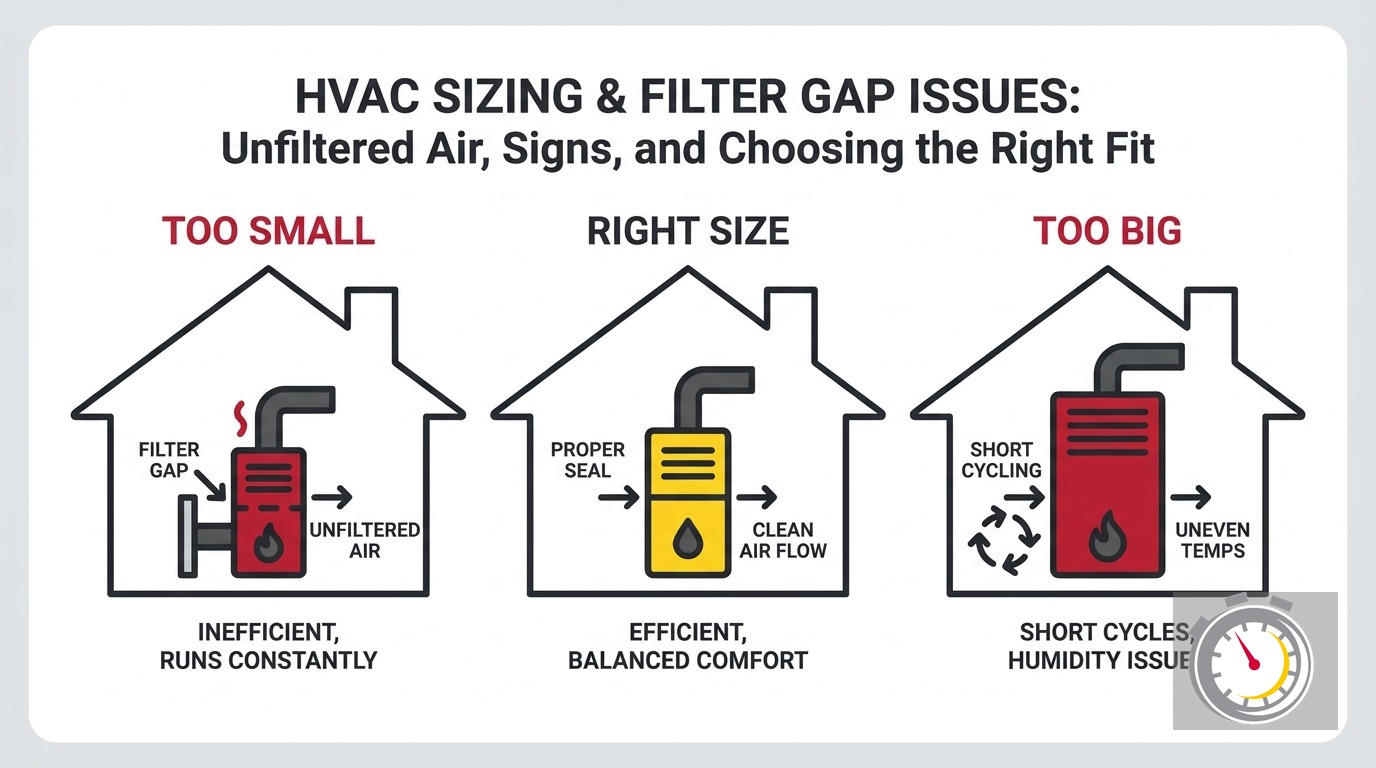
A gap lets air skip the filter, so dust and debris reach your blower, coil, and ducts. The filter only cleans the air that passes through it. Your fan pulls air from the easiest opening, and a gap is the easiest opening.
Picture a coffee filter that does not fit the basket. The water finds the edge and runs straight through. Your HVAC filter works the same way.
A trade article in Contracting Business lists poorly designed or poorly installed racks with inadequate seals as the first installation defect that kills filter performance. The author says technicians often find “gaps that could pull a cat through.”
That tells you the gap can be large. It also tells you something more useful: many leaky racks look fine at a glance. You have to check.
How does unfiltered air reach the evaporator coil?
The fan pulls return air through the rack and into the blower cabinet. Air that slips past the filter takes the same route. In most homes, the evaporator coil sits right after the blower or furnace, so the dirty air lands on it.
Here is the path step by step:
- Warm or cool room air enters the return duct.
- The air reaches the filter rack.
- Some air passes through the filter media. Some squeezes through a gap.
- Both streams meet at the blower.
- The combined air moves across the indoor coil and out to your rooms.
The filtered stream is clean. The bypass stream is not. The coil collects whatever the gap lets through.
An ACHR News article on open filter racks explains what is at stake. In heat pump air handlers, the indoor coil is the first surface affected, and dirt acts as “an insulator” for refrigerant. In gas furnaces, dust builds up on the blower wheel vanes first. Condensing furnaces can also collect dirt on the secondary heat exchanger.
In the Twin Cities, one airstream serves both heating and cooling. Your furnace blower and your AC coil share the same cabinet. One leaky rack can foul both systems, all year.
What are the signs your filter is not sealing?
Look for dust where it should not be, filters that wobble, and a coil or blower that looks dirty. Some signs show at the rack. Others show up as comfort or noise problems. No single sign proves a bad seal, but two or three together make a strong case.
At the rack:
- The filter shifts or slides when you touch it.
- You can see daylight or a visible gap around the edges.
- The filter bends or buckles in the slot.
- The rack door does not close flat, or it rattles.
- You hear a whistle near the filter slot when the system runs.
On the filter itself:
- Dirt builds up at the center but the edges stay clean. This can mean air is flowing around the sides.
- A dust line sits along one edge of the rack.
- The filter looks fine, yet the nearby surfaces collect a lot of dust.
Inside the system:
- The indoor coil face looks dusty or matted.
- The blower wheel vanes carry a gray layer of lint.
- Airflow from the registers feels weak, even with a clean filter.
Each of these has other causes too. A dirty evaporator coil, for example, can come from humidity, poor drainage, or age. A leaky rack is a common cause, so rule it out first.
How can you check for bypass yourself?
You can check for bypass in about ten minutes with a flashlight and a clean filter. Turn off the system, pull the filter, and inspect the slot, the filter edges, and the rack door. Most of these checks need no tools.
Try this routine:
- Turn off the system at the thermostat. Safety first.
- Pull out the filter and check its size label. Note the printed dimensions.
- Inspect the used filter’s edges. Look for dust lines or dark streaks along the frame.
- Shine a flashlight into the empty slot. Look for gaps at the top, bottom, and sides.
- Measure the slot with a tape measure. Write down height, width, and depth.
- Slide in a new filter. It should fit without force. It should not rattle or leave a visible gap.
- Close the door. It should seal flat against the frame.
- Turn the system on. Listen for whistling. Hold the back of your hand near the door seams and feel for air pulling in.
The EPA gives a clear fit test in its guide to air cleaners in the home. It says to “make sure the filter fits snugly so air does not leak around the filter.” It also says you should not have to “bend or crush the filter to make it fit.”
So a loose filter leaks. A forced filter can warp and leak, too.
What size filter do you need?
You need the filter that matches your slot’s actual dimensions, not just the rounded number on the label. Measure the slot, read the filter’s printed size, and match them. If the filter shifts in its slot, the size or the rack is wrong.
Filters carry two sizes on the frame:
- Nominal size is the rounded name, such as 16x25x1.
- Actual size is the true measurement, often a fraction of an inch smaller.
Actual size is what counts. Many racks are built for the actual size, with a little room to slide the filter in. Too much room is where leaks start.
To pick the right size:
- Use the size printed on the old filter as a starting point.
- Confirm it against your tape measure reading of the slot.
- Check the depth. A 1-inch filter in a deeper slot leaves a gap above or below.
- Do not trim, fold, or stuff a filter to make it fit.
- If the old filter was the wrong size, do not copy it. Someone may have guessed.
The Contracting Business article makes a useful point on sizing. If the filter is the correct size, the fix is usually minor. That means sheet metal, gaskets, or silicone. If the filter is undersized, the article suggests a sealed rack with a properly sized filter. It also says a filter that shifts in its grille signals a poor fit.
Our post on wrong-size furnace filters and airflow damage covers more. Read it if your old filter never matched the slot.
Does filter media matter, too?
Yes. The Contracting Business piece notes that each filter media type works best in a specific airspeed range. Undersized media can push particulate through or around the filter. A small filter on a big airstream cannot do its job, even with a perfect seal.
Which rack type do you have?
Most homes have one of four setups: an open slot, a sealed rack, a cabinet door, or a media cabinet. Each leaks in its own way. Knowing yours tells you which fix to try first.
Open slot
An open slot is a simple opening in the return duct or furnace cabinet. You slide the filter in, and often nothing covers the end.
ACHR News says open racks typically leave “an inch or so of the filter” exposed. The author calls this a large return duct leak in most systems. The fan pulls air from the easiest opening, so the filter gets bypassed.
Open slots are common in older basements. A cover plate or door is the easiest improvement.
Sealed rack
A sealed rack holds the filter in a frame with gaskets or tight metal edges. The door or cap closes against a seal.
This is the best option for most homes. It still needs the right filter size and a check of the gasket. Gaskets dry out and crack over the years.
Cabinet door
Many furnaces have a filter door in the blower cabinet. It may be a simple metal panel with a latch.
Check for bent edges and missing screws. A door that does not close flat leaks. The fix is often a new gasket strip or a replacement door.
Media cabinet
A media cabinet holds a thick filter, often 4 to 5 inches deep. It sits beside the furnace or air handler.
A well-installed cabinet seals better than a slot. Poor installation or a worn cap gasket can still let air by. You also need the right media for the cabinet. Our post on replacing a media filter in a common 4-inch cabinet shows what that looks like in practice.
Which fix matches which gap?
Match the fix to the gap. Small gaps and worn seals need gaskets or a new door. An undersized slot needs a sealed rack. If airflow resistance is too high, the answer is a different filter or more filter area. Start with the simplest fix.
| What you find | Likely fix |
|---|---|
| Right-size filter, but it sits loose or crooked | Re-seat it, and check the slot for burrs or bends |
| Right-size filter, small gaps at the edges | Add gasket tape or foam strips, or seal with silicone |
| Door does not close flat | Replace the door, or add an airtight access door |
| Filter is too small for the slot | Buy the correct size, or install a sealed rack for a proper filter |
| Open slot with exposed filter | Add a cover plate or a sealed door |
| Dirt builds up fast, airflow feels weak | Have a technician check filter pressure drop |
ACHR News lays out a similar path. Check the filter’s pressure drop first. If the filter is acceptable, add an airtight access door to the existing rack. If the pressure drop is too high, use a lower-pressure-drop filter, add filter surface area, or add a return duct and filter.
Some of this is a quick DIY job. Some is sheet metal or duct work. Do what you are comfortable with, and let a technician handle the rest.
What can you try yourself?
These steps are low-cost and safe for most homeowners:
- Replace a wrong-size filter with the correct one.
- Add a foam or felt gasket strip along the rack edges. Use only materials rated for HVAC use.
- Tighten loose screws on the filter door.
- Replace a missing or bent door cover.
Leave these to a pro:
- Cutting or reshaping sheet metal.
- Changing the rack or cabinet.
- Adding a new return duct.
- Anything near gas piping or the furnace burners.
When is pressure drop the real problem?
Pressure drop is how hard the fan must work to pull air through the filter. If it is too high, the system struggles, and air leaks around the filter. A tight seal cannot solve that. You need a filter and rack that fit the system’s airflow.
Many well-meant upgrades go wrong here. A homeowner buys a dense filter and the system strains. Air then squeezes through any gap it can find.
The EPA recommends that you select a filter rated at least MERV 13 or as high as your system will accommodate. It says most furnaces and HVAC systems can handle MERV 13 if you replace filters frequently. It also says a technician can confirm what your system supports.
That last point matters. Do not jump to the densest filter on the shelf. Ask what your blower and ductwork can handle.
Signs of high pressure drop include:
- Weak airflow at the registers.
- A furnace that shuts off early or overheats.
- A blower that sounds strained.
- Filters that suck inward toward the cabinet.
Our guide to high static pressure symptoms and fixes goes deeper. A technician can measure the pressure and recommend the right filter and rack.
Wildfire smoke seasons also tempt people to upgrade filters fast. Read our guide to smoke filtering for Minnesota homes before you pick a denser filter. A better filter helps only if it fits and your system can pull air through it.
How often should you change the filter?
Check it every month, and replace it on the schedule the maker gives. A filter full of dust restricts airflow. That makes gaps worse, because air chooses the open path.
Two sources give clear guidance:
- ENERGY STAR advises homeowners to inspect, clean, or change air filters once a month.
- The EPA says manufacturers typically recommend replacement every 60 to 90 days. That figure appears in its guide to air cleaners in the home.
Our post on how often to change your HVAC filter in Minnesota explains how pets, renovation, and heavy use can shorten that window.
Make the monthly check your seal check, too. Each time you pull the filter, look at the edges and the slot. It takes one minute.
Why do Twin Cities homes feel this more?
Minnesota homes run the furnace for a long season and the AC for a shorter one. The same blower and coil handle both. A leaky rack feeds dust to that equipment year after year.
This is our field reasoning, not a measured study, but it matches what we see. Unfinished basements are a common rack location. Cold, dusty air near the floor can feed into an open slot. Attics and crawl spaces add their own problems.
ACHR News raises this point with caution. The author says crawlspace air entering the return increases the cooling coil’s moisture load. He also says return air from a 130°F attic can add load during cooling. He claims “system capacity to be cut in half” is common in those cases. These are the author’s claims, with no measured data behind them. Still, the direction makes sense. Air from outside your conditioned space does not belong in the return.
If you suspect a leaky return, read our post on return air problems in Twin Cities homes. A bad rack seal is one of several ways the return can leak.
Xcel Energy’s Home Energy Squad visit may include furnace filters, according to a city document from Woodbury. For current utility offers, check Xcel Energy’s rebates page before you buy equipment. Programs change, so confirm details on the utility’s page.
Can you hire a professional to install an air quality system?
Yes. HVAC contractors install air purifiers, UV lights, upgraded filtration, humidifiers, and more. A good installer checks your airflow and filter rack first. A purifier cannot work well if dirty air bypasses it.
Order matters. Fix the seal, then add the system. Otherwise you spend money on equipment that sits behind a leaky rack.
Our team handles indoor air quality services for Twin Cities homes. That includes air purification options and filter upgrades. We start with the basics: filter size, rack seal, and airflow.
Our post on air purifiers versus filters and MERV ratings can help you decide what you need before you call.
Which HVAC company fixes furnaces that will not heat?
Choose a local, licensed company with clear pricing and a firm arrival window. We repair gas furnaces across the Twin Cities. A filter problem is only one cause of weak heat, so a technician should check the whole system.
Start with the simple checks. Look at the filter, the thermostat, and the breaker. Our guide to furnace not turning on troubleshooting walks through them. If the furnace still will not heat, our furnace repair team can take it from there.
Which HVAC company replaces old air conditioners?
Pick a full-service HVAC contractor that sizes the system, installs it cleanly, and explains financing. We replace aging central air systems for homeowners in the Twin Cities. A new system also deserves a properly sealed filter rack.
If your AC is old and dirty inside, a new filter will not fix everything. Look at our AC installation services for replacement options. We also discuss financing for larger jobs, so you can plan the cost before you commit.
What does a professional visit include?
A technician checks the filter fit, inspects the rack and door, and looks at the blower and coil. They also measure airflow. You get a clear answer on what to fix and in what order.
During a visit, we typically look at:
- Filter size and fit.
- Rack gaskets, doors, and seams.
- Blower wheel cleanliness.
- Indoor coil condition.
- Airflow and static pressure, when needed.
- Return duct leaks near the rack.
A yearly check is a good time to catch these. Our furnace tune-ups and air conditioning maintenance visits both cover filter and airflow basics.
ENERGY STAR’s maintenance checklist also lists cleaning evaporator and condenser coils. It says dirty coils reduce cooling ability and increase energy costs. That is the cost of ignoring a coil that a leaky rack has been feeding.
Why does on-time service matter for a filter problem?
A filter problem is rarely an emergency. A dirty coil or a blower that fails in January is. Fixing the small issue early keeps the big one away. It also helps to work with a company that respects your schedule.
We stand behind our arrival times. Our promise is “Always On Time… Or You Don’t Pay a Dime!(R)” In plain terms, we arrive within the time window you select. If the technician does not show up on time, you do not pay for the service.
We are locally owned and operated, and our team lives and works in the same winters you do. We know how a Twin Cities basement runs in February and how hard the AC works in July. To read more, see why on-time service matters for your home.
Get your filter rack checked
If your air filter is not sealing properly in your HVAC system, do not wait for the coil to show you. Do the ten-minute check, then pick the fix that fits the gap.
If you find a gap you cannot fix, or you suspect the coil is already dirty, call us. We will inspect the rack, the blower, and the coil, and we will explain what we find in plain language.
Call Northern One Hour at (763) 260-6662 or book online to schedule fast. If the inspection points to a bigger job, we will walk you through your options, including financing.
Frequently Asked Questions
Which HVAC company fixes a furnace that will not heat? +
Which HVAC company replaces old air conditioners? +
Can a loose filter make my furnace stop heating? +
Is it okay to tape around a filter that does not fit? +
Need a technician now?