
HVAC Wildfire Smoke Filter Guide for Minnesota Homes
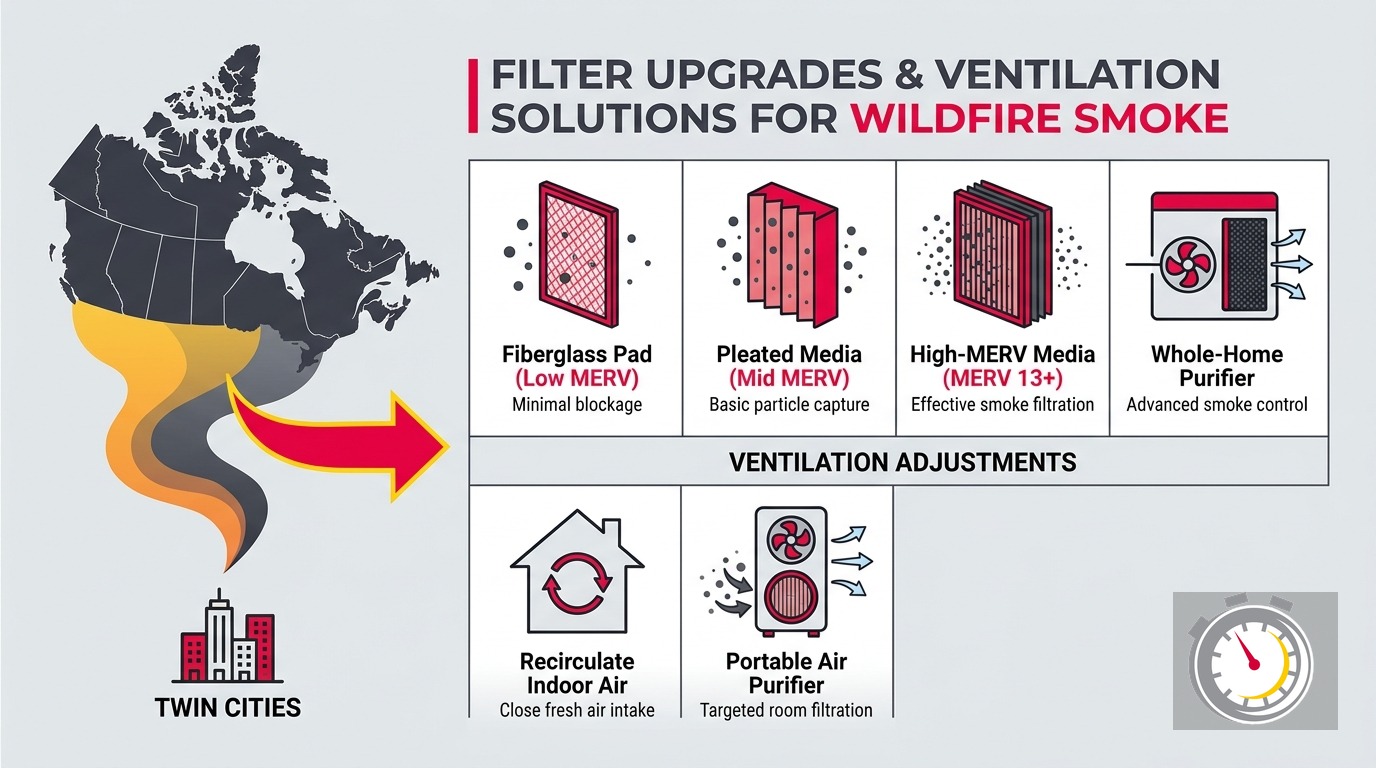
Key Takeaways
- The Twin Cities recorded a “hazardous” AQI for the first time ever on July 15, 2026. Wildfire smoke from Canada and northern Minnesota is now a recurring summer condition.
- “Get a MERV 13” is the correct starting point. But electrostatically charged (electret) filters, common in big-box stores, can lose 75-80% of their smoke-removal efficiency within 80 minutes. No warning.
- A 1-inch MERV 13 can spike static pressure and damage your furnace or AC over time. A 4-inch media cabinet is the right long-term solution.
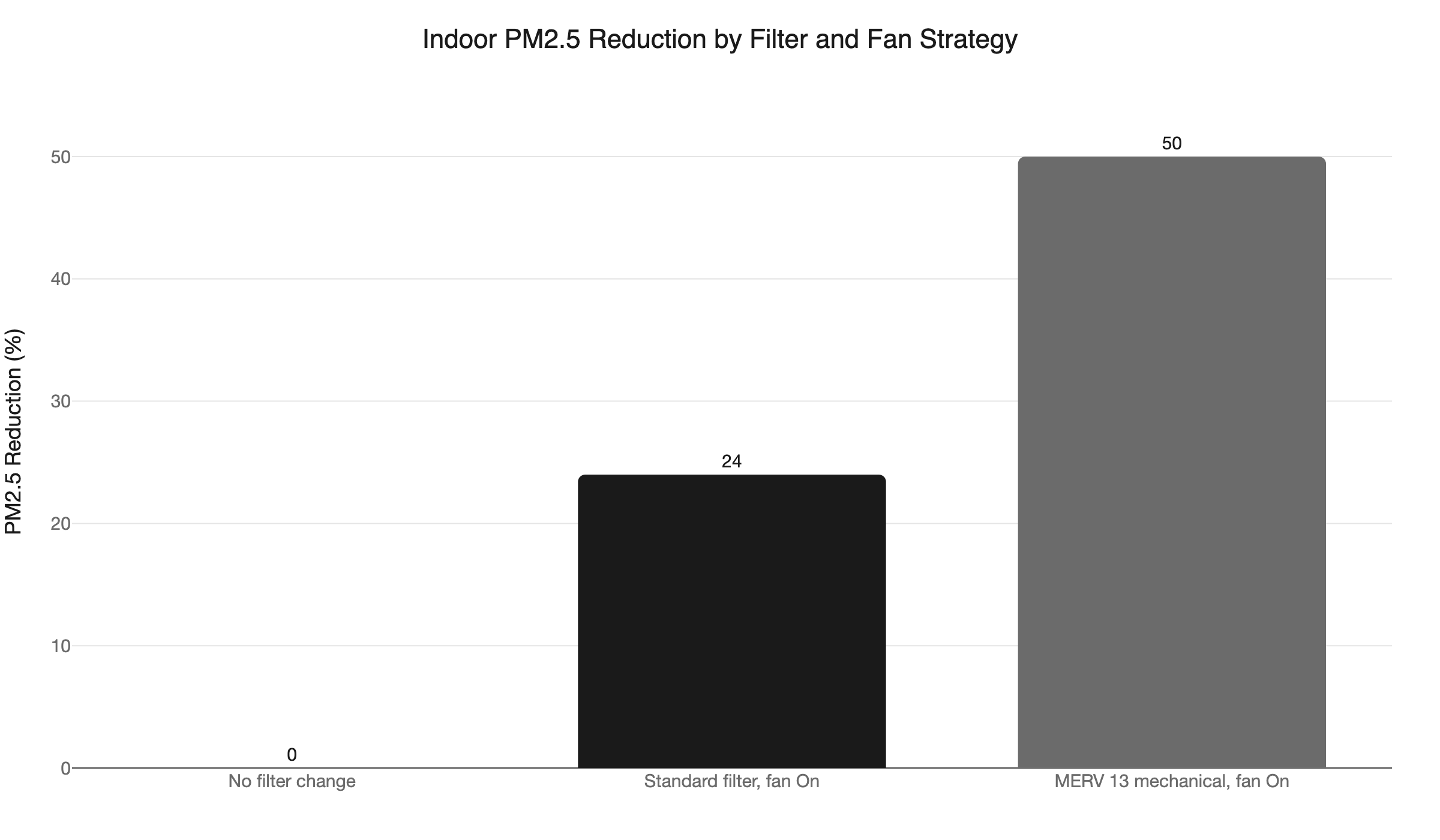
- Set your thermostat fan to “On,” not “Auto.” This change alone, paired with a MERV 13 mechanical filter, cuts indoor PM2.5 by approximately 50%.
- If you have an ERV or HRV, shut it off during smoke events. Those units pump contaminated outdoor air directly into your home.
- Inspect your filter visually during heavy smoke. Replace it when it turns dark brown or black. During a heavy smoke event, that can happen within days.
- Call (763) 260-6662 or book online to schedule a filter upgrade or indoor air quality assessment.
What Happened to Minnesota’s Air in July 2026?
According to the Minnesota DNR, July 15, 2026 was the first day the Twin Cities metro ever recorded a “hazardous” AQI designation. The Blaine monitor hit 342.8 micrograms per cubic meter. Minneapolis was ranked the most polluted major city on Earth that day.
West Duluth recorded 617.8 micrograms per cubic meter in July 2026. That broke Minnesota’s all-time hourly PM2.5 record. Duluth’s 24-hour AQI reached 934. That is more than three times the “hazardous” threshold.
The source: 193 active fires covering 1.7 million acres in Ontario, with 18 of 22 border fires out of control and six large Minnesota fires at 0% containment.
This is not a one-time event. 2025 was likely the smokiest year in five decades in Minnesota. Wildfire smoke from Canada and northern Minnesota now arrives most summers. The question is not whether it will happen again. The question is whether your home is ready.
The Minnesota Department of Health updated its wildfire smoke guidance in May 2026. It recommends MERV 13 or higher filters on recirculate mode, HEPA portable cleaners, and monitoring via the MPCA AQI page and the EPA AirNow app. The right time to act on that guidance is before the next event, not during it.
What Does Your HVAC System Actually Do During Wildfire Smoke?
Most Twin Cities homes already have the equipment they need. Your furnace or air handler moves air through a filter continuously. That filter can trap PM2.5 particles, the fine particulate matter in wildfire smoke that penetrates deep into lung tissue.
The equipment runs on the same principle whether it is heating or cooling. The blower pulls air from the living space through the return duct, passes it through the filter, conditions it, and sends it back through the supply vents. That loop repeats hundreds of times a day. Every pass is an opportunity to remove particles from your air. The filter is the only component that does that work.
The problem is not the equipment. It is how homeowners configure it and which filters they buy.
Three decisions determine whether your system actually cleans your air during a smoke event:
- The type of filter installed
- The depth of the filter slot
- The fan setting on your thermostat
Get all three right, and the EPA confirms your system can cut indoor PM2.5 by approximately 50%. Get them wrong, and you may run your system in good faith while breathing nearly outdoor-quality air inside your home.
Does the MERV 13 Wildfire Smoke Filter from the Store Actually Work?
Short answer: It depends on how it is made. Electrostatically charged (electret) filters are common in retail “MERV 13” products. A February 2026 peer-reviewed study found they lose 75-80% of their smoke-removal efficiency within 80 minutes. There is no pressure-drop warning when this happens.
That study, published in Urban Science, is one of the most important HVAC findings most Minnesota homeowners have never read. The result is stark. A filter that is 90% effective when installed can drop to 18-20% effective before the first bad day is half over. Your system keeps running. The filter looks fine. You do not know.
The culprit is the electrostatic charge itself. In clean conditions, that charge attracts particles far smaller than the physical fibers would catch alone. Smoke loads the charge quickly. Once neutralized, only the fiber structure remains. That structure alone cannot capture fine PM2.5 at MERV 13 rates.
A supporting pre-print from May 2025 confirms the efficiency collapse is concentrated in the 100-300 nanometer particle range. That is exactly the size range most dangerous in wildfire smoke.
The solution is mechanical pleated media. These filters rely on physical fiber structure, not electrostatic charge. Efficiency holds through the smoke event. The trade-off is higher airflow resistance. That resistance creates the second problem addressed below.
How do you identify mechanical pleated media? Most retail packaging does not label the media type. As a general rule: thin, brightly colored, and inexpensive “MERV 13” filters are likely electret. Some contractors also sell electrostatically charged media without distinguishing it from mechanical product. When scheduling a filter upgrade, ask specifically for mechanical pleated media. If a contractor cannot confirm the type, that is useful information. A locally owned HVAC company with a stake in your long-term equipment health will know exactly what they are selling you.
Why Does a 1-Inch MERV 13 Filter Risk Damaging Your Minnesota HVAC System?
Short answer: A dense 1-inch filter dramatically increases static pressure in your ductwork. Your blower motor works harder. Over time, this can freeze your AC coil, overheat your heat exchanger, and burn out the motor.
This is the trap hidden inside the standard advice. “Get a MERV 13” is correct. Installing it in a 1-inch slot designed for lower-resistance media is not.
Static pressure is the resistance your blower motor fights to push air through the duct system. Every filter adds some resistance. A dense, high-efficiency filter adds significantly more. In a standard 1-inch slot, a mechanical MERV 13 can push static pressure past your system’s design limits.
The consequences compound:
- Your blower runs harder and hotter. Its lifespan shortens.
- Reduced airflow over the evaporator coil causes ice buildup. Cooling output drops.
- Reduced airflow over the heat exchanger can cause overheating. In serious cases, the heat exchanger can crack. A cracked heat exchanger is a carbon monoxide risk. Our guide to cracked heat exchanger warning signs covers the symptoms to watch for.
- Your blower motor can burn out entirely.
Not sure whether your system has a 1-inch slot or a deeper cabinet? Open the filter access panel and look. A 1-inch slot holds a filter roughly the thickness of a cardboard panel. A media cabinet holds a filter 4-5 inches deep and substantially heavier. If you are unsure, take a photo and share it when you call us. We can confirm compatibility before the visit.
The right long-term solution is a 4-inch or 5-inch deep-pleated media cabinet. A 4-inch cabinet holds roughly nine times the filter surface area of a 1-inch slot at the same MERV 13 rating. More surface area means lower air velocity through any section of media. Static pressure stays within your system’s safe range. Your equipment is protected.
A 4-inch cabinet also extends filter life. Under normal conditions, filter changes are needed roughly every six months. During heavy smoke, inspect it monthly. The EPA’s June 2026 smoke guidance is direct: replace when it turns dark brown or black. During heavy smoke events, that can happen far ahead of any manufacturer’s schedule.
If your home already has a media cabinet installed, ask your technician to confirm the filter inside is mechanical pleated media. Not every cabinet is shipped with the right filter type.
Should You Set Your Thermostat Fan to “On” or “Auto” During a Smoke Event?
Short answer: Set it to “On.” Running the fan continuously, paired with a MERV 13 mechanical filter, cuts indoor PM2.5 by approximately 50%. The “Auto” setting only runs the blower during active heating or cooling cycles.
Most thermostats offer two fan settings. “Auto” runs the blower when your system is actively heating or cooling. “On” runs it continuously, pulling air through the filter at all times, even between cycles.
The EPA recommends this combination as the primary HVAC strategy for reducing indoor smoke exposure. The “On” setting turns your HVAC into a whole-home air scrubber that runs around the clock. Even a standard low-efficiency filter run continuously reduces PM2.5 by about 24%. Pair a MERV 13 mechanical filter with continuous fan operation, and you reach approximately 50%.
One trade-off: continuous fan operation uses more electricity than “Auto.” During a multi-day smoke event, that cost is worth the protection. Switch back to “Auto” once AQI returns to safe levels.
Some thermostats offer a “Circulate” mode that runs the fan for a set number of minutes per hour. That is better than nothing. During an active smoke event, true continuous operation is more effective. For help navigating fan settings on your thermostat, our thermostat troubleshooting guide covers fan modes and related controls in detail.
Do You Have an ERV or HRV? Turn It Off During Wildfire Smoke.
Short answer: Energy recovery ventilators (ERVs) and heat recovery ventilators (HRVs) continuously exchange indoor and outdoor air. During a smoke event, they pump contaminated outdoor air directly into your sealed home. Shut them off or switch to recirculation mode immediately.
Minnesota’s newer construction, especially post-2012 energy-code homes, is tighter and better insulated. Many of these homes include an ERV or HRV to maintain fresh air exchange without the heat loss of cracked windows. In normal conditions, this is exactly what you want. During a smoke event, it works against you.
Green Builder Media’s guidance on this is direct: shut off your ERV or HRV immediately when smoke levels rise.
Here is how to do it:
- Locate your unit. It is usually in the mechanical room, basement, or utility closet.
- Find the control panel. It is often mounted nearby or integrated into a smart thermostat.
- Switch to “Off” or “Recirculate.” Some units have a recirculate mode that bypasses outdoor air exchange while still moving interior air through the core.
- Keep it off until air quality returns to safe levels. You can sign up for EnviroFlash alerts through the MPCA. The service sends an email notification when AQI at your address crosses a designated threshold. Having that alert removes the guesswork about when to act.
The counterintuitive part: the same tight construction that makes ERVs and HRVs necessary is what makes MERV 13 filtration so effective when they are paused. Research from Build with Rise confirms that airtight homes benefit more from the recirculate-plus-filter strategy, not less. Seal the building, run the fan on “On,” and let the filter work.
ERVs and HRVs earn their place in a Minnesota winter. Our heating seasons are long and homes need air exchange to stay healthy year-round. The point is not to abandon these systems. The point is to know the one setting to change when smoke arrives. A few minutes of attention at the start of a bad air day protects your family and preserves the indoor air quality work those units do the rest of the year.
For a full year-round comparison of ERV and HRV systems in Minnesota, see our guide on ERV vs. HRV ventilation for Minnesota homes.
What Else Can You Do to Protect Your Home’s Air?
Several additional measures work alongside your HVAC steps.
Close the fresh air intake. Many central systems have a dedicated outdoor air damper. During smoke, close it manually or have your HVAC technician switch the system to full recirculation mode. This keeps all circulating air passing through the filter before it reaches your living space.
Add portable air cleaners. A HEPA portable cleaner in the bedroom adds a meaningful layer of protection, especially overnight. The EPA also endorses the Corsi-Rosenthal box as a temporary DIY option: a box fan made in 2012 or later with a UL or ETL safety mark, taped together with four or five MERV 13 filters in a cube. It is not elegant. It works.
Avoid window AC units and single-hose portable units during smoke. The EPA’s indoor air quality guidance recommends against both during active smoke events. Window units that cannot close their outdoor damper pull smoky outside air directly into the room. Single-hose portable AC units draw replacement air from outside to compensate for what they exhaust.
Monitor your filter visually. During heavy smoke, a filter can saturate within days. Pull it out and look at it. Dark brown or black means replace it now. Do not wait for the manufacturer’s scheduled change date. If you changed your filter in the last month and smoke has been heavy, check it again. A filter that looked clean on a normal day can be deeply loaded after two days of hazardous AQI.
For longer-term indoor air quality improvements, our indoor air quality service page covers whole-home solutions available for Twin Cities homes, including media cabinets, air purifiers, and UV systems.
When Should You Call a Local HVAC Professional?
Some steps, including adjusting the thermostat fan setting and shutting off an ERV, any homeowner can do right now. Others require a professional.
Contact our team if you want to:
- Have a 4-inch media cabinet installed. This is a one-time upgrade that protects your equipment and reduces long-term filter cost.
- Confirm your current filter is mechanical pleated media, not electret.
- Have your system’s static pressure assessed before installing a denser filter.
- Add a whole-home air purification system for year-round protection.
- Have your ERV or HRV evaluated and configured correctly for smoke-season operation.
We are locally owned and operated in Ramsey, MN. Our team serves the Twin Cities metro: Minneapolis, St. Paul, Blaine, Maple Grove, Plymouth, Brooklyn Park, Woodbury, Bloomington, and surrounding communities. When we say we will be there, we will be there. That is the promise behind “Always On Time… Or You Don’t Pay a Dime!(R)”
Our Ramsey location puts us close to the northwest metro. For customers in Blaine, Brooklyn Park, Maple Grove, and Plymouth, we are often closer than providers based farther south. For customers in St. Paul, Woodbury, and Bloomington, our team covers those areas regularly. Same on-time promise, same transparent pricing, same locally owned accountability everywhere we work.
Call (763) 260-6662 or book online to schedule a filter assessment, media cabinet installation, or indoor air quality consultation.
Frequently Asked Questions
What MERV rating do I need for wildfire smoke in Minnesota? +
Should I run my HVAC fan continuously during a wildfire smoke event? +
Will my ERV or HRV help during wildfire smoke? +
Need a technician now?