
Wrong Size Furnace Filter Problems: Spot and Fix Them
Key Takeaways
- A filter that is too thin or loose lets dust bypass the media and reach your blower and heat exchanger.
- The printed size on a filter frame is the nominal size. The actual size is slightly smaller.
- Measure your filter slot, read the frame label, and check the fit. It takes about 60 seconds.
- A filter that is too thick or too restrictive can also hurt airflow.
- Check your filter monthly in heating season. Replace it when it looks dirty.
- Call a pro if your slot is nonstandard, the cabinet has no retaining lip, or you need a custom filter.
What Are the Wrong Size Furnace Filter Problems?
A wrong size filter lets air slip around its edges, restricts airflow, or both. Dust reaches the blower and heat exchanger. Your furnace works harder, and your air gets dirtier. Too-small filters leak. Too-thick or too-dense filters choke airflow.
A wrong size filter causes two opposite problems.
Too thin or too small. The filter sits loose in the slot. Air takes the easiest path, which is the gap. Dust rides that air past the media and into the blower.
Too thick or too dense. The filter gets forced into a slot that was not built for it. Or its tight weave makes air struggle to pass. Either way, airflow drops.
In both cases, your furnace loses the clean, steady airflow it needs.
Here are common signs of a sizing problem:
- You can see or feel a gap at the edge of the filter.
- The filter flexes, bows, or slides when the blower starts.
- You see dust streaks along the frame edge.
- You hear a faint whistle near the filter slot.
- The filter looks clean in the middle but dirty around the edges.
- Your return vents and registers collect dust faster than they used to.
Any one of these deserves a closer look. Start with the label on the frame.
How Do You Read the Size on a Furnace Filter Frame?
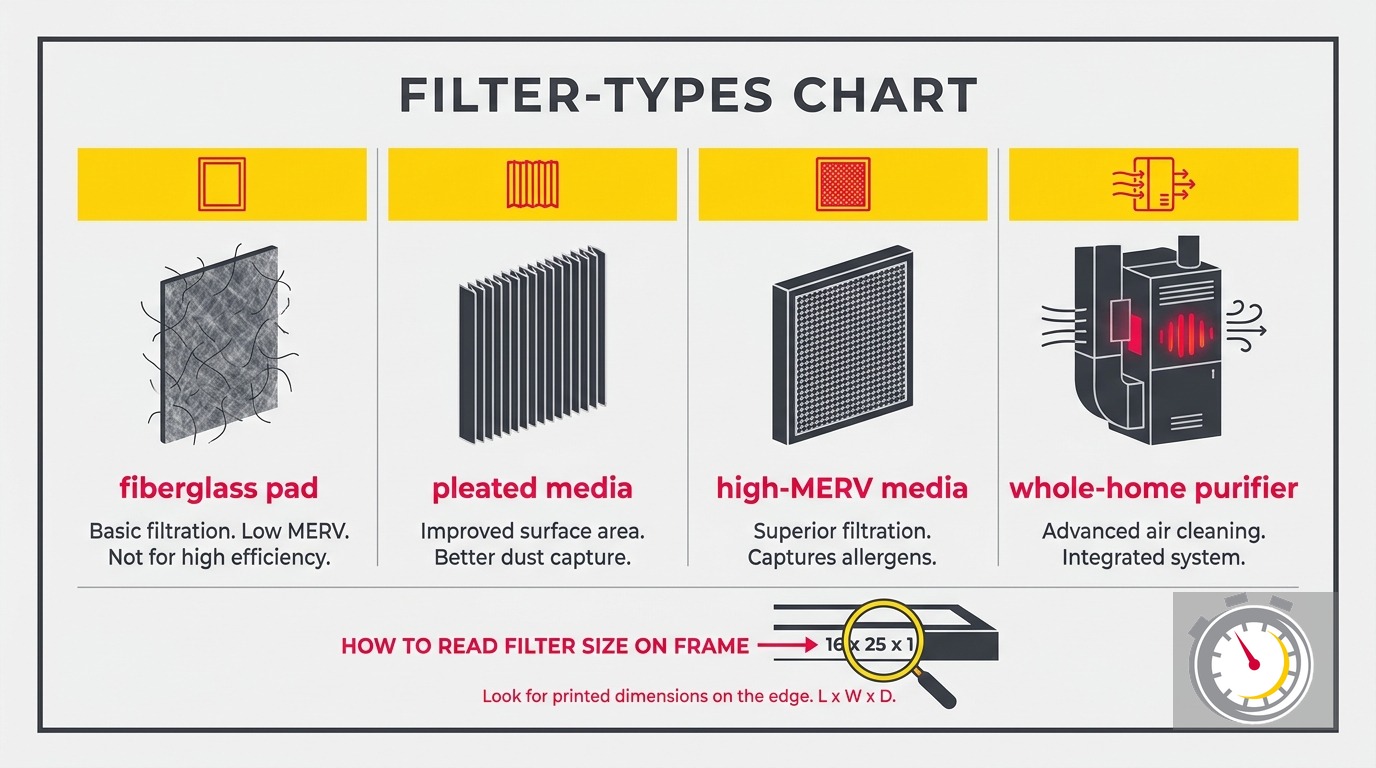
Look for three numbers in inches, written length x width x depth, such as 16x25x1. That is the nominal size, a rounded label. The actual size is usually printed nearby and runs a bit smaller. You will also find a MERV rating and an airflow arrow.
Pull your current filter out and look at the cardboard frame. Most frames carry the same handful of marks.
The nominal size
The big number is the nominal size. Nominal means “in name only.” It is a rounded figure that makes filters easy to shop for.
A 16x25x1 filter is a common example. One filter seller’s size guide says a 16x25x1 measures about 15.5 x 24.5 x 0.75 inches. The label rounds up. The real filter is a little smaller so it can slide into the slot.
The actual size
Many frames print the actual size in small type, often along an edge. Compare this number when two filters share the same nominal size. Brands trim their frames differently, so two “same size” filters can fit differently.
Use the actual size when you can find it. Use the nominal size to shop.
The MERV rating
MERV stands for minimum efficiency reporting value. It tells you how well a filter catches particles. The EPA says MERV ratings report an air filter’s ability to capture particles between 0.3 and 10 microns.
A higher number means finer filtering. It also usually means more resistance to airflow. We cover that tradeoff below.
The airflow arrow
Every filter has an arrow on the frame showing which way air should flow. Point it toward the furnace blower and away from the return duct.
A backward filter can sag into the airflow. It may also sit differently in the slot. Check the arrow every time you swap.
What if the print is worn off?
Basements are humid and dusty, and labels fade. If you cannot read yours, do not guess. Measure the slot instead. The next section shows how.
Then write the size on the furnace cabinet with a marker.
How Do You Know What Size Filter to Get for Your Furnace?
Measure the filter slot, not the old filter. Record length, width, and depth in inches. Match those to the nominal size on a new filter. Then check the fit before you close the cover. The filter should sit snug with no visible gaps.
The old filter may already be the wrong size. A previous owner may have bought the wrong one. The slot is your source of truth. Here is a 60-second routine.
Step 1: Turn the furnace off
Switch off the thermostat or the furnace power switch. Never pull a filter while the blower runs.
Step 2: Find the slot
Most Twin Cities furnaces hold the filter in one of three places:
- A slot in the side of the furnace, near the blower.
- A slot in the return duct, just before the furnace.
- A deeper media cabinet, often 4 inches thick, attached to the furnace.
Slide the old filter out and note which way the arrow pointed.
Step 3: Measure the slot
Use a tape measure. Record three numbers:
- Length: the longest side of the opening.
- Width: the shorter side.
- Depth: how thick a filter the slot can hold.
Round each number to the nearest whole inch. That gives you the nominal size to shop for. Compare it to the label on your old filter.
Step 4: Read the new frame
Check the nominal size, the actual size, the MERV rating, and the arrow. The nominal size must match your slot.
Step 5: Check the fit
Slide the new filter in with the arrow toward the blower. Then look and feel for these signs:
- It slides in without force.
- It does not bow or flex.
- No gap shows at any edge.
- The access cover closes fully.
If you can fit your fingers between the frame and the slot, the filter is too small or the slot has a problem.
A note on the EPA’s advice
The EPA tells homeowners to be sure the HVAC filter is correctly in place. It also says to check your HVAC manual or a professional before changing filter types. If your manual lists a filter size, start there.
What Happens When a Furnace Filter Is Too Thin or Loose?
A thin or loose filter lets air bypass the filter media. Unfiltered dust travels into the blower, heat exchanger, and ducts. Your filter looks fine, but it is not doing its job. Over time, dust buildup can hurt airflow and comfort.
Many articles say bypass is bad. Few show what causes it or how to spot it.
Common physical causes
Here are the fit problems we see most often:
- A 1-inch filter in a deeper slot. A 4-inch media cabinet is built for a thick filter. A thin one rattles around inside it.
- A frame with no retaining lip. Some slots have a small ledge that holds the filter in place. If that lip is missing or bent, the filter can shift.
- A filter that is too small. A filter an inch too short leaves a gap along one side.
- A frame that has warped. Humidity can soften cardboard. A bent frame stops sealing.
- A “same size” filter from another brand. Brands trim differently, so the fit can change from one pack to the next.
Signs you can check yourself
You do not need tools to spot bypass. Look for these:
- A visible gap. Shine a flashlight along the edges of the slot.
- Dust streaks on the frame edge. Air carrying dust leaves a trail where it squeezes past.
- A whistle near the slot. Air moving through a narrow gap can make a thin, high sound.
- A clean center and dirty edges. If the middle of the media looks fine but the edges are gray, air is going around.
- Dust on the blower wheel. Pull the filter and look inside with a flashlight. A heavy gray coat is a warning sign.
What bypass does inside a Twin Cities furnace
This is our reasoning, based on how furnaces work. It is not a sourced statistic.
Twin Cities furnaces run for long stretches in winter. When temperatures drop below zero, the blower may run for hours. A poorly fitting filter passes dust the entire time.
That dust lands on the blower wheel, the heat exchanger, and the inside of the ducts. A dusty blower wheel moves less air. You can read more in our guide to dirty blower wheel symptoms. A heavy dust coat can also cut your comfort and raise your heating bills.
Dry winter air makes things worse. Dust floats more easily in low humidity, then sticks to surfaces and builds up quickly.
A poor fit does not cause a dramatic failure on day one. It causes slow, quiet wear over a whole season.
How to fix a loose filter
Start simple:
- Measure the slot again.
- Buy the correct nominal size.
- Pick a brand with a snug actual size.
- If the slot is deeper than your filter, buy a filter that matches the full depth.
- Do not stuff foam or tape around a gap as a quick patch.
If the slot has no lip, the cabinet may need a better filter rack. That is a job for a pro. We cover it near the end.
What About a Filter That Is Too Thick or Too Restrictive?
A filter that is too thick may not fit the slot. A filter that is too dense restricts airflow even when it fits. Both can strain your blower. Choose the highest-rated filter your system can handle, not simply the highest number on the box.
Bigger is not always better, and many homeowners learn that the hard way.
Too thick for the slot
Forcing a filter into a slot that is too narrow can bend the frame. It may also keep the access cover from closing. A cover that does not close lets room air in and creates gaps.
Never fold, crush, or trim a filter to make it fit.
Too restrictive for the system
Higher-MERV filters catch smaller particles. That sounds great. But finer media also resists airflow more.
The EPA’s guidance is balanced. It advises you to choose the highest-rated filter that your HVAC system fan and filter slot can accommodate. The same page suggests a filter rated MERV 13 or higher for upgrades. Note the key words: your system’s fan and slot.
The EPA also notes that many home systems ship with a MERV-8 filter as the default. A standard filter is a safe baseline.
A thin 1-inch slot may not handle a very dense filter well. A deeper media cabinet has more surface area and handles dense media better. If you want better filtering, ask a pro before you switch. Our post on MERV ratings and air purifiers explains the tradeoffs in plain language.
Signs of too much restriction
Watch for these:
- Weak airflow at the registers.
- A furnace that shuts off on its limit switch.
- A filter that bows inward toward the blower.
- A blower that sounds strained.
If you see these after changing filter types, go back to your previous filter. Then call us.
What Happens If My Furnace Filter Is Dirty?
A dirty filter blocks airflow. Your furnace runs longer, your energy costs can rise, and the equipment can wear faster. ENERGY STAR says a dirty filter can raise energy costs and damage equipment. Check it monthly and change it when it looks gray.
A dirty filter is a different problem from a wrong size filter, but the two often show up together. A loose filter clogs unevenly. A restrictive filter clogs fast.
ENERGY STAR tells homeowners to inspect, clean, or change air filters once a month. The same checklist says a dirty filter can raise energy costs and damage equipment.
The U.S. Department of Energy agrees on the airflow side. Its training module says a dirty or clogged filter can dramatically reduce air flow.
In a house, that looks like this:
- Some rooms feel cooler than others.
- The furnace cycles on and off more often.
- The air smells dusty or stale.
- The filter looks gray, furry, or packed with lint and pet hair.
Pet owners should check even more often. Our guide on how often to change your HVAC filter in Minnesota breaks down timing by home type and season.
Try a simple test. Hold the filter up to a light. If you cannot see light through the media, replace it.
How Often Should You Check Your Filter in a Minnesota Winter?
Check your filter once a month during heating season. Minnesota furnaces run for long stretches in cold weather, so filters load up faster. Check fit every time you swap. A filter that fit in October can shift by January.
Heating season in the Twin Cities is long. Your furnace may run from October well into April. That is a lot of hours of airflow.
Build a habit around three checks:
- Look. Is the filter gray or packed with dust?
- Fit. Does it still sit snug with no gaps?
- Arrow. Does it still point toward the blower?
Set a phone reminder or mark your calendar. The first of the month works well.
Some homeowners also keep a few spare filters in the right size. Then a dirty filter never has to wait until the weekend. Store them flat, in a dry place, away from the furnace.
A local resource worth knowing
Minnesota homeowners may also want to look at the Home Energy Squad. It is a program for Xcel Energy and CenterPoint customers. The program page says free visits are available to income-qualifying households. The page limits the program to Minnesota customers. Check the page for current details and eligibility before you book.
When Should You Call a Pro About Your Furnace Filter?
Call a pro if your slot is a nonstandard size, the cabinet has no retaining lip, you see heavy dust inside the furnace, or you want a better filter than the slot allows. A technician can fix the fit and check airflow at the same time.
Most filter swaps are a do-it-yourself job. Some situations deserve a second set of eyes.
Call us when:
- No standard filter fits. Older homes sometimes have odd-sized slots. A custom filter or a new filter rack may solve it.
- The slot has no lip or a broken one. A filter cannot seal against a missing ledge.
- You see heavy dust on the blower wheel. It may need cleaning.
- The filter collapses or bows every time. Something is pulling too hard on it.
- You want better filtering. A deeper media cabinet or a different filter style may be the answer.
- The furnace shuts off early or the airflow feels weak. That can point to a bigger problem than the filter.
A filter fit check fits naturally into a furnace tune-up. Your technician can measure the slot, inspect the blower, and recommend a filter that suits your system.
When filter trouble is a sign of an older furnace
Sometimes filter trouble points to a bigger issue. An aging furnace with a worn blower or leaky cabinet may struggle no matter which filter you use. If repairs are piling up, read our guide on when to replace instead of repair your furnace. If you decide to replace, ask us about financing for larger jobs.
Why Homeowners Trust Northern One Hour
We are locally owned and operated. Our team lives and works in the Twin Cities. We know how hard your furnace works from the first cold snap to the last spring frost.
We back our work with a 100% satisfaction guarantee and honest, transparent pricing. We also stand behind our on-time promise: “Always On Time… Or You Don’t Pay a Dime!(R)” We arrive within the time window you select. If our technician does not show up on time, you do not pay for the service.
For a filter question, that means you do not have to plan your day around a wide arrival window. You pick the window. We show up in it.
Your 60-Second Filter Fit Check
Keep this short list handy:
- Turn the furnace off.
- Slide out the old filter and note the arrow direction.
- Measure the slot: length, width, depth.
- Read the frame: nominal size, actual size, MERV, arrow.
- Slide in the new filter with the arrow toward the blower.
- Look for gaps, bowing, or a cover that will not close.
- Write the filter size on the furnace cabinet.
- Set a monthly reminder.
A filter that fits well keeps dust out of your blower and helps your furnace move air the way it was designed to.
Not sure your filter fits right? Do not wait for a cold night to find out. Call Northern One Hour at (763) 260-6662 or book online to schedule fast. We will check your filter slot, inspect your furnace, and help you choose the right filter for your home.
Frequently Asked Questions
Why is my furnace filter collapsing? +
Can I use a different brand if the printed size matches? +
What if the size on my old filter is worn off? +
Need a technician now?