
Furnace Not Reaching Thermostat Temperature but Running
Key Takeaways
- A furnace that runs but never catches up has a fault until proven otherwise. Do not blame the weather first.
- Check the filter first. A clogged filter is the cheapest and most common cause.
- Leaky or uninsulated ducts can waste a large share of your heat before it reaches the registers.
- Dirty burners and a weak flame can make the furnace overheat, trip its safety switch, and cycle.
- An undersized furnace usually struggles only on the coldest days. A faulty one struggles on mild days too.
- Log your indoor temperature for an hour or two to test the thermostat.
- A technician can measure temperature rise and static pressure to find the real cause fast.
The Short Answer: Why Your Furnace Runs but the House Stays Cold
If your furnace runs but the house won’t warm up, the problem is almost always heat delivery. Either the furnace isn’t making enough heat, or the heat isn’t reaching your rooms.
The usual suspects are a dirty filter, restricted or leaky ducts, dirty or failing burners, a limit switch that trips early, or equipment that is too small for the house. A thermostat that reads wrong is a less common cause.
This guide covers a normal Minnesota cold snap, not a record-breaking one. If you are dealing with a deep-freeze night, read our guide on what to do when a furnace can’t reach its setpoint in extreme cold instead.
We are Northern One Hour Heating & Air Conditioning, a locally owned and operated Twin Cities company. We see this problem every winter. A few simple checks can usually point you to the likely cause.
Why is my furnace running but not keeping up with the temperature?
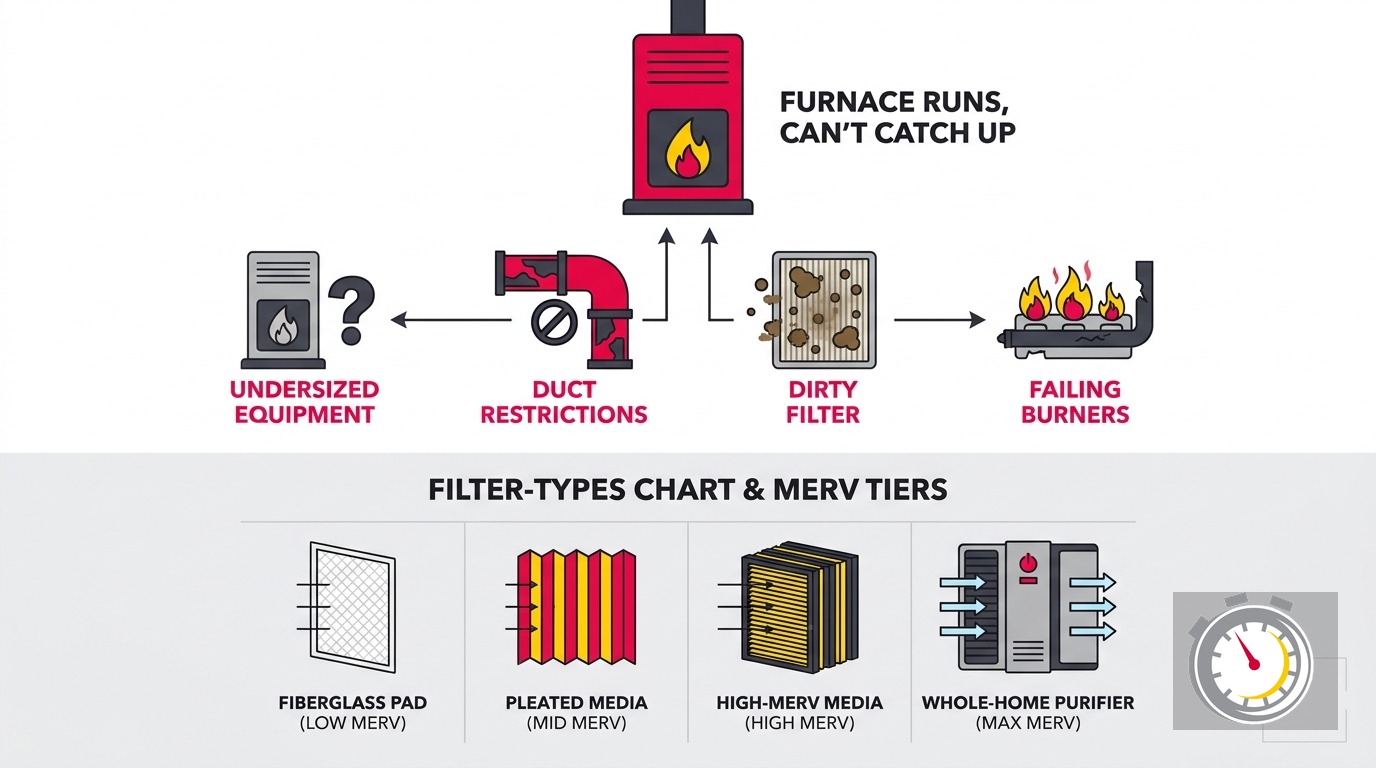
A furnace falls behind when it makes too little heat, moves too little air, or loses heat in the ducts. Filters, burners, ductwork, and sizing are the four big causes. Each leaves a different clue, so a few observations can narrow things down quickly.
Think of your heating system as a chain. The burners make heat. The heat exchanger passes that heat to the air. The blower pushes the air through the ducts. The ducts deliver it to your rooms. A weak link anywhere shows up as a cold house.
Here is how the clues usually line up:
- Weak airflow at the vents: Suspect a filter, blower, or duct restriction.
- Warm air, but rooms stay cold: Suspect duct leaks, poor insulation, or undersizing.
- Furnace shuts off, then restarts, over and over: Suspect overheating, a limit switch, or a flame problem.
- Problem only on the coldest nights: Suspect undersizing or a tired, borderline system.
- Problem every day, even mild ones: Suspect a fault.
That last clue matters most. It separates “this furnace is too small” from “this furnace is broken.”
Is this a normal cold day problem or an extreme cold problem?
Compare how the furnace does on a mild winter day with how it does on a deep-freeze night. If it keeps up at 25°F but fails at minus 10°F, sizing is the likely issue. If it fails on a 15°F day, you probably have a fault.
Furnaces are sized for a design day, which is the coldest weather a house is expected to see. On that day, a correctly sized furnace may run almost nonstop. That is normal, and it should still hold your set temperature.
On an ordinary Minnesota cold day, the furnace should cycle on and off and hold the setpoint. If it runs for hours and loses ground, something is wrong.
Try this simple test over a few days:
- Note the outdoor temperature each morning and evening.
- Note the thermostat setting and the real indoor temperature.
- Write down whether the furnace ran constantly or cycled.
- Look for a pattern.
If the furnace fails only below a certain outdoor temperature, that points to sizing or heat loss. If it fails across a wide range of temperatures, look for a fault.
A new furnace can struggle too. It may have a duct problem the old furnace hid. Our post on uneven temperatures after a new furnace explains how that happens.
Is a dirty filter or blocked airflow the cause?
Check the filter first. A clogged filter chokes airflow, so less heated air reaches your rooms. The furnace may also overheat and shut down early. Replacing the filter takes two minutes and is the most common fix we see.
The U.S. Department of Energy’s home checklist tells homeowners to “Clean or replace filters in your furnace, air conditioner, and heat pump.” The advice is simple. It solves a surprising number of service calls.
Check for these filter problems:
- Too dirty: Hold it up to a light. If you cannot see light through it, replace it.
- Wrong size: A loose filter lets air bypass it. A too-thick one can starve the blower. See our guide on wrong-size filters and airflow damage.
- Too restrictive: Very high-rated filters can slow airflow in some systems. Our post on high-MERV filters and airflow covers it.
- Installed backward: The arrow should point toward the furnace.
Other airflow blockers are easy to miss. Look for closed registers, furniture over vents, and a dirty return grille. A clogged blower wheel also cuts airflow, but you can’t see it without opening the cabinet.
Restricted airflow builds what technicians call static pressure. Think of it as blood pressure for your ducts. High readings mean the blower is working too hard. Our guide to high static pressure symptoms and fixes explains the signs.
Could duct problems be stealing your heat?
Yes. Leaky, disconnected, or uninsulated ducts can lose a lot of heat before it reaches your rooms. The furnace may be fine while the house stays cold. Ducts in attics, crawl spaces, and unheated basements are the biggest offenders in Minnesota homes.
The Department of Energy notes that “Keeping ducts in good repair can prevent heat loss of up to 60% at the registers.” That is a big number. Ducts deserve attention before anyone talks about a bigger furnace.
The same checklist advises you to “Insulate heating ducts in unheated areas, such as attics and crawlspaces.” Many Twin Cities homes run ducts through cold spaces, and those runs lose heat all winter.
Signs of a duct problem include:
- Some rooms stay cold while others are fine.
- Air at the registers feels weak or only lukewarm.
- Dust collects around seams and joints.
- Ducts in the basement or attic feel cold to the touch.
- Heating bills creep up with no change in habits.
You can do a basic check yourself. Look for disconnected sections, crushed flex duct, and gaps at joints. Never cut into ducts, and take care if you go into an attic in deep winter.
Our posts on duct sealing and energy loss and duct insulation in attics go deeper. A technician can seal and insulate problem runs. Full duct sealing typically starts around $1,300, and a full ductwork replacement typically runs $6,500 to $13,000.
Why does my furnace run but shut off before reaching temperature?
A furnace that shuts off early is usually overheating or losing its flame. A dirty filter, blocked airflow, or dirty burners can trip a safety switch. The furnace stops, cools, and restarts. The cycle repeats and the house never catches up.
Furnaces have safety devices that protect you and the equipment. Two matter here.
The limit switch. It shuts off the burners if the furnace gets too hot. Restricted airflow is the most common reason it trips. The switch is doing its job. Our guide on limit switch failure and resets explains when the switch itself is the problem.
The flame sensor. It confirms the burners are lit. If residue coats it, it may not sense the flame, and the furnace shuts the gas off after a few seconds. You hear the burners light, then quit. See our post on cleaning a dirty flame sensor.
Other causes of early shutoffs include:
- A thermostat in a poor spot, such as near a vent or a sunny window.
- A blocked flue or vent pipe.
- A failing control board or pressure switch.
- An oversized furnace that satisfies the thermostat too quickly.
Short cycling wears out parts and wastes gas. We cover it in our post on furnace short cycling causes and fixes.
If your furnace shuts off early and you smell gas, stop. Leave the house and call your gas utility. Never troubleshoot a gas smell yourself.
Can failing burners keep a furnace from heating the house?
Yes. Dirty, corroded, or uneven burners make a weak or lopsided flame, which means less heat for the same fuel. A poor flame can also overheat parts of the heat exchanger. The furnace may then trip its limit switch and cycle.
Burners sit behind a panel, so homeowners rarely see them. Technicians check them during every tune-up for good reason.
A healthy flame is steady and mostly blue. It burns evenly across all the burners, and each burner lights within a moment of the others.
Warning signs of burner trouble:
- A yellow, orange, or flickering flame.
- Some burners lit while others stay dark.
- Flames that lift off the burner or lick outward.
- Soot, rust, or heavy dust around the burner area.
- A delay between the gas valve opening and the flame lighting.
Our post on yellow versus blue flames shows what to look for. A yellow flame can point to a safety issue, including carbon monoxide risk. Treat it seriously.
Cleaning burners and the flame sensor is routine work. A flame sensor or igniter service typically costs $95 to $325. A single tune-up visit typically runs $95 to $250. That is far cheaper than waiting for a part to fail on the coldest night.
If you see cracks or rust in the heat exchanger, do not keep running the furnace. Read our guide to cracked heat exchanger signs and call a pro.
You can book a furnace tune-up before the next cold snap. The Department of Energy also recommends annual maintenance. The agency says “Make sure your furnace or heat pump receives professional maintenance each year.”
How do I know if my furnace is undersized?
An undersized furnace holds temperature on mild days but loses ground in cold weather. It runs nearly nonstop and never cycles off. The best proof is a heat-loss calculation, not a guess. Technicians call it a Manual J. It matches equipment size to your home’s real needs.
Many homes end up with the wrong size. Sometimes the original furnace was too small. Sometimes a family finished the basement or added a room. Sometimes a past replacement copied the old unit without any math.
Signs of undersizing:
- The furnace runs for long stretches in normal cold, with no cycling.
- The house is fine at 30°F but falls behind at 5°F.
- Rooms over a garage, or at the end of a long duct run, never warm up.
- The problem started after an addition or remodel.
- The furnace is new, but the comfort problem is old.
Be careful with this diagnosis. Many homes called “undersized” actually have duct, filter, or burner problems. Fix those first. A bigger furnace on bad ducts will not solve anything.
Sizing cuts the other way too. A furnace that is too big causes problems of its own. Our post on oversized furnace problems explains why bigger is not better.
Proper sizing follows a standard method. A Minnesota rule on equipment sizing, Minnesota Rules 1323.0403, says design loads are determined under ANSI/ASHRAE/ACCA Standard 183. That standard is the same Manual J-style load calculation. Rules differ by building type, so ask your contractor which code applies to your home.
Our guide on right-sizing with Manual J walks through the process. Homes with insulation or window upgrades may also need a fresh look, as covered in our post on resizing after home improvements.
Could the thermostat be fooling you?
Sometimes. A thermostat in a bad spot or with a bad sensor can read the wrong temperature. The furnace may be working fine while the thermostat shuts it off early. A simple log with a separate thermometer will tell you.
Here is the same-day test:
- Place a reliable thermometer a few inches from the thermostat.
- Set the thermostat two degrees above the room temperature.
- Check both readings every 15 minutes for an hour or two.
- Write down the numbers.
- Compare them.
If the two readings differ by more than a couple of degrees, the thermostat may be off. Also check that it is not near a vent, a window, or direct sun. Location matters more than most people think. See our post on thermostat placement and accuracy.
Dead batteries, a weak signal, and schedule settings cause plenty of “my furnace won’t catch up” calls. Smart thermostats can also delay heating on purpose. Our post on smart thermostat recovery mode explains why.
For more steps, use our thermostat troubleshooting guide. If you want a new unit, we also install and service thermostats.
A blower that will not stop running is a different problem. Our post on a blower that runs constantly covers it.
What can you safely check before you call?
You can do five quick checks without tools or risk. Replace the filter, open the registers, clear blocked returns, confirm thermostat settings, and watch the furnace through one full cycle. If none of these fix it, call a technician.
Use this checklist:
- Filter: Replace it if it is dirty. Use the right size.
- Registers: Open them and move furniture or rugs away.
- Returns: Clear dust and clutter from return grilles.
- Thermostat: Check the mode, setpoint, schedule, and batteries.
- Cycle: Note how long the furnace runs and how long it rests.
- Vents outside: Check that high-efficiency intake and exhaust pipes are clear of snow and ice.
Do not remove panels or reach into the burner area. Do not bypass safety switches. Do not relight a gas appliance if you smell gas. If you need to cut gas, our guide on how to shut off the gas to your furnace explains the steps and when not to.
Keep notes on what you see. Tell the technician about the symptoms, when they began, and what you tried. Good notes save time.
What does a technician measure to find the cause?
A technician measures temperature rise, static pressure, and flame quality. These numbers show whether the problem is airflow, heat output, or the ducts. A guess can cost you a part you did not need. A measurement points to the real cause.
Temperature rise. This is the difference between the air entering the furnace and the air leaving it. Every furnace has a nameplate range. A rise that is too high usually means weak airflow. A rise that is too low can mean weak burners or a heat exchanger issue.
Static pressure. This shows how hard the blower pushes against the duct system. High pressure points to a clogged filter, undersized ducts, or restrictions. Low pressure can point to leaks or a blower problem.
Flame and burner check. The technician inspects flame color, burner lighting, and the flame sensor. They also check for soot and corrosion.
Combustion analysis. This test checks how cleanly the furnace burns fuel. Our post on what a combustion analysis tests explains it.
Together these tests show whether you have a filter, duct, burner, or sizing problem. We don’t guess. We measure, explain what we found, and give you honest, transparent pricing before work starts.
What does it cost to fix?
Many fixes are small. A filter costs little. A flame sensor or igniter service typically runs $95 to $325. A draft inducer motor typically runs $375 to $900. A blower motor typically runs $1,100 for a standard type and $2,200 for a variable-speed one. These are starting ranges, and your home may differ.
Sometimes the answer is replacement. If the furnace is old, undersized, and failing, repair money may not be well spent. A furnace replacement typically runs $3,900 to $7,800 installed, with high-efficiency models costing more. Our guides on furnace repair cost and furnace replacement cost in the Twin Cities give more detail.
How do you decide? Consider these points:
- The furnace’s age and repair history.
- Whether the repair cost is a large share of replacement.
- Whether the home’s heat loss matches the equipment.
- Whether duct fixes would solve the problem for less money.
Our post on repairing or replacing a heating system can help you weigh the choice. We also offer financing for larger jobs like a furnace replacement, so a big repair does not have to hit all at once.
If you want a fix, start with furnace repair. If replacement makes sense, see furnace replacements.
Get Your Twin Cities Home Warm Again
A furnace that runs but never catches up wastes money and strains parts. In a Minnesota winter, it can leave you cold at the worst time.
Start with the easy checks: replace the filter, clear the vents, and test the thermostat. If the house still lags, call us. We will measure the problem and fix it right.
Northern One Hour is locally owned and operated, and our technicians serve homeowners across the Twin Cities. We back our service with our promise: “Always On Time… Or You Don’t Pay a Dime!(R)” That means we arrive within the time window you select. If your technician does not show up on time, you do not pay for the service.
Call (763) 260-6662 or book online to schedule fast. We’ll find out why your furnace is running but your house is still cold.
Frequently Asked Questions
Why is my furnace not getting up to temperature set on thermostat? +
Why is my heating never reaching the set temperature? +
Need a technician now?