
Thermostat Reads Wrong Temperature? How to Test It
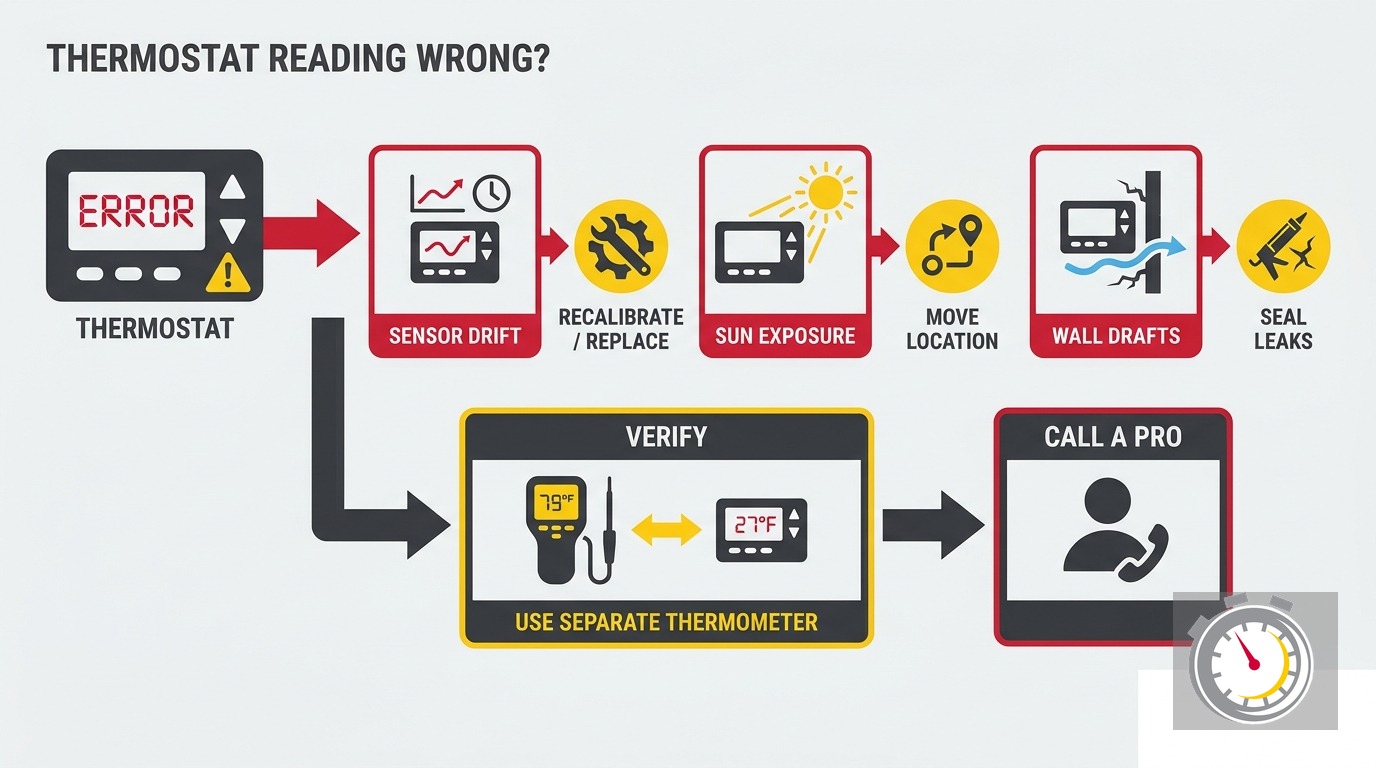
Key Takeaways
- A separate thermometer is the only fair way to check your thermostat.
- Place the test thermometer next to the thermostat, not across the room.
- Sun errors show up at the same hours each day.
- Wall draft errors follow the outdoor temperature and the wind.
- Drift errors stay the same at every hour and in every season.
- Do not recalibrate until you have verified the reading.
- Location problems need a new location. Sensor problems need a new thermostat.
- If you are unsure, call (763) 260-6662 or book online.
Why a Thermostat Reads the Wrong Temperature
Three things usually throw a thermostat off. Sun can heat it. A draft inside the wall can cool it. Or the sensor can drift over the years.
A cheap thermometer and a simple log will tell you which one you have. Plan on about a day, plus one cold night.
We are Northern One Hour Heating & Air Conditioning, a locally owned and operated team serving the Twin Cities. We see this every winter. A home feels cold while the display says 70. Or the furnace shuts off early because the wall near the thermostat is warm.
How Do You Know if Your Thermostat Is Reading the Correct Temperature?
Put a separate thermometer on the wall next to your thermostat. Wait 15 to 20 minutes. Compare the two readings. Repeat at a few times of day. A gap of 1 to 2 degrees is common. A steady gap of 3 degrees or more deserves a closer look.
Details matter here, because a rushed test gives you a bad answer.
What you need
- A basic digital thermometer, or two if you have them
- Painter’s tape
- A notepad or phone notes
- About 15 minutes per reading
A cheap digital thermometer works fine. Two are better. If they disagree with each other, the test tool is the problem. Check them side by side in the middle of a room first.
How to run the test
- Tape the thermometer to the wall about an inch away from the thermostat. Keep it at the same height.
- Do not touch it with your hands. Body heat skews the reading.
- Leave it for 15 to 20 minutes so it settles.
- Write down both numbers.
- Take readings at least three times: morning, mid-afternoon, and late evening.
- Take one more reading on a cold night, if you can.
One snapshot can mislead you. A thermostat that matches at noon may be 4 degrees off at 4 p.m. when low sun hits the wall.
Also take a reading in the middle of the room, away from walls and windows. This shows what the rest of the house feels like. If the room reading matches the thermostat, the thermostat is fine. If the room reading matches the wall thermometer, the spot is the problem.
Where Should a Thermostat Sit for an Accurate Reading?
A thermostat should sit on an interior wall, away from sun, drafts, vents, and heat sources. ENERGY STAR gives a clear rule: mount it on a wall that stays at a steady, typical room temperature. Placement is the most common cause of a wrong reading.
According to ENERGY STAR’s heating and cooling guide, you should “install your thermostat away from heating or cooling registers, appliances, lighting, doorways, fireplaces, skylights and windows, and areas that receive direct sunlight or drafts. Interior walls are best.”
A second ENERGY STAR thermostat guide adds a few more spots to avoid. These include doors or windows to the outside, vents, direct sunlight, and walls with ductwork.
Walk to your thermostat and check it against that list:
- Is it on an exterior wall?
- Does the sun ever land on it?
- Is there a supply vent or return within a few feet?
- Does a lamp or TV sit below it?
- Is there a duct running inside that wall?
One yes can explain a lot. For more, see our post on where a thermostat should be mounted in a Minnesota home.
Why Is My Thermostat Reading Higher Than the Actual Temperature?
A thermostat reads high when something warms the sensor but not the room. The usual causes are direct sun, a nearby lamp or appliance, warm air from a duct in the wall, or a sensor that has drifted. Test it against a separate thermometer to tell which one.
A high reading hurts your comfort in a simple way. The thermostat thinks the house is warm, so in winter it shuts the furnace off too soon. The rest of the house stays cool. You turn the setting up, and the problem repeats.
In summer, a low reading does the reverse. The thermostat thinks the house is cold. The AC shuts off early, and the home feels sticky.
Check these heat sources first:
- A lamp or TV on a table below the thermostat
- A kitchen wall shared with the oven or range
- A sunny window across the hall
- A hot duct in the wall cavity behind the thermostat
- A heat register close enough to blow on it
Move the source or shade the thermostat, then test again. If the gap stays the same, look at drift.
How Does Sun Exposure Fool a Thermostat?
Sun warms the thermostat’s case and sensor faster than the air in the room. The display climbs while the room stays cool. Sun errors follow the clock. They appear at the same hours each day and fade when the sun moves on.
Minnesota winters add a twist. The sun sits low from November through February. It reaches deep into rooms and strikes walls that stay shaded in summer. A south-facing hallway can bake a thermostat at 3 p.m. on a 15-degree day.
Signs of a sun problem:
- The reading jumps in the afternoon, then drops by evening.
- Cloudy days show a smaller error than sunny days.
- The gap grows when you open the blinds.
- Your home feels cool on bright winter afternoons while the display says it is warm.
To confirm, take a reading at noon and again at 3 p.m. Put your hand near the thermostat’s face and check for warmth. If the case feels warm to the touch, sun is likely the cause.
Here is a quick check. Hold a sheet of paper so it shades the thermostat for 20 minutes and watch the display. If the reading falls a few degrees, you have found the culprit.
The fix is usually to move the thermostat. A new spot on an interior wall solves it for good. Shades and curtains help, but they rarely hold up over the seasons.
Can Wall Drafts Make a Thermostat Read Too Low?
Yes. Cold air moving through a wall cavity can chill the thermostat’s sensor from behind. The display then reads lower than the room. Draft errors track the outdoor temperature and the wind. They get worse on cold, windy nights and ease on mild days.
This is the classic Twin Cities problem. Many of our homes have exterior walls with gaps around wiring and outlet boxes. The hole where the thermostat wires enter the wall is often open, and cold air can flow through it steadily.
Signs of a wall draft:
- The error gets bigger when the wind blows.
- It tracks the outdoor temperature, not the clock.
- The thermostat sits on an exterior wall.
- The wall feels cold to your hand.
- The furnace runs longer than it should, and the house feels hot.
Try a simple test. On a windy day, hold a tissue or a strip of tape near the thermostat’s edge. If it flutters, air is moving. You can also take the cover plate off and look at the wire hole. If it is empty, you have found a leak.
A small bit of fire-rated caulk or foam can seal the hole. It takes a few minutes, but turn off power at the breaker first. If you are not comfortable, leave it to a professional. Our post on why a furnace turns on and off but never reaches the temperature you set covers a related problem.
If sealing does not fix it, the wall is likely too cold for the thermostat. Move it to an interior wall.
What Is Sensor Drift, and How Do You Spot It?
Sensor drift is a slow change in how the thermostat measures temperature. Parts age, dust builds up, and the reading slides away from the truth. Drift errors stay constant. They show up at every hour, in every season, and in every room condition.
Picture a bathroom scale that is always 5 pounds off. It does not care what time it is. A drifted thermostat behaves the same way.
Signs of drift:
- The gap is the same at 8 a.m., 3 p.m., and 10 p.m.
- It is the same on sunny days and cloudy days.
- It is the same in January and July.
- The thermostat is more than 10 years old.
- The gap has grown over time.
Age matters. Dust and heat wear on the sensor, and electronics change slowly. If your unit is old and the error is steady, drift is likely.
Dust can also play a part. A thin film inside the case can insulate the sensor. Some owners can gently clean the inside with a soft brush or a puff of air. Turn off power first. Do not use liquids.
If cleaning does not help, the sensor is worn out. Replacement is cheaper than years of poor comfort. Our team handles thermostat service and replacement across the Twin Cities.
How to Tell Sun, Drafts, and Drift Apart
Keep a log for one day and one cold night. Write down the time, both readings, the gap, and the weather. Then look at the pattern. Time-linked errors point to sun. Weather-linked errors point to drafts. Errors that never change point to drift.
Here is a sample log:
| Time | Thermostat | Reference | Gap | Notes |
|---|---|---|---|---|
| 8 a.m. | 68 | 68 | 0 | Cloudy, 12°F outside |
| 12 p.m. | 70 | 68 | +2 | Sun on wall |
| 3 p.m. | 73 | 69 | +4 | Low sun in hallway |
| 7 p.m. | 69 | 69 | 0 | Dark |
| 2 a.m. | 64 | 68 | -4 | Windy, -5°F outside |
This sample shows two problems. The afternoon spike points to sun. The overnight dip points to a wall draft. A pure drift problem would show the same gap on every row.
To read your own log:
- Sun: The gap rises and falls on a daily schedule. It is positive in the afternoon.
- Wall draft: The gap is negative and grows with wind and cold.
- Drift: The gap is the same on every row, whether positive or negative.
Some homes have more than one cause. Fix the biggest one first and test again.
Should You Recalibrate Your Thermostat?
Not yet. Recalibrate only after you confirm the error is steady. If sun or a draft causes the gap, an offset setting will only hide the problem. It will also be wrong again when the weather changes.
Some thermostats let you enter an offset. For example, you can tell it to subtract 3 degrees. This works well for true drift, where the gap never changes.
It works poorly for sun or draft errors. The gap shifts through the day, so a fixed offset is right at 3 p.m. and wrong at 3 a.m. You end up chasing the number.
Follow this order:
- Verify with a separate thermometer.
- Log readings across a day and a cold night.
- Fix location problems first.
- Retest.
- Recalibrate only if a steady gap remains.
Check your manual before you try it. Not every model offers the setting, and the steps vary.
When Should You Relocate, Reseal, Recalibrate, or Replace?
Match the fix to the cause. Relocate for sun and bad placement. Reseal for wall drafts. Recalibrate for a small, steady drift. Replace when the unit is old, the gap is large, or other fixes fail.
| What you found | Best fix |
|---|---|
| Error at set hours, sun on the wall | Relocate to an interior wall |
| Error tracks wind and cold | Seal the wire hole, or relocate |
| Small, steady gap | Recalibrate with the offset setting |
| Large, steady gap | Replace the thermostat |
| Old unit with a growing gap | Replace the thermostat |
| Gap changes with nearby heat source | Move the heat source or the thermostat |
Relocating means running wires to a new spot. It sounds like a big job, but a technician can often finish it in one visit.
If you are replacing anyway, you can pick a smart model. Our guide on smart thermostats in the Twin Cities explains what to look for. ENERGY STAR notes that a smart thermostat should sit reasonably close to your router so it stays connected. Keep that in mind when you pick the new spot.
What Else Can Cause a Wrong Reading?
Other causes include weak batteries, wiring faults, dust inside the case, and software glitches. A thermostat can also end up in a poor spot because the home changed. A new addition or a remodel can alter airflow around the original location.
Check these simple items first:
- Batteries: Replace them if your thermostat uses them. A weak battery can cause odd readings or a blank display.
- Dust: Open the cover and look for buildup.
- Wiring: Loose wires can cause erratic behavior. Do not touch wires unless you know how to work safely.
- Software: Smart thermostats sometimes need a restart or an update.
- Nearby ducts: A duct in the wall can warm or cool the wall surface.
If the display goes blank, see our post on what to do when a thermostat screen goes dark. It covers power problems in more detail.
For other thermostat symptoms, read our thermostat troubleshooting guide.
Does a Wrong Reading Cost You Money?
Yes, it can. Heating and cooling make up a large share of your energy bill. A thermostat that misreads makes your system run at the wrong times. You pay for comfort you do not get.
ENERGY STAR reports that almost half of the annual energy bill in the average American household goes to heating and cooling. It puts that at more than $900 a year. A thermostat that is off by a few degrees works against that money.
Settings matter too. The U.S. Department of Energy says you can save as much as 10% per year on heating and cooling by turning the thermostat down 7°-10°F for 8 hours a day. That savings only works if the thermostat reports the real temperature.
Say your thermostat reads 4 degrees high. A setback to 62 may really be 58 in the rooms. If it reads low, you may heat a house that is already warm.
The same goes for the comfort guidelines in our post on what temperature to leave your house in winter in Minnesota. Those numbers only mean something when the sensor is honest.
Common Mistakes to Avoid
Homeowners tend to make the same few errors:
- Testing across the room. A thermometer on a table tells you about the room, not the thermostat. Put it right beside the unit.
- Testing once. One reading hides sun and draft errors. Take at least three.
- Holding the thermometer. Your hand adds heat. Tape it to the wall.
- Skipping the cold night. Wall drafts hide on mild days.
- Recalibrating first. A fix that covers up a draft will fail when the weather changes.
- Blaming the furnace. The furnace often works fine. The thermostat tells it the wrong story.
- Ignoring age. A thermostat that has run for many years may simply be worn out.
When to Call a Pro
Call a pro when your log shows a large gap, when the wall is cold, or when you are not comfortable working near wires. Also call if your fixes did not help. A technician can test the sensor and wiring, check for duct or draft issues, and move or replace the unit.
Our technicians do this work as part of heating and cooling service for homes across the Twin Cities. We can also look at the rest of your system. If a furnace runs oddly after you fix the thermostat, we will find out why.
Because we are locally owned and operated, we know how Minnesota homes behave. Cold exterior walls, wind, and low winter sun can all mislead a thermostat. We bring that experience to every visit.
We also respect your time. Our promise is “Always On Time… Or You Don’t Pay a Dime!(R)” We arrive within the time window you select. If the technician does not show up on time, you do not pay for the service.
Want your thermostat checked? Call us at (763) 260-6662 or book online.
Frequently Asked Questions
What does it mean when my thermostat displays "LO"? +
Need a technician now?