
Best Thermostat Placement for Your Minnesota Home
Key Takeaways
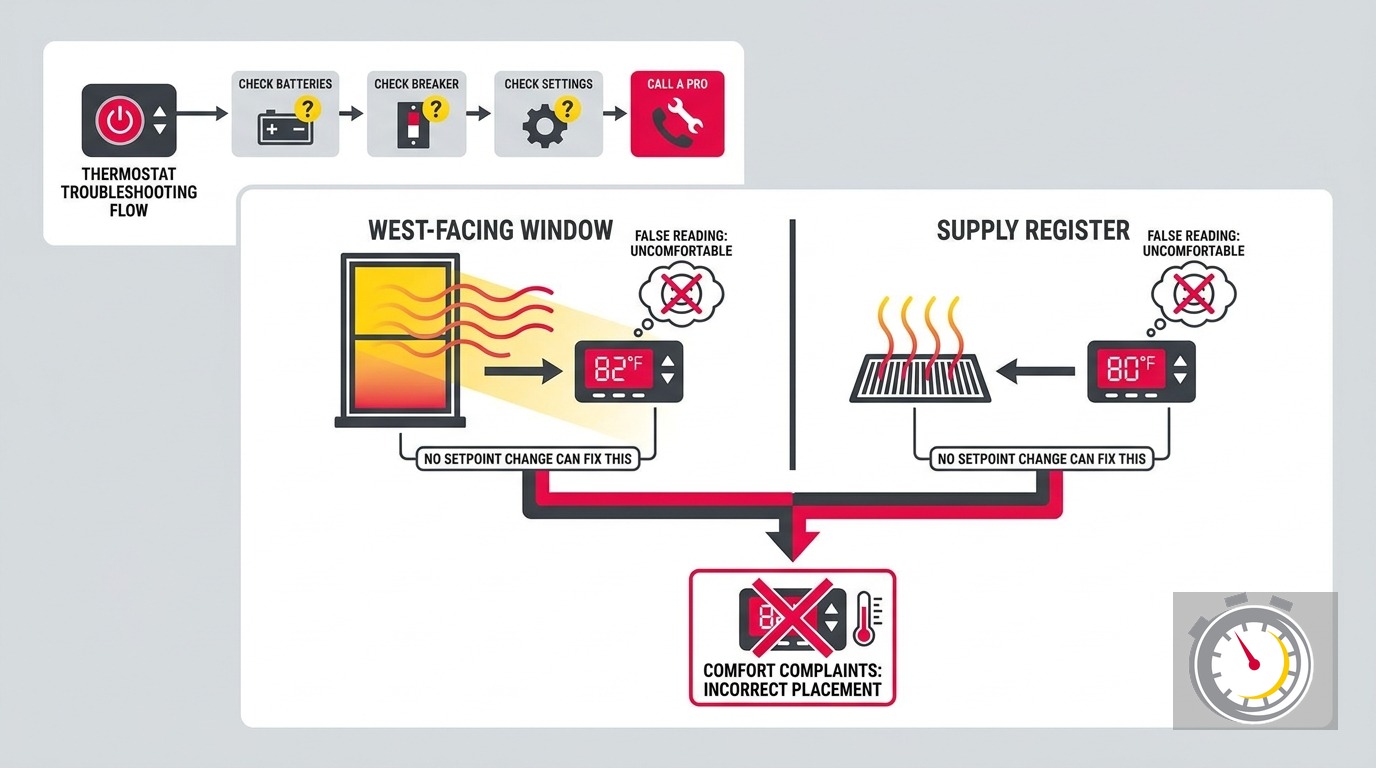
- A thermostat near a west-facing window can read 5-7°F warmer than your home’s actual air temperature, and up to 25°F warmer in extreme direct exposure.
- The west-facing window problem is time-stamped: comfortable in the morning, miserable after 2 PM on sunny afternoons.
- A thermostat above a supply register causes the opposite failure: short cycling that shuts the system off before the home reaches setpoint.
- Lowering the setpoint cannot fix either problem. The sensor is measuring the wrong environment.
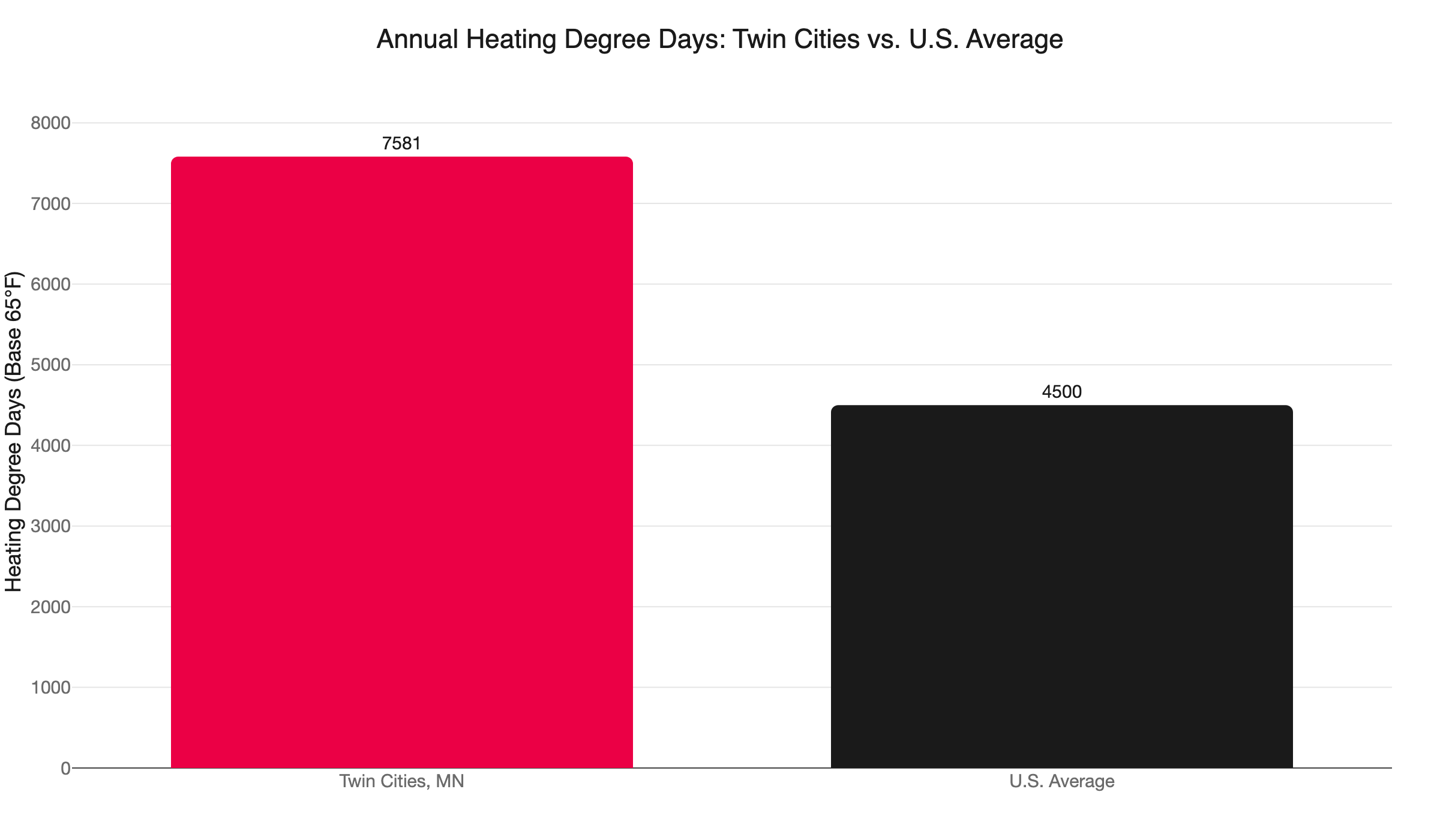
- In the Twin Cities, with 7,581 annual heating degree days, placement errors cost proportionally more than they would in warmer climates.
- Three exits exist: close the blinds as a free diagnostic test, add a remote sensor and claim a $50 utility rebate, or call Northern One Hour to relocate the thermostat permanently.
Is Your Thermostat Actually Measuring Your Home?
The short answer: Probably not, if it sits near a west-facing window or a supply register. Both locations cause what HVAC technicians call ghost readings: the sensor detects a local microclimate instead of your home’s actual air temperature. No setpoint change fixes a ghost reading. Only placement does.
If you have been adjusting your thermostat for months and your home still will not hold a comfortable temperature, the setpoint is not the problem. The location is.
Most homeowners assume the number on the thermostat screen reflects the temperature of their house. It reflects the temperature of the air immediately surrounding the sensor. On a neutral interior wall, those two readings are close enough to matter. Near a west-facing window or a supply register, they can be 5, 7, even 25 degrees apart. The system responds to what the sensor says. You feel what the house actually is. Those two experiences can be worlds apart.
What Is the Best Thermostat Placement for a Minnesota Home?
The short answer: The U.S. Department of Energy is direct: thermostats must be “on an interior wall away from direct sunlight, drafts, doorways, skylights, and windows,” approximately 5 feet off the floor, near the center of the home’s conditioned footprint, away from supply registers, kitchen appliances, and any exterior wall with strong sun exposure.
That rule exists for a reason. A thermostat placed anywhere else risks ghost readings: sensor data that does not represent the home’s actual temperature. The DOE warns that improper placement causes “ghost readings or unnecessary furnace or air conditioner cycling.” Two failure modes. Different causes. Different fixes.
In Minnesota, “interior wall” matters more than it does in moderate climates. Our exterior walls swing through large thermal ranges between seasons. A thermostat on an exterior wall in January reads colder air infiltrating through the insulation. The same wall in July reads radiant heat from the sun baking the siding. An interior wall averaging the home’s conditioned air is the only location where the sensor does its job accurately across all four seasons.
When an original builder ran thermostat wire to a convenient spot on a west-facing wall, or positioned it above an existing supply register because the wire was already nearby, they were solving a wiring problem. Not a comfort problem. Many Twin Cities homes built in the 1970s and 1980s have thermostats in exactly the wrong location for exactly this reason.
Why a West-Facing Window Is the Most Dangerous Thermostat Location in Minnesota
Every competitor article on thermostat placement says “avoid windows.” None of them say which window. Direction matters because solar intensity is not symmetric around a house.
West-facing glazing receives peak solar intensity in the afternoon, when outdoor temperatures are already at their daily maximum. That combination, maximum sun angle meeting maximum outdoor temperature, creates the most severe cooling load of any window orientation. North-facing windows receive almost no direct sun. East-facing windows catch morning sun when outdoor temperatures are mild. South-facing windows are predictable and manageable with standard overhangs. West-facing windows hit hardest at the worst moment of the day.
Standard glass transmits roughly 70-75% of incident solar energy directly into the room as heat gain. A room near a west-facing window can feel 10-15°F warmer than a room on the shaded north side of the same house, even when the thermostat shows the target setpoint.
Now put the thermostat on that west-facing wall.
Direct sunlight on a thermostat sensor can drive its reading 5-7°F above actual ambient air temperature. In extreme cases with prolonged direct exposure, the error can reach 25°F. The plastic housing absorbs radiant heat and retains it for hours after the sun moves on. Your system runs longer than it should. Rooms away from the problem window overcool. You feel cold, the thermostat does not, and every setpoint adjustment you make chases a target the sensor cannot accurately report.
Why Are You Uncomfortable After 2 PM Every Afternoon?
The short answer: West-facing windows receive their peak solar load between roughly 2 and 5 PM. A thermostat near that glass begins sending inflated readings to your system during that window, triggering longer cooling cycles that overcool the rest of the home. The discomfort is not random. It has a clock.
This time-stamp is the diagnostic question that separates a placement problem from an equipment problem. Is the discomfort consistent? Does it arrive around the same time every sunny afternoon and resolve in the evening or on overcast days? If yes, the sun is the diagnosis.
The failure sequence on a typical summer afternoon in the Twin Cities:
- 7 AM: The sun is on the east side of the house. The thermostat reads the room accurately. The house is comfortable.
- 12 PM: The sun is overhead. Your home holds temperature without issue.
- 2-3 PM: The sun moves west and hits the thermostat’s plastic housing directly or through the glass nearby. The sensor reads 74°F when the living room is actually 70°F.
- 3-5 PM: Your AC runs extended cycles chasing that inflated reading. Rooms away from the west wall cool to 65°F. You add a blanket. The thermostat screen shows 70°F. Your body disagrees.
- 7 PM: The sun drops below the roofline. The sensor cools. The system cuts off. Your home is now too cold before the thermostat recalibrates.
If that pattern matches your experience, the thermostat’s location, not its setpoint, not its age, not your equipment, is the problem.
What Happens When a Thermostat Sits Above a Supply Register?
The short answer: The thermostat senses conditioned air the instant a heating or cooling cycle starts and signals the system to shut off before the rest of the home reaches setpoint. This is register-driven short cycling: frequent on-off cycling that stresses equipment and never stabilizes your home’s temperature.
A west-facing window makes the sensor read too warm, driving extended run cycles. A supply register does the opposite: it makes the sensor read the target temperature almost immediately and stops the cycle too soon.
Here is how it works. Your thermostat calls for cooling. The system starts. The supply register directly below or above the thermostat pushes 55°F air across the sensor. Within moments, the sensor reads the setpoint. The system shuts off. The bedroom across the house is still 78°F. Three minutes later the ambient air around the thermostat warms again. The system calls for cooling again. The cycle repeats, never making real progress.
HVAC technicians define this as a ghost reading: the thermostat temperature does not reflect actual home temperature, causing “unnecessary system cycling and energy waste.” Short cycling from register placement looks identical to short cycling from low refrigerant or an oversized system. If you have been chasing a short-cycle problem and your equipment checks out, look at where the thermostat sits relative to the nearest supply register.
Our post on AC short cycling causes and fixes in the Twin Cities covers the full list of causes if you want to rule out equipment factors before scheduling a service call.
Why Doesn’t Lowering the Setpoint Fix the Problem?
The short answer: A setpoint is an instruction to the system. The sensor is the system’s only way to verify that instruction has been met. If the sensor carries a 7°F error, changing the setpoint shifts the target, not the error. The sensor keeps lying by the same amount.
This runs counter to homeowner intuition. When the house feels too warm, you lower the setpoint. That is the natural move. But if the sensor is reading 7°F warmer than your home actually is, lowering the setpoint from 74°F to 71°F tells the system to run until the sensor reads 71°F. The sensor cannot read 71°F until your home is actually 64°F. Your living room becomes uncomfortably cold. The thermostat screen shows 71°F. Your body tells you otherwise.
You have not fixed the comfort problem. You have shifted the discomfort from “too warm in the afternoon” to “too cold until the sun moves.” And your energy bills go up in both directions. The fix is not a different number on the thermostat. The fix is a sensor that accurately measures your home.
What Do Minnesota’s Climate Numbers Have to Do With Thermostat Placement?
The short answer: They make every placement error more expensive. The Twin Cities records 7,581 heating degree days annually, roughly double the U.S. populated-area average of around 4,500. We operate in IECC Climate Zone 6A, meaning our systems run under extreme demand for more of the year than most of the country.
The math is direct. A placement error that adds 10% to your system’s run time costs twice as much here as in a city near the national heating degree day average. We are not burning fuel 50 extra days per year in an abstract sense. We are burning it during polar vortex weeks when the furnace is already working at capacity. A thermostat that tells the furnace to run longer than necessary during those weeks drains real money across every billing cycle.
ENERGY STAR data shows that smart thermostats save the average household more than 8% on heating and cooling energy, about $50 per year nationally. The EPA notes that high-HDD climates like Minnesota see proportionally larger dollar savings because the baseline spend is larger. The percentage is the same. The dollars are not.
Accurate thermostat readings are not a nice-to-have in the Twin Cities. They are a meaningful financial decision across every heating and cooling season.
Three Ways to Fix a Misplaced Thermostat
You have options, ranging from free to a couple hundred dollars. The right choice depends on how severe the placement error is and how much you want to invest in a permanent solution.
Option 1: Control the light (free, diagnostic)
Close the blinds or curtains on the west-facing windows nearest the thermostat every afternoon, starting around 1 PM. Do this for two or three days. If the afternoon comfort problem disappears, you have confirmed the diagnosis: the sun is hitting the sensor.
Reflective window film is a more durable version of the same fix. Neither option solves the placement problem permanently, but both reduce the solar load on the sensor enough to restore reasonable comfort while you decide on the next step.
Option 2: Add a remote sensor (mid-range, often $30-50 out of pocket after rebate)
Many smart thermostats support remote sensors that let the system average readings from multiple locations, or defer entirely to a sensor in a neutral interior room. This resolves most west-facing window and supply register placement errors without moving the thermostat or fishing new wire through your walls.
Both major Minnesota utilities currently offer rebates on qualifying smart thermostats. Xcel Energy residential customers can claim up to $50 on an ENERGY STAR certified smart thermostat. CenterPoint Energy natural gas residential customers can claim a $50 rebate through Dec. 31, 2026. A compatible remote sensor typically runs $30-50 additional. In most cases, you can fix a placement error for $30-50 net out of pocket.
Our blog covers smart thermostat options for Twin Cities homeowners in detail if you want to compare specific models before buying.
Option 3: Relocate the thermostat (permanent)
If the placement error is severe, if remote sensor coverage is not practical for your floor plan, or if you want the problem solved correctly and for good, the right answer is a physical relocation. The thermostat moves to a neutral interior wall, 5 feet off the floor, away from all windows, registers, and exterior walls.
This requires a licensed HVAC technician to extend or reroute the thermostat wiring. Thermostat wiring connects directly to your HVAC equipment’s control board, and a wiring error there is an expensive mistake. Done correctly, a relocation gives you accurate readings for the life of your next thermostat, typically 10-15 years, with no workarounds.
Our thermostat troubleshooting guide walks through the common symptoms if you want to confirm the diagnosis yourself first. Our thermostat services page explains what a professional assessment and relocation involves.
When Should You Call Northern One Hour?
The short answer: Call when the blind-closing test confirms a placement diagnosis, when a remote sensor is not sufficient to correct the error, or when you want a professional to assess the home and recommend the best permanent location for accurate readings.
We are locally owned and operated in Ramsey, MN. Our team serves the full Twin Cities metro: Minneapolis, St. Paul, Blaine, Maple Grove, Plymouth, Brooklyn Park, Woodbury, Bloomington, and the surrounding communities. Thermostat assessments and relocations are regular work for us, because older Twin Cities homes often have thermostats exactly where the builder’s wiring made it convenient, not where comfort science says it should be.
If you have been adjusting your setpoint for months without resolving the problem, a placement assessment is a short appointment that often closes a years-long comfort complaint. We back every service call with “Always On Time… Or You Don’t Pay a Dime!(R).” Call (763) 260-6662 or book online. We will show up when we say we will, give you a straight answer, and get your thermostat reading your home instead of the sun.
Frequently Asked Questions
Where should a thermostat be placed for best results? +
Can a misplaced thermostat raise my energy bills? +
Do I need to move the thermostat to fix a placement problem? +
What is a ghost reading on a thermostat? +
Need a technician now?