
Furnace Blower Turns On and Off Before Heat Is Warm
Key Takeaways
- A short wait before warm air arrives is normal. The blower holds off until the furnace’s inner metal parts heat up.
- A cold blast at the start of a cycle usually means the fan timing is working as designed, or the thermostat fan is set to On.
- True short cycling is different. The burner shuts off before the house reaches the set temperature, and that is a fault.
- Start with the filter, the vents, and the thermostat. Those fixes cost little and take minutes.
- Call a technician if the burner keeps cycling off, you see an error code, or you smell gas or burning.
- Northern One Hour is locally owned and operated in the Twin Cities, and we can diagnose the problem fast.
Why Does My Furnace Blower Wait Before Blowing Warm Air?
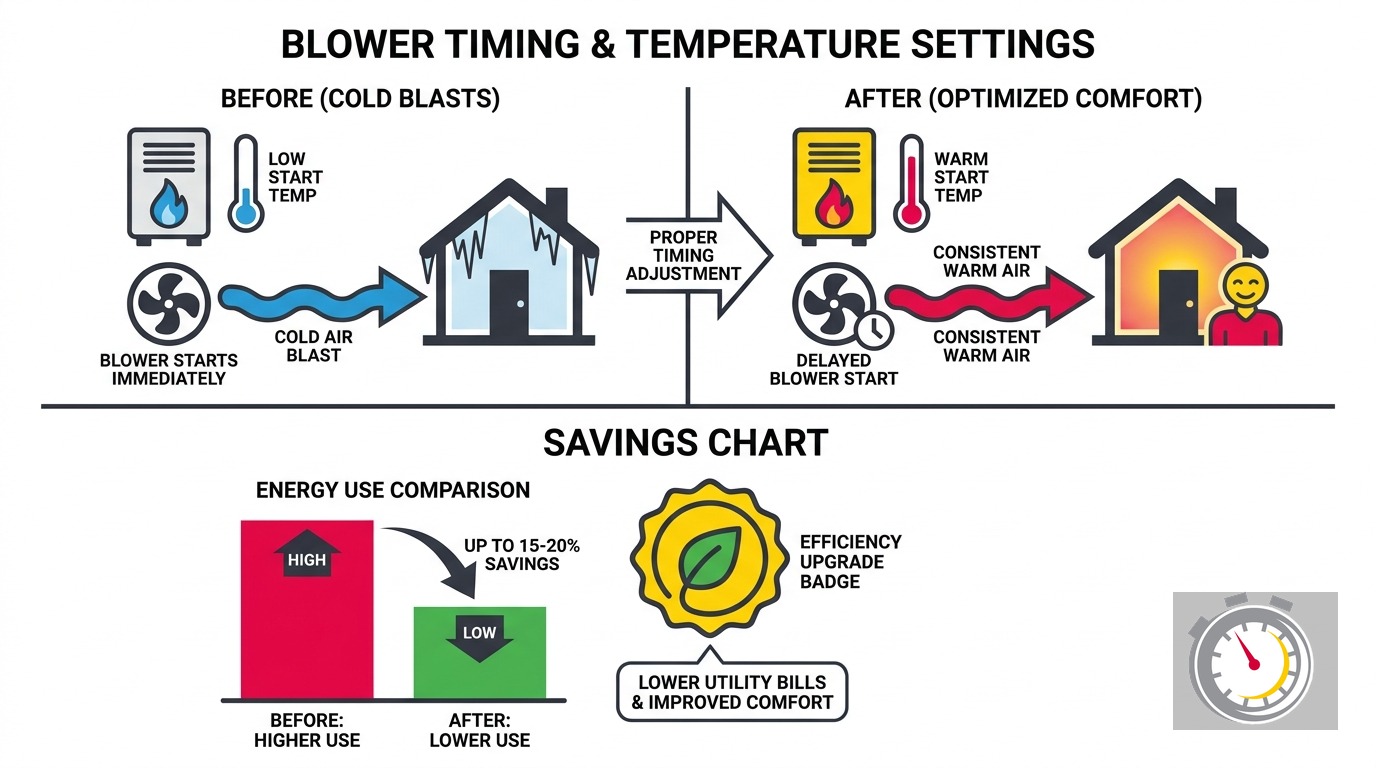
Quick answer: Your furnace delays the blower on purpose. The burner lights first, and the blower waits until the heat exchanger is warm. If the fan started right away, it would push cold air through your vents. The short wait is normal, not a defect.
Here is the order of events in a typical gas furnace:
- The thermostat calls for heat.
- The inducer fan clears the vent pipe and the burners light.
- The heat exchanger warms up.
- The control board starts the main blower.
- Warm air travels through your ducts to the rooms.
Step 4 is where people get confused. You hear the burners and feel nothing at the register. That gap is the fan-on delay.
Some homeowners feel a brief wave of lukewarm or cool air when the blower finally starts. It happens when the blower kicks on a little early, or when the ducts still hold cold air from the last cycle. Both are common.
If your system cycles off before the house warms up, read our guide on why a furnace turns on and off every few minutes. It goes deeper on filters and thermostats.
What Are Fan-On and Fan-Off Settings?
Quick answer: Fan-on and fan-off settings tell the furnace when to start and stop the blower during a heating cycle. Fan-on controls how long the blower waits after the burner lights. Fan-off controls how long the blower keeps running after the burner shuts down. The control board manages both.
The control board is the furnace’s brain. It watches the burner, the safety switches, and the clock. Most boards let a technician adjust the timing.
Some older furnaces used a temperature-based fan switch instead. It sat inside the furnace and opened and closed with the heat. Many newer furnaces use timed settings on the board. Either way, the goal is to move warm air, not cold air.
Fan-on delay
The fan-on delay is the wait before the blower starts. It gives the heat exchanger time to warm up. A very short delay means cooler air at the start. A very long delay means a longer wait, and it can let the furnace run hotter inside than it should.
Fan-off delay
The fan-off delay is the run-on after the burner stops. The blower keeps moving air to pull the last heat out of the heat exchanger and into your home. The Minnesota Center for Energy and Environment describes this as the amount of time the air handler fan keeps operating after a cooling or heating cycle.
Trane says the fan will typically keep running for one to five minutes after a heating or cooling cycle. If your blower runs after the flames go out, that is normal.
Why these settings matter
Poor settings can cause three problems:
- Cold air at the start of the cycle
- Warm air that never reaches the rooms because the blower stops too soon
- A furnace that overheats inside and trips a safety switch
Leave these changes to a technician. The right numbers depend on your furnace model and your ductwork.
Why Do Minnesota Winters Make the Cold Blast Worse?
Quick answer: Cold weather makes the delay feel longer. The return air is colder, the ducts may run through cold spaces, and the heat exchanger has more work to do. Note that this is a general explanation of how heat moves, not a measured Minnesota statistic.
What follows is basic physics and field experience, not a sourced study. We offer it so you can make sense of what you feel at the register.
On a January morning in the Twin Cities, your furnace starts with a lot working against it:
- Cold return air. Air pulled in from a cold basement or a drafty room starts well below room temperature.
- Cold duct runs. Ducts in an unheated attic, crawl space, or outside wall hold cold air between cycles.
- Cold metal. The heat exchanger and cabinet start cold, so they take longer to warm.
- Cold incoming gas and combustion air. In a deep freeze, everything about the start-up is slower.
You get a longer wait and a more noticeable cold puff. The first air out of the register may push out the cold air that sat in the duct. It feels cool even though the furnace works fine.
Homes with long duct runs or ducts in cold spaces feel this most. Older Twin Cities homes often fit that description. Our post on why older Twin Cities homes struggle with winter comfort covers the building side.
Why Does My Furnace Keep Turning Off Before the House Is Warm?
Quick answer: A furnace that shuts off early is usually protecting itself. Common causes are a clogged filter, blocked vents, a dirty flame sensor, a tripped high-limit switch, or a furnace that is too big for the home. Each one has a different fix.
This is true short cycling, and it differs from the normal blower delay. The burner starts, runs briefly, and quits before the thermostat is satisfied. Then it starts again.
The most common causes follow.
Restricted airflow
A dirty filter chokes the airflow. The heat exchanger gets too hot, and the high-limit switch shuts the burner down. The blower keeps running to cool things off. Then the burner tries again.
Closed or blocked registers do the same thing. So do crushed ducts and dirty blower wheels.
Dirty flame sensor
The flame sensor tells the board the burner is lit. When residue coats it, it can fail to detect the flame. The board then shuts off the gas for safety. The furnace may light for a few seconds and quit. Our guide to dirty flame sensors shows the signs.
Tripped limit switch
The limit switch is a safety device that opens when the furnace gets too hot. If it trips again and again, the problem is airflow or the switch itself. Our post on limit switch failure has the details.
An oversized furnace
A furnace that is too large heats the house too fast. It reaches the set temperature in a short run and shuts off, then repeats. That wears out parts and wastes fuel. We cover this in oversized furnace problems.
Thermostat trouble
A thermostat near a supply vent, in direct sun, or on a cold exterior wall can misread the room. It may shut the furnace off too soon. Placement matters more than most people think.
How Can I Tell Normal Delay From a Real Problem?
Quick answer: Normal delay is short, happens only at the start of a cycle, and ends with steady warm air until the thermostat is satisfied. A problem shows up as repeated burner cycles, cold air that never warms, error codes, or odd smells and sounds.
Try this simple test the next time the heat runs.
Signs that your furnace is normal
- You hear the burners light, then the blower starts after a short wait.
- The air from the registers warms up within a few minutes.
- The furnace runs until the room reaches the set temperature.
- The blower runs a few minutes after the burner stops.
- The air stays warm during the heating run.
Signs of a fault
- The burner lights and shuts off again and again.
- The air stays cold for the whole cycle.
- The blower starts and stops while the burner is off.
- The furnace shows a blinking light or error code.
- You smell gas, smoke, or burning dust that does not clear in a short time.
- The house never reaches the thermostat setting.
Time the cold air. If it lasts a short while and then turns warm, that points to normal delay. If it never warms up, see our post on a furnace that runs but blows cold air.
If you smell gas, leave the house and call your gas utility from outside. Do not use switches or phones inside.
Thermostat Fan Setting: Auto Versus On
Many “cold blast” complaints come from one switch on the thermostat. The fan setting has two common choices: Auto and On.
- Auto: The blower runs only when the furnace heats. The control board decides when to start and stop it.
- On: The blower runs all the time, even when the burner is off.
Trane notes that a thermostat fan set to On can blow cool air when the furnace is not producing heat. That is the cool air you feel between cycles.
If you feel cool air at the vents while the furnace is idle, check the setting. Switch it to Auto and wait. Many people find that one step solves it.
There are good reasons to run the fan On. Some homes use it to even out temperatures or move air through a filter. It will not feel like heat, though. For more, read our guide to the thermostat fan Auto versus On setting.
How Do I Fix My Furnace From Short Cycling?
Quick answer: Start with the basics. Replace a dirty filter, open all vents, clear the area around the furnace, and check the thermostat. If the furnace still cycles off early, a technician should test the flame sensor, limit switch, and airflow.
You can do the first steps safely. Work through them in this order.
Step 1: Check the filter
Pull the filter and hold it to the light. If you cannot see through it, replace it. The U.S. Department of Energy guidance covers filter care and says to follow the manufacturer’s recommendation. Check the label on your furnace or filter box for the schedule that fits your model.
In a Minnesota heating season the furnace runs a lot. Filters load up faster than many people expect.
Step 2: Open the vents and returns
Make sure every supply register and return grille is open and clear. Move furniture, rugs, and drapes away. Closing vents in unused rooms can raise pressure in the ducts and hurt airflow.
Step 3: Check the thermostat
Confirm the mode is set to Heat and the fan is on Auto. Replace the batteries if the thermostat uses them. Make sure nothing blocks or heats it, such as a lamp or a sunny window.
Step 4: Clear the furnace area
Keep the space around the furnace free of boxes and stored items. The furnace needs room for combustion air. Our post on furnace clearance explains what to keep clear.
Step 5: Call a technician
If the furnace still short cycles, stop. Do not remove panels or bypass any safety switch. Those switches protect your family from carbon monoxide and fire.
A technician can:
- Clean the flame sensor
- Test the limit switch
- Measure airflow and static pressure
- Check the blower and its capacitor
- Read the control board codes
- Test the safety circuit and venting
Our furnace repair team handles all of these. We also tell you when a repair makes sense and when it does not.
How Do I Reset My Furnace?
Quick answer: Turn the thermostat to Heat and set it above room temperature. Check that the furnace switch and the breaker are on. If the furnace has a reset button, press it once. If it shuts down again, stop and call a technician.
A reset does not fix a cause. It only clears a lockout. Here is a safe way to try it.
- Set the thermostat to Heat and raise the temperature setting a few degrees.
- Check the furnace power switch. It looks like a light switch on or near the furnace.
- Check the breaker for the furnace in your panel.
- Replace a dirty filter if you find one.
- Wait a few minutes to see if the furnace starts its cycle.
- If your furnace has a reset button, press it one time.
Do not press the reset button over and over. A furnace that needs repeated resets has a problem. Repeated tries can also cause a gas buildup in some cases.
If the furnace locks out after a reset, our post on ignition lockout that will not reset explains what may be wrong.
You can also read the furnace error code blinking light guide to see what the pattern on the board means.
How Much Does It Cost to Replace a Blower Motor?
Quick answer: In the Twin Cities, a blower motor replacement typically starts around $1,100 for a standard PSC motor and about $2,200 for a variable-speed ECM motor, installed. Other timing-related repairs cost less. The right number depends on your furnace.
Blower timing problems do not always mean a bad blower. Other parts often cause them. Here is what common repairs run for installed work, parts and labor.
| Repair | Typical Twin Cities cost |
|---|---|
| Flame sensor or igniter service | $95-$325 |
| Capacitor repair | $195-$500 |
| Draft inducer motor | $375-$900 |
| Control board, installed | About $750 |
| Blower motor, PSC | About $1,100 |
| Blower motor, ECM | About $2,200 |
These are starting ranges, not quotes. Brand, model, access, and warranty status all change the price. A technician must see the furnace to give you a firm number.
Why a blower motor can cost so much
An ECM motor is a variable-speed motor with its own electronics. It runs quietly and uses less power than a PSC motor. It also costs more to buy and install.
Signs that the blower itself is failing include:
- A loud grinding or squealing sound
- A blower that does not start
- A motor that hums but does not spin
- A burning smell from the cabinet
- A blower that overheats and shuts off
Our guide to furnace blower motor failure signs and cost has more detail.
Repair or replace?
If your furnace is old and the repair bill is large, compare it against a new unit. A furnace replacement in the Twin Cities typically runs from about $3,900 to $7,800 installed. Higher-efficiency and variable-speed models cost more.
The U.S. Department of Energy guidance also suggests thinking about replacement when a furnace is more than 15 years old, per the DOE Energy Saver guide. A 15-year-old furnace with a $2,200 motor repair is a hard call. We lay out the numbers honestly and let you choose.
We offer financing on larger jobs, so a replacement does not have to hit all at once. Ask us about options when we visit.
Does a Longer Fan-Off Delay Save Gas?
Some people have heard that changing the fan-off delay can save fuel. The research is less simple than that.
The Minnesota Center for Energy and Environment ran a field study on a fan-delay controller. According to the MNCEE fact sheet, “for 14 of 20 sites, there was no statistically significant difference in annual gas use” between systems with and without the controller.
In plain terms, for most homes in that study, adding the controller made no measurable difference. Fan timing is mostly about comfort and furnace health, not big savings.
The MNCEE project page describes the same Minnesota-based research effort. We cite the fact sheet for the figures above.
So do not chase gas savings by changing timing. Set it to protect the furnace and keep you comfortable, and let a technician choose the values.
What a Technician Checks on a Visit
When you call us about a cold blast or a furnace that cycles off, we follow a set process. Here is what to expect.
- Listen to your story. When does it happen? How long does the cold air last?
- Watch a full cycle. We time the ignition, the blower start, and the shutoff.
- Check the filter and airflow. We measure how well air moves through the system.
- Test the safety devices. That includes the limit switch, pressure switch, and flame sensor.
- Review the control board settings. We check the fan-on and fan-off timing against your furnace specs.
- Inspect the ducts and vents. We look for leaks, crushed runs, and weak spots.
- Explain the findings. You get plain language and a clear price before work starts.
A yearly tune-up catches many of these problems early. A single tune-up visit typically runs $95 to $250. A maintenance plan runs $195 to $390 per year. Both cost far less than an emergency call in a January cold snap. See our furnace tune-up service for what we cover.
Tips to Reduce the Cold Blast at Start-Up
You may not be able to remove the delay, but you can often make it feel better. Try these steps.
- Keep the thermostat on Auto, so cool air does not move between cycles.
- Replace the filter on the schedule the manufacturer sets.
- Seal and insulate ducts that run through cold spaces.
- Open all registers, and keep returns clear.
- Avoid big thermostat swings. A deep setback means a longer first cycle.
- Schedule a tune-up before the cold season starts.
A variable-speed blower can also smooth things out. It ramps up slowly, so the air feels gentler at the start. Our post on variable speed blower motor furnace benefits explains the difference.
When to Call Right Away
Some signs mean you should stop troubleshooting and call us.
- You smell gas. Leave the home first, then call.
- You smell smoke or burning plastic from the furnace.
- Your carbon monoxide detector sounds.
- The furnace locks out again after a reset.
- The blower will not start at all in cold weather.
- You hear loud banging, grinding, or screeching.
Do not put off a heating problem in a Minnesota winter. Cold pipes and a cold house can turn into bigger repairs fast.
Why Choose Northern One Hour
We are a locally owned and operated Twin Cities heating and air conditioning company. We serve homeowners in Minneapolis, St. Paul, Ramsey, Blaine, Maple Grove, Plymouth, Brooklyn Park, Woodbury, Bloomington, and nearby communities. We know what a Minnesota winter does to a furnace.
We back our service with a promise: “Always On Time… Or You Don’t Pay a Dime!(R)” We arrive within the time window you select. If our technician does not show up on time, you do not pay for the service.
You also get honest, transparent pricing and a 100% satisfaction guarantee. We explain what we find, what it costs, and what your options are. We do not push parts you do not need.
If your furnace blower turns on and off before the heat is warm, we can tell you whether it is normal timing or a real fault. Call us at (763) 260-6662 or book online to schedule fast.
Frequently Asked Questions
Can a furnace be repaired if it keeps shutting off unexpectedly? +
Need a technician now?