
Furnace Blowing Cold Air Instead of Heat? MN Fix Guide
Key Takeaways
- Cool air for the first 30 to 60 seconds after startup is normal. Longer than that is not.
- Start with the thermostat, the fan setting, the filter, and the vents.
- After snow, check the outdoor intake and exhaust pipes of a high-efficiency furnace.
- Do not touch the gas valve, burners, or control board. Those jobs belong to a technician.
- Never press repeated reset attempts. One reset is the limit.
- A gas smell means you leave the house and call the gas utility from outside.
- Cool air plus headache, nausea, or dizziness can point to carbon monoxide. Treat it as an emergency.
- Minnesota law requires a working CO alarm near every sleeping area.
The Short Answer for Twin Cities Homeowners
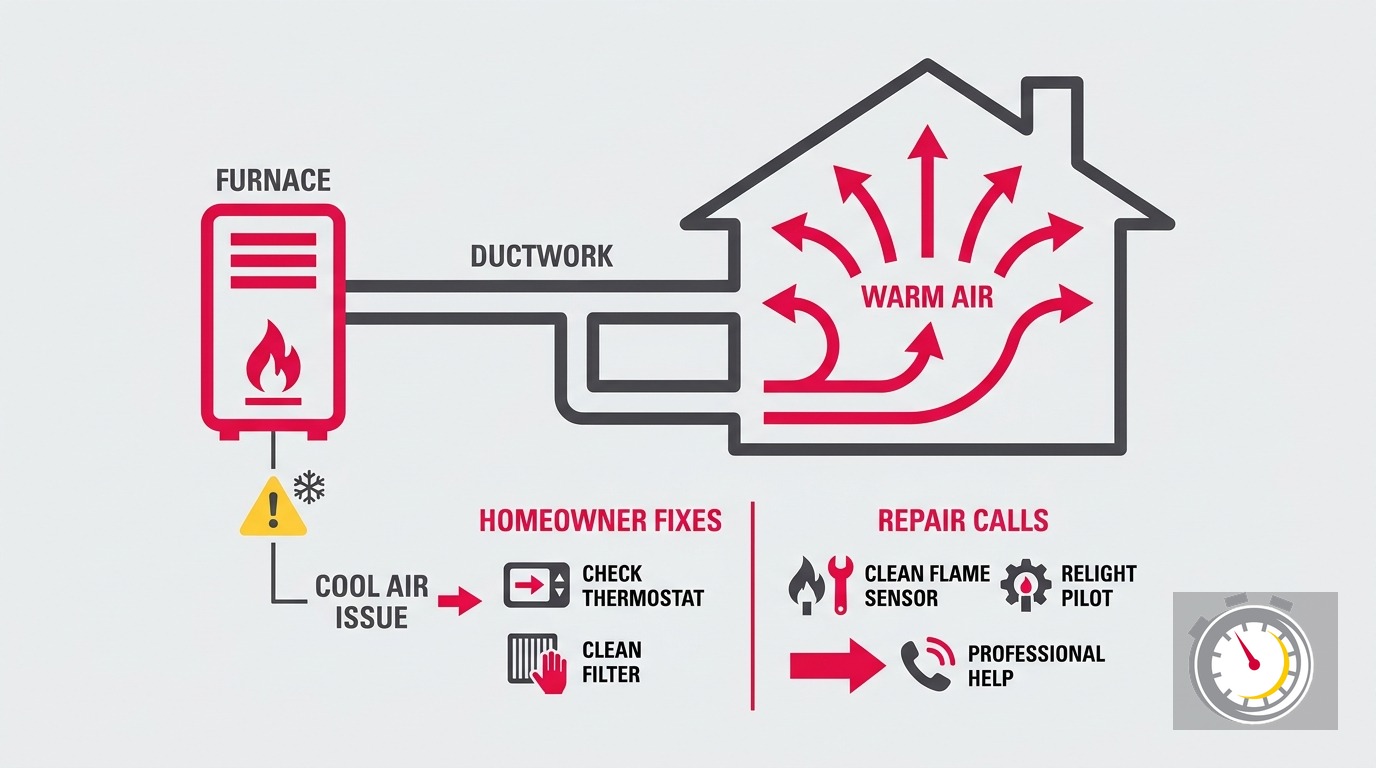
A furnace that runs but blows cool air usually has a simple cause. Check the thermostat, the fan setting, the filter, and the vents first. After a snowfall, go outside and look at the PVC pipes on your house. If the air stays cool, stop and call a pro.
Work in this order: two-minute fixes, then the outdoor pipes, then the problems that belong to a technician.
We are Northern One Hour Heating & Air Conditioning, a locally owned and operated company serving the Twin Cities. We get this call often when the first deep cold of the season arrives.
Why Is Cold Air Blowing When the Heat Is On?
Cold air means the blower is running but the burners are not heating the air. Common reasons include a thermostat set to “on,” a dirty flame sensor, a tripped safety switch, a blocked vent pipe, or restricted airflow. Each has a different fix.
A furnace has two jobs. It makes heat, and it moves that heat through your ducts. When cool air comes out, one of those jobs has stalled.
Sometimes the burners never light. Sometimes they light and shut off within seconds. Sometimes the burners work fine, but the heat never reaches the room.
Here are the main causes, from easiest to hardest:
- The thermostat fan is set to “on” instead of “auto.”
- The filter is clogged and airflow is choked.
- Supply vents are closed or blocked by furniture.
- Snow or ice has blocked the outdoor intake or exhaust pipe.
- A dirty flame sensor is shutting the burners off early.
- A limit switch has tripped from overheating.
- The control board has failed.
The sections below follow that order. Stop wherever the instructions say to stop.
Is a Few Seconds of Cool Air at Startup Normal?
Yes. A furnace needs time to warm up before the blower starts. According to Carrier, the blower may wait 30-60 seconds after ignition. Brief cool air at startup is normal. Cool air beyond that needs attention.
The delay is deliberate. The blower waits so it does not push cold air through the house. Once the heat exchanger warms up, the fan starts and the air turns warm.
Time it. Stand at a supply vent when the furnace starts and count the seconds on your phone.
If warm air arrives within about a minute, your furnace is working as designed. If cool air keeps coming after several minutes, move on to the checks below.
Some furnaces also run the blower at the end of a cycle to push out the last of the heat. The cooler air you feel then is normal too.
Step 1: What Can You Check in Two Minutes?
Start at the thermostat, then the filter and vents. These checks need no tools. Confirm the thermostat is on “heat,” set above room temperature, and set to “auto” fan. Replace a dirty filter, open closed vents, and confirm the furnace switch is on.
Work through this list in order.
1. Check the thermostat mode. Make sure it reads “heat,” not “cool” or “off.” Raise the setting five degrees above the room temperature.
2. Check the fan setting. If the fan reads “on,” the blower runs all the time. Between heat cycles, it pushes unheated air into your rooms. Switch it to “auto.” Our guide to the auto versus on fan setting explains the difference.
3. Check the batteries and display. A blank or dim screen can cause odd behavior. Replace the batteries if your model uses them. Our thermostat troubleshooting guide covers more cases.
4. Check the furnace power switch. It looks like a light switch near the furnace. It gets flipped by accident more often than you might think, by work crews and homeowners alike.
5. Check the filter. Slide it out and hold it to the light. If you cannot see light through it, replace it with the right size. Our post on how often to change your HVAC filter gives timing for Minnesota homes.
A clogged filter can overheat the furnace. The limit switch then shuts the burners off to protect the unit. The blower keeps running, and the air turns cool.
6. Check the vents. Walk the house. Open every supply register and move rugs, couches, and curtains away from them. Closing vents in unused rooms does not save energy. It raises pressure in the ducts. See our post on closing vents in unused rooms.
After a filter change, give the furnace time. Bob Vila suggests calling a pro if the air is still cool a few hours after a filter change.
Step 2: What Should You Check Outside After a Snowfall?
If you own a high-efficiency furnace, walk outside and look at the white PVC pipes on your house. Snow, ice, or drifts can block them. A blocked pipe stops the furnace from starting or running. Clear the snow gently by hand, then restart the furnace.
Most guides skip this step, and in Minnesota it matters.
High-efficiency furnaces pull air from outside through one pipe and push exhaust out through another. A utility warning reported by Michigan Public says snow can pack the intake and block it. Blocked airflow trips the pressure switches, and the furnace will not start.
Here is what to look for:
- Drifts piled against the pipes on the side of the house.
- Ice forming at the pipe opening.
- Frost or ice buildup around the exhaust outlet.
- Leaves, nests, or debris in the opening.
Clear the area by hand. Don’t chip at the pipe with a shovel or ice pick, because PVC cracks in the cold.
Don’t poke anything into the pipe either. If you cannot clear the blockage safely, stop and call us. Birds and small animals also nest in these pipes. Our post on animals nesting in furnace vents covers that problem.
For more detail, read our guide to a high-efficiency furnace exhaust vent blocked by snow or ice. If the pipes are clear and the furnace still struggles, the cause is somewhere else.
Check the condensate line as well. High-efficiency furnaces make water as they run, and a blocked drain can trip a safety switch. Per Bob Vila, a blocked condensate drain can trigger an overflow safety switch. You can clear the line yourself, but a broken condensate pump should go to a pro.
In a Minnesota winter, a condensate line in a cold basement can also freeze. See our post on a frozen high-efficiency furnace condensate drain.
Does Your Furnace Type Change the Diagnosis?
Yes. Older 80% furnaces and newer condensing furnaces fail in different ways. Older units vent through a chimney and may use a pilot light. Condensing units use sealed PVC pipes and make water. Knowing your type tells you where to look first.
Look at the flue. A metal pipe running up into a chimney or wall means a standard-efficiency furnace. White plastic pipes through the side wall mean a condensing unit.
The U.S. Department of Energy’s Building Science Education Support Center describes condensing furnaces as “known as Category 4 appliances.” Their AFUE is “90% to 98%.” One sealed pipe draws combustion air from outdoors. A second sends the combustion byproducts outside.
Here is how the two types compare for cold-air problems:
- Older 80% furnace with a chimney. Check the pilot light, if you have one. Check for a cold chimney draft or a blocked flue. A pilot problem is a pro call in most homes. Read our post on a furnace pilot light that keeps going out.
- Newer condensing furnace with PVC pipes. Check the outdoor pipes first, then the condensate drain. Pressure switch faults are common here.
Not sure what you have? Check the model label on the furnace door. Our post on furnace AFUE ratings explains what the numbers mean.
One more check: make sure the cool air is not coming from a heat pump. Heat pump air feels cooler than furnace air, even when the system works properly. If you have a heat pump, read why heat pump air can feel cool in heat mode.
How Do I Reset My Furnace?
Turn the thermostat to “off.” Switch the furnace power off at the wall switch for 30 seconds, then switch it on. Set the thermostat to “heat” and wait several minutes. Reset only once. If the problem returns, a part has failed.
A reset clears a temporary fault in the control board. It works after a power flicker or a one-time safety lockout. It does not fix a failed part.
Follow these steps:
- Set the thermostat to “off.”
- Turn off the furnace switch.
- Wait 30 seconds.
- Turn the switch back on.
- Set the thermostat to “heat” and raise the setting.
- Wait five to ten minutes.
Don’t repeat this over and over. Each failed start can send raw gas to the burners. Repeated cycling also hides the clue a technician needs.
Don’t open the furnace cabinet and press buttons inside. Some furnaces have a small reset button on a safety switch. That switch tripped for a reason, and pressing it again without finding the cause is a risk.
Many furnaces blink a light that shows a fault code. Write down the pattern before you reset. It saves time on the repair visit. Our furnace error code guide helps you read it.
When Should You Stop and Call a Technician?
Stop when the problem points to gas, burners, sensors, or electronics. Call a pro if you smell gas, see soot, hear repeated clicking, or still get cool air after the basic checks. These parts need training and test equipment. A wrong move can be dangerous.
You handle air, filters, vents, snow, and settings. We handle fuel, flame, and electronics.
Call for service when you see these signs:
- Burners light, then shut off within seconds. A dirty flame sensor is a likely cause. Bob Vila says a dirty flame sensor can cause cold air or rapid cycling between warm and cold. See our guide to cleaning a dirty flame sensor.
- The furnace overheats and shuts down. A limit switch may be tripping. Read about limit switch failure.
- Clicking, but no flame. The igniter or gas valve may have failed.
- Blinking error codes that return after a reset.
- A burning or electrical smell.
- The furnace never starts a heat cycle. Our post on a furnace that will not turn on covers that.
- Water around the furnace.
A flame sensor or igniter service in the Twin Cities typically runs $95-$325. A control board replacement is often near $750 installed. For more detail, see our furnace repair cost guide.
Our furnace repair service covers all of these problems. We find the cause before we recommend a part.
What if you smell gas?
Treat a gas smell as an emergency. Per Carrier, “Do not attempt to diagnose or repair a gas leak yourself.” Leave the home and call the gas utility or emergency services from outside.
Don’t flip light switches, use a lighter, or start the furnace again. Read our guide on what to do about a gas smell near your furnace.
Could Cool Air Mean a Carbon Monoxide Problem?
It can. A blocked vent or a cracked heat exchanger can cause both poor heat and carbon monoxide. The gas is odorless and colorless. If the CO alarm sounds, or you feel sick while the furnace runs, leave the house and call 911.
Many online guides leave this out.
According to the Minnesota Department of Health, furnaces and boilers are among the sources of CO. The gas is odorless, colorless, and tasteless, so you cannot detect it without an alarm.
Know the symptoms. The same MDH page lists mild headache and breathlessness as early signs. Later signs are dizziness, fatigue, and nausea.
Three clues point to CO instead of the flu:
- You feel better when you leave the house.
- Several people in the house are sick at once.
- No one has a fever.
MPR News notes that CO symptoms can resemble a cold or COVID. That is why you need a working alarm.
What does Minnesota law require?
Minnesota Statute 299F.50, as cited by the Minnesota Department of Health, requires at least one operational CO alarm within 10 feet of every room legally used for sleeping. The MDH page lists a typical alarm lifespan of 5 to 7 years. Check the date on yours.
If the alarm sounds and anyone has symptoms, leave immediately and call the fire department. If no one feels ill, call the gas utility or a qualified technician.
MPR News also advises having a technician check fuel-burning appliances once a year to confirm they are “properly vented.” That check is part of our furnace tune-up. See also our guides on CO alarm placement and carbon monoxide safety in furnace season.
A cracked heat exchanger is a serious finding. If your furnace is old, read the signs of a cracked heat exchanger.
What Does a Technician Actually Do on a Cool-Air Call?
A technician works through the same order you did, with test tools. We check settings, airflow, vent pipes, safety switches, the flame sensor, the igniter, gas pressure, and the control board. We explain the cause, show you the part, and give a price before work begins.
Here is a typical visit:
- We confirm the symptom and read any fault codes.
- We check airflow, the filter, and the ducts.
- We inspect the vent pipes and condensate drain.
- We test the flame sensor, igniter, and safety switches.
- We check the control board and gas supply.
- We explain the finding and the price, then repair it once you approve.
Most cool-air repairs are small. A flame sensor cleaning or a switch replacement often gets the heat back on the same visit. Larger repairs, like a blower motor or control board, cost more. See our post on blower motor failure signs and cost.
What about timing?
A cool house in January can’t wait. That is why we built our service around timing. We arrive within the time window you select. If the technician does not show up on time, you do not pay for the service. That is our promise: “Always On Time… Or You Don’t Pay a Dime!(R)”
We are locally owned and operated, and we live through the same winters you do. We also stand behind our work with a 100% satisfaction guarantee.
Should you repair or replace?
Sometimes a repair is not the best use of money. Consider replacement if:
- The furnace is near or past the end of its expected life.
- The repair bill is a large share of a new furnace.
- Repairs keep happening season after season.
- The heat exchanger is cracked.
Furnace replacement in the Twin Cities typically runs $3,900-$7,800 installed. Financing is available, so a large job does not have to hit all at once. Our post on how long furnaces last in Minnesota helps you judge age. Our furnace replacement service page explains your options. You can also compare in our repair or replace guide.
How Can You Prevent Cool-Air Problems Next Winter?
Schedule a fall tune-up, replace filters on time, keep the outdoor pipes clear, and test your CO alarms. Most cool-air calls trace back to a missed filter, a dirty sensor, or a blocked pipe. Each is easier to prevent than to repair in a cold snap.
Follow this short routine:
- Book a furnace tune-up before the first hard freeze.
- Replace the filter on schedule.
- Keep furniture off the supply and return vents.
- Clear snow from the intake and exhaust pipes after every storm.
- Test CO alarms monthly and replace them on schedule.
- Keep a spare filter on hand.
A tune-up is the best protection. We clean sensors, test safety switches, check the vent system, and look for early wear. See what is covered in our furnace tune-up cost guide. An HVAC maintenance plan can make this automatic.
Winter also puts demands on gas supply and equipment. Our post on furnaces that cannot reach the setpoint in extreme cold covers the sub-zero case.
Get Your Heat Back Today
If your furnace is blowing cool air, start with the thermostat, filter, and vents. Check the outdoor pipes after snow. Stop at any sign of gas, soot, or CO symptoms.
If the air stays cool, call Northern One Hour at (763) 260-6662 or book online. We serve Ramsey, Blaine, Maple Grove, Plymouth, Brooklyn Park, Woodbury, Bloomington, Minneapolis, St. Paul, and the surrounding Twin Cities.
Our technicians arrive within the window you choose. We explain the problem in plain language, give you a fair price, and get your home warm again. Our heating repair team is ready when you are.
Frequently Asked Questions
Why is my furnace not blowing warm air? +
How long do furnaces usually last? +
Need a technician now?