
Heat Pump Blows Cool Air in Heat Mode: Normal or Not?
Key Takeaways
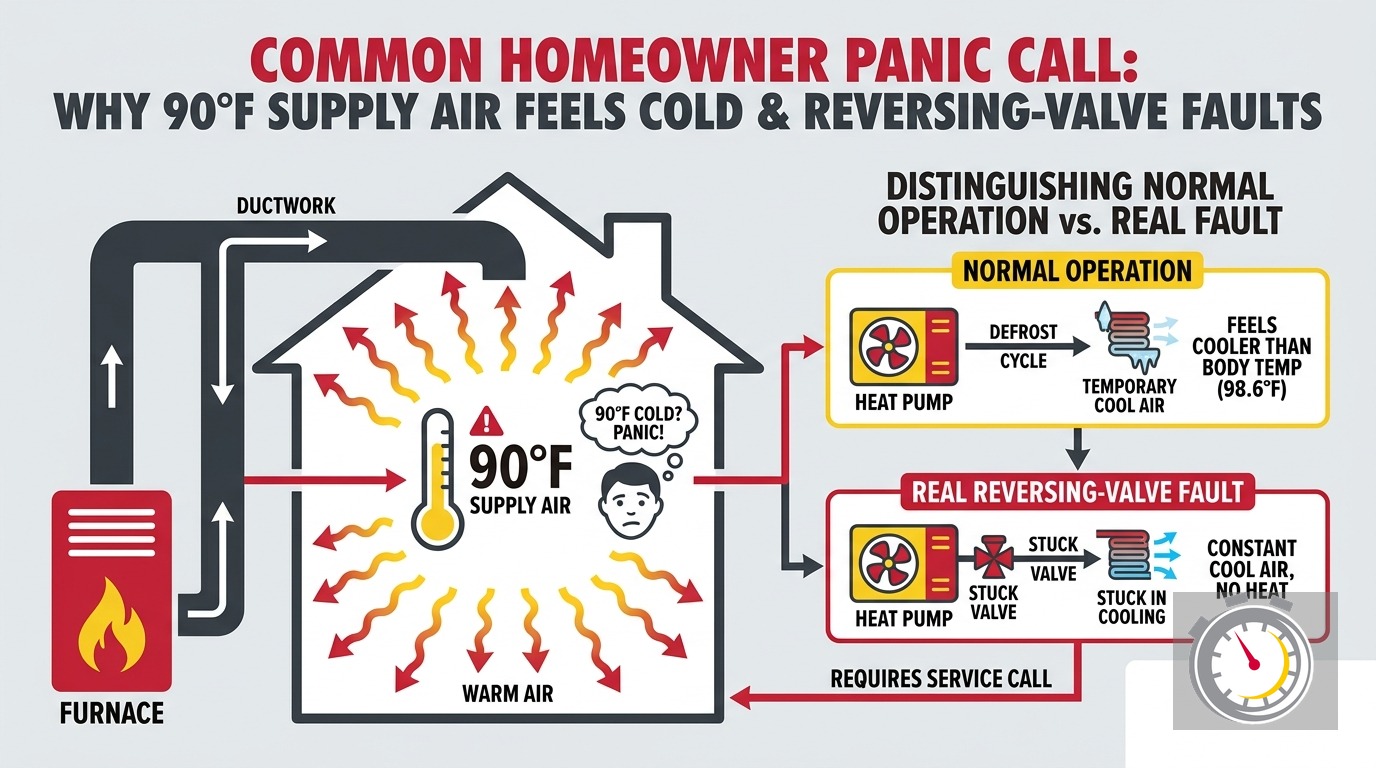
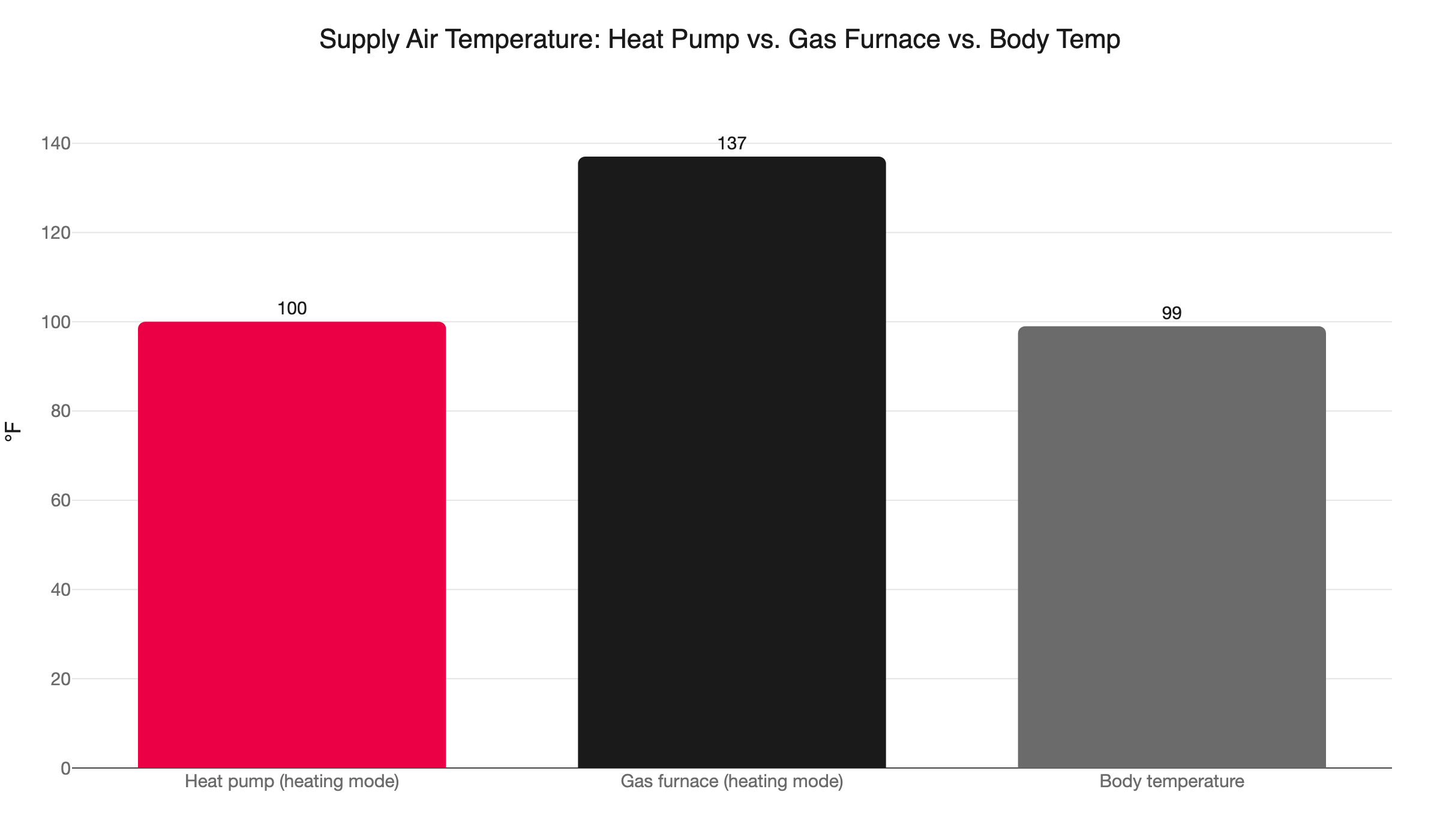
- A heat pump delivers supply air at 90-110°F in heating mode. A gas furnace delivers 125-150°F. The difference in feel is real and normal.
- Air below body temperature (98.6°F) feels cool at the register, even when the system is heating correctly.
- Defrost cycles run every 30-90 minutes in cold or humid weather and last 5-15 minutes. During that time, the heat pump briefly shifts into cooling mode to melt frost off the outdoor coil.
- If auxiliary heat is working correctly, you should not feel the defrost cycle at your vents. Feeling cold air during defrost often points to a problem with the auxiliary heat strips, not the heat pump itself.
- Three reversing valve failure modes exist: mechanical stick, open-circuit solenoid coil, and internal refrigerant leak. All three require a licensed technician.
- The diagnostic question that matters: is your house actually getting colder? Normal operation holds setpoint. A real fault causes the temperature to drop and not recover.
- Minnesota’s cold and humid winters mean more frequent defrost cycles than warmer or drier states. That is expected, not a sign of a failing system.
- Xcel Energy offers up to $2,000 and CenterPoint Energy offers up to $1,500 for qualifying cold-climate heat pumps in Minnesota.
- Call (763) 260-6662 or book online if your heat pump blows cool air and your home is not reaching setpoint.
Why Your Heat Pump Blows Cool Air in Heat Mode
When a heat pump blows cool air in heat mode, the instinct is to assume something is broken. In most cases, the system is doing exactly what it is designed to do. The air coming out of your registers is warm enough to heat your home. It just does not feel that way, because it is not as hot as the gas furnace you may be used to.
The short answer: Heat pump supply air runs 90-110°F in heating mode. A gas furnace runs 125-150°F off the heat exchanger. Body temperature is 98.6°F. Air below body temperature feels cool against your skin, even when it is actively warming your home. That gap in perceived warmth is physics, not a malfunction.
Understanding where normal ends and a real problem begins saves you unnecessary panic. It also helps you catch a genuine fault faster when one does exist.
Is 90°F Air from a Heat Pump Actually Too Cold?
No. It is warm enough to heat your home over time. It just does not feel warm against skin, and that difference trips up a lot of homeowners.
Energy Vanguard’s testing with actual thermometer measurements confirms that a heat pump in heating mode delivers supply air at roughly 90-110°F at the coil. A gas furnace delivers roughly 125-150°F off the heat exchanger. Both can heat a well-insulated Twin Cities home to 70°F on a moderate winter day. The difference is in how they get there: a furnace blasts hot air in short, intense cycles, while a heat pump runs lower and slower for longer periods.
The perceived “cold” comes down to body temperature. Air below 98.6°F feels cool to the touch, regardless of how much warmer it is than the room it is heating. Hold your hand near a register delivering 95°F air. Your skin reads it as cool. Your thermostat reads it as steady progress toward setpoint.
The fastest triage you have is a thermometer. Hold it at a supply register while the heat pump is actively running in heating mode. A reading of 90°F or higher on a mild day confirms the system is working. A reading consistently below that range on a moderate day, combined with a house that is not reaching setpoint, warrants a service call.
One more thing worth understanding: heat pumps run much longer cycles than furnaces. A furnace fires hot, hits setpoint, and shuts off. A cold-climate heat pump may run almost continuously in cold weather, especially near or below the balance point. That means the air at the register feels “not quite warm” more of the time. But the total heat delivered into your home across those longer cycles is meeting its target. Longer run time is not failure. It is how the system is designed to work.
For homeowners switching from a gas furnace to a heat pump, the first Minnesota winter is often an adjustment. The supply air feels different. The system sounds different. The run patterns are different. All of that is expected.
What Is a Heat Pump Defrost Cycle, and Why Does It Blow Cold Air?
A defrost cycle is a planned, automatic process where the heat pump briefly reverses into cooling mode to melt frost off the outdoor coil. It lasts 5-15 minutes and repeats every 30-90 minutes in cold or humid conditions. Done correctly, you should not notice it inside your home.
Here is the mechanism. When outdoor temperatures drop below freezing, moisture from the air freezes onto the outdoor coil surface. Ice builds up. A heavy ice layer blocks airflow and sharply reduces system efficiency. The control board detects frost buildup through a combination of time, outdoor temperature, and pressure sensors. It then reverses the refrigerant flow direction. For the duration of the cycle, the outdoor coil acts as a condenser, pushing warm refrigerant through itself to melt the ice. The indoor coil briefly operates in cooling mode during this window, which is why slightly cooler air can appear at your registers.
Lennox’s consumer resource on the heat pump defrost cycle confirms a standard cycle runs 5-15 minutes and can repeat as often as every 30 minutes in cold or humid weather.
From inside the house, here is what a normal defrost cycle looks and sounds like: the outdoor fan stops running, a soft hissing or gurgling sound may come from the refrigerant circuit, and steam may visibly rise from the outdoor unit as ice melts off the coil. All of that is normal.
Here is the part that surprises many homeowners. Trane’s consumer guide on the defrost cycle explains that auxiliary electric heat strips automatically engage during defrost to compensate for the temporary drop in heating capacity. When everything is working correctly, the supply air at your vents stays warm throughout the defrost window. You do not feel the cycle pass. You may hear the outdoor fan stop and restart. You may see steam outside. But you should not feel cold air indoors.
If you do feel cold air for 5-15 minutes and then the system returns to normal warmth, defrost is the likely explanation and that is normal operation. But if you feel cold air during defrost and it is notably uncomfortable, the auxiliary heat strips may be offline, undersized, or not wired to engage during defrost. That is the service item, not the heat pump itself.
Why Twin Cities Homeowners Experience More Defrost Cycles Than Most
Our climate is a combination that drives frequent frost formation: cold temperatures and significant humidity. Together, they produce more defrost cycles than warmer or drier parts of the country.
The Twin Cities sits in IECC Climate Zone 6, with a heating design temperature of approximately -16°F. That is among the colder design conditions in the contiguous United States. At those temperatures, frost accumulates on the outdoor coil faster and more densely than it would in a milder climate.
The humidity adds another layer. The metro sits near the Minnesota River, the Mississippi, and dozens of lakes. High relative humidity on a cold day drives frost formation faster than dry cold does. A 28°F day at 80% relative humidity causes more frequent defrost cycles than a 10°F day at low humidity. That is pure physics.
The practical result for Minnesota homeowners: if you installed a heat pump in the last few years and your system defrosts frequently, that is not a sign of a problem. It is a sign that you live in a cold, humid climate. Guides written for Phoenix or Atlanta will make it sound unusual. It is not unusual here.
The Northeast Energy Efficiency Partnerships cold-climate air-source heat pump specification v4.0 requires that a ccASHP-certified unit maintain rated capacity down to -13°F and achieve a coefficient of performance of at least 1.75 at 5°F. COP means units of heat output per unit of electricity in: a COP of 2 means you get two units of heat for every unit of electricity you pay for. A unit carrying that certification is designed to perform in a Minnesota winter, not just a mild one. But it will defrost frequently, and that is by design.
When Your Heat Pump Blows Cool Air in Heat Mode: Is It a Real Fault?
Three situations cross from normal operation into a problem that needs service.
1. The house temperature drops below setpoint and keeps dropping.
A defrost cycle ends within 15 minutes, and the house temperature remains steady throughout. If your home temperature falls below what you set on the thermostat and continues to fall over the course of an hour or more, the system is not heating. Start by checking the thermostat: confirm the mode is set to “heat” and not “cool” or “fan only.” If the thermostat is correct and the house is still losing temperature, call a technician.
2. Supply air stays below 90°F on a mild day with no active defrost cycle.
Hold a thermometer at a supply register on a 35-40°F day, with the system actively heating and no defrost cycle running in the last 15 minutes. A consistent reading of 60-70°F means the heat pump is not delivering full capacity. Low refrigerant charge, a failing compressor, and a stuck reversing valve can all produce this symptom. None of these are conditions you can diagnose or correct without equipment.
3. Cool air combined with unusual sounds from the outdoor unit.
Grinding, clanking, or persistent hissing from the outdoor unit alongside cool air in heat mode is a stop-and-call situation. Running a compromised compressor or refrigerant circuit can turn a fixable repair into a full unit replacement. For a full reference on heat pump normal noises versus problem sounds in Minnesota, we have a dedicated post covering what each sound typically means.
Three Ways a Reversing Valve Fails
The reversing valve is what makes a heat pump reversible. It sits inside the refrigerant circuit and controls which direction refrigerant flows. Flip the direction and you flip the system from heating to cooling. The valve connects to your thermostat at the O or B terminal, depending on manufacturer convention, and shifts position based on a voltage signal.
Mechanical stick. The spool inside the valve body gets physically stuck in one position. If it sticks in cooling mode while the thermostat calls for heat, the system delivers cold air all winter. Mechanical sticks do not self-clear. The valve must be replaced.
Open-circuit solenoid coil. The solenoid is what energizes to shift the spool when it receives a voltage signal. An open-circuit coil does not respond to that signal, so the spool does not move. A technician tests for this with a multimeter, checking for continuity and correct voltage at the coil terminals. A working coil also produces a magnetic field: a technician can test this by holding a screwdriver near the coil while energized and feeling for attraction. In some cases the solenoid coil alone can be replaced without removing the full valve body, which reduces the repair cost.
Internal refrigerant leak. This is the hardest failure to diagnose in the field. The valve develops an internal leak where high-pressure refrigerant bleeds to the low-pressure side. The symptoms look almost identical to low refrigerant charge or a failing compressor. Diagnosis requires comparing suction line temperature at the outdoor unit inlet to suction line temperature at the compressor inlet. A difference greater than 3°F between those two measurement points indicates the valve is leaking internally and needs replacement.
All three failures are inside the sealed refrigerant circuit. As the U.S. Department of Energy’s heat pump systems overview explains, refrigerant circuit work requires EPA 608 certification. This is not a DIY repair. The pressures involved are high, refrigerant is a regulated substance, and attempting this without certified equipment creates a real safety hazard.
The homeowner-level distinction that matters most: a stuck reversing valve causes the house temperature to fall and not recover. A defrost cycle causes 5-15 minutes of slightly different air at the vents, then returns to normal. One is a fault. The other is a built-in feature.
What About Dual-Fuel Heat Pump Systems in the Twin Cities?
Dual-fuel is a common and practical configuration in Minnesota. A heat pump covers most of the heating load from fall through moderate winter temperatures. Below a set outdoor temperature - the balance point, often in the 25-35°F range - the gas furnace takes over, because burning gas is more cost-effective than running a heat pump when outdoor temperatures are extreme.
If you have a dual-fuel system and you are reporting cool air concerns, the first question is which system is actually running at that moment. At -5°F outside, the gas furnace should be the active heating source. If the heat pump is running at those temperatures instead and blowing cool air, the balance point may be configured incorrectly or the furnace may not be responding to the handoff signal. That is a controls diagnosis, not a heat pump fault.
For a full breakdown of how heat pump balance points work in Minnesota and when backup heat takes over, see our dedicated post.
Dual-fuel setup also affects your rebate eligibility. CenterPoint Energy offers up to $1,100 additional on top of the base heat pump rebate for dual-fuel configurations. That stacks meaningfully with the base program.
Minnesota Rebates for Cold-Climate Heat Pumps
If this situation has you thinking about an upgrade, whether that means replacing an aging heat pump or making the switch from a gas-only furnace, the incentive environment in Minnesota is worth knowing right now.
Xcel Energy offers up to $2,000 for a qualifying cold-climate ducted heat pump. Qualifying units must have a COP of 1.75 or higher at 5°F and appear on the NEEP ashp list. Gas furnace rebates from Xcel were discontinued January 1, 2026.
CenterPoint Energy offers up to $1,500 for a ducted air-source heat pump in existing Minnesota homes, with up to $1,100 additional for dual-fuel systems. The federal 25C heat pump tax credit expired December 31, 2025. Utility rebates are now the primary savings path for Minnesota homeowners considering a heat pump installation or upgrade.
For a full look at current Minnesota heat pump rebates and utility programs, see our dedicated rebates post with updated program details.
What Should You Do If Your Heat Pump Blows Cool Air in Heat Mode?
Start with the thermometer test. Hold a standard thermometer at a supply register during active heating. A reading of 90°F or higher on a mild day means the heat pump is working. A reading well below that, with the house not reaching setpoint, means call a technician.
Time the cool air episode. If it lasts 15 minutes or less and the house temperature holds steady throughout, that is a defrost cycle. Normal. If the house temperature drops during or after the episode and does not recover over the next hour, that is a genuine fault.
Do not wait out a failing heat pump on a Minnesota winter night. At -10°F overnight, a system that is not heating drives interior temperatures down quickly. Pipes can freeze. That is not a situation to troubleshoot over several days.
Northern One Hour is locally owned and operated in Ramsey, MN. We serve the Twin Cities metro including Minneapolis, St. Paul, Blaine, Maple Grove, Plymouth, Brooklyn Park, Woodbury, and Bloomington. Our technicians diagnose heat pump issues with transparent pricing and give you a straight answer on repair versus replacement. When we say “Always On Time… Or You Don’t Pay a Dime!(R)”, we back it with a 100% satisfaction guarantee.
Call (763) 260-6662 or schedule a heat pump repair visit online. Same-day service is available for urgent heating needs.
Frequently Asked Questions
Why does my heat pump blow cool air in heat mode? +
How long does a heat pump defrost cycle last? +
What does a reversing valve failure actually feel like? +
Can I get a rebate for a cold-climate heat pump in Minnesota? +
Need a technician now?