
Heat Pump Low Refrigerant Symptoms: A Minnesota Winter Guide
Key Takeaways
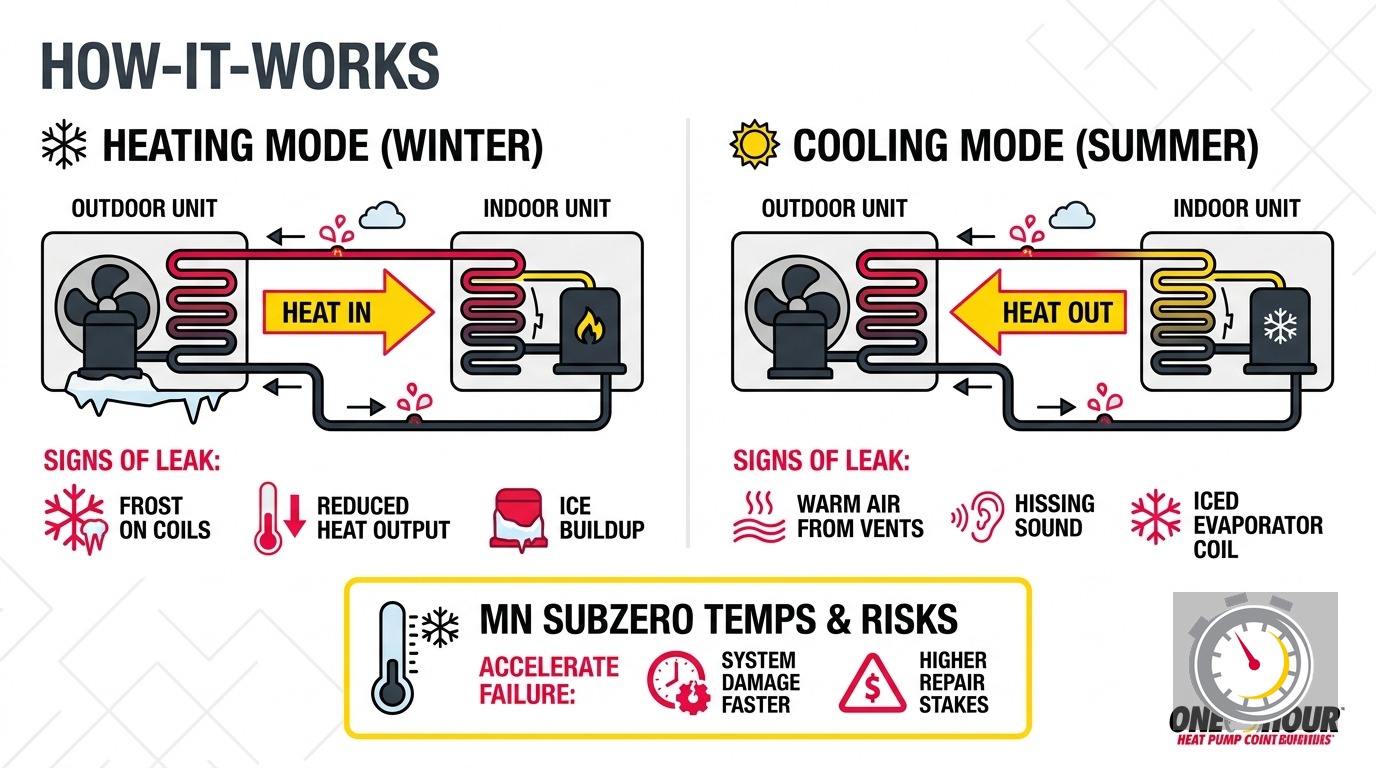
- Heat pump low refrigerant symptoms in Minnesota change with the season. In cooling mode, the indoor coil ices. In heating mode, the outdoor coil ices instead. The same problem shows up in a completely different location.
- Normal frost on an outdoor heat pump unit clears within 5-15 minutes during the defrost cycle. Ice that persists or returns quickly after defrost is a warning sign.
- Below 0°F, a low-refrigerant heat pump can reach compressor failure within hours. Same-day service is the right call.
- You cannot legally buy or recharge refrigerant yourself. EPA Section 608 certification is required, and R-410A sales to uncertified buyers are now restricted.
- R-410A supply will tighten as the industry transitions to newer refrigerants. Fixing a leak now costs less than replacing a compressor later.
- If you suspect a refrigerant problem this winter, call (763) 260-6662 or book online today.
Why Do Heat Pump Low Refrigerant Symptoms in Minnesota Differ by Season?
In short: The reversing valve switches which coil acts as the evaporator. In summer, the indoor coil absorbs heat from your home and can ice over when refrigerant is low. In winter, the outdoor coil absorbs heat from outside air. That role switch changes where symptoms appear and what to look for.
Most guides on heat pump low refrigerant symptoms treat heating and cooling mode as interchangeable. They are not. The difference comes down to one component: the reversing valve.
In cooling mode, refrigerant enters the indoor coil at low pressure. It absorbs heat from your home’s air. The indoor coil is the evaporator. When refrigerant is low, pressure drops and that indoor coil ices over.
In heating mode, the reversing valve sends the flow in the opposite direction. Now the outdoor coil is the evaporator. Refrigerant absorbs heat from outdoor air and carries it inside. Ice from a low-refrigerant charge in winter forms on the outdoor unit, not the indoor one.
That is the opposite of what happens in summer. And it is what every generic symptom list misses.
For Minnesota homeowners, this distinction is not academic. Your heat pump is already working close to its rated limits during a January cold snap. A system running low on refrigerant at those conditions has no buffer left. When suction pressure drops, the compressor takes the hit. Understanding where to look is the first step to catching the problem before it becomes a component failure.
What Does Low Refrigerant Look Like in Cooling Mode?
In short: In summer, watch for ice on the indoor air handler, warm air from vents, longer run times, and higher electricity bills. The indoor coil is the evaporator in cooling mode. That is where symptoms show up first.
Understanding the summer picture makes the winter picture clearer by contrast. When refrigerant is low in cooling mode, these signs appear:
- Ice on the indoor air handler or on the refrigerant lines near your basement or utility closet.
- Air from your vents that feels barely cool or warm even on a moderate day.
- Longer run cycles that still do not bring the home to the set temperature.
- Electricity bills that climb without a clear explanation.
- A faint hissing or bubbling sound near the refrigerant lines.
Summer symptoms tend to appear gradually. You might notice the house is never quite as cool as it should be, or that the system runs all afternoon without shutting off. By the time ice is visible on the air handler, the problem has usually been building for a while.
For a fuller look at warm-weather refrigerant problems, see our post on AC refrigerant leak signs in Minnesota. Summer diagnosis is more straightforward because the ice forms on the indoor unit, which is usually visible, and a technician can check system pressures in the same mode the home is actively running.
What Are the Heat Pump Low Refrigerant Symptoms Minnesota Homeowners See in Heating Mode?
In short: In winter, watch for the outdoor unit encased in thick ice that does not clear after the defrost cycle, short cycling, weak warm airflow, and heating bills that spike without explanation. Backup or emergency heat switching on earlier than expected is another signal to take seriously.
A technician who only services a heat pump in summer can miss a winter-mode refrigerant leak. On some systems, Schrader access port pressure on the indoor coil is lower in cooling mode. The leak does not show then. In heating mode, suction-side pressure shifts and the leak becomes detectable. A diagnosis of “no problem” in July does not rule out a refrigerant issue in January.
As a homeowner, here is what to look and listen for when the system is in heating mode:
- Outdoor unit fully coated in thick ice. Not just frost on the fins. The whole cabinet, including the top and sides, is coated in ice and will not clear.
- Ice that returns quickly after the defrost cycle. A defrost cycle should clear the outdoor unit in 5-15 minutes. Rapid refreezing after defrost is a red flag.
- Short cycling. The system starts, runs briefly, then shuts off before the home reaches the set temperature. The cycle repeats without heating the space.
- Weak or lukewarm airflow. In heating mode, a properly charged heat pump delivers noticeably warm air. Lukewarm output means the system is struggling to move heat.
- Heating bills up with no clear cause. The compressor works harder and longer to compensate for the shortfall. Electricity use rises, sometimes sharply.
- Backup or emergency heat switching on earlier than normal. This mode is designed for temperatures below your system’s rated floor. Premature activation suggests the heat pump is not keeping up.
If your backup heat is running more than it should, read our post on when to use heat pump emergency heat mode. It explains what that mode actually costs to run and how to respond when it activates unexpectedly.
Normal Frost vs. Dangerous Ice: How Can You Tell the Difference?
In short: Light surface frost on the fins that clears within 5-15 minutes of a defrost cycle is normal operation. A unit coated in thick ice that does not clear after defrost, or that refreezes within an hour, needs a technician the same day.
This is one of the most common points of confusion for Twin Cities homeowners. Heat pumps are designed to frost over in cold weather. The defrost cycle exists to melt that frost. Most of what you see on a cold January morning is exactly what the system was built for.
The defrost cycle has a sound to it. The system briefly reverses to cooling mode to warm the outdoor coil. You may hear the unit hum differently, and warm air may discharge from the outdoor unit for a few minutes. That is normal. What is not normal is a defrost cycle that completes and leaves the unit still coated in ice, or one that clears the ice only to have it return within the hour.
Here is the clearest way to tell the difference:
- Normal: light frost on the fins, clears fully within 5-15 minutes of defrost.
- Warning: thick ice coating the entire outdoor cabinet, top, and sides.
- Warning: ice that persists more than 20-30 minutes after the defrost cycle ends.
- Warning: ice that returns within an hour after defrosting.
- Warning: frost or ice on the refrigerant lines themselves at the wall penetration point.
Lennox’s consumer guidance draws the same line: light surface frost on cold mornings is expected; a unit encased in ice is not. That same guidance warns against chipping ice with sharp tools. Puncturing a coil turns a repairable refrigerant situation into a far more expensive one. If you are unsure what you are looking at, take a photo and call us at (763) 260-6662. Our team can walk you through what the image shows before we dispatch a technician.
What Happens to a Heat Pump Running Low on Refrigerant in a Minnesota Winter?
In short: A correctly charged cold-climate heat pump already loses significant capacity at -13°F. Low refrigerant removes the margin that remains. Compressor failure can follow within hours at subzero temperatures. In Minnesota, subzero temperatures are not a rare scenario. They are the expected design condition.
This is where the Minnesota context separates this topic from every guide written for a warmer climate.
The Twin Cities metro sees extended stretches below 0°F most winters. Metro temperatures reaching -14°F are documented. Subzero cold is not an edge case here. It is the baseline condition that every Twin Cities heat pump must be sized and charged to handle.
At that baseline, a correctly charged cold-climate system is already working near its rated limits. The Department of Energy’s cold-climate heat pump challenge data shows that top-rated systems can lose up to 60% of rated capacity and 50% of COP at the -13°F test condition. That is when everything is working as designed.
Now add low refrigerant. Suction pressure drops below the minimum safe range for the compressor. The system cannot maintain the pressure differential it needs to move heat effectively. The compressor strains against conditions it was not designed to handle in that state.
What this means practically: at -10°F with a depleted refrigerant charge, this is not a comfort problem. It is a compressor failure problem. The window to act is measured in hours, not days.
Real-world performance data from Minneapolis homes confirms the stakes. A properly charged cold-climate heat pump measured a COP of 1.98 at -17°F. At -27°F, it measured 1.37. Both figures are still ahead of electric resistance backup heat. A low-refrigerant system loses that advantage entirely. At that point, your backup heat carries the full load while the heat pump contributes nothing useful and risks permanent damage.
For more on how cold-climate heat pumps actually perform at the extreme low end of a Twin Cities winter, see our post on heat pump below-zero performance in Minnesota.
Can You Just Top Off the Refrigerant?
In short: No. The EPA requires a certified technician to find and repair the leak within 30 days of discovery. Simply recharging without fixing the source does not meet that requirement, will not solve the problem long-term, and may void your equipment warranty.
This is the most common misunderstanding in refrigerant service. A homeowner gets a diagnosis of “low charge,” a technician offers a quick recharge, and the problem seems to go away. A few months later, it is back. The cycle repeats.
Refrigerant does not wear out or evaporate on its own. A system that is low has a leak. Topping it off adds refrigerant to a system that is still losing it. The charge drops again.
There is also a legal requirement. The EPA mandates that Section 608 certified technicians find and repair leaks within 30 days of discovery. The 2026 AIM Act rule lowered the charge threshold that triggers leak-rate tracking from 50 pounds to 15 pounds. Comfort cooling systems above that threshold must be repaired, not just recharged. Documenting that you found the leak and simply refilled it does not satisfy the requirement.
For homeowners, there is an additional barrier: R-410A in containers larger than two pounds is restricted to EPA-certified technicians under the AIM Act’s expanded sales restrictions, which took effect January 1, 2025. Refrigerant is not a DIY project. It is certified-technician-only work under federal law.
The correct sequence is the only sequence: find the leak, fix the leak, verify the repair, then recharge to manufacturer specifications.
What Does Refrigerant Service Cost in the Twin Cities?
In short: Costs vary by leak location and system condition. A pressure check visit runs $95-$250. Compressor replacement from a delayed repair runs $1,950-$4,500. A full high-efficiency cold-climate heat pump replacement, fully installed, runs $11,000-$15,600. Catching the problem early is almost always the cheaper path.
There is no flat rate for refrigerant leak service. The cost depends on where the leak is, how long it went unaddressed, and whether secondary damage has occurred. A technician who arrives before the compressor is stressed gives you the most options.
Key cost thresholds to understand before you call:
- A single tune-up and pressure check: $95-$250.
- Compressor replacement if a delayed leak led to failure: $1,950-$4,500.
- A high-efficiency cold-climate heat pump system, fully installed: $11,000-$15,600.
The rebate picture is also a reason to keep your system correctly charged. Xcel Energy offers up to $2,000 for qualifying cold-climate heat pump installations. One of the qualification thresholds is efficiency performance at 5°F. A heat pump running low on refrigerant cannot meet that efficiency benchmark. The system would not qualify for the rebate. Our post on Minnesota heat pump rebates and tax credits covers the full incentive landscape, including how to stack Xcel and CenterPoint incentives.
If a repair or replacement creates sticker shock, ask our team about financing. Northern One Hour works with financing partners to make service manageable for Twin Cities homeowners. Spreading the cost over monthly payments changes the calculus considerably.
The Refrigerant Transition Is Another Reason to Act Now
This applies to any homeowner with a heat pump running R-410A, which covers most systems installed before 2025.
New HVAC equipment manufactured after January 1, 2025 must use refrigerants with a global warming potential at or below 700. R-410A carries a GWP of 2,088. It is being replaced by R-454B (brand name Puron Advance, GWP 466) and R-32 (GWP 675). R-410A will remain available to service existing systems for years. But supply tightens and prices rise as the industry transitions away from it. The R-22 phase-out is the exact pattern to expect, and it is already underway.
If you have been topping off a leaking R-410A heat pump each season, you are paying more each time. That cost will keep climbing.
Fixing the leak now is the more cost-effective path. After the repair, look honestly at the system’s age. If it is within a few years of end of life, a new high-efficiency cold-climate heat pump gives you lower operating costs, a modern refrigerant with long-term availability, and eligibility for available rebates while programs are funded. Waiting costs you on every front.
When to Call and What Not to Do
The list of heat pump low refrigerant symptoms Minnesota homeowners should treat as same-day calls:
- Outdoor unit coated in thick ice that does not clear during or after the defrost cycle
- Short cycling in heating mode
- Backup or emergency heat activating above your system’s rated temperature floor
- Heating bills rising sharply with no clear explanation
- Weak or lukewarm airflow when the system is set to heat
- Hissing or bubbling sounds near the refrigerant lines
Do not chip ice off the outdoor unit. Do not attempt to recharge the system yourself. Do not wait a few days to see if the problem resolves on its own. At subzero temperatures, waiting is how a repair call becomes a compressor replacement.
Northern One Hour Heating & Air Conditioning is locally owned and operated in Ramsey, serving the Twin Cities metro. Our team shows up when we say we will. That is the promise behind “Always On Time… Or You Don’t Pay a Dime!(R)”
Call (763) 260-6662 or book online to schedule service. If you are not certain whether what you are seeing is urgent, call anyway. We would rather talk you through a non-emergency than miss a real one.
Frequently Asked Questions
What are the signs of low refrigerant in a heat pump in winter? +
Can a homeowner recharge a heat pump refrigerant themselves? +
How long can a heat pump run low on refrigerant in a Minnesota winter? +
Does a refrigerant top-off fix a heat pump leak? +
Need a technician now?