
Heat Pump Making Noise in Minnesota? Normal vs. Not
Key Takeaways
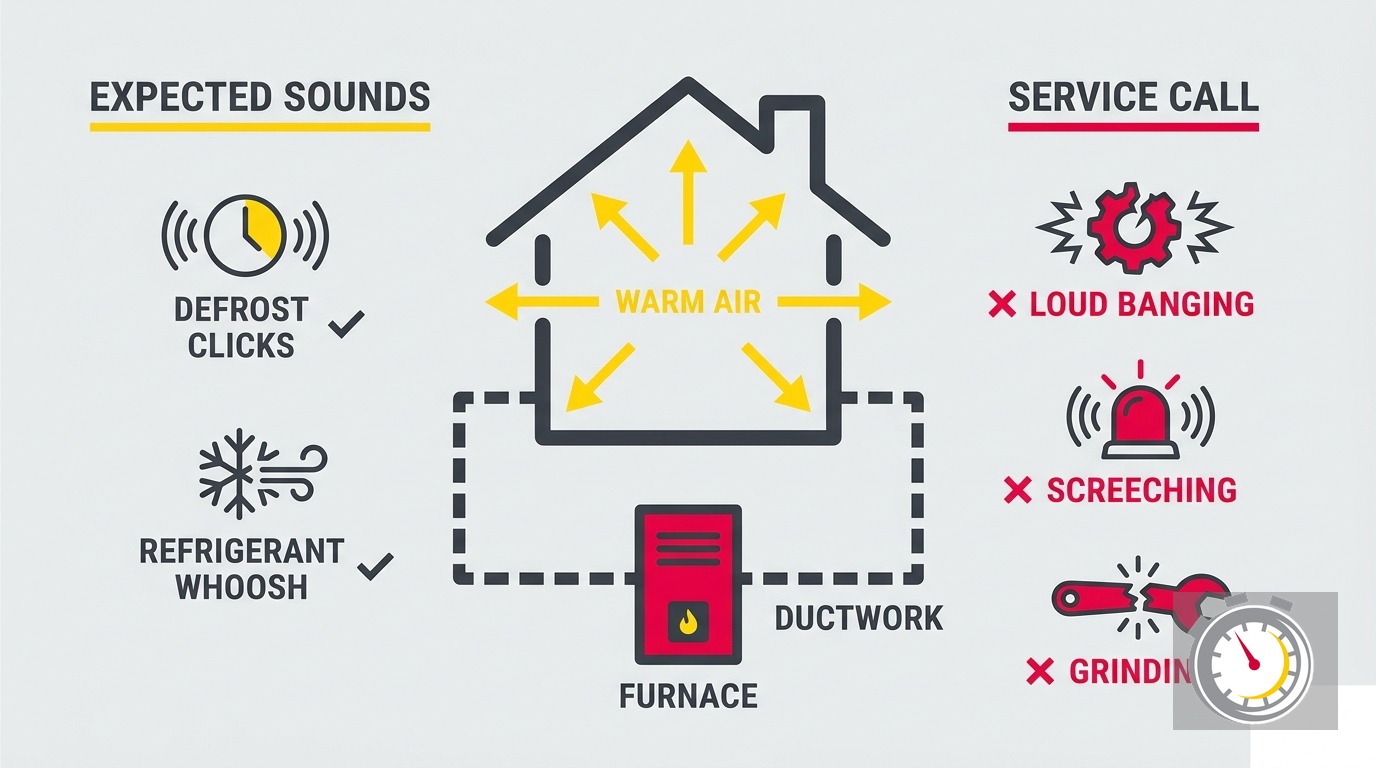
- A whooshing or rushing sound means the defrost cycle is running. This is normal.
- Defrost cycles last 5 to 15 minutes and should activate no more than twice per hour in cold weather.
- 1 to 3 clicks at startup, shutdown, or mode change are expected. Rapid, continuous clicking is a red flag.
- Grinding, scraping, high-pitched squealing, and loud banging are never normal. Call for service right away.
- Cold-climate heat pumps hum softly at partial load. That hum is correct operation, not a malfunction.
- Unit still covered in ice after a defrost cycle completes? That warrants a call.
- 2026 Minnesota rebates: up to $2,000 from Xcel Energy and up to $1,500 from CenterPoint Energy for qualifying upgrades. The two programs are stackable.
Why Your Heat Pump Makes More Noise in a Minnesota Winter
Most heat pump noise guides are written for warmer climates. A homeowner in Tennessee might run one or two defrost cycles on a cold night. A homeowner in Ramsey, Blaine, or Maple Grove can run several in a single afternoon during a snowstorm.
The reason is humidity. Twin Cities winters bring heavy moisture from frequent snow and freezing fog. That moisture accelerates frost buildup on the outdoor coil. The system defrosts more often to stay efficient. Each defrost cycle produces sound.
That is why a Minnesota heat pump sounds busier in January than the same model would in most of the country. Most of what you hear is the system working correctly.
We are Northern One Hour Heating & Air Conditioning, locally owned and operated in Ramsey. We service heat pumps across the Twin Cities. This guide is a straight decision tool: hear a specific sound, here is what it means, here is what to do.
What Is That Whooshing Sound? Is My Heat Pump Broken?
Short answer: No. A whooshing or rushing sound in winter almost always means the defrost cycle just started. It is normal and should stop on its own within 5 to 15 minutes.
The outdoor coil pulls heat from the air, even in freezing temperatures. Moisture from that air freezes onto the coil. Frost buildup reduces the coil’s ability to absorb heat. The system fixes this by reversing refrigerant flow. It briefly runs in a cooling direction, pushing warm refrigerant through the outdoor coil to melt the frost off.
That reversal is what you hear. The defrost cycle runs 5 to 15 minutes and ends when the outdoor coil reaches roughly 57°F. Then the system flips back to heating mode and the sound stops.
In Minnesota, you will hear this more than homeowners in milder climates. High humidity drives more frequent defrost cycles. A wet snow day in January produces more whooshing than a dry, sunny day at negative-10°F. Both are correct behavior for the conditions.
During defrost, you will likely also see steam or vapor rising from the outdoor unit. The warm refrigerant is melting frost, and the water vaporizes on contact. It looks alarming the first time. It is just physics.
What Does the Full Defrost Cycle Sound Like?
Short answer: A click, then whooshing, then possibly a brief gust of cooler air from your indoor vents, then back to normal heat. Steam may rise from the outdoor unit. The whole sequence takes under 15 minutes before the system returns to heating mode.
Here is each step in order.
- A click or thump as the reversing valve shifts direction. Sudden but not loud.
- Whooshing or rushing as refrigerant moves through the outdoor coil in reverse.
- The outdoor fan may stop. Some units cut the fan during defrost to speed up the melt. Your outdoor unit may go quiet except for the whooshing.
- Steam rising from the outdoor unit. Frost is melting and turning to vapor. This is normal.
- A second click as the reversing valve returns to heating mode.
- A brief gust of slightly cooler air from your indoor vents. This lasts a minute or two, then your heat returns.
The full sequence should complete in under 15 minutes. If yours runs longer than 20, if ice is still coating the coil at the end, or if the system shuts down instead of returning to heat, something is wrong. The red flags section at the end of this post covers those scenarios.
Is Clicking From My Heat Pump Normal?
Short answer: A small number of clicks at specific moments are normal. Your heat pump clicks when contactors engage, when the reversing valve shifts, and when metal expands and contracts with temperature changes. Rapid, continuous clicking or clicking followed by a system shutdown is not normal and warrants a service call.
Pattern recognition is everything here.
Normal click patterns:
- 1 to 3 clicks at startup
- 1 to 3 clicks at shutdown
- 1 to 3 clicks when entering or exiting defrost mode
- Occasional soft ticking from the cabinet as it warms or cools
Red-flag click patterns:
- Rapid, continuous clicking like a playing card in bicycle spokes
- Clicking immediately followed by the system shutting itself off
- Clicking that repeats every few minutes without the unit completing a full cycle
Rapid clicking often points to a failing contactor or a low-voltage issue. Clicking that ends in shutdown usually means the system detected a fault and cut off to protect itself. Either pattern warrants a call to a technician.
What Heat Pump Noises in Minnesota Mean I Need to Call Right Now?
Short answer: Grinding, scraping, high-pitched squealing, and loud banging or clanking are never normal, regardless of the weather or season. These sounds point to active mechanical failure: bearing wear, fan motor stress, a broken blade, or a foreign object in the housing. Call for same-day service.
These sounds have nothing to do with defrost cycles or cold-weather operation. They mean something is failing.
Grinding or scraping: Almost always a bearing wearing out in the fan motor or compressor. Metal-on-metal contact worsens quickly. Left running, the motor can seize entirely.
High-pitched squealing: Usually a fan motor or compressor under stress. A brief squeal at startup on a very cold morning, lasting under 30 seconds, can happen as bearings warm up. A squeal that continues or that repeats throughout the day is a problem.
Loud banging or clanking: Often a broken fan blade, a loose component, or a foreign object inside the fan housing. Shut the unit off before running it further. The object can destroy the fan or puncture the refrigerant coil.
Persistent rattling: Loose cabinet panels vibrate as the compressor runs. This is often harmless, but rattling can also indicate a loose compressor mount, which is not.
Grinding and squealing in particular signal active mechanical failure and will not self-correct. Do not wait to see if the sound goes away.
Why Does My New Heat Pump Hum So Differently Than My Old One?
Short answer: Cold-climate and variable-speed heat pumps run at partial load for long stretches, producing a soft 40 to 50 decibel hum. That is roughly whisper-quiet. It is correct operation, not a malfunction.
Older single-speed heat pumps ran at full output or shut off completely. A modern cold-climate heat pump (CCHP) uses a variable-speed inverter compressor that adjusts output to match demand. On a 20°F day, the system might run at 40 or 50 percent capacity for hours.
At that load, the compressor produces a soft 40 to 50 dB hum that sounds nothing like older equipment. Many Twin Cities homeowners who upgrade to a CCHP call within the first few weeks. They are not used to a system that runs at a steady, quiet hum. Older equipment cycled on at full speed every 15 minutes, then shut off completely. This is different.
If a soft, steady hum is your only concern, run this check. Stand outside near the unit. Is the hum consistent and steady? Does it get quieter as outdoor temperatures rise? Is there no vibration you can feel on the cabinet panels? If yes, you have a healthy variable-speed compressor doing exactly what it was designed to do.
If the hum is accompanied by cabinet vibration, or if it suddenly changes pitch or gets louder, that shift is worth a look.
The DOE Cold Climate Heat Pump Challenge has documented that qualifying CCHP models maintain meaningful heating output well below 32°F. The inverter compressor producing that quiet hum is also what gives the system its efficiency in extreme cold, rather than forcing a switch to resistance backup heat.
For more on how these systems perform in sub-zero conditions, our post on heat pump performance below zero covers the operating-temperature specifics.
The Sound Decision Tree: Heard This? Do That.
Use this as a quick reference when you hear something unfamiliar.
| Sound | Normal? | Action |
|---|---|---|
| Whooshing, lasts under 15 minutes, then stops | Yes | None needed |
| Whooshing running longer than 20 minutes | No | Call for service |
| 1 to 3 clicks at startup, shutdown, or defrost | Yes | None needed |
| Rapid, continuous clicking | No | Call for service |
| Clicking followed by shutdown | No | Call for service |
| Soft, steady hum (especially on newer units) | Yes | None needed |
| Grinding or scraping | No | Shut off and call today |
| High-pitched squeal lasting more than 30 seconds | No | Call for service |
| Loud banging or clanking | No | Shut off immediately and call |
| Unit encased in ice after defrost cycle completes | No | Call for service |
When Should I Schedule Heat Pump Service, Not Just Watch and Wait?
Short answer: Schedule service when a sound fits any red-flag category, when it arrives alongside reduced heating performance, when it repeats daily without a clear cause, or when your system is more than 10 years old and producing a new sound you have not heard before.
Watching and waiting is reasonable for a one-time whoosh or a three-click startup. It is not reasonable for grinding, for a unit that shuts itself off, or for ice that does not melt after defrost.
To assess after you hear something unfamiliar, check these four things:
- Is your home reaching its set temperature on schedule? A system running longer than usual to hold temperature has changed.
- Is the outdoor unit clear of ice between defrost cycles? A frost-covered coil cannot pull heat efficiently.
- Has your energy bill climbed without a thermostat change? A struggling system uses more energy before it fails outright.
- Does your thermostat or air handler display show any error codes? Fault codes narrow the diagnosis fast.
A sound that arrives with any of these signs is the system telling you something has changed mechanically or electrically. Our heat pump repair team can diagnose the issue before a minor problem becomes a compressor replacement.
System age matters too. A noise worth monitoring on a two-year-old system is a stronger signal on one that has logged 12 Minnesota winters. Aging components fail more readily under sub-zero thermal stress.
Minnesota Rebates: A Noise Call Can Open a Bigger Conversation
Not every heat pump noise calls for a repair. Some signal an aging system. If your system is 12 to 15 years old, a service visit is a natural time to get an honest replacement assessment alongside the diagnostic.
If you decide to upgrade, Minnesota has real money on the table in 2026.
Xcel Energy (through September 30, 2026):
- Standard ASHP: $1,100 to $1,600
- Cold-climate ASHP (ccASHP): $1,500 to $2,000, for units that achieve a COP of at least 1.75 at 5°F and are listed on ashp.neep.org
CenterPoint Energy (through December 31, 2026):
- Hybrid dual-fuel ASHP: $1,100 to $1,500, independent of Xcel rebates
- The heat pump must be programmed to hand off to the gas furnace at 40°F or lower
These two rebates are stackable if you qualify for both. For many Twin Cities homes, a hybrid dual-fuel setup is the most practical configuration. The heat pump carries the load above 30 to 35°F. The gas furnace takes over below that threshold. You get the efficiency of a heat pump in moderate cold and the raw output of gas in the deepest Minnesota cold snaps.
Checking the NEEP database at ashp.neep.org is the right first step when shopping. It is the official qualifying list for Xcel’s ccASHP rebate tier, and it filters for units that actually meet the cold-climate performance standard.
For a full breakdown of current incentives and how federal tax credits layer on top, our Minnesota heat pump rebates post covers eligibility, stackability, and the NEEP qualifying process in detail.
Defrost Cycle Red Flags: When Normal Behavior Stops Being Normal
Even the whooshing sound, nearly always benign, can cross into problem territory. These are the specific signs that a defrost cycle is not completing correctly:
- Ice still on the coil after defrost ends. The cycle ran but did not finish the job. Occasional stubborn ice in extreme cold can happen, but repeated occurrences point to a defrost sensor, control board, or reversing valve issue.
- Defrost runs longer than 20 minutes. Normal cycles complete in 5 to 15 minutes. Extended cycles strain the compressor and point to a sensor or control problem.
- Defrost triggering on days above 40°F. If the cycle activates when conditions do not call for it, the defrost sensor or board is misreading the outdoor environment.
- System shuts down at the end of defrost instead of returning to heat. This usually means a fault code was triggered. Check your thermostat or air handler display for error codes.
If you are seeing ice that will not clear, our post on heat pump ice and the defrost cycle covers the ice-on-coil scenario in detail, including what conditions cause it and what a technician checks first.
If a sound on your heat pump fits any red-flag description in this guide, our locally owned team is ready to help. Call (763) 260-6662 or book a service visit online. We back every call with our on-time guarantee: “Always On Time… Or You Don’t Pay a Dime!(R)”
Frequently Asked Questions
Why does my heat pump make a whooshing sound in winter? +
How often should my heat pump run defrost cycles in cold weather? +
What heat pump noises mean I should call for service right away? +
Do cold-climate heat pumps sound different from older models? +
Need a technician now?