
Heat Pump Reversing Valve Failure Symptoms Explained
Key Takeaways
- The reversing valve is the single component that switches a heat pump between heating and cooling. When it fails, the system locks into one mode regardless of what the thermostat says.
- Two failure types, two very different repair costs: a dead solenoid coil runs $100-350 installed, while a failed valve body costs $450-$1,500 after refrigerant recovery and recharge.
- Minnesota winters force more defrost cycles than mild climates do, putting extra mechanical stress on the valve’s internal slide over years of service. That makes this failure more common here than national guides suggest.
- A useful homeowner observation: if both refrigerant lines at the outdoor unit feel the same temperature while the system runs, that is a signal worth relaying to your technician.
- Systems older than 12 years, or those running R-22 refrigerant, are often better replaced than repaired. Minnesota utility rebates can offset $3,000-$5,000 of a qualifying replacement.
What Is a Reversing Valve, and What Does It Do?
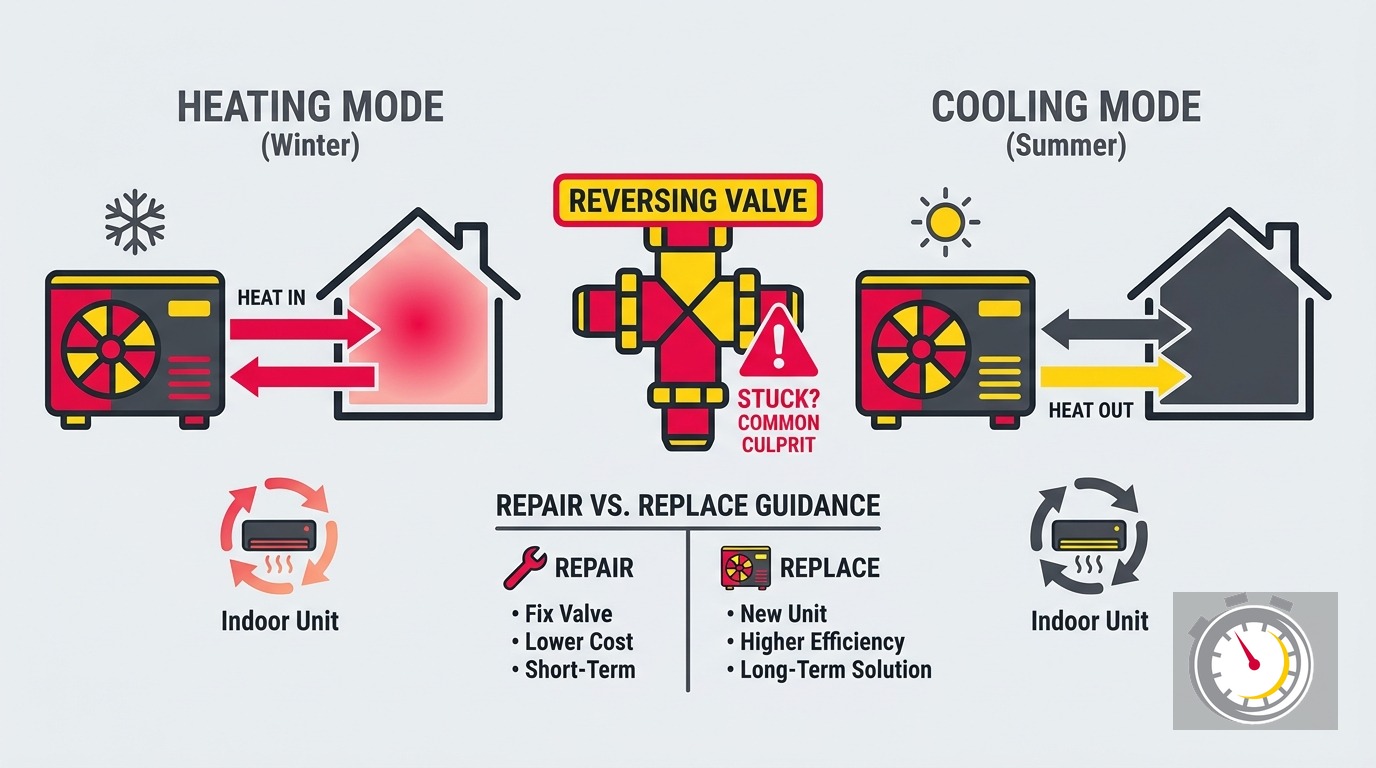
Short answer: It is a four-port refrigerant valve with an internal slide controlled by a solenoid coil. The slide reroutes refrigerant between the indoor and outdoor coils, letting one machine both heat and cool your home. When it stops shifting, the machine stops switching.
A heat pump does not generate heat the way a gas furnace does. It moves heat: pulling warmth from outdoor air in winter, and pushing heat out of your home in summer. That reversal requires a switching mechanism, and the reversing valve is it.
The valve has four refrigerant ports and an internal slide. Energizing the solenoid coil shifts the slide, rerouting refrigerant flow so the indoor coil functions as either a heat exchanger or a condenser depending on the season.
One detail that matters for diagnosis: manufacturers choose which operating mode is energized and which is the default when power is absent. A system wired to energize in cooling mode defaults to heating when the solenoid loses power. A system wired the other way defaults to cooling. That design choice dictates which failure mode appears. A knowledgeable technician will ask about your system’s wiring before interpreting the symptoms.
The reversing valve also handles the defrost cycle. The control board briefly shifts the valve back to cooling mode so hot discharge gas flows through the outdoor coil and melts accumulated ice. In a Minnesota winter, that sequence can run multiple times per night. Over years of service, those cycles accumulate into real mechanical wear on the valve’s internal slide.
What Are the Heat Pump Reversing Valve Failure Symptoms?
Short answer: The primary signs are wrong-temperature air for the selected mode, a hissing or whooshing sound at the outdoor unit, and a system that runs but never reaches setpoint. Two or three of these together point directly at this component.
When this valve fails, it rarely announces itself dramatically. The symptoms tend to be operational: the system runs, the compressor hums, but comfort is wrong in a specific and persistent way.
Blowing the wrong temperature air
This is the most common presentation. Your heat pump blows warm air in cooling mode, or cold air in heating mode, and changing the thermostat setting has no effect. The compressor is running and refrigerant is moving, but the valve is not routing it to the right circuit. The symptom holds steady across multiple thermostat adjustments.
A hissing or whooshing sound at the outdoor unit
A hissing or whooshing at the outdoor unit while the compressor runs suggests the valve slide is not fully seating. Refrigerant is leaking past the valve internally rather than following its intended path. This is distinct from the brief hiss you might hear when the system switches modes normally at startup or shutdown.
Short cycling without reaching setpoint
A partially stuck valve allows refrigerant to bleed between the high and low sides simultaneously, reducing system capacity and causing short cycling. The system runs in short bursts, never quite reaching the temperature you set. This pattern is easy to confuse with a refrigerant leak, a dirty filter, or an oversized system, which is exactly why professional diagnosis matters.
Rising utility bills with declining comfort
When the valve is partially stuck, refrigerant is not completing the intended circuit efficiently. The system works harder for less result. That combination often shows up on the utility bill before the homeowner connects it to the HVAC equipment. If your bills crept up while comfort dropped, and the filter and thermostat check out fine, the reversing valve belongs on the short list.
The same-temperature line observation
Here is something any homeowner can check at the outdoor unit. Both refrigerant lines connect to the reversing valve. When the system is running, those lines should be at noticeably different temperatures. A temperature difference of less than 3 degrees Fahrenheit between the two refrigerant lines indicates internal leakage; valve replacement is typically warranted. You do not need a clamp thermometer to notice they feel identical to the touch. If they do, report that observation to your technician. It is a useful diagnostic starting point that sets the direction for the service call.
Why Does Minnesota’s Climate Stress the Reversing Valve?
Short answer: Each defrost cycle mechanically shifts the valve’s internal slide under refrigerant pressure. Minnesota winters force far more defrost cycles than a mild climate does, accelerating wear on the slide and its sealing surfaces faster than most national HVAC guides account for.
When outdoor temperatures drop into the single digits, ice builds quickly on the outdoor coil. The heat pump cannot extract heat through a frozen coil, so the control board has to clear it periodically. Cold-climate heat pumps rated for Minnesota winters run more defrost cycles than systems in mild climates, stressing the reversing valve’s mechanical slide more frequently.
Each defrost event shifts the slide from heating mode to cooling mode and back again under live refrigerant pressure. Over a single Minnesota winter, that can mean dozens of cycles. Over ten years of Minnesota winters, it adds up to thousands of mechanical shifts on the same internal component. The sealing surfaces inside the valve body wear gradually with each one.
Generic HVAC articles written for homeowners in moderate climates do not factor this in. When you read a national estimate of how long a reversing valve lasts, apply some skepticism if you live in the Twin Cities. The wear profile here is not comparable.
There is a summer dimension too. A valve stuck in heating mode in a Minnesota July cannot run a proper cooling cycle. That means no dehumidification. Minnesota summers carry real humidity, and an HVAC system stuck delivering warm air will let indoor moisture climb fast. The comfort problem compounds beyond temperature alone: a humid 78 degrees feels much worse than a dry 78 degrees, and a stuck valve in summer creates both problems at once.
How Do Technicians Diagnose Heat Pump Reversing Valve Failure?
Short answer: The technician first measures solenoid coil resistance and checks the 24V supply. If the coil is good but the valve will not shift, they try rapid mode cycling to free a stuck slide. If that fails, the valve body needs replacement. The solenoid test is quick; the valve body job involves refrigerant recovery and brazing.
This diagnostic sequence is what separates an efficient service call from a guessing game. The reversing valve is two components in one housing: the solenoid coil (electrical) and the valve body (mechanical). Either can fail, and the repair is very different depending on which one is the problem. Most homeowner-facing articles skip this fork entirely.
Checking the solenoid coil
A technician checks solenoid resistance, typically 15-65 ohms depending on the model, and verifies that 24V AC is reaching the coil terminals. An open circuit reading (OL on the meter, meaning infinite resistance) tells the technician the coil has burned out. The valve body is likely intact. Replacing just the coil runs $100-350 installed. It does not require opening the refrigerant circuit, which keeps the job fast and the cost low.
When the coil tests good but the valve will not move
If the coil is within spec but the valve still does not shift, the technician can try cycling rapidly between heating and cooling modes; this sometimes frees a mechanically stuck slide. This is a diagnostic step, not a repair. If rapid cycling frees the slide and it holds position reliably, the technician will note it and monitor for recurrence. If it does not free the slide, the valve body must come out.
Replacing the valve body
This is a full refrigerant circuit job. The technician recovers the refrigerant, cuts out the old valve, brazes in a new one, pressure-tests the system, evacuates it, and recharges with fresh refrigerant. Parts run $250-$900 depending on system tonnage and brand. Refrigerant recovery and recharge adds $150-$700. Total installed cost for most residential systems lands in the $450-$1,500 range.
Labor runs $80-$150 per hour, and the job typically takes four to ten hours. If the valve has failed on a weekend or after hours, the emergency premium applies on top of that.
Knowing which failure is in front of you before any work begins lets you evaluate the estimate with full context. Our technicians confirm the diagnosis before quoting the repair, and they explain the finding in plain terms.
What Does a Reversing Valve Repair Cost in the Twin Cities?
Short answer: Solenoid coil replacement: $100-350 installed. Full valve body replacement: $450-$1,500 for most residential systems, depending on brand, tonnage, and refrigerant costs. After-hours or emergency service adds $180-$270 per hour on top of standard rates.
Here is a breakdown across the repair scenarios:
- Solenoid coil replacement: $100-350 installed. Best-case scenario; no refrigerant handling required.
- Valve body parts: $250-$900, depending on system size and manufacturer.
- Refrigerant recovery and recharge: $150-$700, added to any job that opens the refrigerant circuit.
- Full valve body replacement (combined): $450-$1,500 for most residential systems.
- After-hours or emergency premium: $180-$270 per hour above standard labor rates for evening, weekend, or same-day calls.
For context on where this falls in the broader HVAC repair range: an AC compressor replacement runs $1,950-$4,500 in the Twin Cities. A full heat pump replacement starts at $7,500-$10,400 for a mid-tier installed system. Knowing where the reversing valve repair lands on that spectrum helps you frame whether the fix is straightforward or whether the repair-vs.-replace conversation deserves time.
If the diagnosis is a burned-out solenoid coil on an otherwise healthy system, the decision is simple. If it is a full valve body replacement on a 10-year-old system with additional wear items, the next question matters more.
Should You Repair the Reversing Valve or Replace the Whole System?
Short answer: Under 8 years old, repair. Between 8 and 12 years, weigh the repair cost against remaining useful life and refrigerant type. Over 12 years, or if the system uses R-22, lean strongly toward replacement.
Most articles say “ask your technician” here. That is correct, but going into the conversation with a framework lets you evaluate what you hear.
Under 8 years: repair almost always makes sense
A heat pump this young has a good decade or more of service life ahead. Even a full valve body replacement at the high end of the cost range is money well spent on a system that should run cleanly for years. The math works clearly in favor of repair.
8-12 years: run the numbers
Between 8 and 12 years, weigh the repair cost against remaining useful life. If the repair is $600 and the system otherwise checks out cleanly, fix it. If the repair is $1,400 and the compressor is making noise and the coils show corrosion, you may be spending toward an inevitable replacement anyway.
Ask your technician to assess the full system before committing to the repair. Request written estimates for both options so you have a real basis for comparison. A technician who will not produce both estimates is a signal worth noting.
Over 12 years: lean toward replacement
Over 12 years, replacement is typically the better call, especially if the system uses R-22 refrigerant. An aging system will face the next failure sooner. Spending $1,500 on a valve today does not reset the clock on the compressor, the coils, or the heat exchanger. You are buying time, not a renewed system.
The R-22 accelerator
R-22 systems are past end-of-life for refrigerant support, making a costly valve repair hard to justify financially. R-22 is no longer manufactured in the United States. When a system running R-22 needs refrigerant, the cost is unpredictable and climbing because supply is limited and shrinking every year.
If you are unsure whether your system uses R-22, check the data plate on the outdoor unit. A system installed before 2010 is a reasonable candidate to check.
For a broader framework on the repair-vs.-replace decision, see our post on when to repair or replace your HVAC system.
Minnesota Rebates: When Valve Failure Opens a Replacement Conversation
When a repair estimate runs high and your system is aging, the replacement math in Minnesota changes quickly. Stacking available incentives can reduce out-of-pocket cost on a qualifying cold-climate heat pump by $3,000-$5,000 or more. That materially changes the decision when a repair estimate and a replacement estimate are closer than you might expect.
Here is what is available to Twin Cities homeowners:
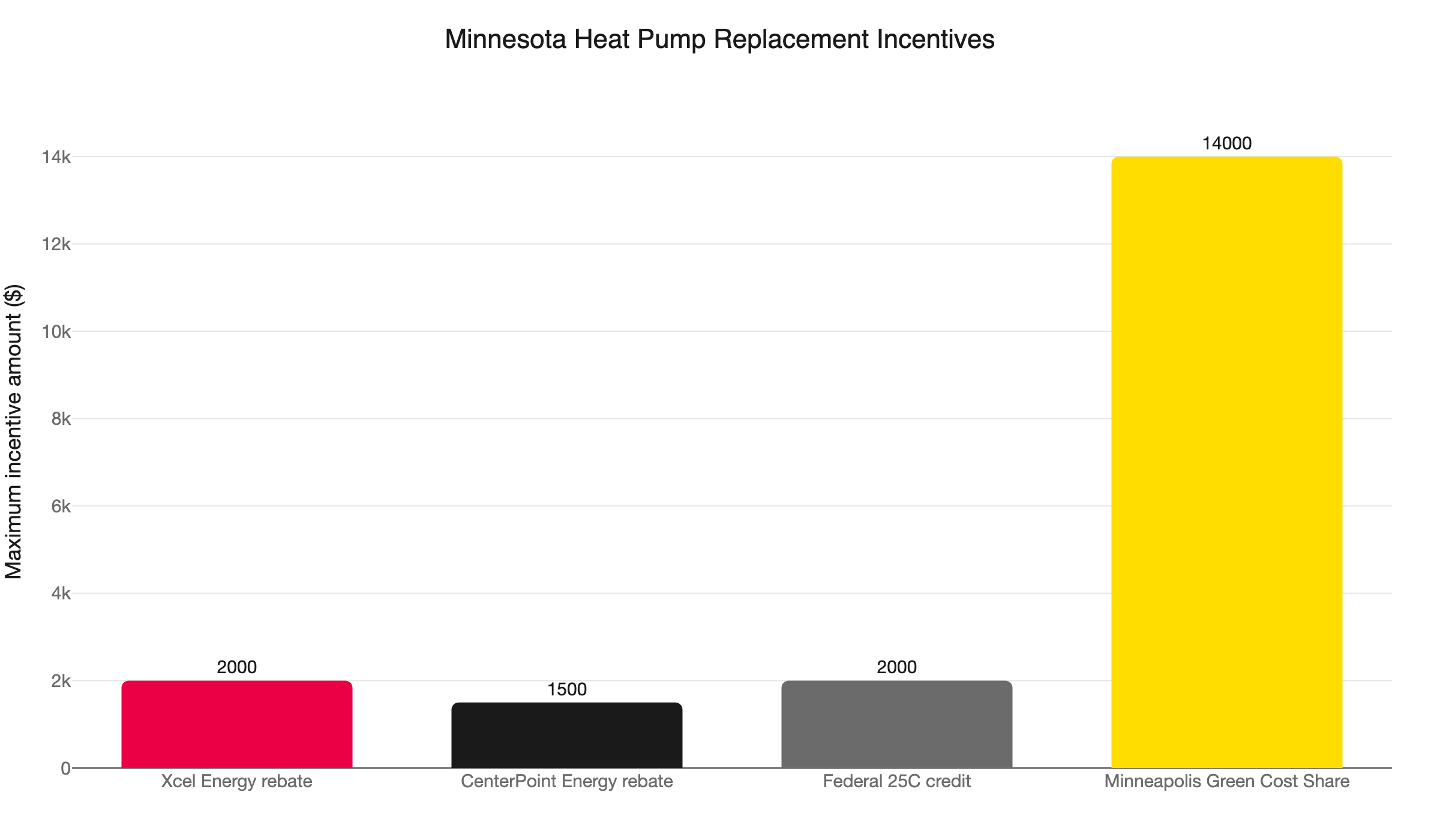
- Xcel Energy (electric customers): up to $2,000 rebate on a qualifying cold-climate air-source heat pump replacement.
- CenterPoint Energy (gas customers): up to $1,500 for a qualifying dual-fuel hybrid setup pairing a heat pump with a high-efficiency gas furnace, with a switchover temperature at or below 40 degrees Fahrenheit.
- Federal 25C tax credit: 30% of installed cost, up to $2,000. Confirm current-year eligibility with your tax preparer before counting this number in your budget.
- Minneapolis Green Cost Share: residents in qualifying Green Zone areas may stack additional funding, potentially up to $14,000 for eligible projects.
When a valve repair on an older system costs $1,200-$1,500 and rebates can put $3,000-$5,000 back in your pocket on a new system, the gap between the two paths narrows significantly. Spending $8,000 on a new cold-climate heat pump with $4,000 in combined incentives is a different calculation than it looks at first glance.
For the complete picture of what is available and how to apply, see our Minnesota heat pump rebates and tax credits guide.
If a dual-fuel hybrid configuration fits your home, a heat pump handles shoulder-season heating efficiently while a high-efficiency gas furnace takes over when temperatures drop past the balance point. CenterPoint’s rebate is specifically designed for that pairing. Read more about dual-fuel heat pump and gas furnace hybrid systems in Minnesota if that option is on the table.
What to Expect When You Call Northern One Hour
Diagnosing and repairing a reversing valve is not a DIY job. It requires refrigerant handling certification, brazing skills, and calibrated test equipment. Our technicians carry what is needed to measure solenoid resistance, compare refrigerant line temperatures, and recover refrigerant without releasing it into the atmosphere.
As a locally owned and operated company serving the Twin Cities from Ramsey, we are invested in the outcome beyond the initial service call. When you call, here is how the visit goes:
- We diagnose whether the failure is the solenoid coil or the valve body before quoting the repair. You know exactly what you are paying for before we start.
- We give you transparent, itemized pricing upfront. No surprises on the invoice.
- If the repair-vs.-replace question is close, we walk through the age-and-refrigerant framework with you. No pressure; just the information you need to make a confident decision.
- If replacement makes more financial sense and rebates apply, we identify which programs your system qualifies for so you can capture every dollar available.
Our scheduling commitment means you will not spend half your day in a four-hour wait window: “Always On Time… Or You Don’t Pay a Dime!(R)”
Call us at (763) 260-6662 or schedule a heat pump repair online. We serve homeowners across Minneapolis, St. Paul, Ramsey, Blaine, Maple Grove, Plymouth, Brooklyn Park, Woodbury, Bloomington, and the surrounding Twin Cities metro.
Frequently Asked Questions
How do I know if my heat pump reversing valve has failed? +
What is the difference between a solenoid coil failure and a valve body failure? +
How much does a reversing valve replacement cost in Minnesota? +
Should I replace my heat pump instead of repairing the reversing valve? +
Need a technician now?