
Heat Pump Compressor Failure: Signs and Costs in Minnesota
Key Takeaways
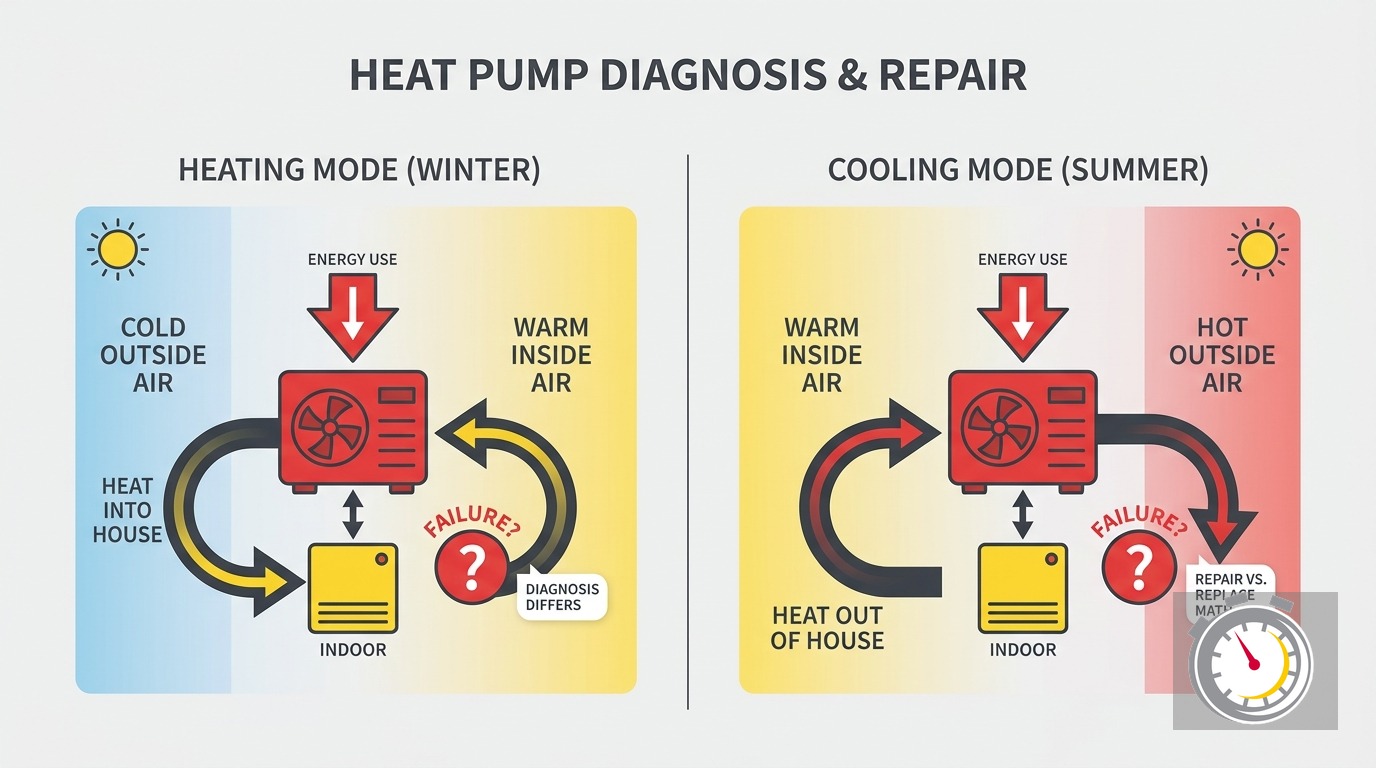
- A heat pump compressor can fail in heating mode or cooling mode. The same component handles both, and the diagnostic path differs depending on which mode surfaces the problem.
- Steam and temporary ice on the outdoor unit in winter are usually a normal defrost cycle, not a failure sign.
- A failed reversing valve mimics compressor failure in heating mode. Confirm the diagnosis before authorizing a compressor replacement.
- Warning signs include a repeatedly tripping breaker, a 10-30% jump in electricity bills, short cycling, hard starts with a shudder, and loud banging from the outdoor unit.
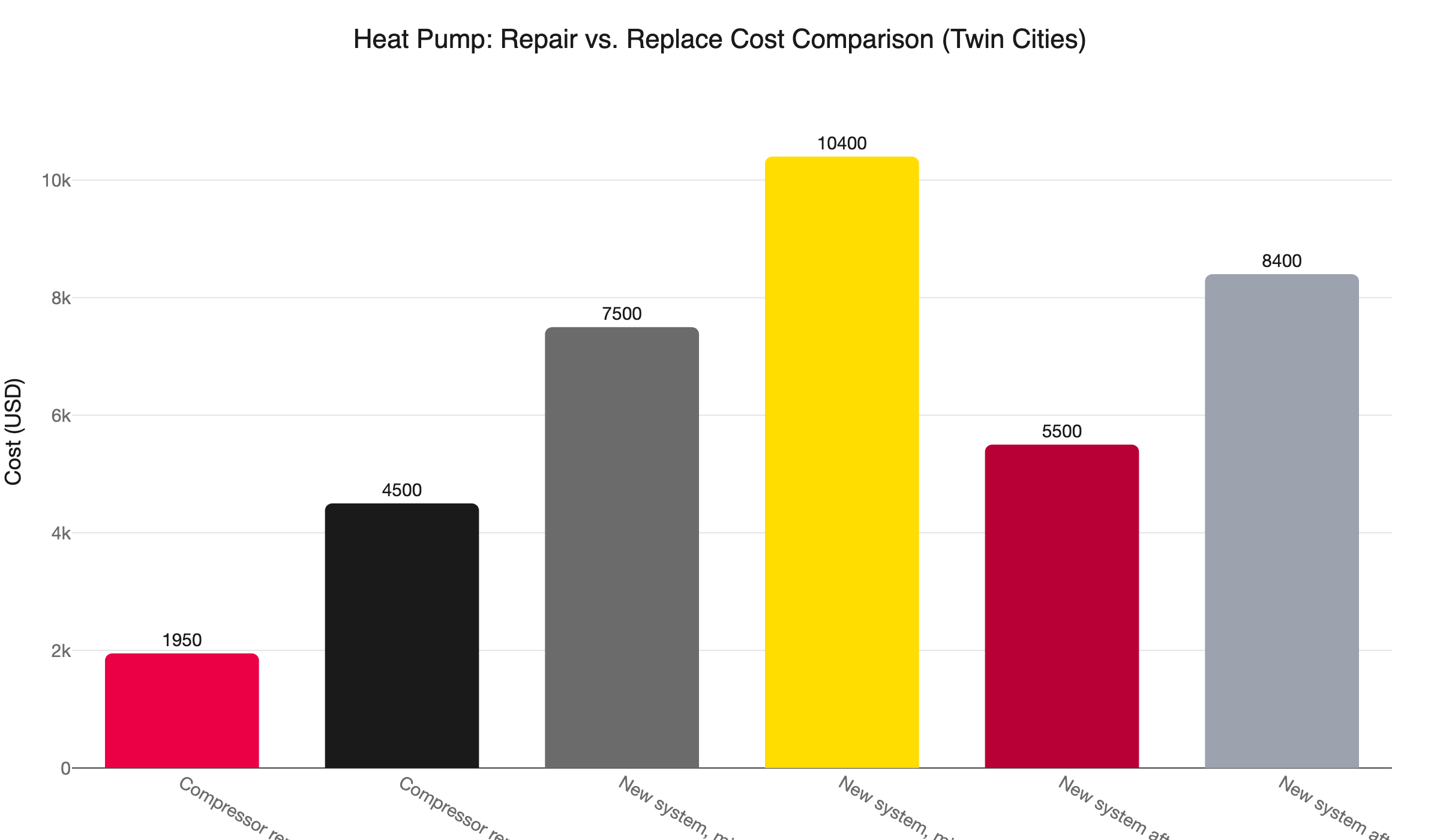
- Compressor repair runs $1,950-$4,500 installed in the Twin Cities. A new mid-tier cold-climate system starts at $7,500-$10,400 installed.
- The federal 25C heat pump tax credit expired December 31, 2025, and has not been renewed. Do not budget for it on a 2026 purchase.
- Xcel Energy offers up to $2,000 for a qualifying cold-climate heat pump installation in Minnesota. That rebate does not apply to a compressor swap on an existing unit.
- The 10-year rule: if your system is 10 or more years old and the repair quote approaches half the cost of a new system, replacement is usually the better investment.
What Makes Heat Pump Compressor Failure Different From AC Failure?
A heat pump compressor runs in both heating and cooling modes. That means failure can appear in January as “my heat pump is blowing cold air,” or in July as “the house won’t cool down.” An AC compressor only fails in one mode. The diagnostic path is different, and so is the replacement math.
Most articles about compressor failure are written with a central AC in mind. They address one mode of operation and one failure scenario. A heat pump in the Twin Cities is a different machine. With roughly 7,900 heating degree days annually, your heat pump runs in heating mode for about six to seven months each year. That means the compressor accumulates heating-mode runtime that a southern AC-only system never sees. More runtime means more wear, and it means more situations where failure presents differently than expected.
In heating mode, compressor failure is not the only explanation for cold air from a running heat pump. A failed reversing valve produces the same symptom. A normal defrost cycle, in the middle of a cold snap, can look alarming to a homeowner who has never seen it. None of this means the compressor is fine - but it means diagnosis matters before any repair is authorized.
This post focuses on the heat-pump-specific diagnostic path: how to recognize real compressor failure, how to tell it from a reversing valve problem or a defrost cycle, what the repair-vs-replace math looks like with current Minnesota rebates, and why the federal tax credit many homeowners are expecting is no longer available for 2026 installs. For a parallel look at central AC compressor problems, see our AC compressor failing signs and repair cost guide.
What Are the Warning Signs of Heat Pump Compressor Failure?
The most reliable signs are a circuit breaker that keeps tripping, a 10-30% spike in your electricity bill without a weather explanation, short cycling, hard starts with a shudder, and loud banging from the outdoor unit. Any of these warrants a service call before the problem gets worse.
Here is the full list of what to watch for, whether the issue surfaces in heating or cooling mode:
- Breaker tripping repeatedly. A failing compressor draws high amperage as it struggles. Reset the breaker once. If it trips again, stop resetting it and call a technician.
- Electricity bill spike. A compressor losing efficiency works harder to move the same amount of heat. A 10-30% jump in your electric bill with no weather explanation is a warning sign worth investigating.
- Short cycling. The system starts, runs briefly, shuts off, and starts again within minutes. Short cycling accelerates compressor wear and speeds up failure.
- Hard start or shuddering. A shudder when the outdoor unit kicks on means the compressor is straining to start. A hard-start capacitor sometimes buys time, but it is a patch, not a cure.
- Loud banging or clunking. This sound from the outdoor unit often means the compressor is slugging liquid refrigerant. Liquid does not compress; the result is internal mechanical damage that typically requires a full compressor replacement.
- Weak or lukewarm airflow in the expected direction. The system is running but is not heating or cooling effectively. The air coming from your vents does not match what the thermostat is calling for.
- Persistent ice on the outdoor unit. Some frost in cold weather is expected. A solid block of ice that does not clear between defrost cycles is not.
One important qualifier: a refrigerant leak, a failing capacitor, or a failed contactor can produce several of these same symptoms at a fraction of the compressor replacement cost. Our AC keeps tripping the breaker guide covers how electrical component failures overlap with compressor symptoms. Do not assume it is the compressor until a technician has confirmed the diagnosis.
Is That Ice and Steam on the Outdoor Unit Normal?
In cold weather, ice forming on the outdoor coil is expected. The heat pump extracts heat from outside air, moisture in that air freezes onto the coil, and the defrost cycle melts it - producing visible steam. That process is normal operation. The problem is ice that never clears, combined with declining heat output.
Every winter, we get calls from Twin Cities homeowners who have never owned a heat pump before and are alarmed by the steam coming off the outdoor unit. In most of those cases, they are watching a normal defrost cycle. The cycle runs roughly every 30-90 minutes in cold weather, briefly reverses refrigerant flow to melt the accumulated frost, and then returns to heating mode. You may notice a short drop in heat output during that reversal, which is also normal.
The signs that ice buildup is an actual problem:
- Ice does not clear after multiple defrost cycles
- The outdoor unit is a solid block of ice after several hours of operation
- Performance has declined alongside the ice buildup and the house is not reaching setpoint
- An error code or blinking light has appeared on the indoor unit
The practical test: does the ice fully clear between cycles? If yes, you are watching normal operation. If ice builds faster than defrost can handle it, or the unit is running but not producing heat, that warrants a call.
How Do You Tell Compressor Failure From a Reversing Valve Problem?
In heating mode, a failed reversing valve and a failed compressor produce nearly identical symptoms: the system runs but delivers cold or cool air. A reversing valve failure usually preserves cooling capacity but blocks the shift into heating mode. A technician confirms the difference with refrigerant pressure readings and a mode-switching test.
This distinction is what every other article on heat pump compressor failure misses, and it matters significantly for your repair bill. The reversing valve switches the direction of refrigerant flow between heating and cooling modes. When it fails or sticks in the cooling position, the system blows cold air in heating mode. To a homeowner, that looks exactly like compressor failure. The cost difference between a reversing valve replacement and a compressor replacement is not small.
A solid diagnostic rules out the reversing valve before condemning the compressor. If a technician quotes you a compressor replacement based purely on heating-mode symptoms, ask whether the reversing valve was tested and what the refrigerant pressure readings showed. If you cannot get a clear answer, request a written summary of what was tested - or get a second opinion. For more on the reversing valve specifically, see our heat pump reversing valve failure symptoms post.
The diagnostic sequence for a heat pump that is not heating:
- Check refrigerant charge. Low charge causes weak heating and weak cooling.
- Check the capacitor and contactor. These are inexpensive to replace and produce convincing compressor-failure symptoms when they fail.
- Test the reversing valve. Confirm it is shifting modes correctly.
- Check the defrost board and outdoor sensor. A stuck defrost cycle interferes with normal heating.
- If all of the above check out: test the compressor directly with electrical and pressure measurements.
Do not skip steps. Step 5 is the expensive one.
What Causes a Heat Pump Compressor to Fail?
Heat pump compressors are designed to last 10-15 years with proper maintenance. Most early failures trace to a handful of preventable causes.
Low refrigerant charge. The leading cause of compressor failure. When a system runs undercharged, the compressor operates at higher temperatures and under greater stress than it was built for. The internal components break down over time. Finding and repairing the refrigerant leak is the fix; topping off the charge without addressing the leak is not.
Failed capacitor or contactor. The capacitor delivers the electrical jolt the compressor needs to start. When it weakens, the compressor hard-starts repeatedly. Hard starting shortens compressor life significantly. Capacitor and contactor replacements are among the least expensive HVAC repairs - catching them before they damage the compressor is exactly what an annual maintenance plan is designed to do.
Dirty condenser coil. A coil coated in dirt, cottonwood, or debris cannot shed heat efficiently. The compressor runs longer and hotter to compensate. Annual coil cleaning during a tune-up prevents this failure mode.
Liquid slugging. When liquid refrigerant enters the compressor, it causes immediate mechanical damage. It usually arrives with a loud banging from the outdoor unit. Once slugging has caused internal damage, the compressor must be replaced, not repaired.
Age and accumulated runtime. A heat pump in Minnesota runs in heating mode roughly six to seven months per year, accumulating far more total compressor hours than a unit in a warmer climate. Normal wear eventually catches up, and on a system approaching 12-15 years, it often arrives alongside another component failure.
One additional factor worth noting: R-410A refrigerant is in active phasedown. Recharge costs on existing systems are rising. If your unit needs a refrigerant recharge as part of a compressor repair, factor current and future recharge costs into the repair-vs-replace math.
How Much Does Heat Pump Compressor Repair or Replacement Cost in Minnesota?
Compressor repair - part, labor, and refrigerant recharge where needed - runs $1,950-$4,500 in the Twin Cities for most units. A new mid-tier cold-climate heat pump system, fully installed, starts at $7,500-$10,400. A high-efficiency cold-climate unit starts at $11,000-$15,600.
Several factors push repair costs toward the high end of that range:
- Refrigerant recharge. If a refrigerant leak caused or contributed to the compressor failure, a recharge is part of the job. Leak detection and repair add to the total.
- Proprietary compressors. Some manufacturers require brand-specific components that carry a price premium.
- Additional components found during service. A capacitor, contactor, or coil issue found in the same visit is worth addressing at the same time. Catching these while the technician is already on-site costs less than a separate call.
For broader context: average heat pump repair cost in Minnesota is around $420 for minor work, and $800-$4,500 for major repairs including compressor replacement. The top of that range reflects compressor work on larger or more complex systems.
Should You Repair the Compressor or Replace the System?
If your heat pump is under eight years old and the compressor is the confirmed failure, repair usually makes sense. If it is 10 or more years old and the repair quote approaches half the cost of a new system, replace - especially with the Xcel rebate available for a qualifying new install.
The 10-year rule. If the unit is 10 or more years old and the repair cost approaches half the replacement cost, replace. A compressor swap on an aging system still leaves you with old coils, old refrigerant circuits, and the system’s original efficiency rating. You are paying a major repair bill to continue operating an aging machine.
What repair does not give you. Replacing the compressor keeps the system’s existing SEER2 and HSPF2 ratings. It does not restart the warranty clock on the rest of the system. It does not make the system eligible for utility rebates. And it keeps you on R-410A refrigerant that costs more to recharge with each passing year.
What a new system gives you. Modern cold-climate heat pumps are rated to maintain heating capacity down to -13 degrees Fahrenheit - a spec that matters in a Minnesota January. A new system comes with a 10-year equipment warranty, a higher efficiency rating, and full rebate eligibility.
The Xcel rebate changes the numbers. Xcel Energy offers up to $2,000 for a qualifying cold-climate ducted heat pump in Minnesota. Eligibility requires the unit to be listed on the NEEP database with a COP at 5 degrees Fahrenheit of at least 1.75 and heating capacity at 5 degrees Fahrenheit of at least 70% of its 47-degree rated capacity. Those thresholds are designed for climates like ours, where the system may run near or below that temperature for days at a time.
If you are deciding between a $3,500 compressor repair and an $8,500 new system, the Xcel rebate brings the net replacement cost to $6,500. On a 12-year-old unit, that gap narrows considerably, and the new system wins.
Xcel also offers a $600 bonus when a qualifying heat pump is installed following qualifying insulation or air-sealing upgrades. Minneapolis homeowners in Green Zone areas may qualify for Green Cost Share up to $14,000, which can stack on top of the Xcel rebate. Ask our team about eligibility when you call.
Financing is available on new system installs. We will walk you through current terms on the call.
What About the Federal Tax Credit?
The 25C Energy Efficient Home Improvement Credit for air-source heat pumps expired December 31, 2025, and has not been renewed. Do not budget for it on a 2026 purchase.
Many homeowners are still researching based on 2024 articles referencing a 30% federal credit worth up to $2,000. That credit covered air-source heat pumps purchased and installed January 1, 2023 through December 31, 2025. The IRS page for the credit was last reviewed April 28, 2026, and no renewal is in place as of that date.
The credit may return. We will update this post if it does. For now, the Xcel Energy rebate is the confirmed available incentive for Minnesota homeowners. The Minnesota HEAR and HOMES rebates under the Save Energy Minnesota program have not launched as of fall 2026 - the state is still awaiting formal federal approval, and no launch date is confirmed.
Use the Xcel rebate now. It is real money on qualifying installs, and we will confirm your system’s eligibility at the time of the quote.
Schedule a Diagnostic With Northern One Hour
We are locally owned and operated in Ramsey, MN, serving Minneapolis, St. Paul, Blaine, Maple Grove, Plymouth, Brooklyn Park, Woodbury, Bloomington, and the Twin Cities metro. When you call about a heat pump that is not performing, here is our approach.
We run a full diagnostic before recommending any repair. We check refrigerant charge, electrical components, reversing valve function, and coil condition. We give you a written explanation of what was tested, what was found, and your options - repair and replacement side by side with current numbers. If replacement is on the table, we will walk you through Xcel rebate eligibility at the time of the call.
We back our work with a 100% satisfaction guarantee, and we stand by the promise we have kept since we opened: “Always On Time… Or You Don’t Pay a Dime!(R)”
Call us at (763) 260-6662 or book your service online. We show up when we say we will.
Frequently Asked Questions
Does homeowners insurance cover heat pump compressor failure? +
Can I keep running my heat pump if the compressor is failing? +
Will replacing the compressor qualify for the Xcel Energy rebate? +
How long does a heat pump compressor last in a Minnesota climate? +
Need a technician now?