
How Much Space Around Furnace? Minnesota Clearance Guide
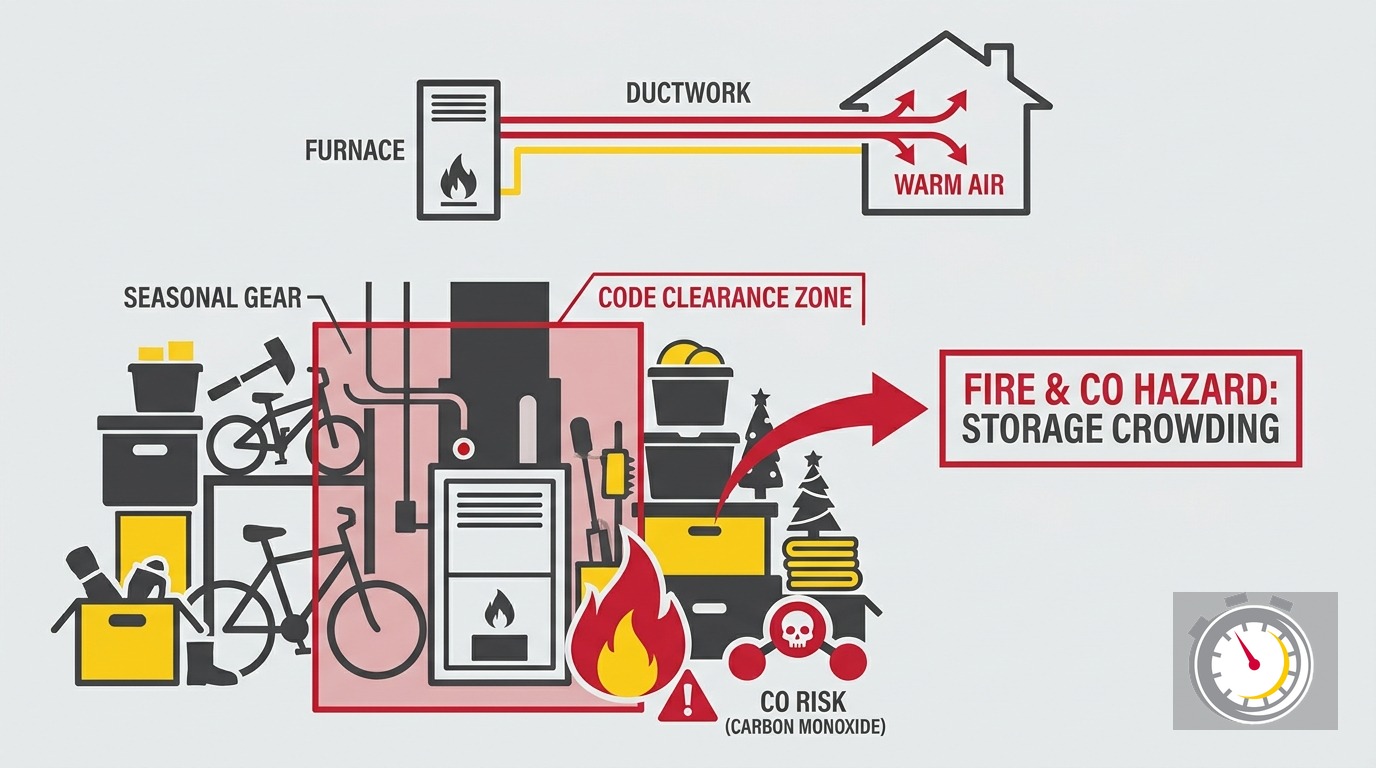
Key Takeaways
- Three numbers matter: service space (30 inches), the nameplate clearance to the building, and the storage distance (36 inches in the Minnesota fire code).
- Use 3 feet as your rule of thumb. Keep that zone clear on every side you can reach.
- Nothing flammable closer. Paint, gas cans, cleaners, cardboard, and holiday decor stay out of the furnace room.
- Your nameplate wins. The label on your furnace sets the exact clearance for that model.
- CO alarms are required near bedrooms in Minnesota homes, and they belong on every level.
- A yearly professional inspection catches problems that clutter can hide.
- Call (763) 260-6662 or book online if your furnace room is tight or you are not sure what you have.
How much space around a furnace do you need?
Plan on at least 30 inches of open floor in front of your furnace for service, plus the clearances printed on its nameplate. Then keep everything stored at least 3 feet away. These are three different numbers, and each one protects something different.
Most Twin Cities homeowners never measure any of this. The furnace sits in a basement corner or a utility closet, and over the years the space around it fills up.
Holiday bins, paint cans, lawn gear, and cardboard boxes all drift toward the warm spot. That habit is the real risk, and it is easy to fix.
We are locally owned and operated, and we see these rooms every week.
Why do three different numbers confuse homeowners?
Search results give you one table of “furnace clearance” numbers. That table mixes three separate ideas. Split them apart and the rules make sense.
- Service space: the open area a technician needs to work on the furnace. The model code sets this at 30 inches.
- Listed clearance: the distance from the furnace cabinet to walls, framing, and other building materials. The nameplate sets this.
- Storage distance: how far your belongings must stay from the equipment. The Minnesota fire code uses 36 inches.
A furnace can pass one test and fail another. Picture a perfect 30-inch work area in front, and a stack of paint cans 12 inches from the side. The service space is fine. The storage is not.
Some tables also give wide ranges, with side clearances from 1 inch up to 24 inches. That spread is real, because furnace models carry different labels. It is also why a generic number cannot replace your own nameplate.
What is the 30-inch service space?
Service space is the open area in front of the furnace where a technician stands and works. It is about access, not heat.
The Minnesota mechanical code is built on the International Mechanical Code. Section 306.1 says a level working space not less than 30 inches deep and 30 inches wide must be provided in front of the control side to service an appliance.
Think about what a tech does there. We pull the burner door, test the igniter, clean the flame sensor, and swap parts. We need room to kneel, set tools down, and see.
If a water heater, a shelf, or a stack of bins blocks that area, the visit slows down. In the worst case, the tech cannot reach a part safely, and you wait for a second visit.
Here is a quick check you can do today:
- Stand where the furnace access panel opens.
- Measure out from the front of the unit with a tape.
- Confirm you have 30 inches of clear floor and 30 inches of width.
- Make sure you can open the door fully and lift the panel off.
If you fail that test, clear the space before your next tune-up.
What does the nameplate clearance mean?
The nameplate clearance is the minimum gap between the furnace and the building around it. It keeps nearby wood framing and drywall paper from getting hot enough to char over time.
The model code does not give one number for this. IMC 304.9 says heat-producing appliances must keep the clearances to combustible construction “as specified in the listing and manufacturer’s instructions”. Those clearances can be reduced only under Section 308.
So the number lives on your furnace. Look for a silver or white data plate on the cabinet. It often lists distances for the front, sides, back, top, and vent connector.
A few plain points help:
- The label is model-specific. A neighbor’s number may not match yours.
- Many modern furnaces list small side clearances. That does not make the room safe to fill up.
- Reducing clearance is not a DIY project. It takes approved protection methods and often a permit.
If you have ever boxed in a furnace with a wall or a closet door, check the label first. If you plan to change the room, read our guide on when an HVAC permit is required.
This clearance covers the structure. Your stored items fall under a different, stricter idea.
What does the Minnesota fire code say about storage near a furnace?
The Minnesota fire code sets a clear benchmark for furnace and boiler rooms. It says at least 36 inches shall be maintained for access to equipment.
It also addresses storage directly. For equipment of 400,000 BTU/hr or less, combustible storage is allowed only with an approved automatic fire-extinguishing system throughout the room. Even then, no combustible storage shall be within 36 inches of fuel-fired equipment.
Mechanical rooms get a similar rule. The same section says a 3-foot aisle shall be maintained to all equipment. It also bars storage within 3 feet of fuel-fired equipment.
Two caveats, stated plainly.
First, the text we reviewed does not say whether this rule covers one- and two-family homes. We will not tell you it legally binds your basement. Treat it as the state fire code’s benchmark for furnace rooms.
Second, storage is allowed only with automatic fire extinguishing. Most homes do not have that in the utility room. For a typical house, the safe advice is simple: no storage near the furnace.
That is why we call 36 inches the sensible target. It comes from the state’s own fire code, it is easy to measure, and it costs nothing to follow.
What does a typical Minnesota utility room look like?
Our long winters push a lot of stuff indoors, and utility rooms become the default storage zone. We see the same pile-ups again and again.
Common culprits include:
- Holiday bins, wrapping paper, and artificial trees
- Paint cans, stains, and thinners left from summer projects
- Lawn gear, gas cans, and small-engine fuel
- Cardboard boxes from moves, appliances, and online orders
- Laundry supplies, aerosol cans, and cleaners
- Old rugs, blankets, and packing foam
- Firewood, kindling, or newspaper for the fireplace
Many of these burn easily. Paint, solvents, and fuel also give off vapors. Fuel vapors can drift along the floor, and a furnace burner is an ignition source.
Cardboard and fabric ignite at lower temperatures than you might expect. A box leaning on a hot flue pipe can smolder for a long time before anyone notices.
The pile also causes a quieter problem: it blocks the air the furnace needs to burn fuel. More on that next.
How can a crowded furnace room cause fire or carbon monoxide trouble?
A packed furnace room can cause a fire when flammable items sit near hot surfaces. It can cause CO when stacked items starve the burner of air or block the vent. Both risks grow quietly over a season.
Start with fire. Your furnace has a burner, a flue pipe, and a hot cabinet. Anything touching or leaning on those parts gets heated every cycle. In January, the furnace may run for long stretches.
Now CO. Gas furnaces need air to burn cleanly. Many utility rooms supply that air through gaps, grilles, or openings to the rest of the basement. Wall off the furnace with boxes, bins, or a makeshift closet, and the burner can run short on air.
A burner without enough air can burn poorly. Incomplete combustion makes CO. Soot, yellow flames, and a lingering smell can follow.
Other crowding problems add up:
- Blocked combustion air openings. Bins in front of a louvered door or wall grille choke the supply.
- Stacked items on the flue pipe or vent connector. They can knock it loose or trap heat.
- Dust and lint on the burner area. Storage stirs up debris that settles near the flame.
- Blocked access to the shutoff. In an emergency, you need quick reach. Our guide to finding the gas shutoff valve shows what to look for.
Exhaust fans and fireplaces can pull air away from a furnace too. A crowded room makes that worse, because there is less spare air to draw on.
On numbers, we will be honest. The 2026 federal safety release we reviewed did not give furnace-specific CO death or fire counts, so we will not quote scary statistics. The mechanism is well understood, and it is what matters.
Where should CO alarms go in a Minnesota home?
Put CO alarms outside every sleeping area and on every level of the home. Minnesota law requires an approved alarm within ten feet of each bedroom. Test the alarms monthly, and replace them on the maker’s schedule.
The state rule is specific. Minn. Stat. 299F.51 says every single-family dwelling and every dwelling unit in a multifamily building needs an approved CO alarm installed within ten feet of each room lawfully used for sleeping purposes.
The Consumer Product Safety Commission adds to this. Its 2026 winter guidance says CO alarms should be placed on every level of the home and outside sleeping areas. It also tells owners to test them monthly.
If your furnace is in the basement, that means an alarm on the furnace level too. Our post on CO detector placement near a furnace or boiler covers the best spots in detail.
An alarm is a backup, not a fix. If it sounds, get everyone outside and call for help. Do not wait to see if it stops.
What are the venting requirements for a 90% furnace?
A 90% or higher efficiency furnace vents through sealed plastic pipe, usually PVC, instead of a metal chimney flue. The pipe must slope, stay sealed, and end outdoors in a spot that stays clear of snow, ice, and obstructions.
These furnaces pull in outside air and push out cool exhaust. Because the exhaust is cooler, it does not need a hot chimney, so plastic pipe works.
Pipe size, length, and termination spot depend on your model. The installation manual and the local code set those details. Do not guess, and do not re-route pipe yourself.
In a crowded utility room, three vent points matter:
- Keep the pipes visible. Do not box them in or bury them behind storage.
- Leave the drain line free. Condensate drains from these furnaces, and a bin on top of the line can kink it.
- Check the outside end after storms. Snow drifts and ice can block the vent.
Winters here make that last point a real issue. Our guide to PVC vent pipe problems on high-efficiency furnaces explains what to watch for.
A 90% furnace is also less sensitive to some clutter problems, since it pulls air through a sealed intake. That does not make clutter safe. The cabinet, wiring, and controls still need space and air.
How do you clear out your utility room?
You can fix most storage problems in an afternoon. Work in this order, and stop to call us if you find anything odd.
Step 1: Turn off the furnace at the switch. Do this before you move things near the cabinet. Never move or pull on gas lines or vent pipes.
Step 2: Remove the flammables first. Take paint, thinners, gas cans, aerosol cans, and cleaners out of the furnace room. Store them in a detached shed or a well-ventilated garage, away from heat sources.
Step 3: Pull cardboard and paper. Boxes are fuel. Break them down and recycle them. Use plastic bins with lids for anything you keep.
Step 4: Clear a 3-foot zone. Measure from the cabinet outward. Keep the area free on all sides you can reach, especially in front.
Step 5: Open the air. Make sure grilles, louvers, and openings to the room are not blocked.
Step 6: Mark the line. Put a strip of floor tape 3 feet from the furnace. It gives the whole family a visual rule.
Step 7: Restart and watch. Turn the furnace back on. If your model has a viewing window, look at the flame. Call us if it looks yellow, flickers, or smells odd.
A few more habits help:
- Wipe dust off the top of the cabinet each fall.
- Do not hang clothes or hoses on pipes.
- Do not stash cleaning rags near the furnace.
- Keep a path to the water shutoff and electrical panel.
When you swap summer and winter gear, check the furnace room first. That is the easiest time to reset the zone.
What about floor moisture and flood storage?
Basement furnaces face another problem: water. Minnesota basements see sump failures, spring melt, and humid summers. A furnace sitting on a wet floor rusts faster.
The mechanical code addresses this. IMC 304.10 says units installed at grade need support not less than 3 inches above adjoining grade.
That gap protects the cabinet from small floods and mop water. It also means you should not stack cardboard beneath or beside the unit. Wet cardboard breaks down into mush.
If you store anything on the basement floor near the furnace, use plastic tubs on a shelf. Keep the base of the furnace dry and visible.
Our guide to basement humidity control in summer helps you keep the whole room drier.
When should you call a professional?
Call a pro if your furnace room is tight, if you cannot find the nameplate, or if you see soot, rust, or scorch marks. Also call if an alarm has sounded or the burner flame looks wrong.
The federal safety agency is clear on this. Its 2026 release says to have a professional inspect all fuel-burning heating systems, including furnaces each year.
A yearly visit is the best time to review the room. During a furnace tune-up, our technician checks the burner, the vent, the airflow, and the surrounding space. We tell you plainly what we find.
In a crowded room, we look at:
- Clearances against the nameplate
- Combustion air openings
- Vent connections and slope
- Scorch marks, soot, or rust
- Access for service and shutoff
If the work turns out to be a repair, we explain the cost before we start. If the unit is old and the room needs a redesign, we talk about replacement and financing options for larger jobs.
How much do furnace repairs and replacement cost?
Repair costs depend on the part, and replacement depends on the efficiency tier. We list the typical ranges in the FAQ below so you can plan. For a part-by-part view, read our furnace repair cost guide.
Crowded rooms can raise repair bills in small ways. A cluttered space slows access, and dust in the burner area fouls sensors. A clear room helps keep visits quick and simple.
What should you remember about on-time service?
We are locally owned and operated, and we serve homeowners across the Twin Cities. We know how these rooms look in Ramsey, Blaine, Maple Grove, Plymouth, and Woodbury. The homes were built in different decades, and each one has its own quirks.
When you book, pick a time window that works for you. We arrive within the window you select. If our technician does not show up on time, you do not pay for the service. That is our promise: “Always On Time… Or You Don’t Pay a Dime!(R)”
One tip for visit day: clear a path to the furnace first. Move anything blocking the 30-inch service area. It saves time for both of us.
Your next step
Take ten minutes this week and walk to your furnace with a tape measure. You want 30 inches open for service, the nameplate distances to the building, and 3 feet clear of storage. Nothing flammable goes closer.
If the room fails, move the clutter before the deep cold arrives.
Not sure what you have? Call (763) 260-6662 or book online, and we will take a look. We will tell you what we see, in plain language, and we will show up on time.
Frequently Asked Questions
How much does a gas furnace cost in the Twin Cities? +
How much does furnace repair cost? +
Can I store boxes in my furnace room if they are 2 feet away? +
Where do I find my furnace's required clearances? +
Do I need a carbon monoxide alarm near my furnace? +
Need a technician now?