
Furnace in Lockout Mode How to Reset: Safe Steps for MN
Key Takeaways
- Lockout mode means the furnace control board stopped the start-up on purpose to protect your home.
- A soft lockout retries on its own. A hard lockout stays off until someone resets it.
- Check your carbon monoxide alarm before you touch the furnace.
- Reset once, using the steps in your owner’s manual. If it locks out again, stop and call.
- A repeat lockout is a symptom. Dirty filters, flame sensors, tripped switches, and blocked vents are the usual causes.
- Some causes are safety problems. Never bypass or jumper a safety switch.
- On a subzero night, a lockout is urgent. Know your backup plan before you need it.
Furnace in Lockout Mode: How to Reset It Safely
Your thermostat calls for heat. The furnace tries to start, then quits. A light blinks, or nothing happens at all. That is often lockout mode.
Lockout means your furnace shut itself down because something did not look right. A reset can sometimes bring heat back, but you need to know when a reset is safe and when it is not.
We are Northern One Hour Heating & Air Conditioning, a locally owned and operated company serving the Twin Cities. Below is the safe way to handle a furnace in lockout mode, including how soft and hard lockouts differ and what repeat lockouts mean.
What does it mean when a furnace is in lockout mode?
Lockout mode means the furnace control board has stopped trying to start the heating sequence. The board does this when a safety device trips or the furnace fails to light. It is a protective shutdown, not a random glitch.
Your furnace follows a strict start-up order. The inducer fan starts. A pressure switch confirms airflow. The igniter heats up. The gas valve opens. A flame sensor then confirms the burners lit.
If any step fails, the board stops the sequence. That keeps gas from flowing without flame. It also keeps the furnace from running hot or pulling exhaust the wrong way.
Brands show lockout differently. Some blink a code on the control board. Some show a message on the thermostat. Others sit silent while the thermostat calls for heat.
Your control board usually has a small window or LED light. A blinking pattern there often points to the cause. Our furnace error codes guide explains how to read those flashes.
What is the difference between a soft lockout and a hard lockout?
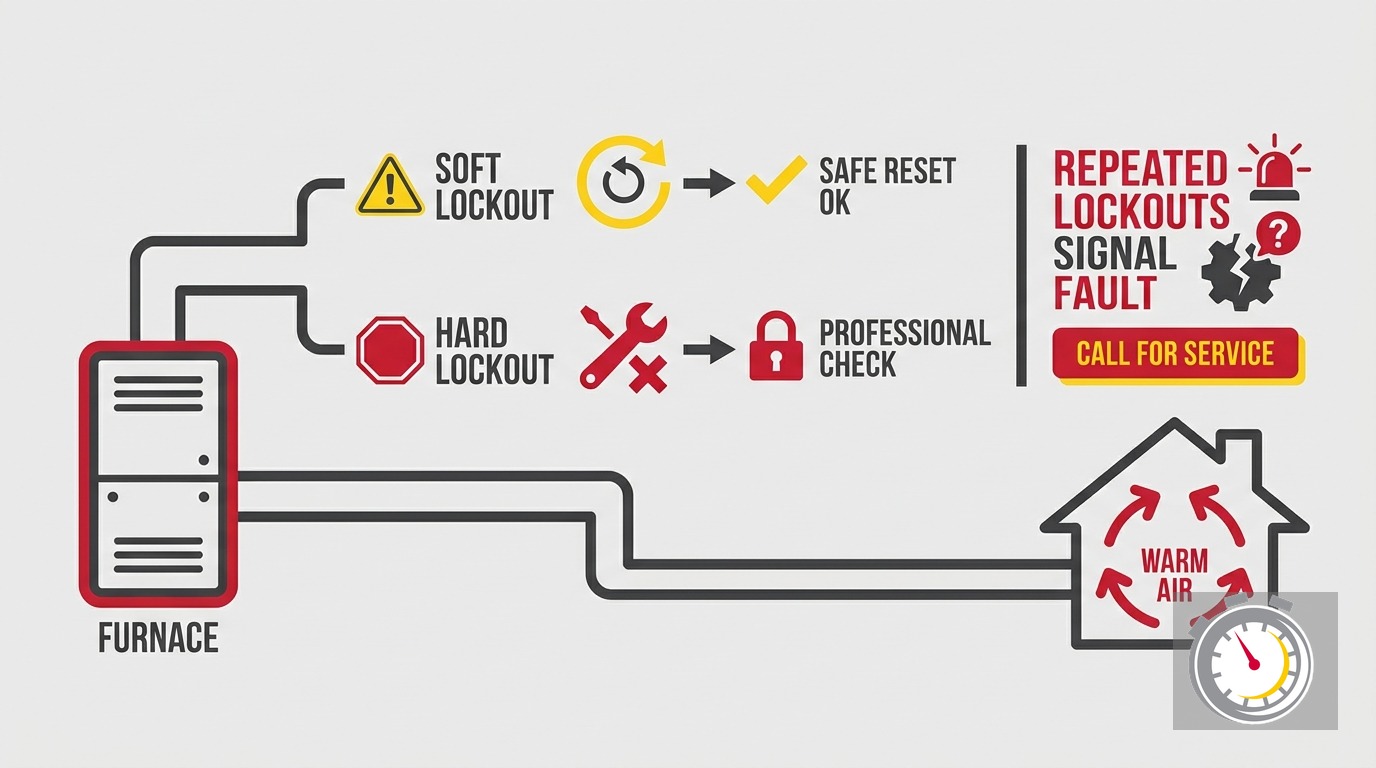
A soft lockout is a temporary stop. The control board drops the heat call and tries the sequence again on its own. A hard lockout is a longer stop. The board will not restart until the furnace is manually reset.
One technical resource describes the two types this way. In a soft lockout, a safety device trips or gives no proper signal, so the board drops the heat call and restarts the sequence. In a hard lockout, the board will not restart after a tripped safety.
That same page lists examples of hard lockout triggers: rollout switches, many high-limit switches, and repeated failed ignition attempts.
How many tries before a hard lockout?
The count depends on the manufacturer. One technical page says a hard lockout follows “multiple (usually 3-5)” ignition attempts without sensing flame. A furnace maker’s troubleshooting page says a soft lockout happens the first one or two times the sequence stops. It calls the third time a hard lockout.
The numbers differ, and that is normal. Your furnace may follow either pattern or its own. Your owner’s manual or the label inside the furnace door is the best guide.
What you will notice at home
You can tell the two apart by what you see:
- Soft lockout: The furnace clicks, hums, or tries again after a pause. Heat may return by itself.
- Hard lockout: The furnace stays off. The thermostat keeps calling, but nothing happens.
Some controls unlock automatically after a waiting period. One homeowner guide says some controllers unlock on their own after “an hour or two.” Don’t count on that when it is 5 degrees outside.
What should you check before you reset a furnace in lockout?
Check three things before any reset. First, confirm your carbon monoxide alarm is working and quiet. Second, make sure you smell no gas. Third, look at the filter and the thermostat. Skipping the safety checks is the biggest mistake homeowners make.
Work through them in this order.
1. Check your carbon monoxide alarm
A lockout can come from a vent problem, and a vent problem can push carbon monoxide into your home. So the alarm check comes first.
Minnesota law takes this seriously. Minnesota Statute 299F.51 requires an “approved and operational carbon monoxide alarm installed within ten feet of each room lawfully used for sleeping purposes.” That applies to every single-family dwelling and multifamily unit.
The same statute says “No person shall remove batteries from, or in any way render inoperable, a required carbon monoxide alarm.” A first violation gets a safety warning. A second or later violation is a petty misdemeanor.
Don’t disable an alarm because it annoys you during a furnace problem. If it is chirping, find out why.
Watch for these symptoms in your household:
- Headache or dizziness
- Nausea
- Confusion or unusual sleepiness
- Symptoms that ease when you leave the house
If the alarm sounds, or anyone feels these symptoms, leave the home. Call 911 from outside. Do not reset the furnace. Our guide on a CO alarm going off near your furnace explains what to expect next.
2. Rule out a gas smell
If you smell gas, do not touch the furnace or any switch. Leave the house. Call your gas utility and 911 from outside.
3. Check the thermostat and filter
Make sure the thermostat is set to heat and calling for heat. Replace the batteries if the screen is dim or blank. Then pull the furnace filter and hold it to the light.
A filter packed with dust restricts airflow. That can overheat the furnace and trip a limit switch. One manufacturer’s page says to change filters every 30-90 days. In a Twin Cities winter, lean toward the shorter end.
That page also says the only thing a homeowner should do is change the filter, and a technician handles the rest. We think that is a fair rule for anything beyond a basic reset.
How do you reset a furnace in lockout mode?
To reset a furnace in lockout, turn off power at the furnace switch, wait about 20 seconds, then turn it back on. Let the furnace try one full start-up. Your owner’s manual overrides these general steps. Reset once only.
Controls vary a lot between brands and ages. Check your manual first, and treat these steps as general.
Basic reset steps for a gas furnace
- Complete the safety checks above. Confirm no CO alarm, no gas smell, and a clean filter.
- Set the thermostat to heat. Set it a few degrees above room temperature.
- Find the furnace power switch. It looks like a light switch on or near the furnace.
- Turn the switch off.
- Wait about 20 seconds.
- Turn the switch back on.
- Stay nearby. Watch one full start-up, which can take a few minutes.
Some owner’s manuals describe a different method. One manufacturer notes that your manual may suggest turning the power on-off-on-off twice in 30 seconds. Follow what your manual says for your model.
What a good restart looks like
A healthy start-up follows a pattern. You hear the inducer fan spin up. You hear a click as the igniter warms. The burners light with a soft whoosh. After a short delay, the blower pushes warm air.
If you see that sequence and warm air arrives, the reset worked. Write down the date. A lockout that cleared once can come back, and your technician will want to know when it happened.
Oil furnaces and pilot units
Oil furnaces often have a red reset button on the burner. Press it once, and only once. Pilot-light units may need relighting. Our guide on why a furnace pilot light keeps going out walks through that problem.
What not to do
- Do not remove the furnace panel and poke around inside.
- Do not hold a reset button down repeatedly.
- Do not bypass, jumper, or tape over any safety switch.
- Do not keep cycling power to “try again.”
These shortcuts turn a protective shutdown into a hazard.
Why should you reset a furnace only once?
Reset once because a lockout is a warning, and repeated resets ignore it. If the problem remains, each retry runs the furnace with an unsolved fault. One reset tests whether the cause was temporary. A second lockout proves it was not.
Think of a smoke detector. When it goes off, you check for smoke. You don’t keep silencing it until the noise stops.
A one-time lockout can be a fluke. A short voltage dip, a gust against the vent, or a dusty sensor can trigger one. The furnace clears and runs fine for months.
A lockout that returns means a part is failing or a condition is wrong. The board is doing its job by stopping the furnace again.
Our simple rule:
- Locks out once, runs fine after reset: Change the filter, watch it, and schedule a tune-up.
- Locks out again within hours or days: Stop resetting and call for service.
- Locks out with a CO alarm, gas smell, or scorched smell: Leave the home and call for help.
What causes a furnace to keep going into lockout?
The most common causes are a dirty filter, a dirty or failing flame sensor, a faulty igniter, a tripped rollout or high-limit switch, and a blocked vent or flue. Fuel pressure problems and a failing control board also cause lockouts.
A furnace manufacturer lists these causes: a dirty or defective flame sensor, a faulty igniter, fuel pressure issues, overheating, a dirty filter, blocked vent pipes or flue, and a faulty control board. Each one is covered below.
Dirty filter and poor airflow
A clogged filter, closed vents, or a failing blower can choke airflow. The furnace overheats, and the high-limit switch trips to stop it.
Airflow problems are the easiest to prevent. They are also one of the few causes a homeowner can address safely. Our post on high-efficiency filters that restrict airflow explains why a thicker, denser filter is not always better.
Dirty flame sensor
The flame sensor is a thin metal rod in the burner flame. It tells the board that fire is present. When residue coats it, it cannot sense the flame.
The burners light, then shut off after a few seconds. After several failed tries, the board locks out. This is one of the most frequent causes we see.
Cleaning or replacing a sensor is usually a quick, affordable service call. In the Twin Cities, flame sensor or igniter service typically runs $95-$325. Our post on dirty flame sensors and cleaning cost has more detail.
Failed igniter
The igniter heats up to light the gas. If it cracks or weakens, it may not get hot enough. The furnace tries and fails to light, and after several attempts it locks out.
Tripped rollout or high-limit switch
A rollout switch senses flames or heat where they should not be. A high-limit switch senses a furnace running too hot. Both are safety devices. Rollout switches and many high-limit switches are examples of hard lockout triggers.
A tripped rollout switch is serious. It can point to a blocked flue, a cracked heat exchanger, or poor combustion. Read our guide on why a rollout switch trips before you consider anything else.
Blocked vent pipe or flue
A furnace needs a clear path to exhaust its gases. A blocked vent can make a pressure switch fail or push exhaust back into the house.
In the Twin Cities, we see vent trouble from several sources:
- Snow drifts against a sidewall vent
- Frost or ice at the vent opening
- Birds, squirrels, or other animals nesting in the pipe
- Condensate freezing in a high-efficiency furnace drain line
Clear snow from outside vents gently, and only if it is safe. Don’t poke at the pipe or chip at ice with tools.
Fuel pressure issues
A furnace needs steady gas pressure to light. Low pressure from the supply side can cause failed ignitions. This may show up during a deep cold snap, when demand is high.
Faulty control board
The board runs the whole sequence. A failing board can lock out for no clear reason. It is also one of the last things a technician should blame, because a good diagnosis rules out the simpler causes first.
Which lockout causes are safety problems?
Rollout switch trips, blocked vents or flues, and cracked heat exchangers are safety problems. They can involve carbon monoxide or fire risk. A dirty filter or flame sensor is usually a maintenance issue. A technician should still confirm which one you have.
Use this table to sort what you see.
| What you find | Likely type | What to do |
|---|---|---|
| Dirty filter | Maintenance | Replace the filter, reset once |
| Dirty flame sensor | Maintenance | Schedule a service call |
| Failed igniter | Repair | Schedule a service call |
| Tripped high-limit switch | Safety and airflow | Check filter, then call if it repeats |
| Tripped rollout switch | Safety | Do not reset again, call right away |
| Blocked vent or flue | Safety | Turn furnace off, call right away |
| CO alarm sounding | Emergency | Leave the home, call 911 |
Never bypass a safety device to get heat. A bypassed switch removes the one thing protecting your family. It also may void your warranty and complicate an insurance claim.
If a vent problem is possible, take it seriously. Our guide on high-efficiency furnace vents blocked by snow and ice shows what to look for outside.
What should you do when your furnace locks out on a subzero night?
On a subzero night, do the safety checks, try one reset, and call for help if heat does not return. Keep your family warm in the meantime. A lockout in extreme cold is urgent because indoor temperatures can fall fast and pipes can freeze.
A house can lose heat quickly when it is well below zero outside. Here is what to do.
Protect your family first
- Gather everyone in one room, ideally an interior room.
- Close doors to unused rooms to hold heat.
- Add layers, blankets, and warm bedding.
- Check on older adults, young children, and pets.
Do not use unsafe heat sources
Never run a gas oven or stove to heat your home. Never bring a grill, camp stove, or portable generator indoors or into a garage. These can cause carbon monoxide poisoning.
Our post on portable generator carbon monoxide risk explains why this matters during outages and cold snaps. If you use a plug-in electric space heater, keep it away from bedding and curtains.
Protect your pipes
If the house starts to cool, open cabinet doors under sinks on exterior walls. Let a faucet drip. Our guide on frozen pipes and HVAC failure covers the risks in more detail.
Call early
Don’t wait until morning if indoor temperatures are dropping. Call for emergency service. Our guide on what to do when your furnace is out tonight has a step-by-step plan.
After-hours calls often carry an added hourly premium on top of standard rates. We will tell you about that before we start, not after.
When should you call a technician about a furnace lockout?
Call a technician if the furnace locks out a second time, if a rollout switch tripped, or if you suspect a venting problem. Also call when you smell gas, see soot, or hear loud booms. Never keep resetting a furnace that keeps locking out.
Call right away if you notice any of these:
- The furnace locks out again after one reset
- Yellow or flickering flames, or soot around the furnace
- A burning, scorched, or gas smell
- Water pooling around the furnace
- A CO alarm that has gone off or chirps repeatedly
- Loud banging or booming at start-up
- You are not sure why it locked out
A technician does more than press reset. We find the reason behind the lockout. That means checking the flame sensor, igniter, switches, venting, gas pressure, and the board.
A proper visit includes a combustion and safety check. We test that exhaust leaves the home as it should. We also confirm your CO alarms are present and working.
Most lockout repairs are modest. A cleaned sensor, a new igniter, or a cleared vent gets heat back. Our furnace repair service covers these fixes.
Sometimes the fault is bigger. A cracked heat exchanger or a failing board on an old furnace can change the math. In that case, we explain your options plainly. We also review financing so a larger job does not catch you off guard.
How can you prevent furnace lockouts?
Prevent lockouts by changing the filter on schedule, keeping vents clear, and booking a yearly tune-up before winter. A tune-up cleans the flame sensor, checks safety switches, and tests the venting. Working CO alarms add a second layer of protection.
Most lockouts build up from small, ignored issues. These habits help.
Change your filter on schedule
Change filters every 30-90 days. Check it monthly during heating season. If you have pets or a dusty home, change it more often.
Keep the furnace area clear
Keep boxes, paint, and laundry away from the furnace. It needs space for airflow and combustion air. Our post on clearance around your furnace explains the basics.
Watch outdoor vents after storms
After heavy snow or freezing rain, look at your furnace vent and intake pipes. Clear drifts from a safe distance. Report ice buildup to a professional.
Book a fall tune-up
A tune-up catches small problems before the first cold snap. Technicians clean the sensor, test the igniter, and inspect the venting. A single tune-up visit typically runs $95-$250. An annual maintenance plan runs $195-$390 and spreads the care across the year.
Our furnace tune-up service is built around these checks. You can also read what a maintenance plan includes.
Keep your CO alarms working
Test your alarms monthly. Keep one within ten feet of each sleeping area, as Minnesota law requires. Replace batteries on schedule. Replace any alarm that is past its service life, which is printed on the unit.
How does Northern One Hour handle a furnace lockout?
We send a licensed technician who finds the cause, explains it in plain language, and gives you honest pricing before work begins. We arrive within the time window you select. We are locally owned and operated, so your neighbors are our customers.
Our promise: “Always On Time… Or You Don’t Pay a Dime!(R)” If the technician does not show up within your window, you do not pay for the service.
When you call about a lockout, expect this:
- We ask about symptoms, blinking codes, and your CO alarm status.
- We help you decide if it is an emergency.
- We schedule a window that fits your day or night.
- Your technician diagnoses the cause, not just the symptom.
- You get clear options and pricing before we start.
We back our work with a 100% satisfaction guarantee. If a lockout points toward replacement, we walk you through choices and financing without pressure.
Reset Once, Then Call
Check your CO alarm. Replace a dirty filter. Reset one time using your owner’s manual. If heat returns, schedule a tune-up and keep an eye on the furnace.
If it locks out again, stop. Don’t keep resetting, and never bypass a safety. Leave the home if a CO alarm sounds or you smell gas.
For fast help anywhere in the Twin Cities, call Northern One Hour at (763) 260-6662 or book online. We will get your heat back on and tell you exactly what went wrong.
Frequently Asked Questions
How do I reset a furnace in lockout mode? +
Is a soft lockout different from a hard lockout? +
How many times can I reset a furnace in lockout? +
Can a furnace lockout be a carbon monoxide risk? +
Why does my furnace keep locking out in winter? +
Need a technician now?